Tell Us About Your Project
Share your product, quantity and project requirements. We will review the details and respond with the relevant next steps.

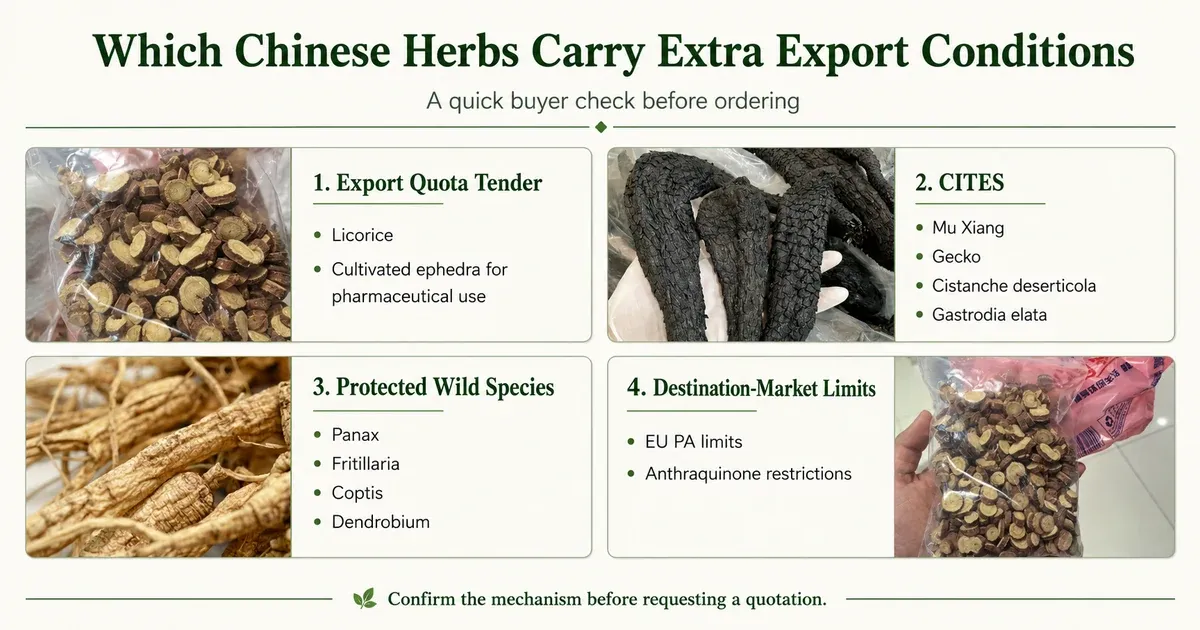
A purchase specification answers what the material is. It does not answer whether the material can legally leave China and enter the destination market. For most Chinese herbal materials those two questions never separate — ordinary export documentation covers it. For a specific and knowable set of herbs, they do separate, and a buyer who discovers this after agreeing a specification has lost the time spent agreeing it.
Four different mechanisms are involved, and they do not overlap. A herb can be freely exportable but inadmissible into the EU as food. Another can be legally harvested and domestically traded but require an international permit for every shipment. A third can be prohibited outright. Knowing which mechanism applies to which herb is what turns a wasted month into a five-minute question at the quotation stage.
Two herbal materials sit in China’s quota-tender export category. Under the Catalogue of Goods Subject to Export Licence Administration (2026), jointly issued by the Ministry of Commerce and the General Administration of Customs and effective 1 January 2026, an exporter of these goods applies for the export licence on the strength of a successful quota tender document.
Licorice (Gan Cao) and artificially cultivated ephedra herb for pharmaceutical use (Ma Huang Cao) are both named in that provision.
Read what quota tender means in practice. The state releases a fixed volume each year. Companies bid for it. Only a company holding a winning tender document can obtain an export licence, and only for the volume it won. Holding a general export licence does not help. Being a registered manufacturer does not help. Having complete documentation does not help. A supplier without an allocation cannot ship these materials legally, regardless of how much material it holds.
For 2026 the announced quota volumes are 5.2 million kg for licorice and licorice products, and 1.0289 million kg for pharmaceutical-use cultivated ephedra herb. The licorice allocation covers six HS codes spanning raw material, extract and glycyrrhizic acid derivatives — a buyer purchasing an extract rather than the raw herb is inside the same quota system, not outside it.
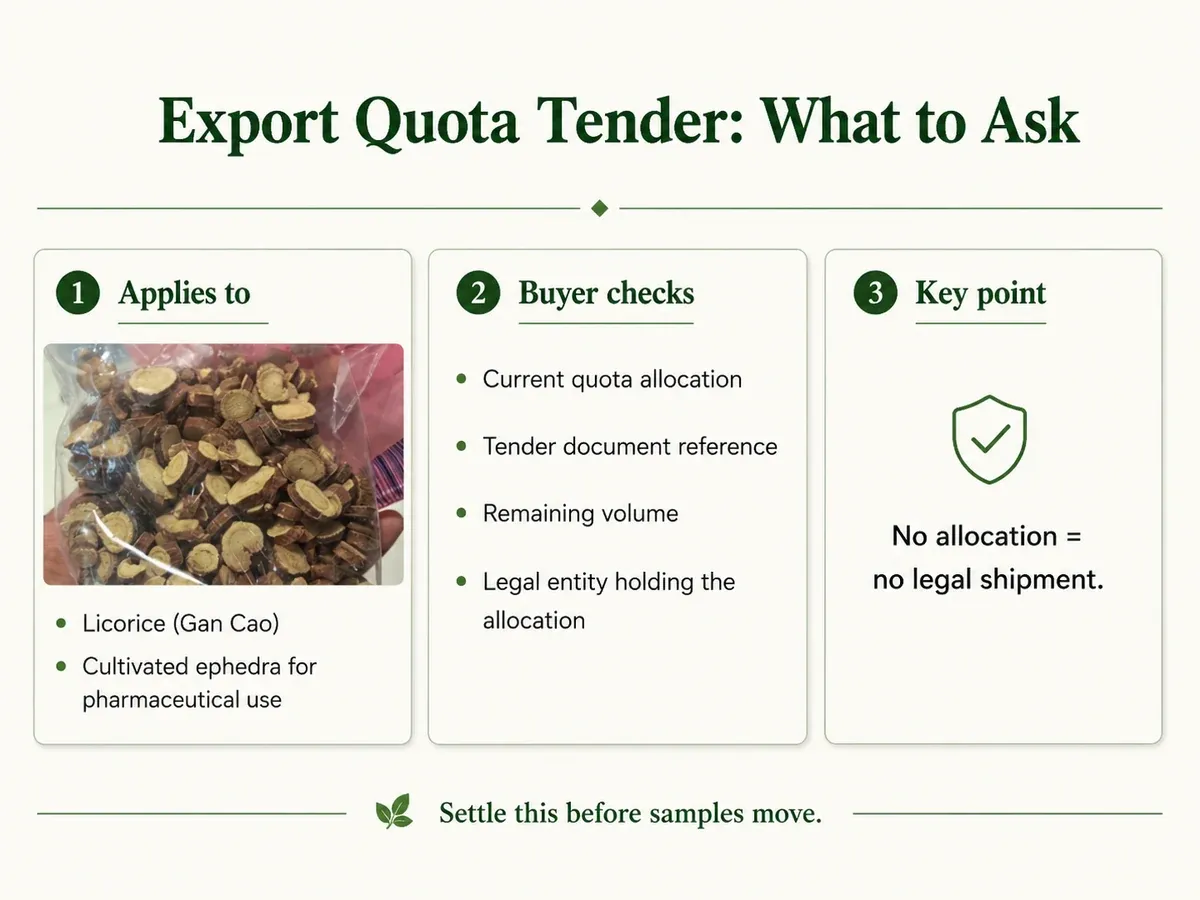
A supplier that cannot answer these is not necessarily acting in bad faith. Most suppliers have never handled a quota-managed commodity and do not know the rule applies to them. But the answer decides whether a contract can be performed, and it should be settled before samples move.
CITES controls international trade in listed species. It operates independently of Chinese domestic rules: a herb can be freely cultivated, freely traded inside China, and still require a CITES export permit for every international shipment.
Three points cause most of the confusion.
Appendix I and Appendix II are not degrees of the same thing. Appendix II means trade is permitted with an export permit. Appendix I means commercial international trade in wild-sourced specimens is prohibited, with a narrow exception for specimens from CITES-registered artificial propagation operations, requiring both an export permit and an import permit.
Annotations decide what is actually covered. A plant listing without an annotation covers everything — roots, slices, powders, extracts, finished preparations. A listing with an annotation covers only what the annotation says. Reading the species name without reading the annotation produces the wrong answer in both directions.
Cultivation does not remove the obligation. Artificially propagated Appendix II plants still require a CITES export permit. Some importing countries accept a phytosanitary certificate in its place, but that has to be confirmed with the destination country’s management authority in advance, not assumed.
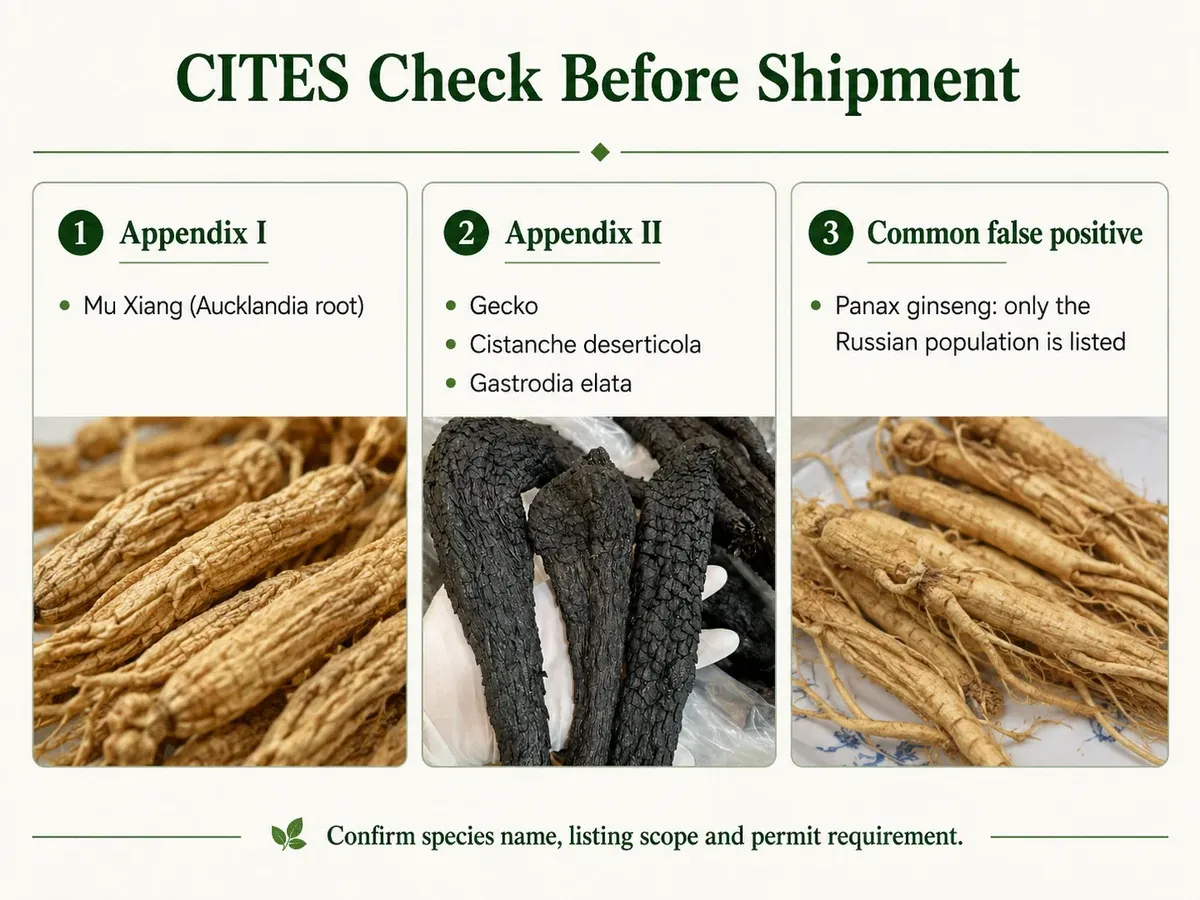
The material traded in China as 木香 / Radix Aucklandiae, source plant Aucklandia lappa Decne., is the same taxon CITES lists under the standard reference name Saussurea costus. The CITES taxonomic record gives the synonymy explicitly: Saussurea lappa, Theodorea costus, Aplotaxis lappa, Aucklandia lappa, Aucklandia costus.
It was listed in Appendix II in 1975 and moved to Appendix I in 1980, with an effective listing date of 1 August 1985. The listing carries no annotation, which means roots, slices, powders, extracts and essential oil are all covered.
This is the strictest category any commonly traded Chinese herb falls into. A quotation for Mu Xiang that makes no reference to CITES paperwork should be treated as a reason to stop, not a bargain.
Gecko (Ge Jie) — Gekko gecko was added to Appendix II at CoP18 and entered into force on 26 November 2019. The EU wildlife trade regulation lists it in Annex B with no annotation, so dried bodies, parts and derivatives are all covered. There is no exemption for the medicinal dried form.
Cistanche (Rou Cong Rong) — Cistanche deserticola is in Appendix II with annotation #4. That annotation exempts seeds, spores, pollen, sterile tissue cultures, cut flowers of artificially propagated plants, and certain retail cosmetics — none of which describes dried stem, slices, powder or extract.
There is an important scope point here. Only Cistanche deserticola is listed. Cistanche tubulosa, which supplies a large share of the commercial Xinjiang crop, is not a CITES-listed species. Because both are traded under the same Chinese name 肉苁蓉, a buyer specifying “cistanche” has not specified which regulatory situation applies. Where the material is C. tubulosa, botanical identification and a species declaration on the invoice are what prevent customs treating it as the listed species.
Gastrodia (Tian Ma) — the entire family Orchidaceae is in Appendix II with annotation #4, and Gastrodia elata is an orchid not listed in Appendix I. Annotation #4 contains one Gastrodia-specific exemption: finished, retail-packaged cosmetics containing parts and derivatives of Gastrodia elata. Dried tubers, slices, teas, capsules and food products are not covered by that exemption.
Ginseng (Ren Shen) — this one is a common false positive. Panax ginseng is in Appendix II, but the listing applies only to the population of the Russian Federation, and carries annotation #3, which covers whole and sliced roots but excludes powders, extracts, tonics, teas and confectionery. Chinese, Korean and DPRK material is outside CITES entirely. A country-of-origin statement on the COA is what stops the question being raised at the border. Note separately that Panax quinquefolius (American ginseng) is listed for all populations.
China’s 2021 Catalogue of Wild Plants Under State Priority Conservation, approved by the State Council and in force since September 2021, lists species at Grade I and Grade II. This is a harvesting and domestic-utilisation control, not an export licence system. For the herbs below there is no MOFCOM quota or export licence requirement — but wild material is controlled at source, and a supplier should be able to evidence cultivated origin.
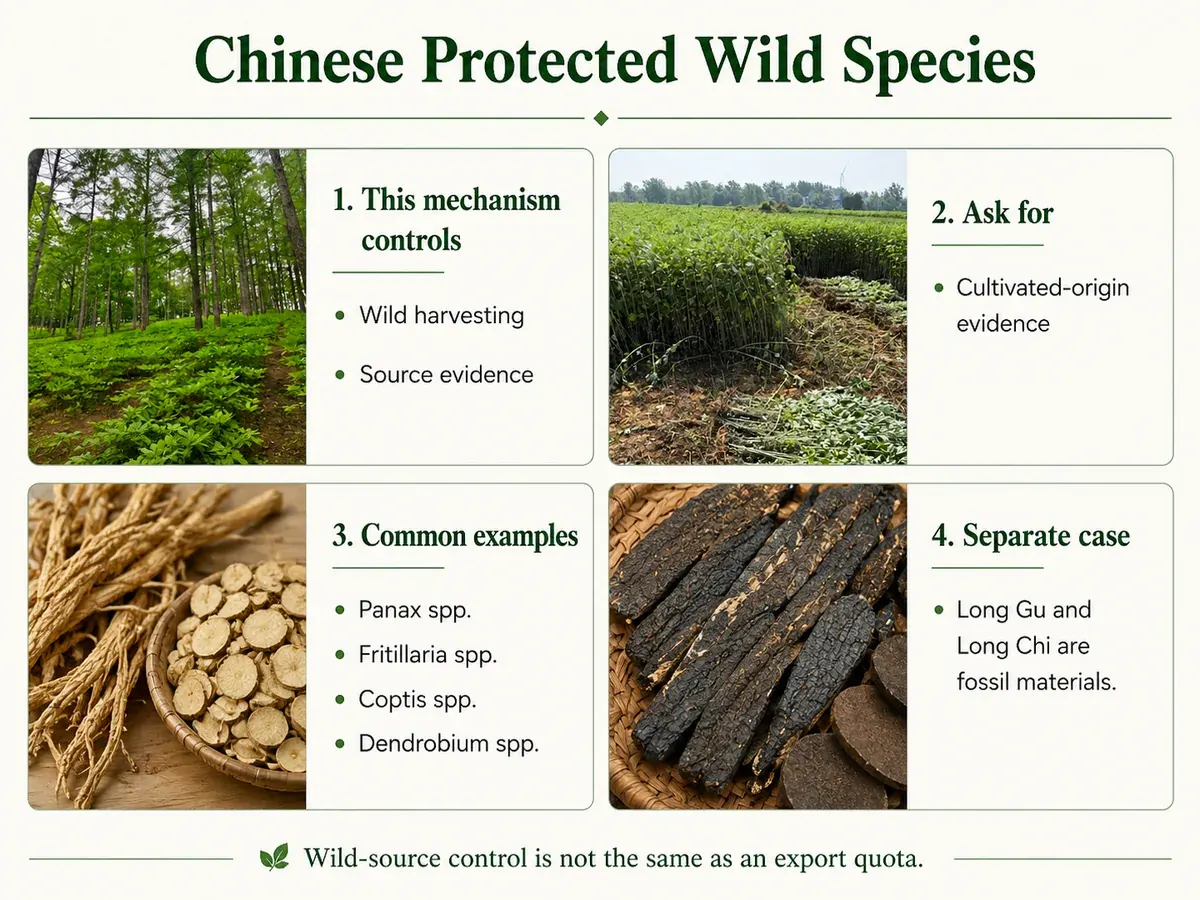
Several entries are genus-wide, which catches more material than buyers expect:
One administrative detail that saves time: entries marked with an asterisk in the catalogue are administered by the agriculture and rural affairs authorities; the rest by the forestry and grassland authorities. Panax, Fritillaria and Coptis carry the asterisk. Approaching the wrong authority is a common cause of delay.
A related correction worth making, because it appears in a lot of older supplier documentation: Eucommia bark (Du Zhong) is not on the 2021 catalogue. It appeared on the 1999 first-batch catalogue, but that catalogue was repealed when the 2021 one took effect. Documentation still describing Du Zhong as a state-protected species is citing a repealed instrument.
Dragon bone (Long Gu) and dragon tooth (Long Chi) are not herbs at all. They are fossil vertebrate material — typically Neogene and Quaternary large mammals — and fall under China’s Regulations on the Protection of Palaeontological Fossils (State Council Order No. 580, in force 1 January 2011, amended 2019). Export requires approval from the natural resources authorities. These materials have been traded as ordinary herbal commodities for a long time, but the regulation is not ambiguous about them.
The first three mechanisms decide whether material can leave China. This one decides whether it can enter the destination market, and it applies to material that is otherwise completely unrestricted.
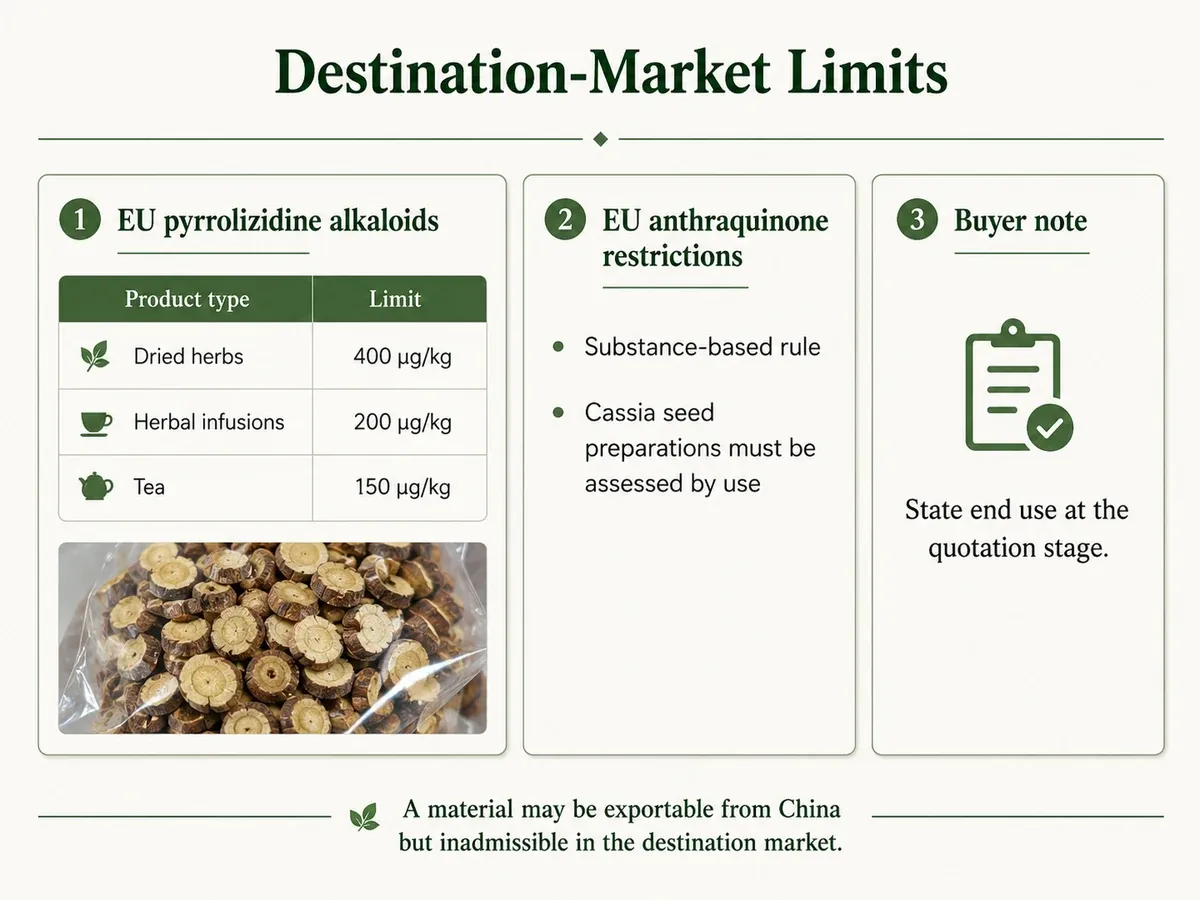
Commission Regulation (EU) 2020/2040, applying since 1 July 2022, sets maximum pyrrolizidine alkaloid levels in food:
| Category | Maximum level |
|---|---|
| Dried herbs | 400 µg/kg |
| Food supplements containing botanicals | 400 µg/kg |
| Herbal infusions (dried) | 200 µg/kg |
| Tea and flavoured tea | 150 µg/kg |
| Tea and herbal infusions for infants and young children (dried) | 75 µg/kg |
The relevance for Chinese herbal materials is concentrated in the Boraginaceae. Published measurements of Arnebia euchroma (Xin Jiang Zi Cao) report total PA content in the tens to low hundreds of µg per gram — orders of magnitude above the food limits above. Arnebia guttata and Lithospermum erythrorhizon measure higher still.
Two qualifications matter here, and both cut against over-reading the numbers.
First, the regulation defines its limit as the sum of a specified list of PAs; published studies typically quantify a smaller subset. The comparison is directionally unambiguous but the exact multiple is not.
Second, these are food limits. External and non-food applications — dyes, cosmetic raw material, topical preparations — are not subject to them. A risk assessment published in 2023 using relative potency factors concluded that oral A. euchroma is low risk. That scientific conclusion and the regulatory limit are separate things: customs and importers enforce the limit, not the assessment.
The practical consequence is that end use has to be stated at the quotation stage for this material, because it determines whether PA testing is needed and whether the material is admissible at all.
A different EU instrument works the same way. Regulation (EU) 2021/468 amended Annex III of Regulation (EC) No 1925/2006, adding to the prohibited list: “aloe-emodin and all preparations in which this substance is present”, “emodin and all preparations in which this substance is present”, and “danthron and all preparations in which this substance is present”.
Cassia obtusifolia, Cassia tora, Senna obtusifolia and Senna tora — the source species for Cassiae Semen (Jue Ming Zi) — are not named anywhere in that regulation. The prohibition is written on the substance, not on the plant, and the absence of the species name does not by itself place a preparation outside the Part A entries. For EU-bound food supplement use the question is settled by testing the preparation, not by reading the species list.
For most herbs the ordinary sequence works: agree the specification, approve a sample, place the order. For the materials above, two questions come first.
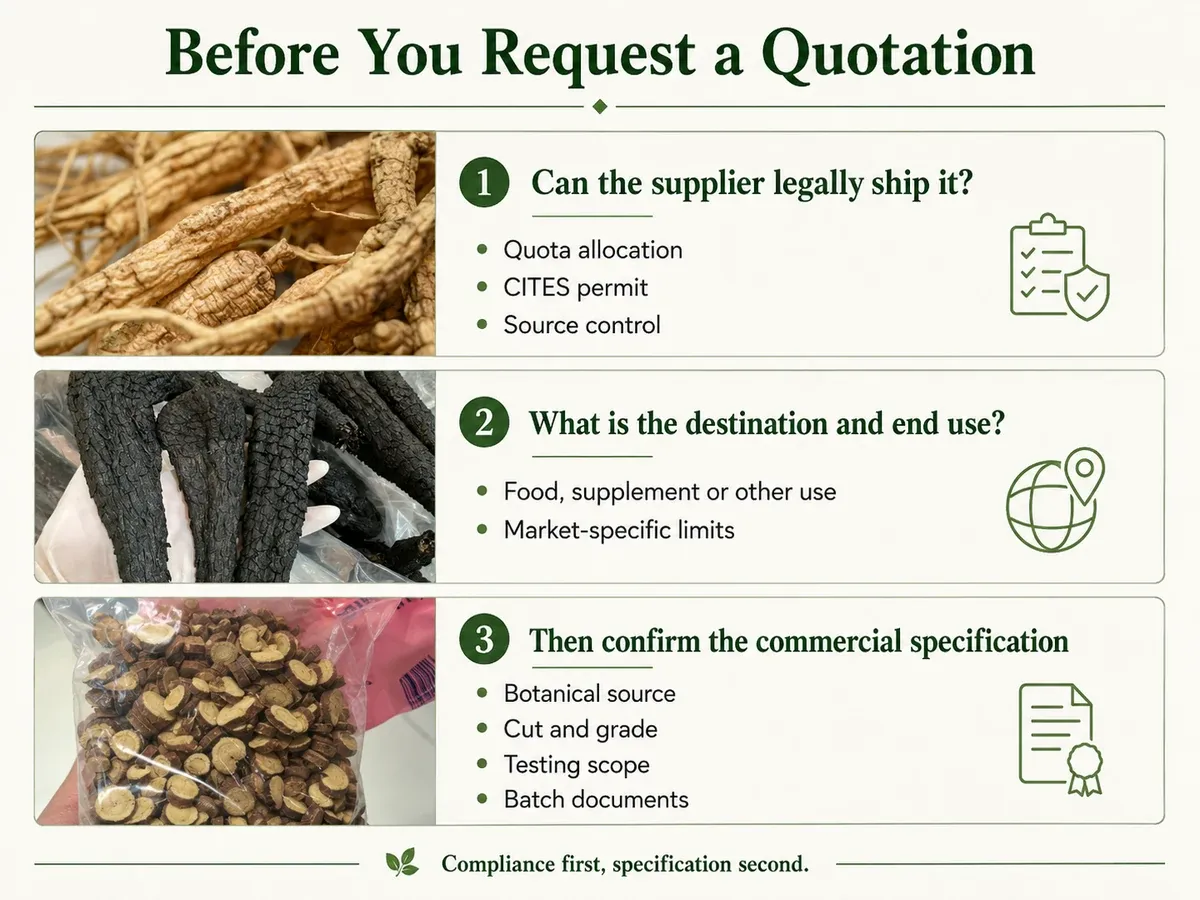
Only then do botanical source, cut, grade, testing scope and batch documentation become the productive conversation. Our sourcing guides cover those herb by herb.
We state this plainly because it saves enquiries that cannot be fulfilled.
Aile Herb does not hold an export quota allocation for licorice or ephedra, and does not offer either for export. We do not supply Aucklandia root (Mu Xiang), gecko (Ge Jie), dragon bone (Long Gu) or dragon tooth (Long Chi).
For materials we do supply — across root and rhizome herbs, flower and leaf herbs, fruit and seed herbs and bark, fungi and specialty herbs — send the intended destination market and end use with your enquiry, and we will confirm what documentation the shipment needs before quoting.
| Organisation | Document | Source |
|---|---|---|
| MOFCOM / GACC (China) | Catalogue of Goods Subject to Export Licence Administration (2026) | xkzj.mofcom.gov.cn |
| CITES | Appendix I listing, Saussurea costus | cites.application.developpement-durable.gouv.fr |
| CITES / EU | Commission Regulation (EU) 2026/1383, Annex B | eur-lex.europa.eu |
| EU | Commission Regulation (EU) 2020/2040 (pyrrolizidine alkaloids) | eur-lex.europa.eu |
| EU | Regulation (EU) 2021/468 (Annex III amendments) | eur-lex.europa.eu |
| State Council (China) | Catalogue of Wild Plants Under State Priority Conservation (2021) | gov.cn |
| State Council (China) | Regulations on the Protection of Palaeontological Fossils (Order No. 580, amended 2019) | gov.cn |
To have an ingredient list screened for export conditions before quotation, send it through our Chinese herbal slices page with the destination market; we reply in writing item by item.
