Tell Us About Your Project
Share your product, quantity and project requirements. We will review the details and respond with the relevant next steps.

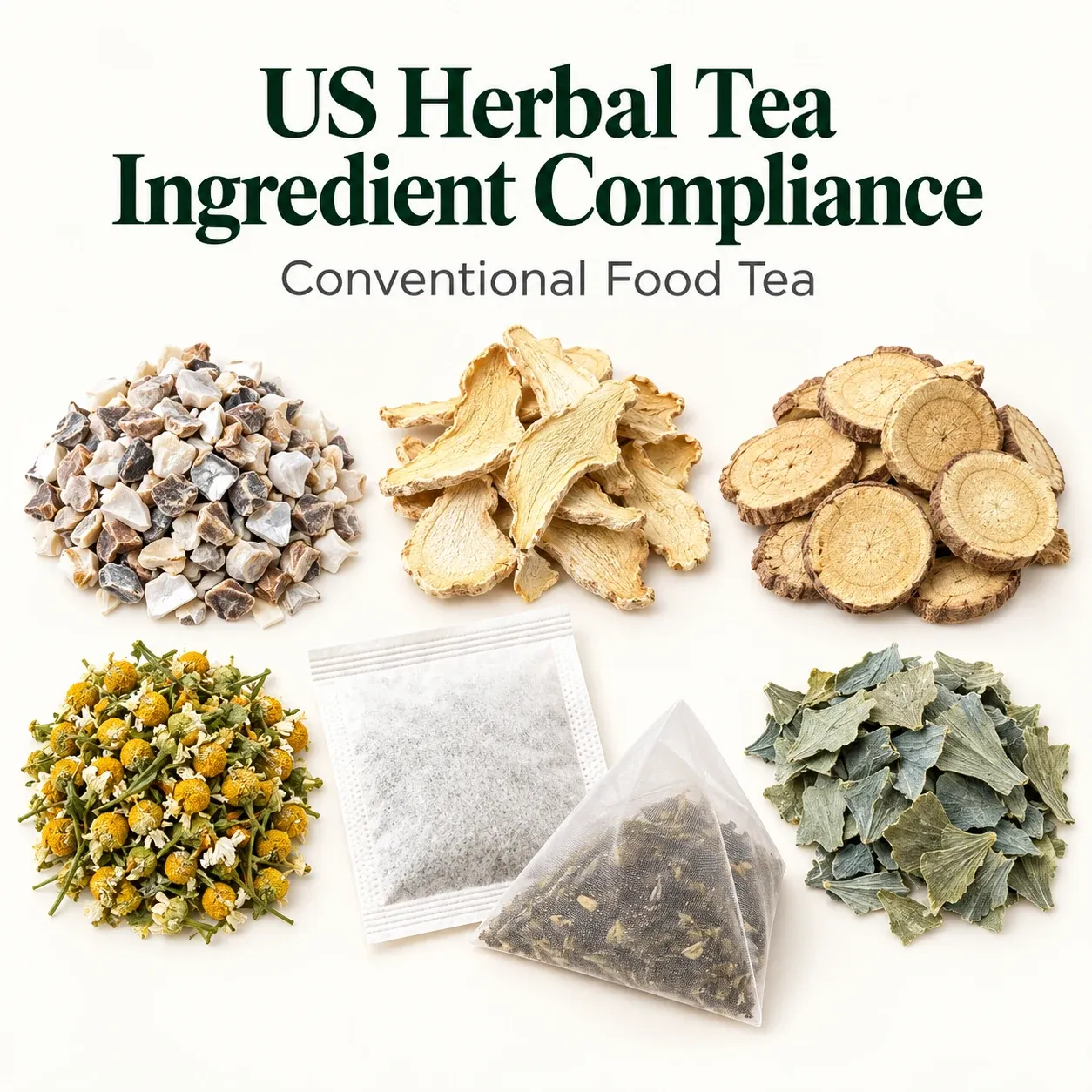
Most private label tea projects for the US market arrive with a wish-list formula: a sleep blend with ashwagandha and valerian, a focus blend with ginkgo and guayusa, a “glow” tea with edible gold dust. Before we quote, we check each ingredient against one question: does it have a recognised legal basis for use in a conventional food sold in the United States?
This article explains how we run that check, which common ingredients have a clear basis, which are limited to a specific form or use level, and which we ask buyers to replace. It is written for brand owners and sourcing teams, not lawyers, and it is not legal advice. Your importer of record and your own regulatory counsel make the final call.
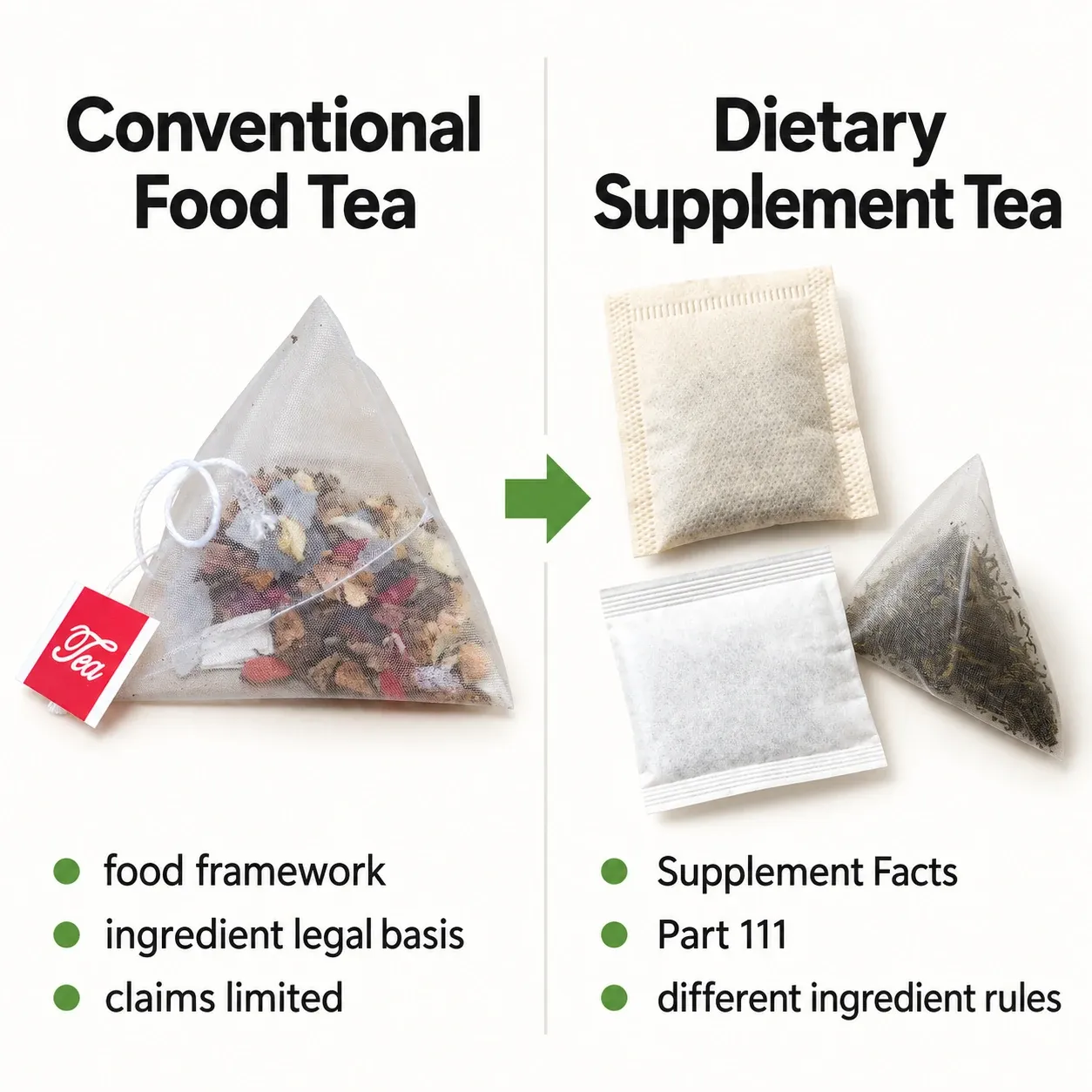
In the US, a tea bag can be sold under two different frameworks, and the ingredient rules are not the same.
The wording planned for the box decides a lot. We ask buyers to send the intended claims together with the formula, because the two are reviewed together.
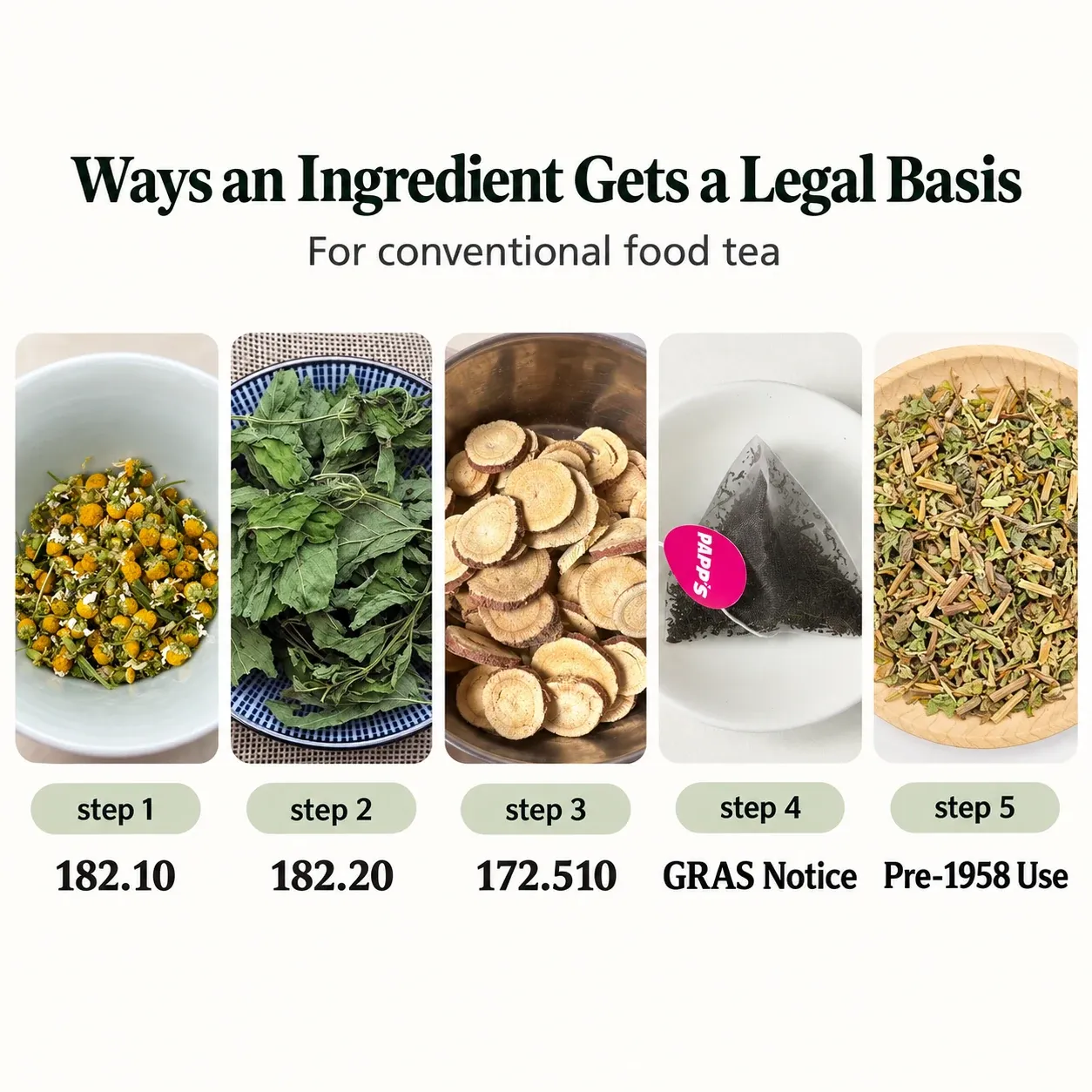
There is no single “approved herbs for tea” list in the US. The routes are:
Two developments this year make the check more important, not less.
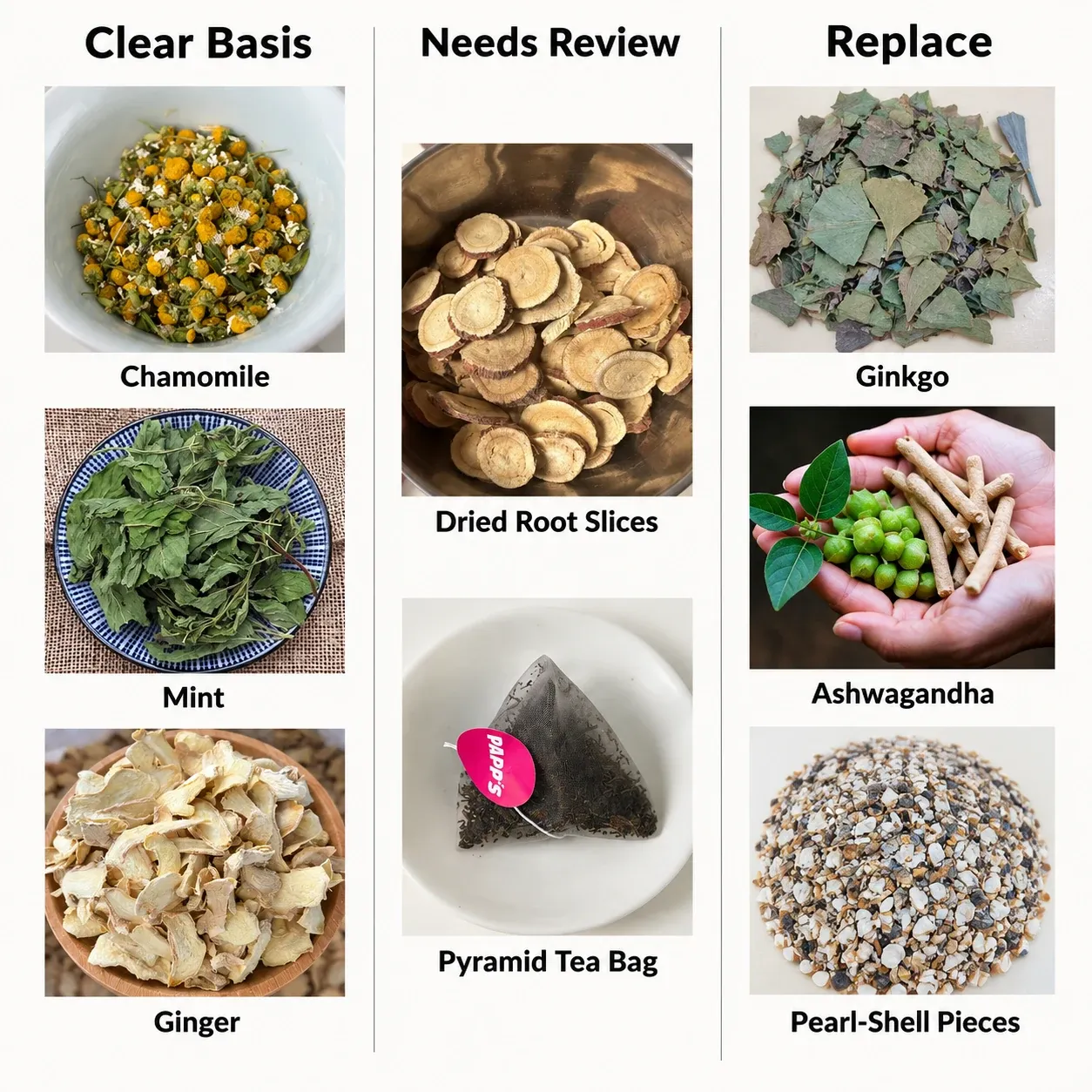
The table covers the ingredients that appear most often in US private label tea requests we receive. “Basis” is our reading of the public record for conventional food use; each buyer should confirm with their own counsel.
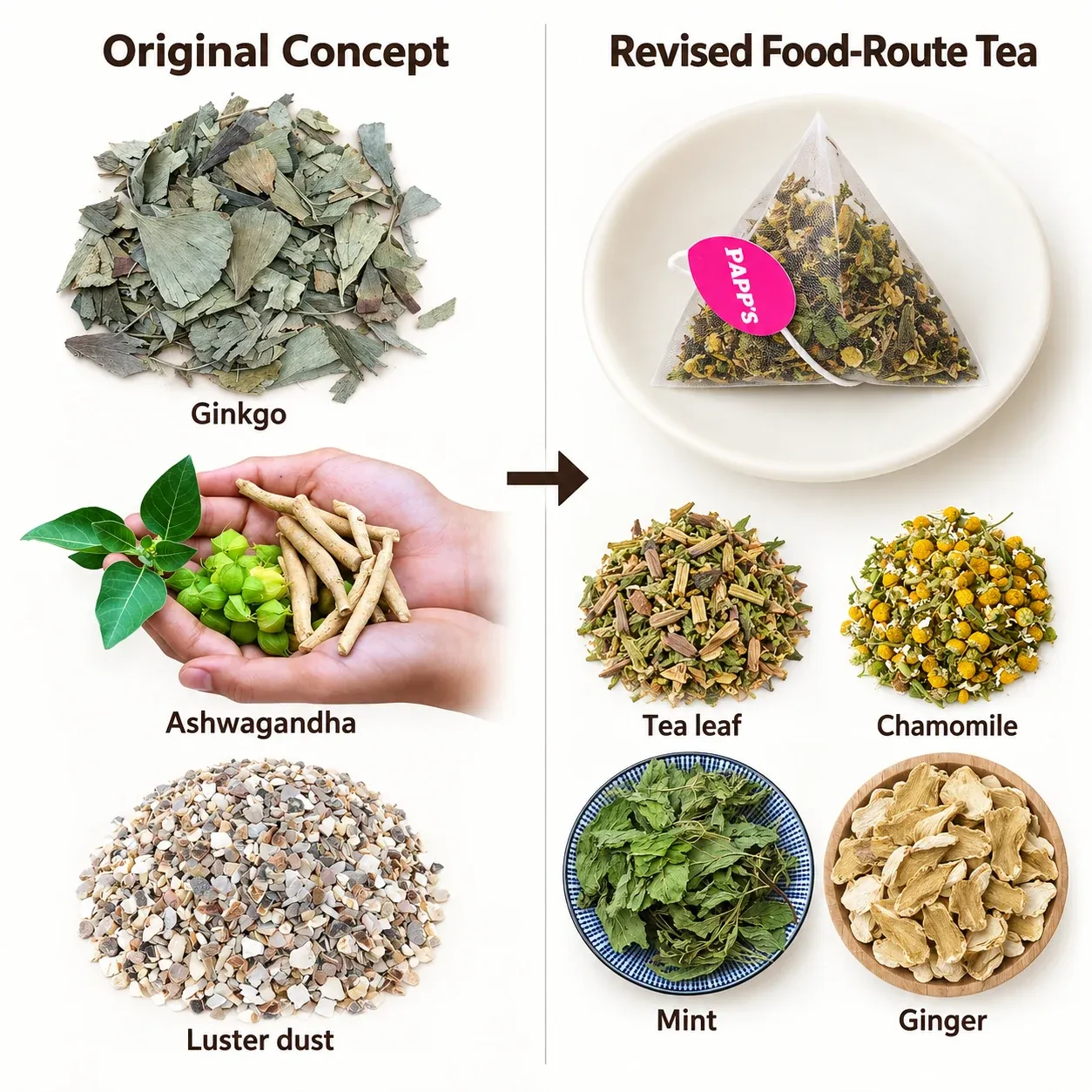
A US brand sent us a four-blend concept: energy (guayusa 25%), focus (ginkgo 10%), calm (ashwagandha 12%, licorice) and sleep, plus a gold luster finish. Run through the table, the changes were:
| Ingredient | Basis for US conventional-food tea | What we tell buyers |
|---|---|---|
| Chamomile flowers | GRAS, 21 CFR 182.10 (named species) | Clear basis. Standard base for calming blends; specify the listed species. |
| Lemon balm, peppermint, ginger, elder flowers | GRAS, 21 CFR 182.10 | Clear basis. Check the listed species and plant part match what is supplied. |
| Hops, rose, yerba mate | Listed in 21 CFR 182.20 as essential oils / extractives only | The listing covers extracts, not the dried leaf or flower in a tea bag. Whole-plant use rests on history-of-use documentation the buyer’s counsel has to establish. Yerba mate is an imported raw material with limited small-lot availability in China. |
| Valerian root | Natural flavoring, 21 CFR 172.510 | Basis exists for flavoring-level use only. European Pharmacopoeia grade must be imported; not a Chinese stock herb. |
| Passion flower | Natural flavoring, 21 CFR 172.510 | Same as valerian: flavoring-level use, imported. |
| Hibiscus / roselle flowers | Natural flavoring, 21 CFR 172.510 | Basis exists at flavoring-type levels; widely used in US teas. Chinese stock item. |
| Linden flowers / leaves | Linden flowers in 182.10; linden leaves in 172.510 are for alcoholic beverages only | Specify flowers, not leaves. |
| Licorice root | GRAS with limits, 21 CFR 184.1408: glycyrrhizin not more than 0.15% in nonalcoholic beverages and in herbs & seasonings, as served | The limit is on glycyrrhizin in the finished beverage, not on the percentage of root in the blend, and glycyrrhizin content of raw licorice varies by lot. Meeting it needs a raw-material specification or test that the buyer defines. Chinese licorice is also subject to export licensing. |
| L-theanine | “No questions” GRAS notices GRN 209 and GRN 338 at up to 250 mg per serving, each for the notifier’s own substance, process and uses | A notice is not a licence for every supplier’s L-theanine. The buyer nominates the source and holds the documentation showing the material matches a notified substance and use. |
| Guayusa leaf | Guayusa leaf hydroethanolic extract has a “no questions” GRAS notice (GRN 870, 2020) for beverages; the dried leaf is not covered by that notice | A basis exists for the extract, not the tea leaf. Supply is the harder problem: guayusa grows in the Amazon (Ecuador, Colombia, Peru) and is not stocked in China. We recommend tea leaf as the caffeine source. |
| Ashwagandha root | No GRAS regulation and no GRAS notice on file. FDA has treated ashwagandha in conventional foods, including tea, as an unsafe food additive (2026 recall). A self-determined GRAS exists for one branded extract; FDA has not reviewed it | We do not accept ashwagandha in food-route teas. It stays on the supplement-route list. |
| Ginkgo biloba leaf | FDA’s 2012 scientific memorandum finds no basis to consider ginkgo biloba extract GRAS in conventional food, citing NTP carcinogenicity findings; no GRAS basis is on record for the dried leaf either | Our policy: no ginkgo in food-route teas, leaf or extract. Remove, or move the product to the supplement route. |
| Edible gold / pearl luster dust | Mica-based pearlescent pigments are permitted only in listed foods (cereals, confections, candies, gum, certain alcoholic drinks and cocktail mixers) under 21 CFR 73.350; tea and dry beverage mixes are not listed. Metallic gold is not a listed US food colour | Remove. Visual effect can come from whole flowers (rose, chrysanthemum, osmanthus, butterfly pea) instead — each checked as an ingredient in its own right. |
| Dried orange peel (chen pi) | Citrus peel appears in 182.20 as an extractive; the dried whole peel as a food ingredient rests on history of use | Commonly used; buyer’s counsel confirms the basis for whole peel. We supply species and processing details. |
| Jujube, goji, chrysanthemum, osmanthus | Not on the 182 or 172 lists. Any GRAS basis has to be built on documented common food use before 1958 (21 CFR 170.30); presence on the US market does not establish it | Widely used in US-sold teas, but we hold no GRAS documentation for them. We supply species, plant part, origin, processing and serving weight so the buyer’s counsel can assess each one. Chrysanthemum in particular is species- and preparation-specific. |
| Jujube seed (suan zao ren), poria, other homology-list herbs | Chinese homology-list status only; no US record | Case by case. We say so plainly and offer a 182.10-based alternative for comparison. |
The full custom-formula process, including sampling rounds and small first runs, is described in our guide to custom branded tea bags in small batches.
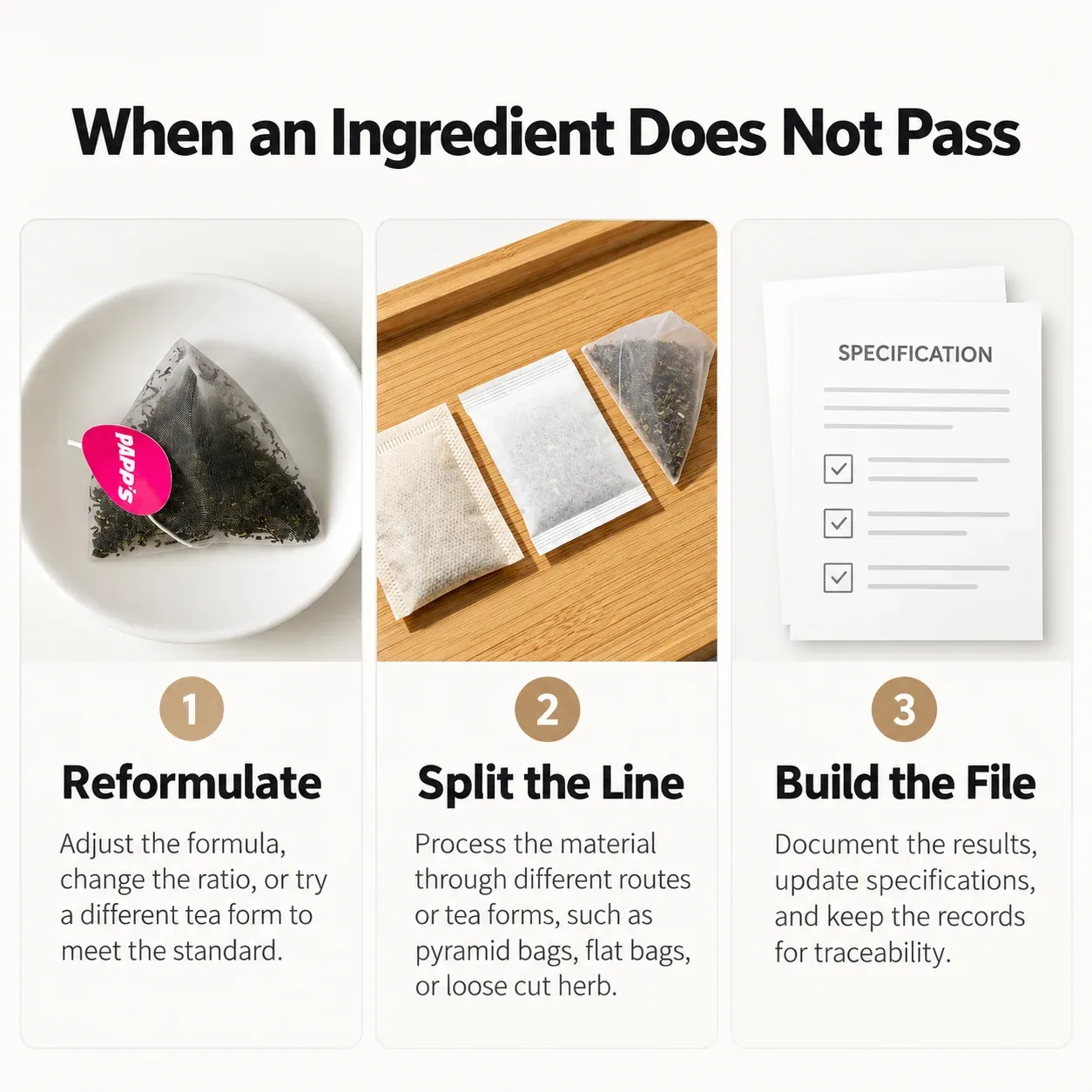
In our experience the decision is rarely “drop the product”. It is one of three moves.
Whichever route is chosen, the decision is made before sampling starts. Changing an ingredient after the packaging artwork is approved means new artwork, new labels and, often, a new sample round.
Before we can run the table on your formula we need, per ingredient:
With those five items an initial check takes a few working days and comes back as a marked-up version of your formula — clear basis, limited basis, or replace — with the reasoning for each line.
We provide: botanical species, plant part, origin, processing method and serving weight per bag for every ingredient; a candid note on each ingredient’s regulatory footing; and, once the project scope is agreed, batch documentation and testing confirmed per project — see testing and documents for herbal tea ingredients by destination market.
We do not provide: GRAS assessments, FDA “approval” of a formula, or a claim that a Chinese food-medicine homology list entry equals US food status. Where an ingredient needs its own GRAS documentation, the buyer nominates the supplier and holds that file. For more on how the Chinese list works and where it stops, see Chinese herbs that are food grade in China: the homology list.
Is a herb on China’s food-medicine homology list automatically legal in a US tea?
No. The Chinese list decides what can be sold as ordinary food in China. US status depends on the 182 or 172 lists, a GRAS regulation, a GRAS notice, or documented common use in food before 1958.
Can we keep ashwagandha or ginkgo if we make no health claims?
Claims and ingredient status are separate tests. Removing the claim keeps the product a conventional food, but each ingredient still needs a legal basis for that food. FDA has treated ashwagandha in tea as an unsafe food additive, and has found no GRAS basis for ginkgo extract.
Can you make the same blend as a dietary supplement instead?
Not as a finished product; our tea workshops are food-licensed, not 21 CFR Part 111 facilities. We can discuss supplying bulk herbs to a US Part 111 co-packer.
Do you test to US standards?
Test scope is confirmed per project against the destination market. Destination-specific panels, including California Proposition 65 lead testing, are quoted separately through third-party laboratories.
What should we send to get an ingredient check before quoting?
The full ingredient list with percentages, target serving weight, the route you intend (conventional food or supplement), and the wording you plan to print on the box. Send it through our private label herbal tea bags page.
