Tell Us About Your Project
Share your product, quantity and project requirements. We will review the details and respond with the relevant next steps.

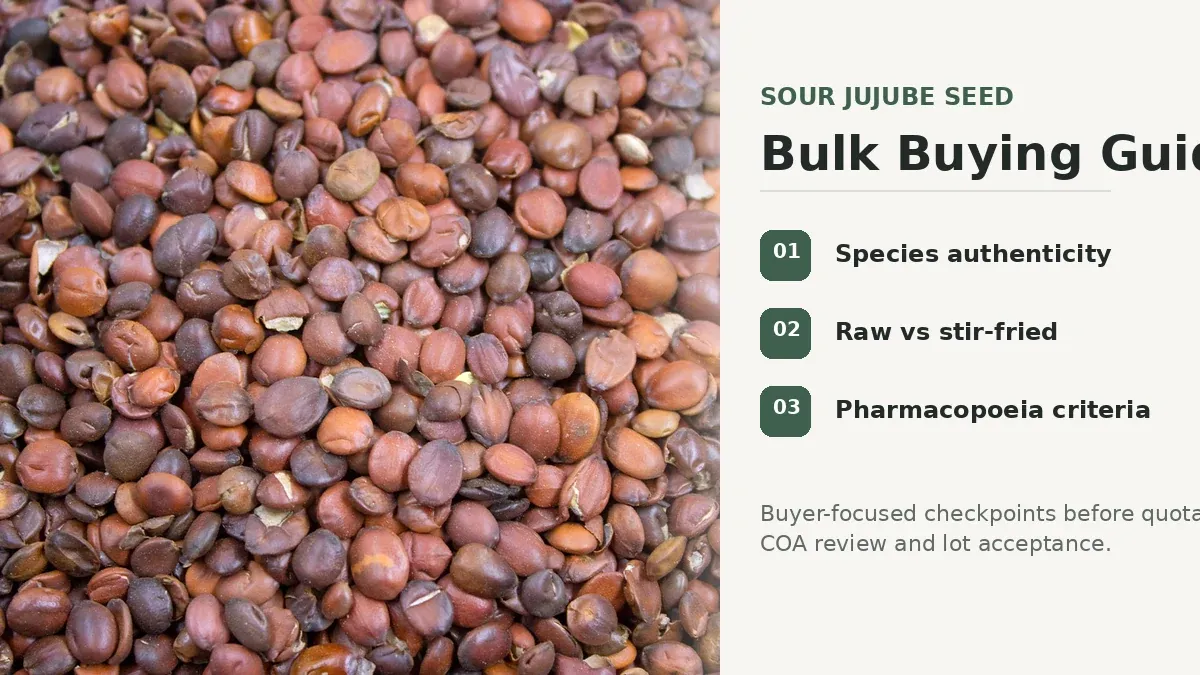
Sour jujube seed — Ziziphi Spinosae Semen, Suan Zao Ren (酸枣仁) — is a high-value herbal seed with a documented adulteration risk. For bulk buyers that means a quotation alone tells you very little. This guide covers the three parameters that separate a usable lot from a problem lot: species authenticity, processing state, and Pharmacopoeia quality criteria.
Sour jujube seed is the dried ripe seed of Ziziphus jujuba Mill. var. spinosa (Bunge) Hu ex H. F. Chow, a wild or semi-wild thorny jujube that grows across northern China. The main producing provinces are Hebei, Shandong, Shaanxi, Shanxi and Liaoning. The seed is listed in the Chinese Pharmacopoeia and is used in traditional sleep and calming formulas; in Western markets it appears in herbal tea blends, extracts and dietary supplements.
The seed is small relative to the fruit, the fruit is largely wild-collected, and market prices have fluctuated sharply in recent years. Published studies continue to document substitution with lower-cost look-alike seeds, which is why specification matters more for this item than for most herbal raw materials.
The most important line on a sour jujube seed purchase order is the botanical identity. Several lower-cost seeds can resemble genuine sour jujube seed closely enough to create problems in bulk purchasing, especially when materials are mixed, processed or viewed without a reference sample.
The best-documented substitute is Ziziphus mauritiana Lam. seed, referred to in the Chinese trade as Dian Zao Ren (滇枣仁), Li Zao Ren (理枣仁) or Mian Zao Ren (缅枣仁). It resembles genuine Ziziphus jujuba var. spinosa seed but has a different chemical profile. In a 2017 comparative study published in Frontiers in Pharmacology, jujubosides A and B were detected in genuine sour jujube seed but were too low to detect in the tested Z. mauritiana samples. Spinosin alone, however, is not a reliable discriminator: the Z. mauritiana samples in that study did not consistently contain less spinosin than the genuine seed (Frontiers in Pharmacology, 2017).
Seeds of Hovenia species (Zhi Ju Zi, 枳椇子) are another documented look-alike. A 2025 authentication study in Foods collected 88 batches of Z. mauritiana seed and 100 batches of Hovenia acerba seed as counterfeits of genuine sour jujube seed, noting that rising prices have driven the appearance of look-alikes (Foods, 2025).
The practical conclusion for buyers: do not accept appearance, or a single marker assay, as proof of botanical identity.
Quick visual screening: genuine seed vs Z. mauritiana
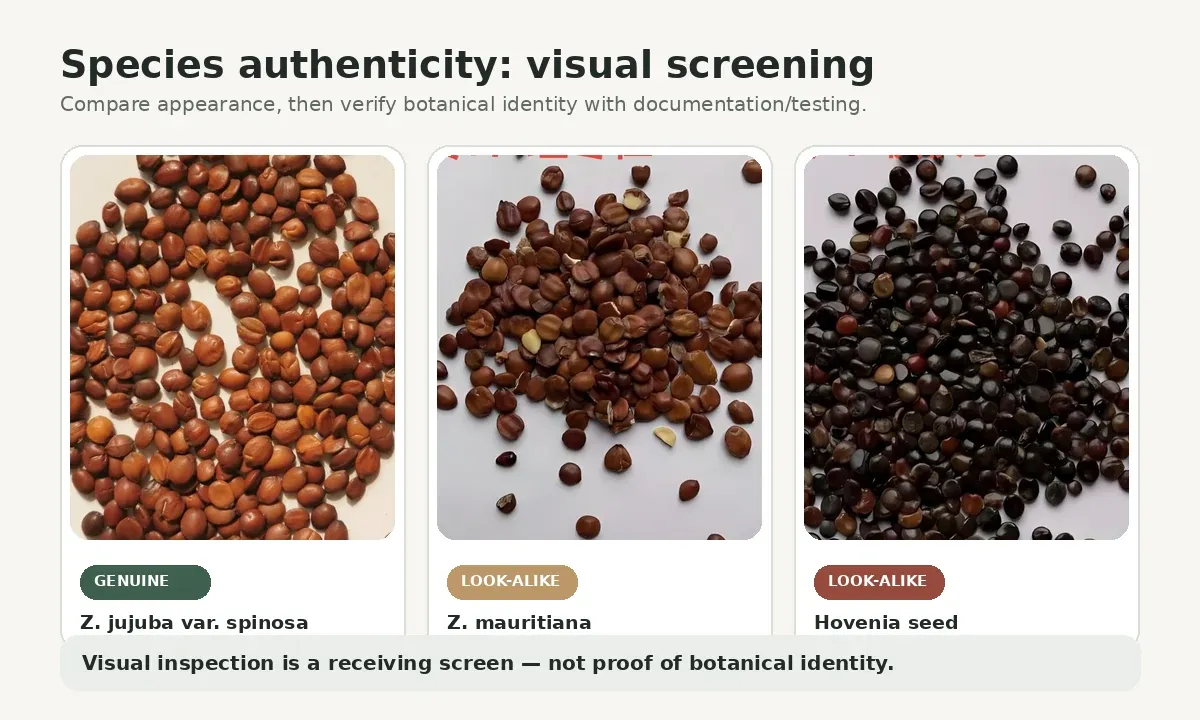
| Genuine sour jujube seed (Z. jujuba var. spinosa) | Z. mauritiana (Dian Zao Ren / Li Zao Ren) | |
|---|---|---|
| Shape | Flat, oval, 5–9 mm long, 5–7 mm wide | Rounder, thicker, less flattened |
| Surface | Smooth, glossy, purplish-red to purple-brown | Duller, often lighter brown |
| Mid-line | One side shows a distinct raised longitudinal ridge | Ridge indistinct or absent |
| Kernel | Pale yellow, oily, two cotyledons | Similar in appearance |
Other look-alike seeds, including Hovenia species, have different morphological characteristics. Visual inspection is a receiving-screening tool, not a substitute for botanical identification; it catches gross substitution but not blending.
For pharmacopoeial purchasing, ask whether the batch documentation includes an identity test in addition to quantitative marker assays. Under the Chinese Pharmacopoeia 2025 monograph, identification includes TLC comparison against sour jujube seed reference material and jujuboside A, jujuboside B and spinosin reference compounds, while jujuboside A and spinosin are determined separately as quantitative markers. A COA with an assay line but no identification line is incomplete.
What to write on the specification: Ziziphi Spinosae Semen, Ziziphus jujuba var. spinosa, single species; identity by TLC against reference material; free of Z. mauritiana and Hovenia seed.
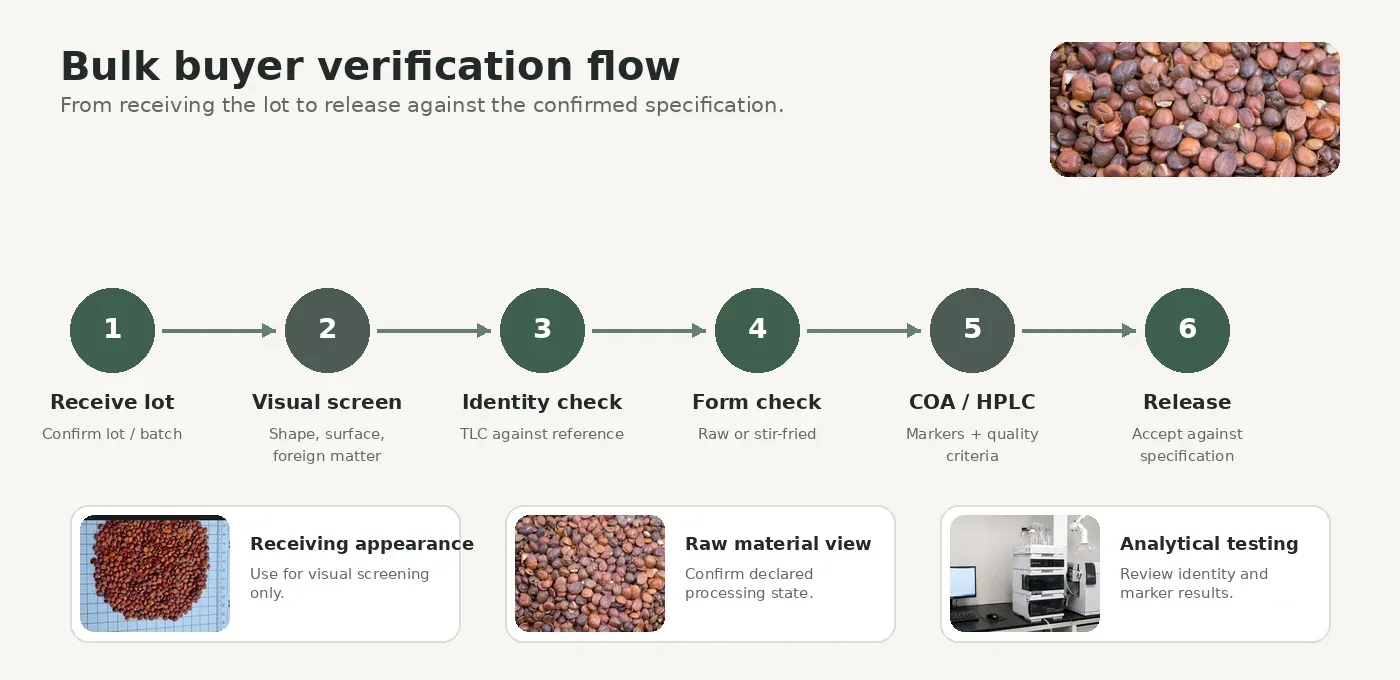
Sour jujube seed is traded in two processing states, and they are specified and quoted differently.
Raw seed (生酸枣仁): cleaned, dried, otherwise unprocessed. Used where the buyer will process further, or in formulations that call for the raw material.
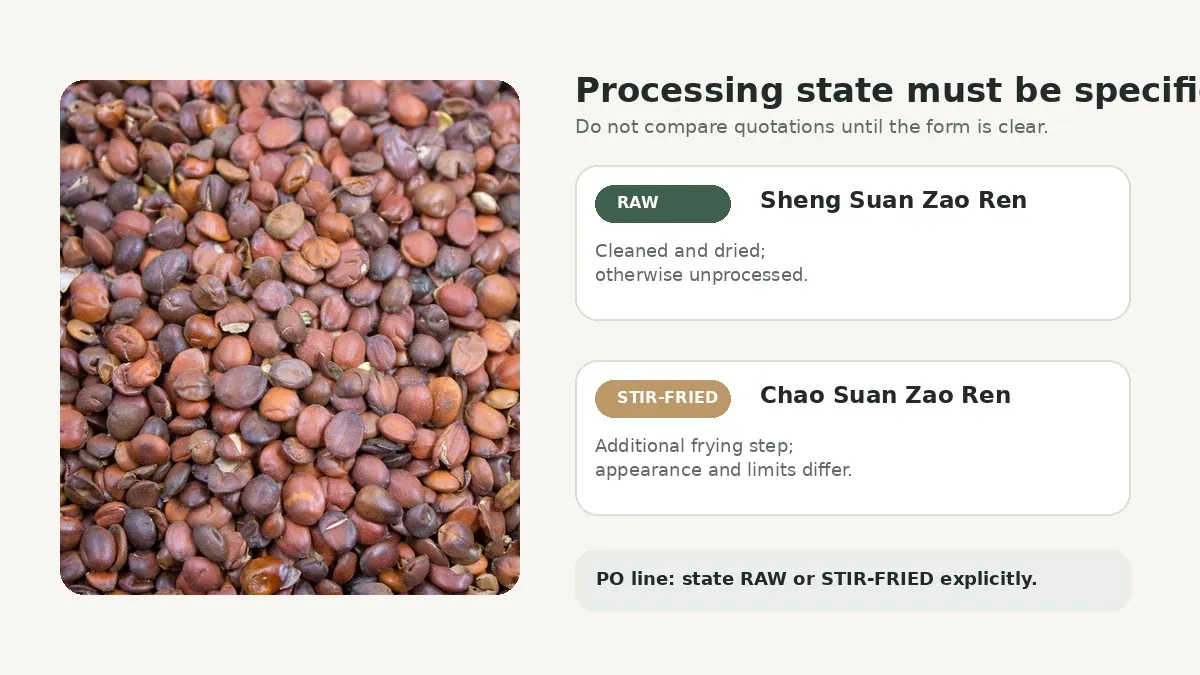
Stir-fried seed (炒酸枣仁): the seed is dry-fried until the surface darkens slightly and swells, with a faint roasted aroma. This is the form most traditional formulas specify. Correctly fried seed is uniformly slightly puffed and darkened; over-fried lots show scorched, blackened seeds and a burnt smell; under-fried lots are indistinguishable from raw.
The two forms share the same identity, extractive and marker-content requirements, but their moisture and total-ash limits are not the same (see Parameter 3). A buyer comparing quotations needs to know which form is being quoted; stir-fried material may be quoted differently because an additional processing step is involved.
What to write on the specification: state raw or stir-fried, and for stir-fried, ask for a photo of the lot against a reference so the degree of frying can be checked before shipment.
The current Chinese Pharmacopoeia (2025 edition, in force since 1 October 2025 specifies not less than 0.030% jujuboside A and not less than 0.070% spinosin, calculated on the dried material. The full set of limits:
| Test | Raw sour jujube seed | Stir-fried sour jujube seed |
|---|---|---|
| Jujuboside A (酸枣仁皂苷 A) | ≥ 0.030% | ≥ 0.030% |
| Spinosin (斯皮诺素) | ≥ 0.070% | ≥ 0.070% |
| Alcohol-soluble extractives | ≥ 12.0% | ≥ 12.0% |
| Moisture | ≤ 11.0% | ≤ 9.0% |
| Total ash | ≤ 7.0% | ≤ 4.0% |
| Impurities, including shell | ≤ 5.0% | — |
| Aflatoxin B1 | ≤ 5 μg/kg | ≤ 5 μg/kg |
| Aflatoxins B1 + B2 + G1 + G2 | ≤ 10 μg/kg | ≤ 10 μg/kg |
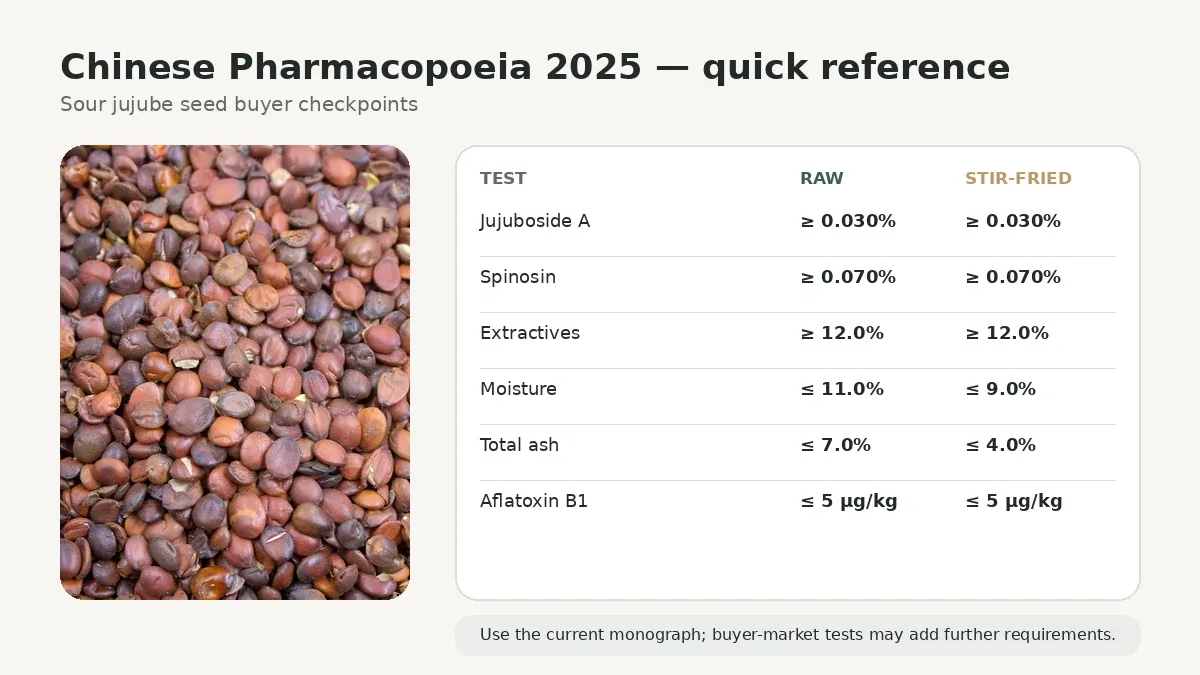
Note that the 2025 edition changed several values from the 2020 edition — the spinosin minimum, the raw-material moisture limit and the test methods — so a COA or specification sheet that still quotes 2020 figures should be updated.
These limits give you a basis for accepting or rejecting a shipment that does not depend on the supplier’s description. What to ask for: a batch COA showing identification (TLC), both marker assays by HPLC with method and reference standard stated, extractives, moisture, ash, impurities and aflatoxins. A COA that reports only “complies with CP” without figures is not sufficient for a specification.
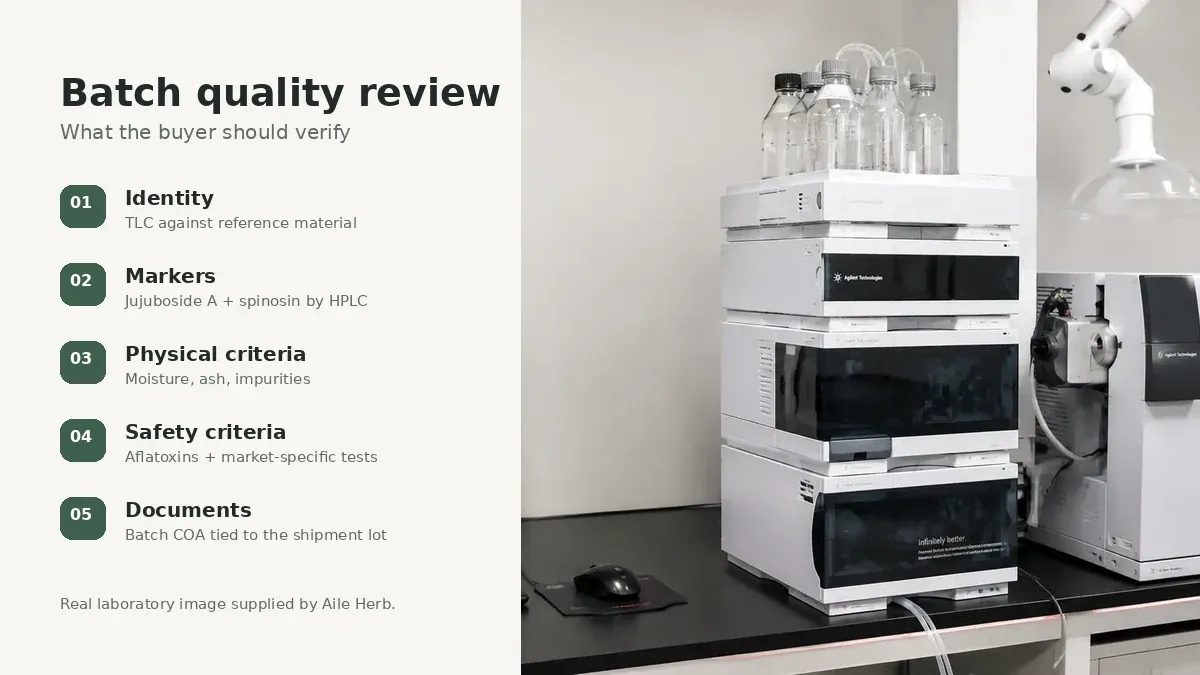
The Pharmacopoeia monograph covers aflatoxins; export buyers may need additional pesticide-residue, heavy-metal, microbiological or other testing depending on the destination market, product category and their own specification. See how to read a Certificate of Analysis for Chinese herbs for what a complete COA should contain.
A complete purchase specification for bulk sour jujube seed covers:
What is the difference between sour jujube seed and jujube (red date) seed?
Sour jujube seed comes from the wild thorny jujube Ziziphus jujuba var. spinosa; the seed of the cultivated red date (Z. jujuba, Da Zao) is a different article and is not interchangeable in pharmacopoeial use. Only Ziziphi Spinosae Semen is listed under the sour jujube seed monograph.
Which Chinese Pharmacopoeia edition applies to sour jujube seed now?
The 2025 edition, in force since October 2025. It sets spinosin at not less than 0.070% and jujuboside A at not less than 0.030%, with moisture not more than 11.0% for raw seed and 9.0% for stir-fried seed.
Can a COA alone confirm the seed is genuine?
Only if it includes an identification test (TLC against reference material and reference compounds) as well as the marker assays. Spinosin content by itself does not rule out Z. mauritiana.
Should I order raw or stir-fried sour jujube seed?
Specify whichever your formulation calls for. Stir-fried (Chao Suan Zao Ren) is the form most traditional formulas use; raw seed is used where the buyer processes further. The two are quoted and tested as separate forms.
How should bulk sour jujube seed be stored?
Sealed, dry and cool, away from strong odours. The seed is oily, so moisture and heat shorten usable life. See Chinese herbal ingredient storage for general handling.
Aile Herb supplies sour jujube seed (Suan Zao Ren) for bulk B2B orders, raw or stir-fried, with grade, testing scope and packaging confirmed against the buyer’s specification. Supply is supported by a GMP-certified production facility in Gansu, and each batch ships with a Certificate of Analysis; third-party testing against the destination market’s limits is arranged per order. For first orders, see MOQ and order planning, or send your specification through the contact form for a quotation.
