Tell Us About Your Project
Share your product, quantity and project requirements. We will review the details and respond with the relevant next steps.

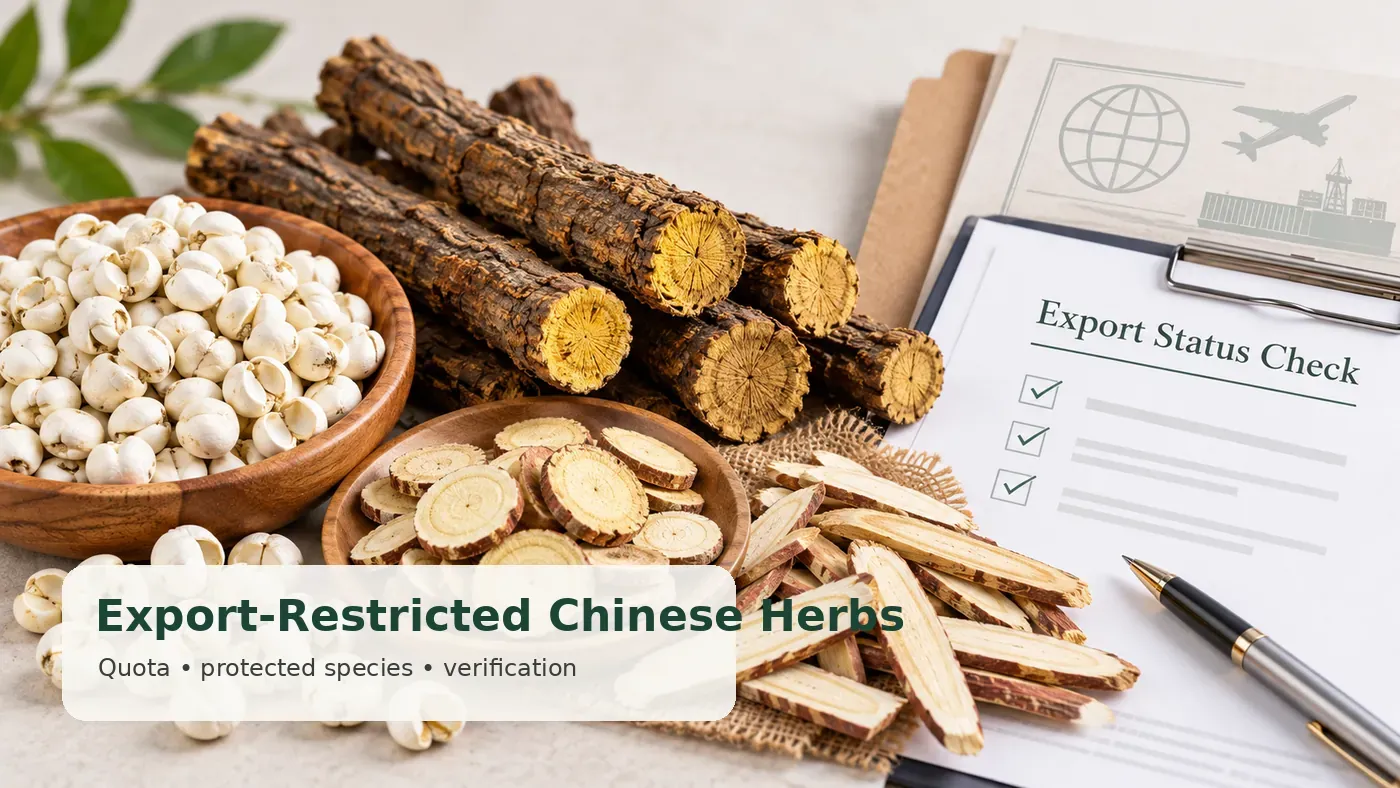
Not every Chinese herb can be exported freely. Some are quota-managed, some fall under protected-species controls, while most are unrestricted.
Export status should be confirmed at the specification stage, before a formula is finalized or a quotation is accepted. This guide explains the three categories of control and which official sources to check.
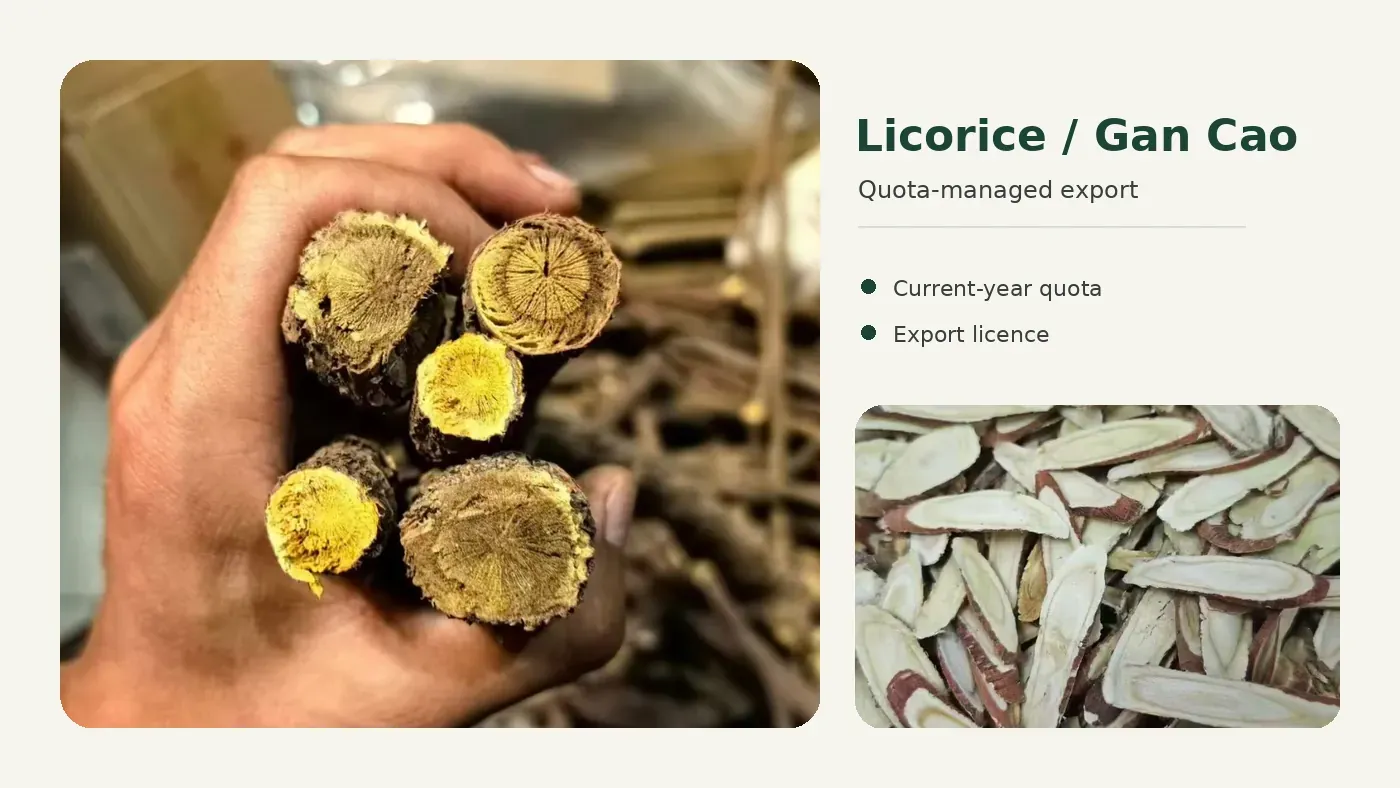
Certain herbal materials are managed under China’s annual export quota system. For these goods, the exporter must hold the required current-year quota and export license before shipment.
Two herbal materials are on the current quota list:
| Material | 2026 export quota | Allocation | Legal basis |
|---|---|---|---|
| Licorice and licorice products (Gan Cao, Glycyrrhiza spp.) | 5,200,000 kg | Bidding (two rounds: 75% / 25%) | MOFCOM Announcement 2025 No. 69; No. 78 |
| Cultivated ephedra for medicinal use (Ma Huang) | 1,028,900 kg | Quota application | MOFCOM Announcement 2025 No. 69 |
Fresh or dried licorice root is declared under HS code 1211903600, and its quota is allocated only by bidding. Under MOFCOM Announcement 2025 No. 78, companies may bid for fresh or dried licorice only if they exported the product in 2025, or exported Chinese medicinal materials and decoction pieces in every year from 2023 to 2025 with average annual exports of at least USD 500,000, or supplied at least 50,000 kg of the product for export per year over 2023–2025. After each round, MOFCOM publishes the winning companies and their quantities; the 2026 second-round list, issued on 16 June 2026, names 75 companies for fresh or dried licorice. A general export license or trading history is therefore not sufficient. If a supplier quotes licorice, the correct follow-up question is not “can you export it” but “do you hold a licorice export quota award for this year, and can you show the export license before shipment” — and whether the exporter of record appears on MOFCOM’s published award list.
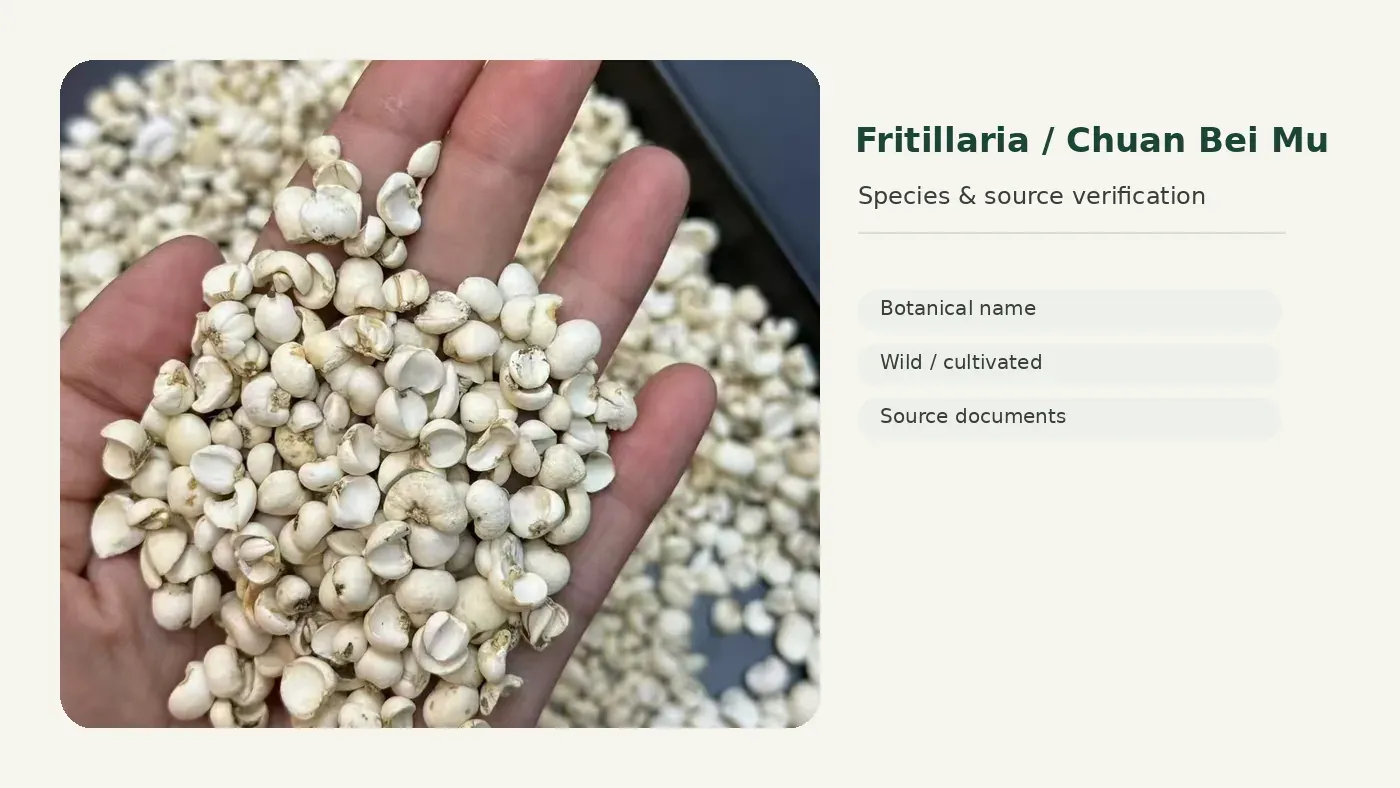
A second layer of control comes from species protection rules, separate from trade quotas.
China’s List of National Key Protected Wild Plants (State Forestry and Grassland Administration & Ministry of Agriculture and Rural Affairs, Announcement 2021 No. 15) assigns listed plants to Class I or Class II protection. Internationally, the CITES appendices control cross-border trade in listed species.
One example directly relevant to herbal buyers: all wild species of the genus Fritillaria — the botanical sources of Chuan Bei Mu (Fritillariae Cirrhosae Bulbus) — are listed as Class II protected wild plants under the 2021 list.
| Rule | Why it matters |
|---|---|
| Verify by Latin name, not trade name | One trade name (e.g. “Shi Hu” / Dendrobium, “agarwood”) can cover multiple species with different statuses |
| Wild and cultivated sources are treated differently | Cultivated material may be tradable where wild material is not — but this must be confirmed per species, with source documentation. Do not assume cultivated automatically means unrestricted |
| CITES-listed species need trade permits | Import-side requirements apply in the destination country as well |
Most commonly traded Chinese herbs, such as Astragalus root, Angelica sinensis and goji berry, are not subject to these quota or protected-species controls.
For these, the export process is standard:
If your sourcing list stays within this category, export restriction is not a factor in your project. The remaining questions are quality documentation and destination-market compliance, covered in our quality control process.
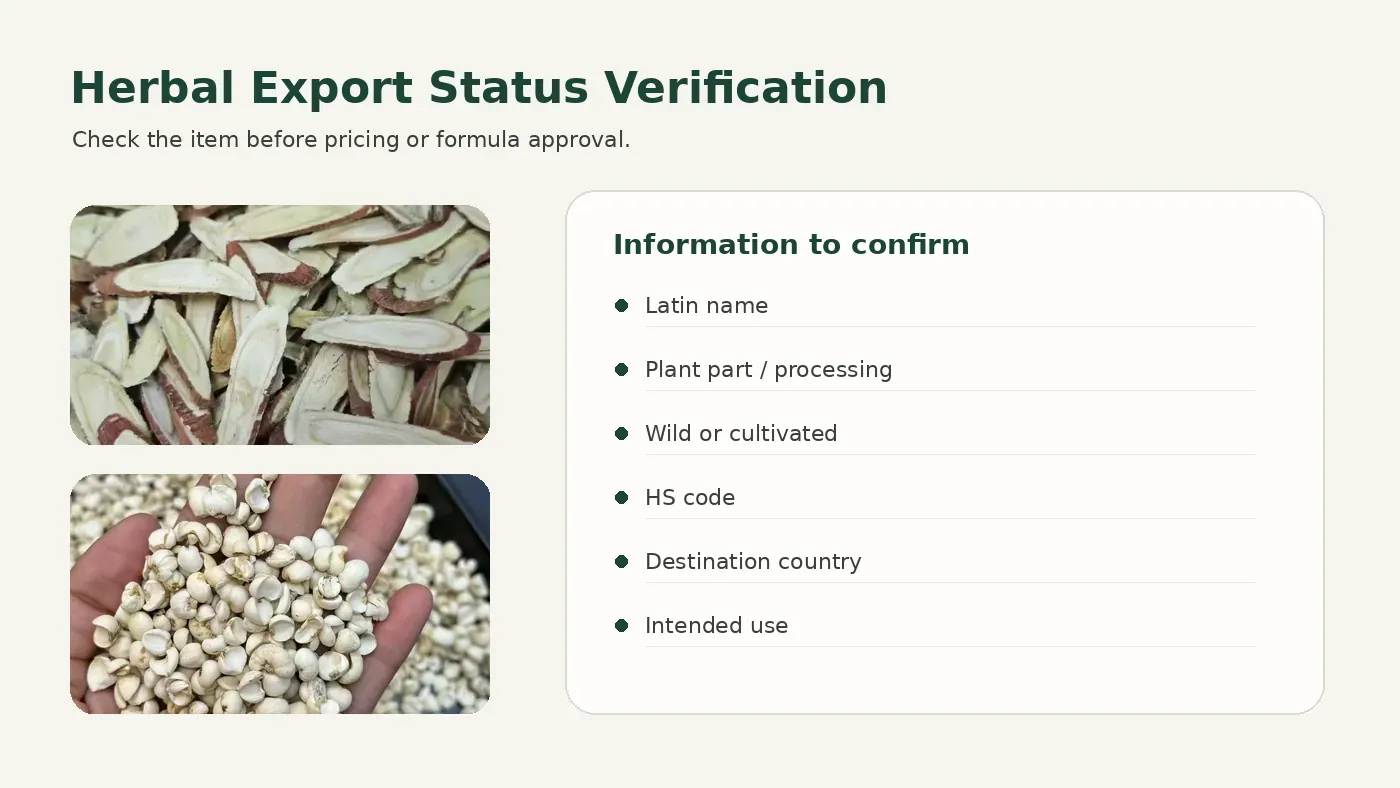
A Chinese trade name alone is not enough. Different species sold under one name can carry different statuses.
| What to check | Where |
|---|---|
| Annual export quota goods (licorice, ephedra) | MOFCOM annual quota announcements (2026 totals, licorice bidding) |
| National protected wild plants | 2021 List, Announcement No. 15 |
| CITES appendix status by Latin name | CITES Checklist |
Buyers do not need to interpret every Chinese regulation themselves, but the supplier should confirm export status in writing before quoting restricted items.
This costs us some line items on large sourcing lists. It also means every quoted item can actually ship.
Is licorice (Gan Cao) banned from export? No. It is quota-managed. Export requires a current-year quota award and export license.
How can I check whether a Chinese supplier holds a licorice export quota? Ask for the Chinese legal name of the exporter of record and compare it with the award lists MOFCOM publishes after each bidding round. For 2026, the second-round list issued on 16 June 2026 names 75 companies for fresh or dried licorice (HS 1211903600). A supplier that is not on the list must ship through a company that is.
Can cultivated Chuan Bei Mu be exported? Wild Fritillaria species are Class II protected plants. Whether cultivated material can be exported depends on species, source documentation and permit requirements, confirmed case by case. Ask for the export-status confirmation in writing.
How do I know if a herb on my list is restricted? Send the Latin name, plant part, source (wild or cultivated) and destination country. A competent exporter can screen the item and reply in writing.
Does “food-medicine homology” mean freely exportable? No — it concerns permitted use in food within China, and is a separate question from export restriction. In practice most catalog herbs are unrestricted, but each item should be screened individually.
To have your ingredient list screened for quota and protected-species restrictions, send it through our Chinese herbal slices page with the destination market.
