Tell Us About Your Project
Share your product, quantity and project requirements. We will review the details and respond with the relevant next steps.

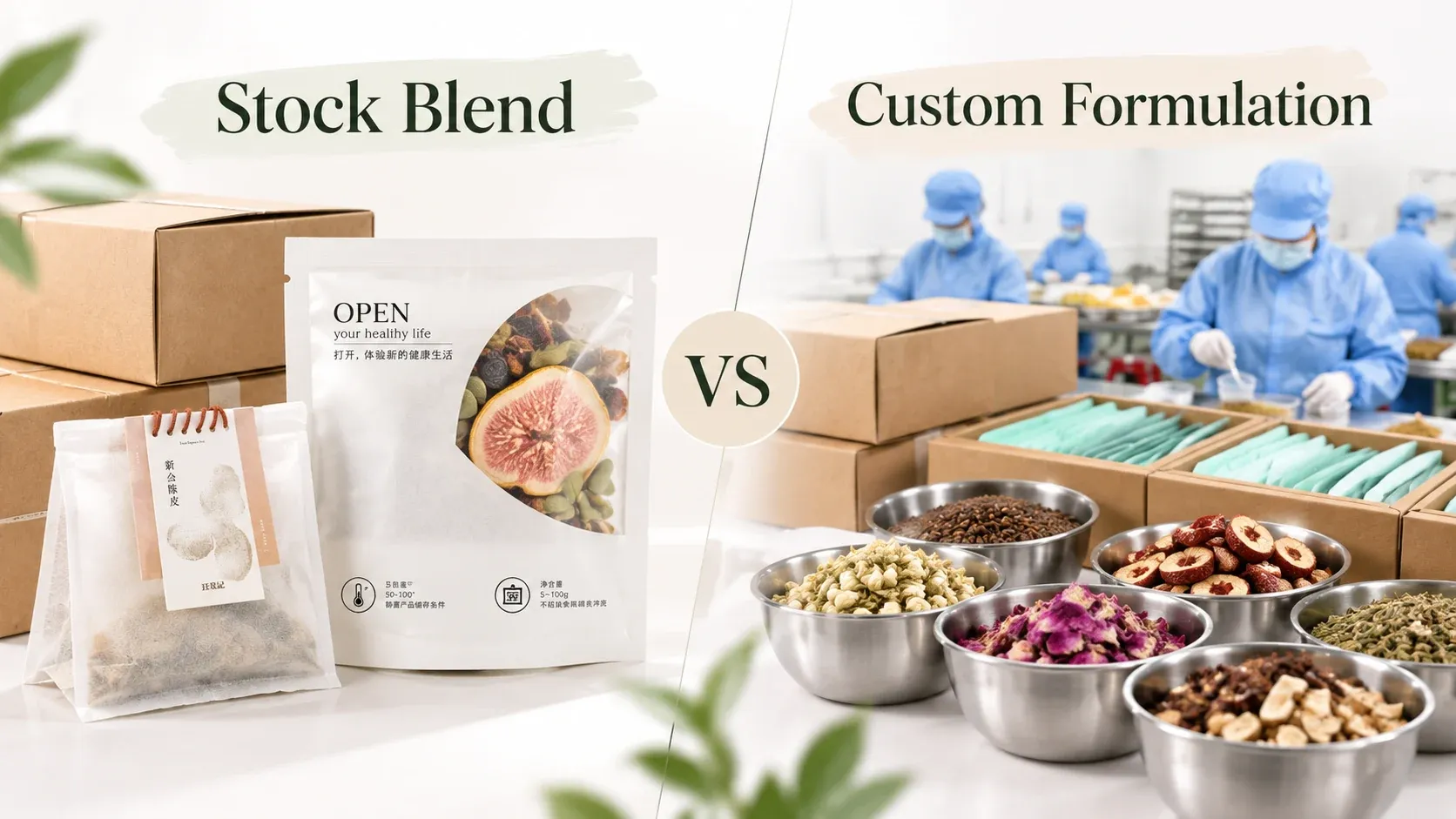
Private label herbal tea can follow two different routes.
With a stock blend, you use an existing supplier formula under your own brand and packaging. With custom formulation, the formula is supplied, adjusted or developed specifically for the project.
Both routes can carry your brand. What changes is the amount of development work, the MOQ, the sampling process, packaging requirements and the number of approvals needed before production.
| Item | Stock / Existing Blend | Custom Formulation |
|---|---|---|
| Formula | Existing supplier formula | Buyer-supplied or project-specific formula |
| Development work | Mainly product selection and packaging | Formula review, sampling and production setup |
| Sampling | Existing product may be evaluated first | Formula sample usually required |
| Packaging | Stock or custom packaging | Stock or custom packaging |
| Typical use | Market testing or first launch | Defined formula, re-sourcing or stronger differentiation |
Terms such as white label, private label and custom blend are not used consistently across suppliers.
Instead of relying on the label, confirm whose formula is being used, whether it can be changed, how MOQ is calculated and whether any exclusivity applies.
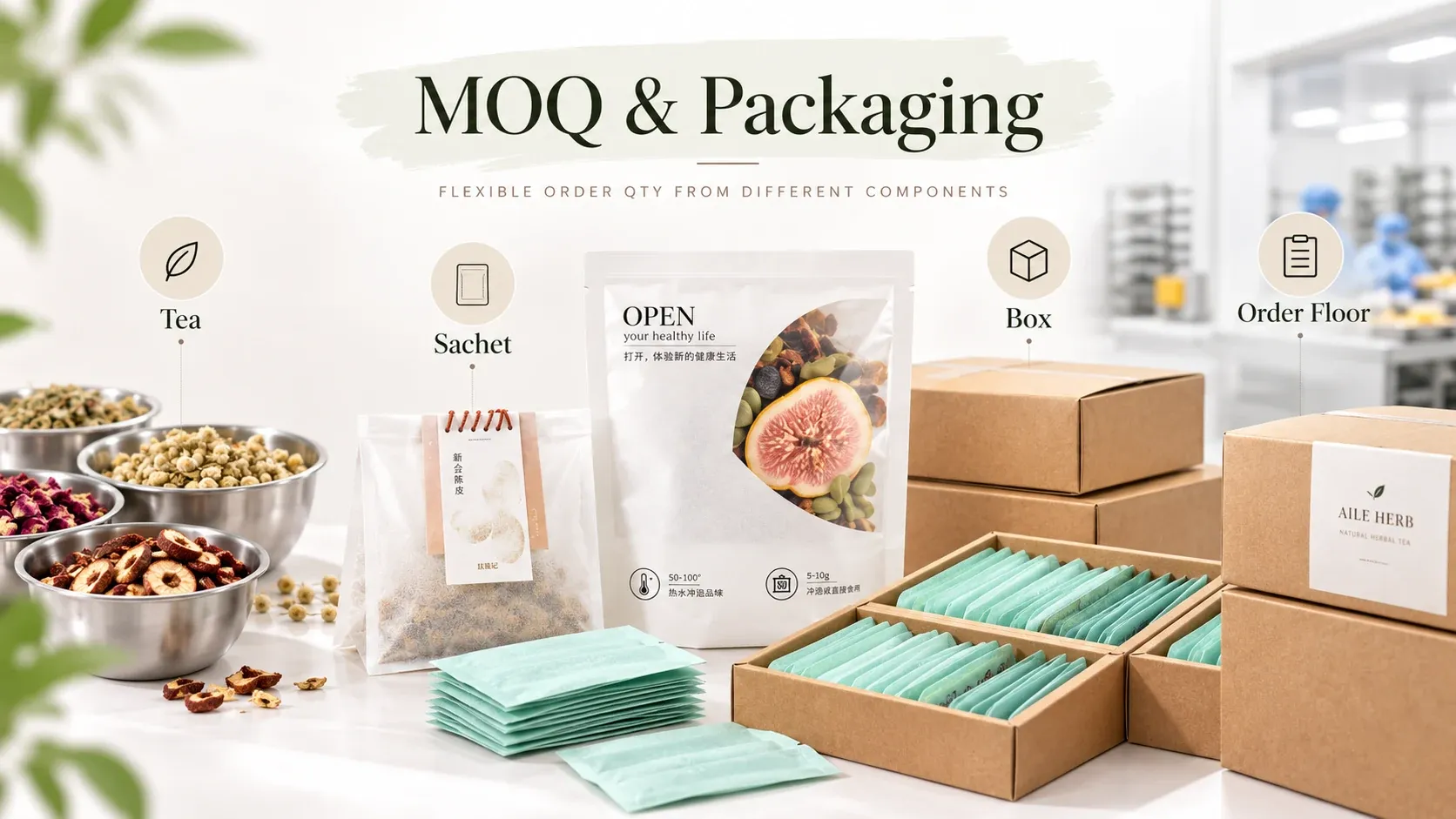
MOQ is not always one number.
For our current production setup, Aile Herb’s working starting points are:
| Project Route | Current Starting Point |
|---|---|
| Stock retail product | From 10 boxes |
| Stock blend + custom printed packaging | From 300 boxes |
| Custom formulation | From 1,500 tea bags |
| Custom printed plastic pouch | From 1,000 pouches |
These are Aile Herb operating thresholds, not industry-wide standards.
The practical MOQ may come from several different parts of the project:
This is why two projects using the same tea can still have different minimum quantities.
A custom formula may also introduce formula-specific setup, production and testing work. If an order contains several formulas, each formula may need to be evaluated separately rather than treating the total order volume as one production run.
Tea MOQ and packaging MOQ are separate.
A printed carton, pouch or individual sachet may have its own production minimum. The component with the highest minimum can become the practical order floor.
For example, if an individual printed sachet has a fixed print minimum, a box containing 20 tea bags uses those sachets faster than a box containing 10.
This means the number of bags per box can affect the minimum number of finished boxes required.
For a new project, confirm:
Do not assume the formula MOQ automatically equals the finished-product MOQ.
With an existing blend, the formula already exists. Buyers may be able to evaluate the current product before deciding on branding or packaging.
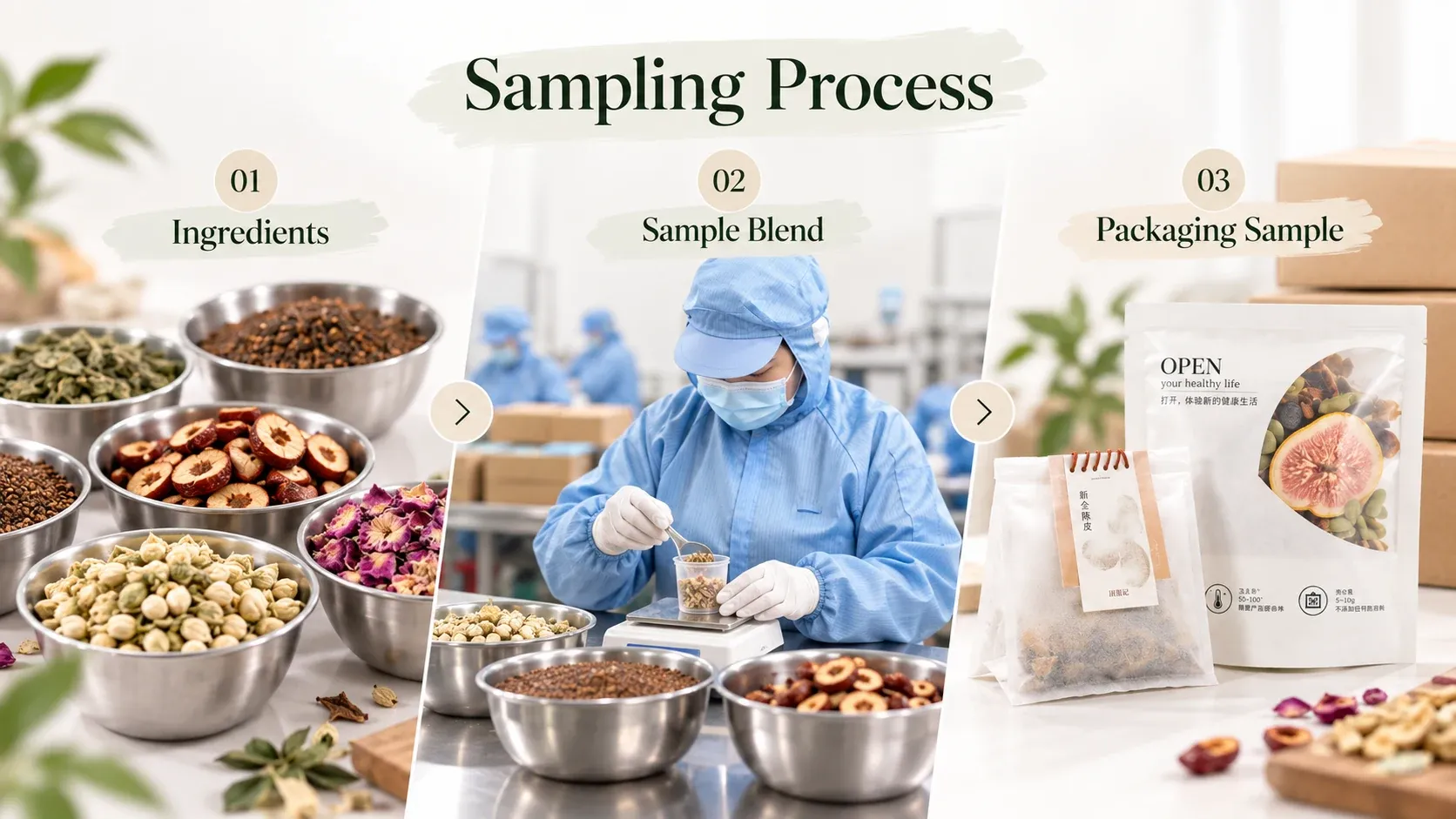
A custom formulation usually adds more steps:
At Aile Herb, a formula sample can usually be prepared in about 5 working days when the required raw materials are available.
This is an internal working estimate for a standard sample. Additional revisions, special raw-material sourcing, market review or testing can extend the timeline.
Packaging samples are handled separately and may take about one week after artwork is confirmed, depending on the packaging type.
A production lead time is only useful if the starting point is clear.
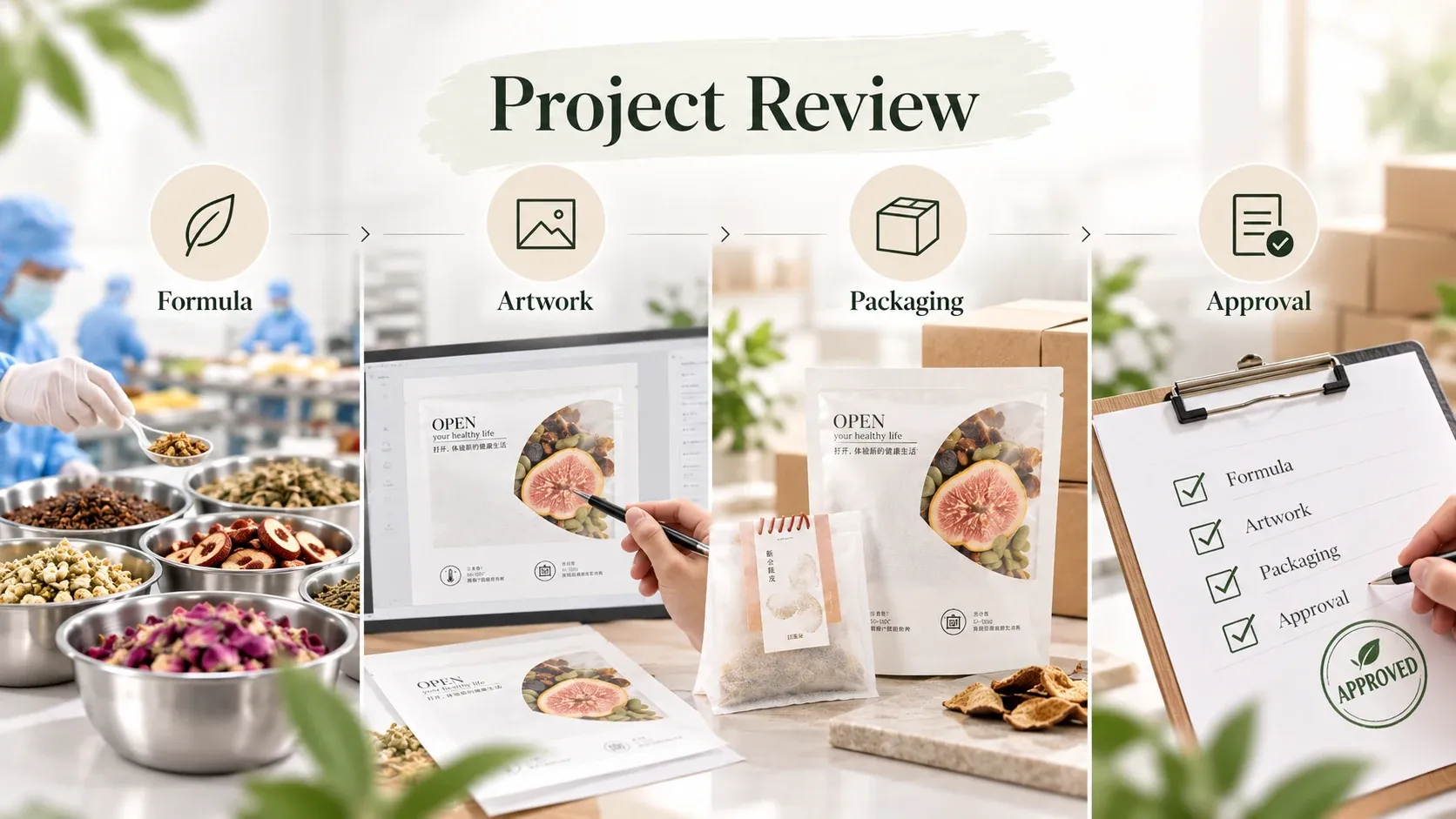
For a custom project, the sequence normally needs to move through several approval points:
Formula approval → Packaging / artwork approval → Material readiness → Production release
Changes made after one of these stages can affect the next stage.
For example, changing an ingredient after formula approval may require another sample. Changing the pouch size or box dimensions after artwork approval may require new packaging files or a revised quotation.
For standard custom projects using available materials, Aile Herb’s current production planning can start from around 15 working days, subject to formula confirmation, packaging readiness, payment and production scheduling.
This should be treated as a project estimate, not a universal custom-tea lead time.
Custom formulation should not begin with only a product idea and an MOQ discussion.
Several commercial terms should be confirmed in writing first.
Confirm who controls the final production formula.
A buyer-supplied formula, a supplier-owned formula and a jointly adjusted formula may be treated differently.
Do not assume a custom formula is automatically exclusive.
Confirm whether the supplier may produce the same or a similar formula for another customer, and whether any exclusivity applies by market, channel or time period.
Confidentiality and exclusivity are not the same thing.
Confirm what the NDA covers, such as ingredient ratios, artwork, specifications and commercial information.
Confirm what the first sample includes and what happens if the formula changes.
A new ingredient, weight or product format may require another sample or quotation.
Ask when the project becomes locked for production.
Ingredients, tea-bag material, pouch size, carton dimensions and bags per box should all be confirmed before production release.
A stock blend may be more suitable when:
Custom formulation may be more suitable when:
Neither route is automatically better. The right choice depends on how much of the product is already defined before you approach the manufacturer.
We currently support several project formats:
For custom projects, we work best when the buyer already has a formula, ingredient framework or clearly defined product specification.
We do not currently position the service as open-ended flavor development with unlimited tasting rounds from a broad concept. Buyer-supplied formulas are also checked ingredient by ingredient against China’s food-medicine homology list and related food ingredient approvals before sampling; ingredients without a Chinese food basis cannot be produced on a food line.
Documentation and testing are confirmed according to the formula, destination market and agreed order scope. Batch COA, traceability and testing options are covered in our quality control process.
A stock blend uses an existing supplier formula. A custom formulation requires a buyer-supplied or project-specific formula and normally involves additional sampling and approvals.
Yes. A stock formula can still be sold under the buyer’s own brand and packaging, subject to the agreed private-label scope.
It can. Printed sachets, pouches and boxes may each have their own production minimum, separate from the tea itself.
There is no automatic answer. Formula ownership, confidentiality and exclusivity should be confirmed in writing before development begins.
It depends on the project. Formula approval, artwork approval, material readiness and payment may all need to be completed before production is released.
To start either route, see our private label herbal tea bags service: pick from the stock range or send your formula, target pack format and quantity for a custom development review.
