Tell Us About Your Project
Share your product, quantity and project requirements. We will review the details and respond with the relevant next steps.

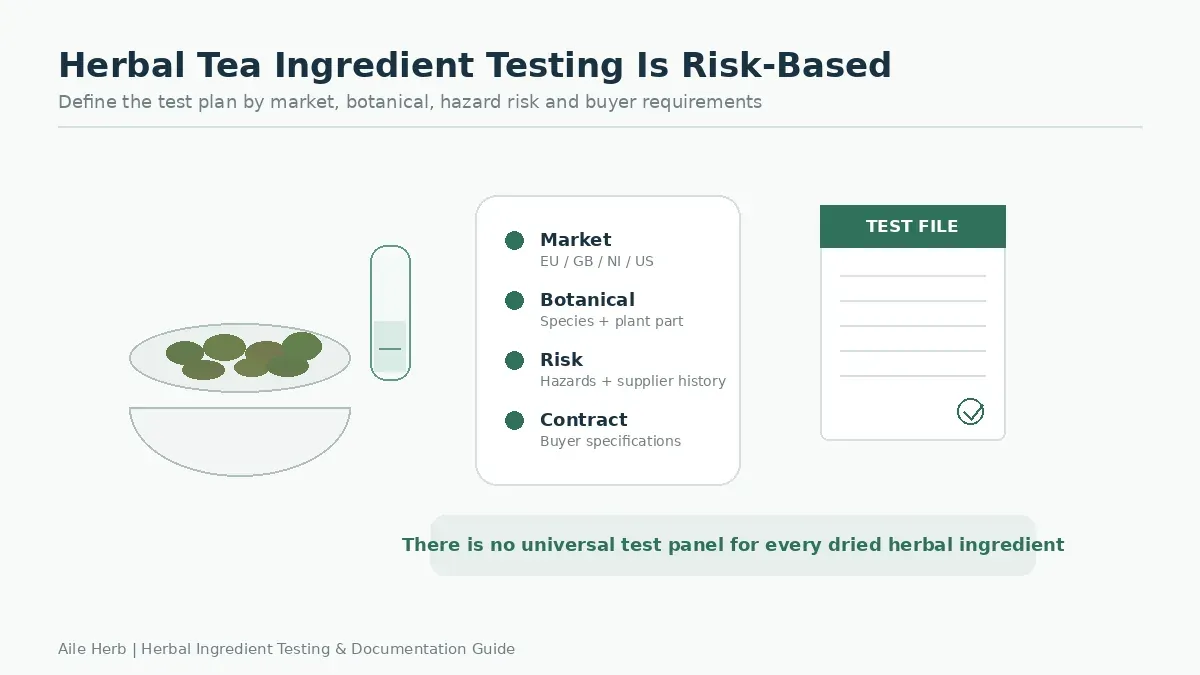
There is no universal test panel or document package for every dried herbal tea ingredient, and herbal tea ingredient testing requirements differ between the EU, Great Britain, Northern Ireland and the United States.
Legal maximum levels apply to specific commodities, contaminants and food categories. A legal limit does not by itself mean that every supplier must run a complete panel on every batch.
Buyers should define testing and documentation based on the destination market, the botanical’s legal classification, hazard risk and contract requirements.
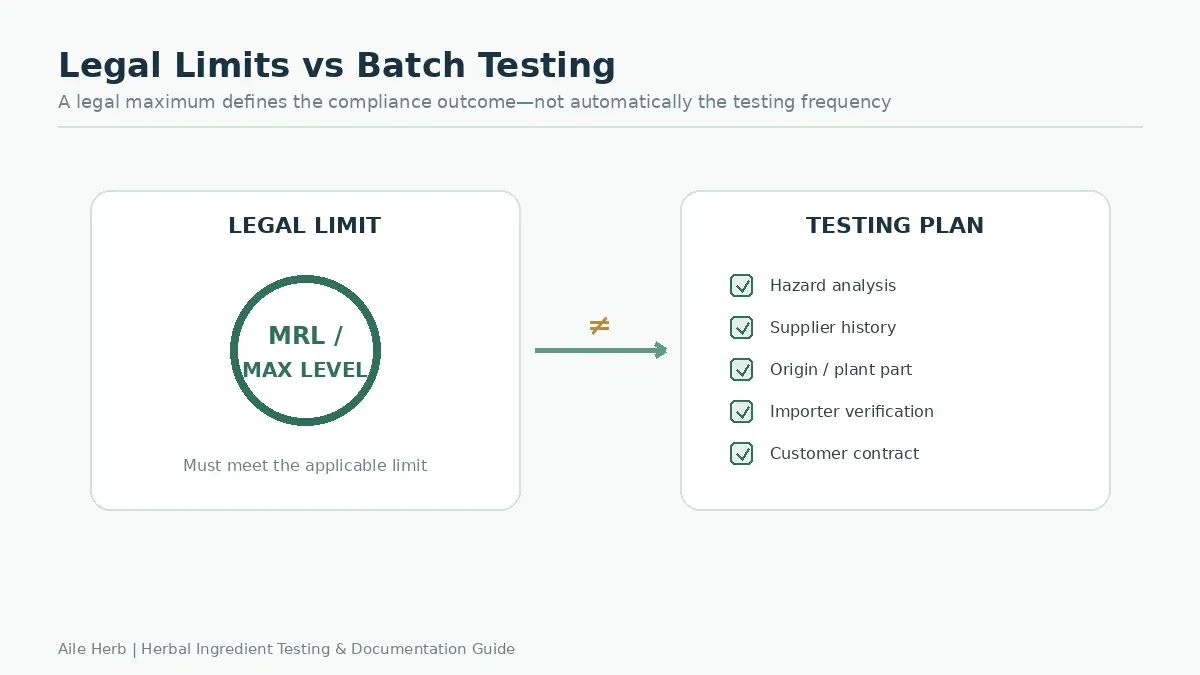
A legal maximum residue level (MRL) or contaminant maximum level defines a compliance outcome. Food placed on the market must not exceed the applicable limit.
That obligation does not automatically create a rule that every batch must be fully tested, every shipment must carry a COA, or every supplier must provide the same laboratory panel.
Testing frequency and scope are usually shaped by risk.
Factors can include:
| Question | Legal requirement? | Typical practice? |
|---|---|---|
| Product must meet the applicable MRL or maximum level | Yes | — |
| Every batch needs a full pesticide panel | Not universally | Sometimes, depending on risk or contract |
| Every shipment needs a COA | Not universally | Common buyer practice |
| Traceability / verification records | EU/GB/NI: legal requirements apply; US: depends on applicable importer and FSVP recordkeeping requirements | Normal supply-chain practice |
Less testing is not automatically better.
The point is that the testing plan should be designed around the product, destination and risk rather than copied from a generic checklist.
In the EU, pesticide MRLs are set under Regulation (EC) No 396/2005.
Each MRL applies to a combination of a pesticide active substance and a commodity or product category defined in the Regulation’s Annex I.
There is no single pesticide limit for “herbal tea ingredients”.
The botanical first needs to be matched to the applicable Annex I commodity or category. The relevant MRL can then be checked for each pesticide.
Where no specific MRL is set for a pesticide and commodity combination, a default of 0.01 mg/kg generally applies. That default should only be used after confirming the commodity classification and any specific rules or footnotes.
Drying and processing can also change residue concentration. Values for a fresh commodity should therefore not be applied automatically to a dried botanical without checking how the rules treat the processed product.
When reviewing a pesticide report, buyers should ask:
For more detail, see our guide on how to read pesticide and heavy metal test reports.
No.
EU contaminant maximum levels are set in Regulation (EU) 2023/915, which replaced Regulation (EC) No 1881/2006.
The Regulation establishes maximum levels for listed contaminants in listed food categories.
It does not create one lead, cadmium, mercury and arsenic limit for every dried botanical ingredient.
Some botanical products may fall within a category that has a maximum level for a particular metal. Others may not.
Tea, herbs, spices, food supplements and ingredients used for herbal infusions should not automatically be treated as the same legal category.
Before assigning a heavy-metal specification, first identify which legal food category the botanical falls into.
Limits written for food supplements, pharmaceuticals or another food category should not simply be transferred to a conventional food ingredient.
No.
EU mycotoxin limits in Regulation (EU) 2023/915 are also category-specific.
For example, dried herbs have an ochratoxin A (OTA) maximum level of 10.0 μg/kg.
That does not mean all dried herbal tea ingredients share one common aflatoxin B1 or total-aflatoxin limit.
Nuts, oilseeds, dried fruits, spices and other named commodities have their own entries.
Before asking a supplier for “EU aflatoxin compliant” material, clarify:
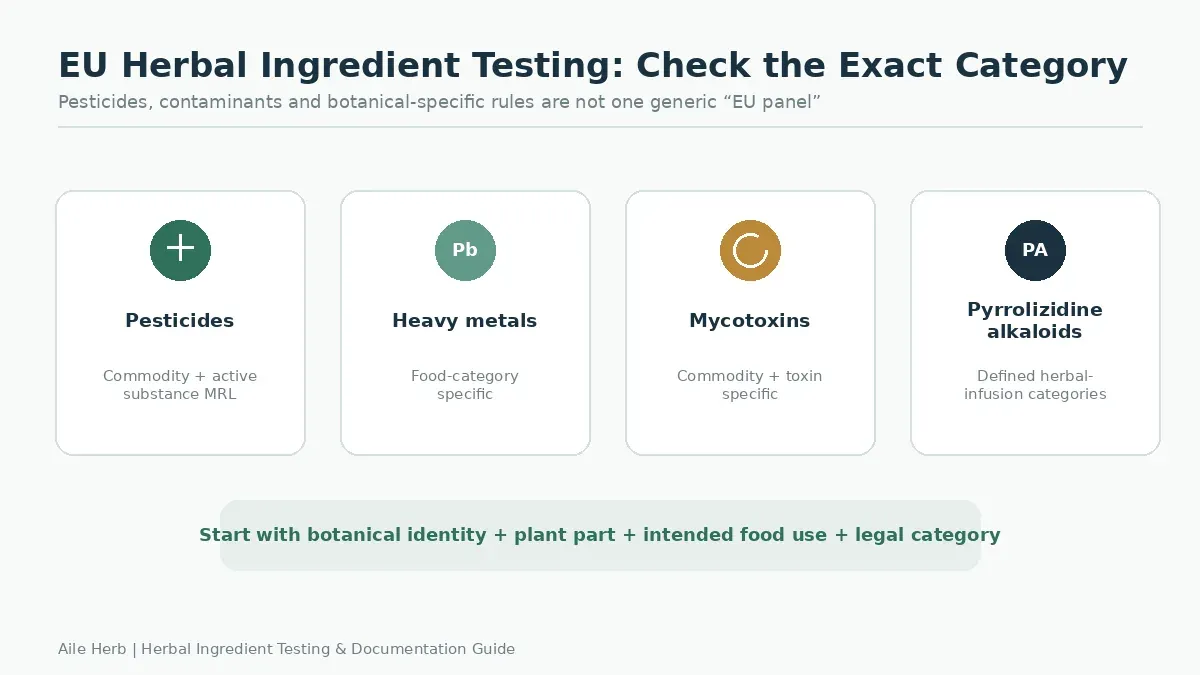
Pyrrolizidine alkaloids (PAs) are one of the more important botanical-specific contaminant rules for herbal infusions in the EU.
Under Regulation (EU) 2023/915, which carries forward limits first applied from 1 July 2022, maximum levels apply to defined herbal infusion categories.
The definition of dried herbal infusions covers dried plant material such as flowers, leaves, stems and roots, in sachets or in bulk, when used to prepare herbal infusions.
This can include B2B ingredients intended for herbal infusion production, not only finished consumer tea bags.
| EU category | PA maximum level |
|---|---|
| Most dried herbal infusions and dried ingredients used for them | 200 μg/kg |
| Rooibos, anise, lemon balm, chamomile, thyme, peppermint and lemon verbena category | 400 μg/kg |
| Dried tea and herbal infusions for infants and young children | 75 μg/kg |
The limits apply to the sum of a legally defined set of PAs and their N-oxides.
A laboratory report should therefore be checked for whether its analytical method covers the legally relevant analytes rather than being accepted only because it says “PA test: pass”.
These figures describe the relevant EU and Northern Ireland categories covered here.
The same botanical supplied for a different food use may fall into another category.
EU microbiological criteria are set in Regulation (EC) No 2073/2005.
The Regulation establishes criteria for specified microorganisms in listed food categories.
There is no single statutory specification for all dried herbs covering:
Unless a product matches a listed legal category, these should not be presented as universal EU numerical limits.
Buyers can still require microbiological specifications by contract, and many do.
Requirements such as Salmonella absence in 25 g, or limits for aerobic plate count and yeast and mould, can be commercially important buyer specifications.
They should not be described as universal EU law unless a specific legal criterion actually applies.
Sulphur dioxide and sulphites above 10 mg/kg or 10 mg/L, expressed as total SO₂, trigger labeling requirements under Regulation (EU) No 1169/2011.
The calculation is based on the final food as consumed or, where relevant, after reconstitution according to the manufacturer’s instructions.
The same threshold applies under the GB allergen-labeling framework described in the current guidance.
Under 21 CFR 101.100, sulfiting agents at 10 ppm or more in the finished food are considered detectable.
Whether they need to be declared depends on the applicable regulatory conditions, including whether the sulfiting agent has a technical or functional effect.
Sulfites are not classified as a US federal “major food allergen”.
These rules concern the finished-food labeling outcome.
They do not create a universal rule that every herbal ingredient supplier must issue a standalone sulphite certificate. Other packaging wording, such as health or benefit statements, is covered in herbal tea packaging health claims.
For sourcing issues related to sulphur treatment, see our guide to sulfur-free Chinese herbal slices.
In the EU, Northern Ireland and Great Britain, “gluten-free” is a regulated voluntary claim.
A food sold to the final consumer may use the claim only when gluten does not exceed 20 mg/kg.
Ordinary herbal ingredients do not automatically require a gluten-free certificate.
A gluten statement or laboratory test may be requested where:
No.
In the EU and Great Britain, food businesses must be able to identify the business that supplied them and the businesses they supplied — commonly described as one step back and one step forward.
Useful traceability records can include:
Traceability is a legal obligation in the relevant markets.
A document specifically titled “Certificate of Analysis” is not universally mandated.
A COA is a common way to connect laboratory or specification results to a particular batch.
See our guide to what a COA for Chinese herbs should include and our article on herbal ingredient batch traceability.
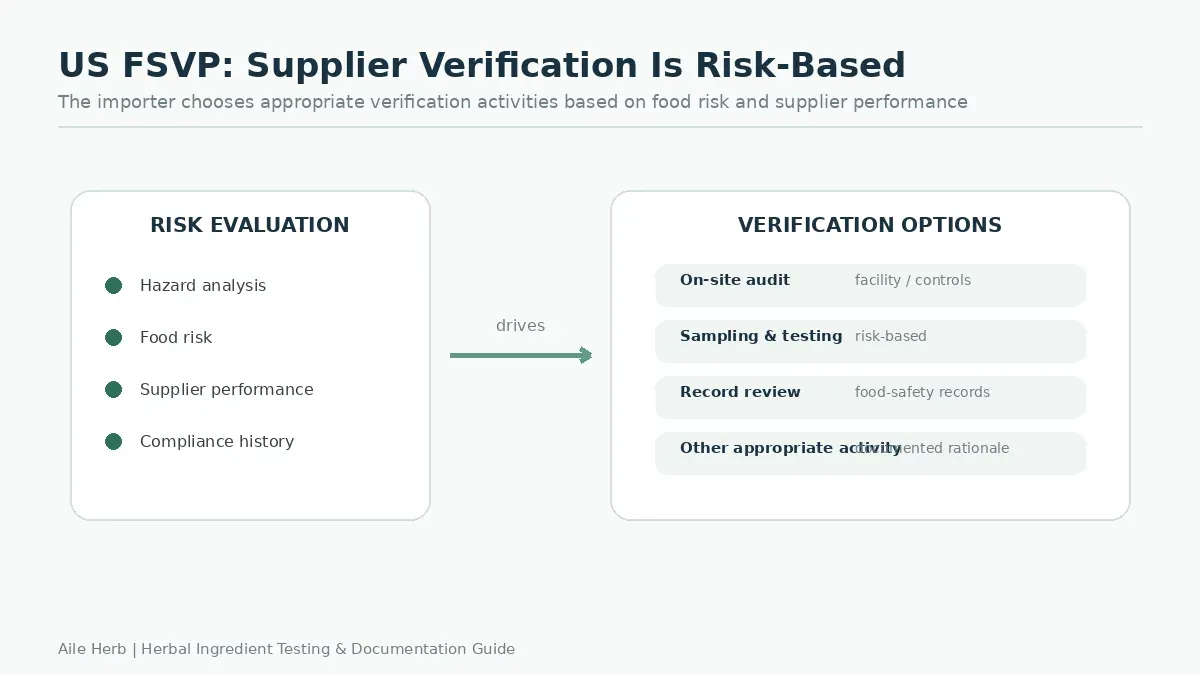
The Foreign Supplier Verification Program (FSVP), under 21 CFR Part 1, Subpart L, places its core obligations on the US FSVP importer.
It does not establish one fixed document package that every overseas supplier must provide.
The importer must establish a risk-based program that can include:
Verification activities may include:
FSVP does not universally require every foreign supplier to provide a COA, pesticide report, HACCP plan and third-party certificate for every shipment.
Those documents can still be useful, and a particular importer may require them under its own verification program.
But they are not one universal FDA supplier checklist.
US food pesticide compliance relies on EPA tolerances for specific pesticide and commodity combinations, with FDA involved in food enforcement.
There is no universal FDA rule requiring every dried herb lot to undergo a complete pesticide panel.
There is no single federal lead, cadmium, arsenic or mercury numerical maximum level that applies to every dried herbal tea ingredient.
California Proposition 65 is a California state law and should not be described as the national FDA food heavy-metal standard.
FDA action levels and enforcement policies are specific to particular foods and toxins.
There is no single federal aflatoxin number that can be safely applied to every dried botanical ingredient.
There is no single FDA numerical specification covering APC, yeast and mould, E. coli, Salmonella and other organisms for all dried herbal ingredients.
As in other markets, buyers may set their own microbiological specifications based on product risk and intended use.
Not automatically.
Great Britain — England, Scotland and Wales — retained or assimilated many former EU food-law instruments, including a pesticide framework based on Regulation (EC) No 396/2005.
GB rules can diverge from EU rules over time.
Contaminant limits, PA rules and other requirements should therefore be checked against the current GB rules rather than assumed permanently identical to the EU.
GB also operates its own high-risk import controls.
Some tea from China under the relevant Camellia sinensis classification has been subject to increased official controls for pesticide residues.
That measure is specific to the listed product and should not automatically be extended to every herbal infusion ingredient.
Treat Great Britain as a separate regulatory destination when preparing procurement specifications.
Northern Ireland remains closely aligned with the relevant EU food-law framework for food placed on the NI market.
Applicable EU requirements should therefore be checked for Northern Ireland.
Do not merge Great Britain and Northern Ireland into one undifferentiated “UK” compliance column.
No universal rule applies.
Plant-health requirements can depend on:
For Great Britain, official plant-health guidance indicates that dried or freeze-dried plant material without viable plant parts may fall outside certain plant-health controls, subject to relevant pest and disease conditions.
This GB position should not automatically be generalized to the EU or United States.
Check plant-health requirements for the exact species, processing status and destination.
The document package should be agreed according to the product, market and buyer’s quality system.
| Document or information | Classification | Common buyer practice? | Usually requested when |
|---|---|---|---|
| Product specification | Industry practice | Yes | Supplier qualification, before PO |
| Batch COA | Supporting document for compliance | Yes | Batch release, before shipment |
| Pesticide report | Supporting document for compliance | Yes | Qualification, risk-based monitoring or per batch by contract |
| Heavy-metals report | Supporting document for compliance | Yes | Qualification, risk monitoring |
| Microbiological report | Industry practice / supporting evidence | Yes | Qualification, higher-risk products |
| Mycotoxin / aflatoxin report | Supporting document where an applicable category limit exists | Common for higher-risk commodities | According to commodity and origin risk |
| PA report | Supporting document in relevant EU/NI herbal-infusion projects | Often | Qualification, product development, risk monitoring |
| Allergen statement | Supporting document for final-food labeling | Yes | Supplier onboarding, label approval |
| Gluten statement | Industry practice | Yes | Gluten-free claims, cross-contact review |
| Sulphite statement | Supporting document for final-food labeling | Yes | Label review, sulphur-treatment risk |
| GMO statement | Industry practice | Yes | Buyer qualification, retail programs |
| Country of origin | Conditional trade / import information | Yes | Quotation, PO, shipment |
| Traceability / batch records | Legal requirement in applicable markets | Yes | Throughout the supply chain |
| Certificate of Origin | Conditional trade / import document | Common | Customs, tariff preference, letters of credit |
| HACCP / food-safety information | Supplier-qualification / food-safety information | Yes | Supplier approval, audits |
| Third-party food-safety certificate | Customer / retailer / certification requirement | Common | Onboarding, annual review |
| SDS / MSDS | Customer requirement in many ordinary food projects | Sometimes | Customer EHS or warehouse systems |
| Phytosanitary certificate | Conditional official import document | When applicable | Checked before import |
The important distinction is that a document can be commercially required by a buyer without being universally required by food law.
No.
BRCGS certification, retailer onboarding and customer contracts may require:
These requirements can be commercially mandatory for a particular customer.
They should not automatically be described as universal EU, GB or US statutory requirements.
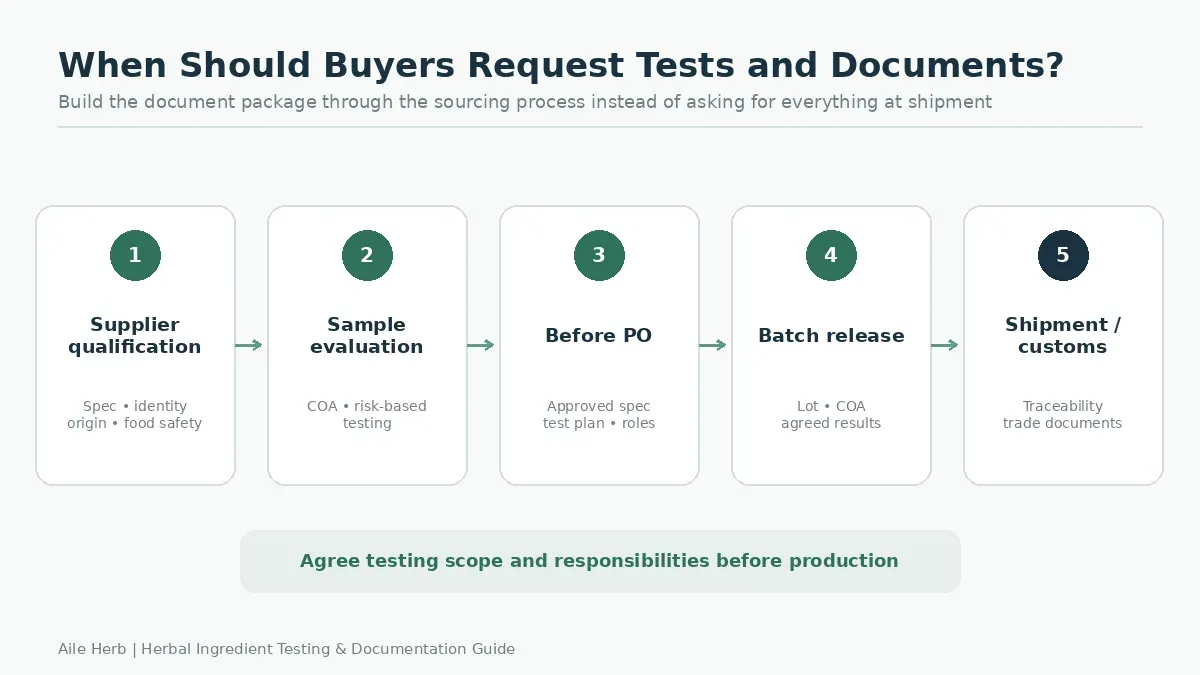
The following sequence reflects typical B2B practice unless a specific legal requirement applies.
Common documents include:
A buyer may request:
See paid samples for lab testing for how a tested sample can be linked to a later commercial lot.
Agree:
Typical records can include:
Typical documents can include:
Depending on the product and destination, this may include:
| Question | EU | Great Britain | Northern Ireland | United States |
|---|---|---|---|---|
| Pesticide compliance | Commodity- and pesticide-specific MRL | Check current GB framework | EU rules | EPA tolerances / FDA enforcement |
| Heavy metals | Category-specific | Check current GB rules | EU rules | No universal federal limit identified for all dried herbs |
| Mycotoxins | Category-specific | Check current GB rules | EU rules | Food- and toxin-specific |
| PA | Defined herbal-infusion categories | Check current GB rules | EU rules | No universal limit identified |
| Microbiology | Specific listed categories | Check applicable GB criteria | EU rules | No universal dried-herb specification identified |
| Sulphites | >10 mg/kg or mg/L total SO₂ in final food | Same threshold under GB rules reviewed | EU rules | 10 ppm detectable amount; conditions apply |
| Gluten-free claim | ≤20 mg/kg | ≤20 mg/kg | EU rules | Separate US framework |
| Traceability | Legal requirement | Legal requirement | EU-aligned requirements | Applicable FSVP/importer and other recordkeeping requirements |
| COA | Not universally required | Not universally required | Not universally required | Not universally required |
| Supplier verification | Food-business safety duties | Food-business safety duties | EU-aligned duties | Risk-based FSVP by importer |
| Phytosanitary certificate | Conditional | Conditional | Conditional | Conditional |
For private-label and botanical-ingredient projects, the testing plan should be agreed according to the botanical, destination market and buyer specification before the order is finalized.
Depending on the product and project scope, testing can cover pesticide residues and heavy metals for raw materials, and moisture and heavy metals for finished products.
Microbiology, aflatoxins and broader EU-specific panels may require third-party testing depending on the project.
COAs and batch documentation are provided according to the agreed order and testing scope.
The exact document and test package should be confirmed before production rather than assumed to be identical for every destination. More on how batch testing is organized is available on our in-house laboratory page.
Before placing an order, confirm:
No universal legal rule requires every shipment to carry a document specifically titled “Certificate of Analysis”.
COAs are commonly requested by buyers and are useful for connecting specifications or test results to a batch.
EU/GB/NI traceability obligations and applicable US importer or FSVP recordkeeping requirements should be considered separately from whether a COA is provided.
Applicable pesticide MRLs must be met.
EU law does not set a universal rule requiring every dried botanical supplier to run a complete pesticide panel on every batch solely because MRLs exist.
Testing frequency is normally determined by risk, supplier controls, importer requirements and contractual specifications.
No.
Maximum levels under Regulation (EU) 2023/915 are contaminant- and food-category-specific.
A specification should be based on the applicable legal category rather than a generic “herbal ingredient” limit.
No.
Mycotoxin maximum levels must be checked against the exact Annex I food category.
For example, dried herbs have an OTA maximum level, but that should not be interpreted as a universal aflatoxin limit for all herbal infusion ingredients.
Yes, for defined EU and Northern Ireland herbal-infusion categories.
Those categories can include dried ingredients intended for preparing herbal infusions, not only finished consumer tea bags.
No universal fixed COA requirement applies to every foreign supplier.
The US FSVP importer must operate a risk-based supplier-verification program. Depending on the hazard analysis and verification approach, the importer may use COAs, laboratory testing, audits, food-safety records or other appropriate evidence.
No universal numerical specification was identified for all dried herbs.
Specific legal criteria can apply to particular food categories, while buyers may also impose their own microbiological specifications contractually.
No.
The requirement depends on the species, degree of processing, plant-health classification, origin and destination.
It should be checked for the specific shipment rather than assumed.
No.
BRCGS, retailer and customer requirements may be commercially mandatory for a particular supply relationship, but they are not automatically statutory EU, GB or US food-law requirements.
To source tea ingredients with the test panel and documents matched to your market, see our page for herbal tea and beverage companies and send the ingredient list and destination.
