Tell Us About Your Project
Share your product, quantity and project requirements. We will review the details and respond with the relevant next steps.

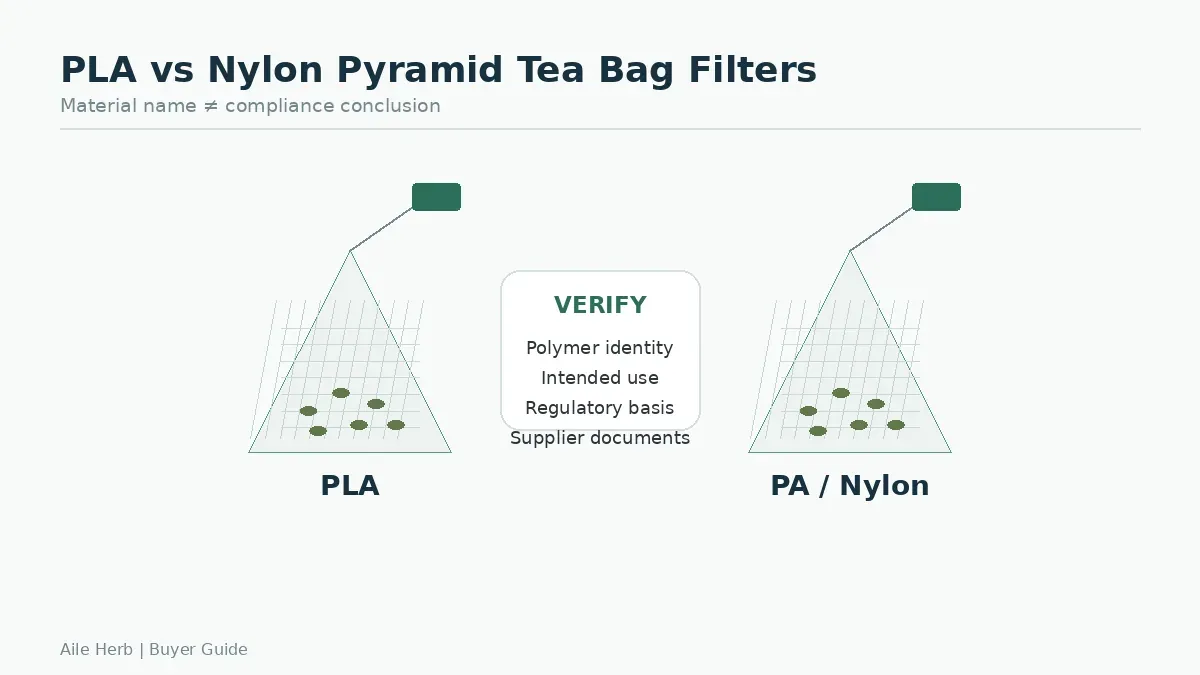
When comparing pyramid tea bag material options, note that PLA and nylon (polyamide, PA) are material families, not compliance conclusions. In the United States, the regulatory basis for a filter depends on the specific polymer, its other components, and the intended conditions of use.
In the European Union, plastic food-contact materials may fall under several layers of food-contact legislation, including Regulation (EC) No 1935/2004, Regulation (EC) No 2023/2006 and, where applicable, Regulation (EU) No 10/2011.
For buyers, the practical question is not simply whether a filter is called PLA or nylon. It is whether the specific material and finished construction have suitable documentation for the intended market and brewing conditions.
“Nylon”, “PA”, “nylon 6”, “nylon 6,6” and nylon copolymers are not necessarily the same regulatory material. PLA can also be supplied in different polymer grades, blends and formulations from different manufacturers.
A supplier description such as “PA food-grade mesh” tells the buyer the general material family. It does not by itself establish which regulatory basis applies or whether that basis covers the finished filter under its intended brewing conditions.
The assessment may depend on the exact polymer, resin formulation, additives, coatings, adhesives, pigments, food type, temperature and contact time.
| Buyer question | Why it matters |
|---|---|
| What polymer is it? | Helps determine the applicable regulatory basis |
| Who manufactured the resin or filter? | Some authorizations, such as US FCNs, are manufacturer-specific |
| Are additives or coatings used? | Other components may need their own compliance basis |
| What brewing conditions are intended? | Compliance depends on intended conditions of use |
| Does the documentation cover the resin or the finished filter? | The finished construction may introduce additional components |
21 CFR §177.1500 covers specified nylon resins for food-contact applications under defined conditions. It describes different polyamide compositions and includes applicable restrictions and extractives requirements.
The regulation does not specifically approve “tea bags” as a product category. Instead, it provides a regulatory basis for certain nylon resin formulations when they meet the relevant composition, restrictions and conditions of use.
Not every commercial material described as “PA” automatically falls under the same provision.
Before relying on 21 CFR §177.1500, buyers and suppliers should confirm which nylon resin is actually being used and whether the applicable conditions cover the intended food-contact use.
The regulatory status of a food-contact material depends on the relevant substances used to make it.
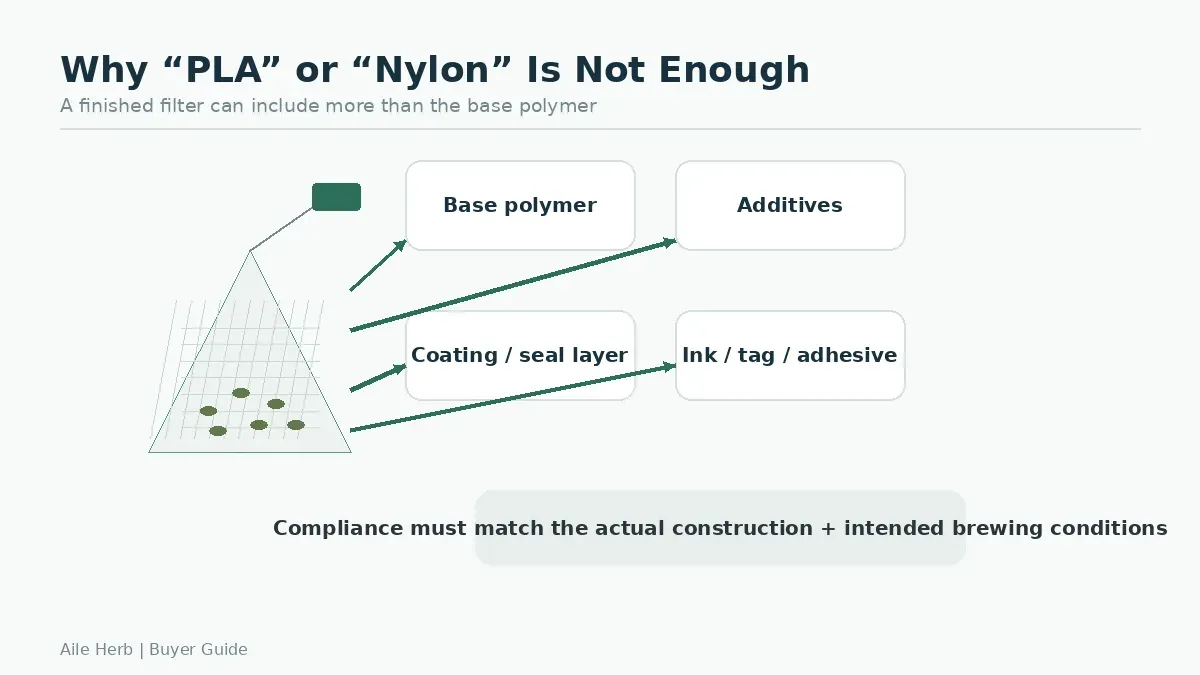
A finished pyramid tea bag filter may contain more than the base polymer, including:
Relevant components need an appropriate regulatory basis, which may come from an applicable CFR provision, a Food Contact Notification, a prior sanction, a threshold-of-regulation exemption or another recognized regulatory route.
A compliant base resin is therefore evidence about one part of the construction. It does not automatically establish the regulatory status of every component in the finished filter.
This does not mean every finished tea bag requires a separate FDA approval. It means the relevant components and intended conditions of use should be covered by appropriate regulatory documentation.
It also explains a common sourcing misunderstanding.
FDA does not normally issue an “FDA certificate” for an ordinary tea bag filter material. A supplier may instead provide a food-contact compliance statement identifying the CFR provision, FCN or other regulatory basis on which it relies.
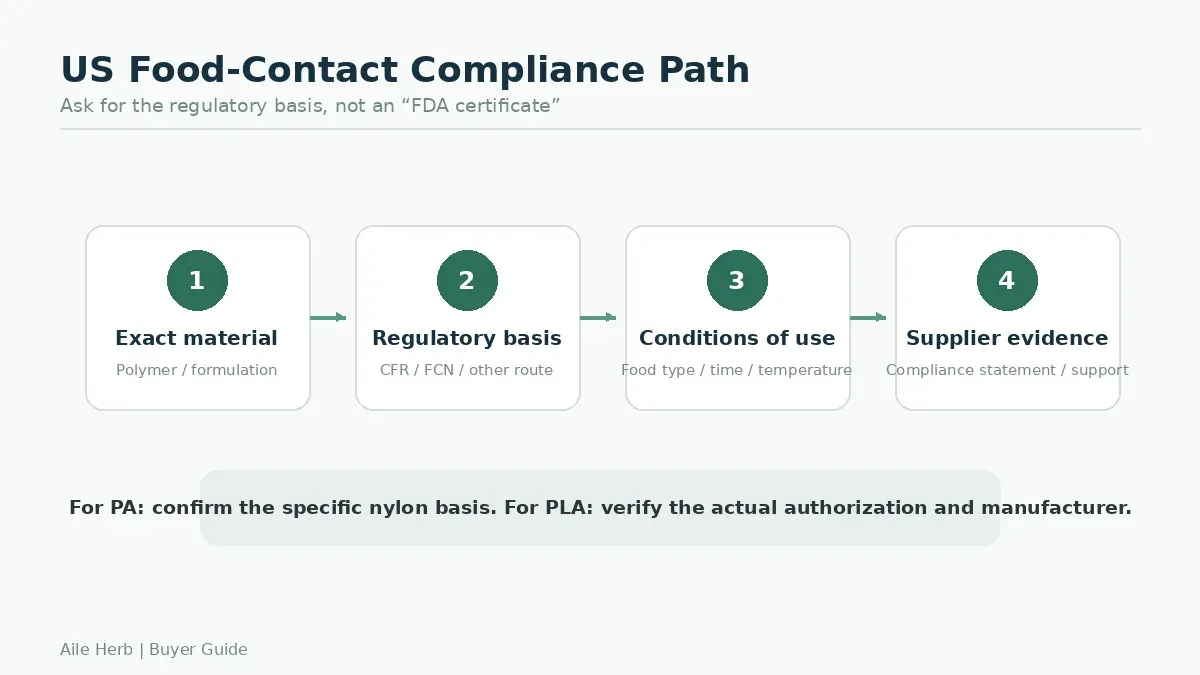
Specific PLA food-contact substances may rely on Food Contact Notifications (FCNs) or other applicable regulatory bases. There is no single blanket FDA authorization covering every material described as PLA.
An FCN is specific to the food-contact substance, manufacturer or supplier identified in the notification, and the intended conditions of use.
For example, FCN No. 2312 concerns a specific polylactide polymer manufactured by Pliith Biomaterials Co. Ltd and identifies defined conditions of use. It should not be interpreted as a general authorization for all PLA polymers, all manufacturers or all tea bag filters.
When a supplier says that its PLA material is “FDA approved” or “FDA compliant”, a buyer should ask:
Yes.
Food-contact compliance is linked not only to material identity but also to the intended conditions of use. Temperature, contact time, food type and whether the application is single-use can all affect the applicable assessment.
A tea bag is typically exposed to hot water for a relatively short period and is then discarded.
However, there is no single universal migration or extractives test condition that automatically applies to every tea bag filter.
The supplier’s documentation should therefore support conditions that are appropriate for the actual brewing application.
In U.S. food-contact regulations, conditions of use are expressed as lettered categories in 21 CFR 176.170(c), Table 2. Condition of Use B is “boiling water sterilized”, the category most relevant to a tea bag steeped in freshly boiled water. When a supplier cites a CFR provision or an FCN, check that the permitted conditions include B, or the more severe condition A; a document limited to room-temperature, refrigerated or frozen use (conditions E, F or G) does not support hot brewing.
For a buyer, this is more meaningful than a general statement that the material is simply “food grade”.
EU food-contact compliance should be considered under several regulatory layers.
This is the general framework for food-contact materials.
Materials and articles must not transfer constituents to food in quantities that could endanger human health, cause an unacceptable change in the composition of the food, or deteriorate its organoleptic characteristics.
The Regulation also establishes traceability requirements for food-contact materials.
This Regulation establishes Good Manufacturing Practice requirements for food-contact materials and articles.
Manufacturers should operate appropriate quality assurance and quality control systems and maintain supporting documentation.
Where a tea bag filter falls within the scope of Regulation (EU) No 10/2011 as a plastic material or article, the Regulation establishes requirements including:
For buyers, the key takeaway is simple:
An EU plastic food-contact statement should normally provide more useful information than the phrase “EU food grade” alone.
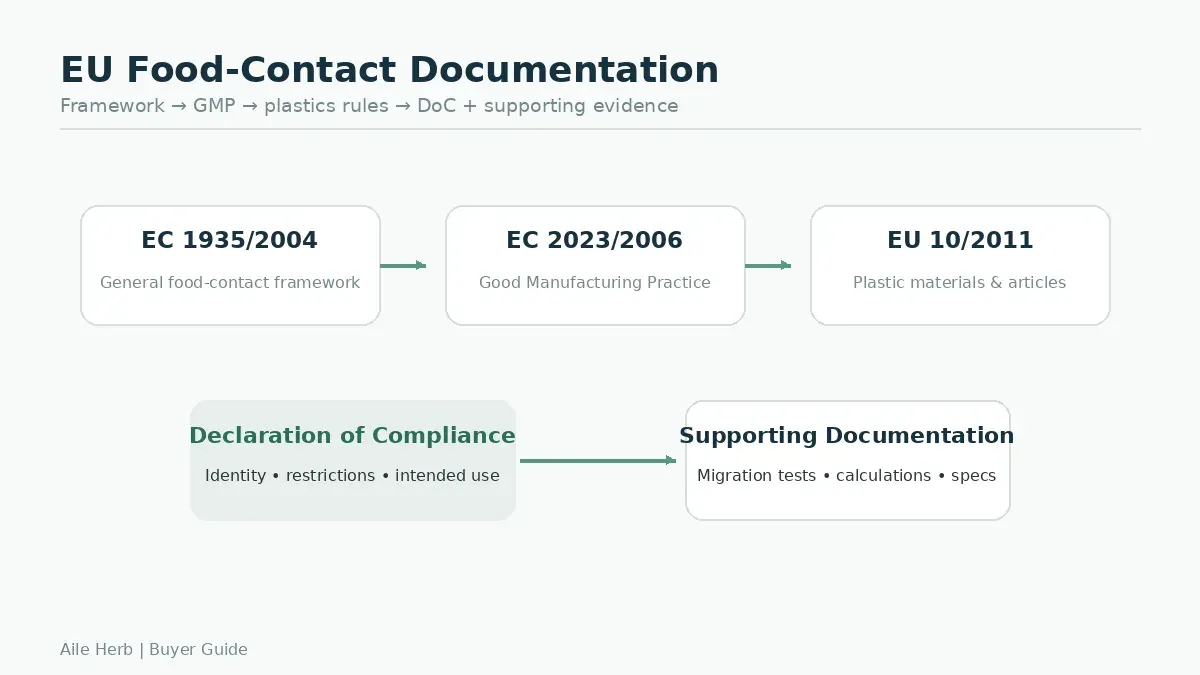
Two types of documentation are often confused.
The Declaration of Compliance (DoC) communicates required compliance information through the supply chain.
Supporting documentation is the technical evidence behind the declaration, which may include testing, calculations, specifications or other evidence used to demonstrate compliance.
Supporting documentation must be available to competent authorities where required, but this does not mean every underlying laboratory report must automatically be provided in full to every downstream buyer.
A useful DoC should allow the buyer to understand:
Regulation (EU) No 10/2011 uses both overall and substance-specific migration controls.
Overall Migration Limit (OML): for plastic food-contact materials and articles, the general overall migration limit is 10 mg of total constituents per dm² of food-contact surface.
Separate rules apply to materials and articles intended for foods for infants and young children.
Specific Migration Limits (SMLs): certain substances listed under the Regulation have individual migration limits or other specific restrictions.
A migration result also has to be interpreted in the context of the conditions under which the material was tested.
Passing one migration test does not automatically establish compliance for every possible use. The test conditions should be relevant to the intended food-contact application.
This question needs to be handled carefully.
Germany’s Federal Institute for Risk Assessment (BfR) has assessed the migration of certain polyamide oligomers from polyamide kitchen utensils during contact with hot food.
The BfR recommended minimizing prolonged contact between those utensils and hot food under the conditions considered in its assessment.
However, three distinctions are important:
It should therefore not be interpreted as evidence that nylon pyramid tea bags are generally unsafe.
For tea buyers, the more useful question is whether the specific filter material has appropriate food-contact documentation for its intended hot-water use.
European authorities continue to assess micro- and nanoplastics associated with food and food-contact materials.
Current evidence does not support a simple regulatory conclusion that one tea bag material is safe and another is unsafe based solely on particle-release concerns.
The available official assessment has also not established a specific EU migration limit or prohibition specifically for nylon or PLA tea bags based on microplastic release.
For procurement purposes, microplastics should therefore not be used as an unsupported marketing argument that automatically makes PLA superior to nylon or vice versa.
No.
Several terms are frequently used as though they mean the same thing, but they do not.
PLA is a polymer identity. It does not by itself establish that the finished tea bag is compostable.
Finished-product performance can depend on:
A compostability claim should therefore be supported for the relevant finished article, not merely inferred from the resin name.
These terms refer to different things.
ASTM D6400 and D6868 are technical standards used to evaluate products intended for industrial composting.
They are not US federal statutes.
Some US state laws expressly reference ASTM compostability standards, while federal FTC guidance focuses more broadly on whether environmental marketing claims are properly substantiated and appropriately qualified.
The Biodegradable Products Institute (BPI) is a private certification organization.
BPI certification is not a US government certification.
Its certification programs use recognized compostability standards to evaluate qualifying products.
EN 13432 is a European technical standard relating to packaging recoverable through industrial composting and biodegradation.
It is not itself an EU Regulation.
Compliance with EN 13432 also should not be described as proof that a product is home compostable.
The Packaging and Packaging Waste Regulation, Regulation (EU) 2025/40, has applied generally since 12 August 2026.
Article 9 introduces a future compostability requirement relevant to permeable tea, coffee and other beverage bags.
From 12 February 2028, these products are required to be compatible with industrially controlled composting conditions under the PPWR framework.
For buyers planning products for the EU market beyond that date, filter-material strategy should therefore be considered early in the packaging-development process.
A current PLA tea bag should not automatically be assumed to meet the future requirement simply because the base polymer is PLA.
The technical standards and conformity routes used to demonstrate compliance under the PPWR also need to be followed as implementation develops.
EN 13432 should not automatically be treated as the only possible future compliance route.
A compostability claim in the United States should not be treated as a single nationwide certification question.
At federal level, the FTC Green Guides focus on whether environmental claims are properly substantiated and whether qualifications are needed.
For example, a claim may need qualification if the product is compostable only in industrial facilities or if appropriate composting facilities are not widely available.
Individual states may impose additional requirements.
California has specific rules governing environmental labeling of plastic products and other compostable products.
Applicable requirements can include recognized compostability standards as well as labeling, identification and other conditions.
Washington regulates the use of terms such as “compostable” on covered products.
Its rules address recognized standards, third-party certification and product identification, and restrict certain terms such as “biodegradable” for plastic products.
Colorado also has compostable-product labeling requirements that reference recognized ASTM standards and third-party certification.
For a brand selling across the United States, the practical conclusion is:
Do not approve a “compostable” statement based only on the resin supplier’s marketing description. Check the requirements of the states where the finished product will be sold. Health and benefit wording on the same packaging raises separate questions, covered in herbal tea packaging health claims.
The exact document package depends on the material, destination market and supply chain. Filter documentation is separate from the batch testing and COA for the tea ingredients themselves, which are covered in our quality documents and testing guide.
The table below is a practical starting point.
| Document or information | US | EU | Why buyers request it | Typical source |
|---|---|---|---|---|
| Material specification | Yes | Yes | Identifies the exact material and filter construction | Filter material manufacturer |
| Polymer identity | Yes | Yes | Helps determine the applicable regulatory basis | Resin or filter material manufacturer |
| Food-contact compliance statement | Yes | As applicable | Identifies the applicable regulatory basis and intended use | Material manufacturer or supplier |
| Applicable CFR reference | Where relevant | — | Supports the US regulatory basis, such as an applicable nylon provision | Supplier compliance statement |
| FCN number and notifier/manufacturer | Where relevant | — | Helps verify whether the FCN covers the actual material and manufacturer | Resin or material manufacturer |
| EU Declaration of Compliance | — | Required where Regulation 10/2011 applies | Passes required compliance information through the supply chain | Material manufacturer, importer or supplier |
| Migration or extractives supporting evidence | Supports compliance | Supporting documentation | Shows performance under defined test conditions | Material manufacturer / laboratory |
| GMP or quality documentation | As applicable | Relevant under Regulation 2023/2006 | Supports controlled manufacturing | Manufacturer or converter |
| Compostability test or certificate | If making a compostability claim or required by destination rules | Relevant to claims and future PPWR requirements | Supports compostability of the applicable finished product | Laboratory / certification body |
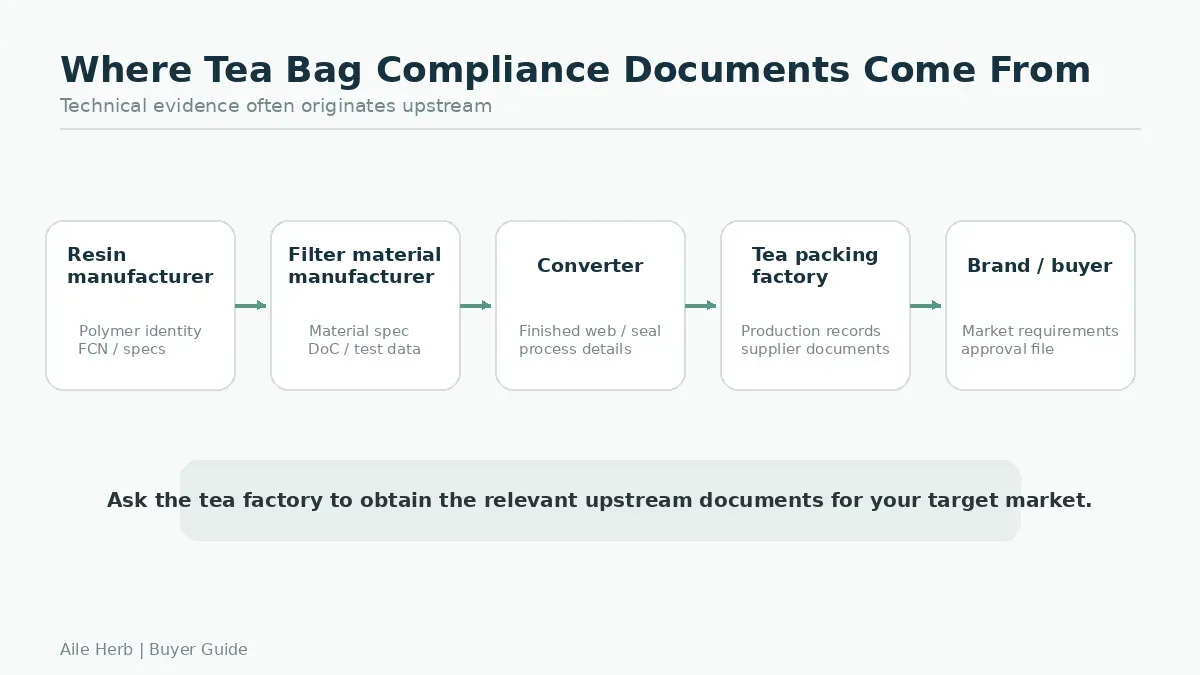
Tea bag filter material normally passes through several stages before it reaches a private-label brand:
resin manufacturer → filter material manufacturer → converter → tea packing factory → brand
Some of the most technical compliance information originates upstream.
This can include:
A tea factory may therefore need to obtain these documents from the filter material manufacturer or resin supplier.
That does not automatically indicate poor control at the tea factory. It reflects where the underlying material information and regulatory documentation originate. Filter material is one of several packaging decisions in a project, alongside those described in private label packaging.
For buyers, a more useful question is:
Can you obtain the relevant food-contact documentation from the filter material supplier for my target market and intended use?
rather than simply asking:
Can your factory issue an FDA certificate?
Before approving a pyramid tea bag filter, confirm:
For private-label projects, these questions are best resolved before final packaging approval, together with the packaging minimums and timing covered in herbal tea MOQ and first order planning.
When buyers share their target market and intended tea bag format at the beginning of a private label herbal tea project, the material-documentation requirements can be raised with the upstream filter supplier before production decisions are finalized.
There is no blanket FDA approval for everything described as “nylon”.
Certain nylon resins may have a regulatory basis under 21 CFR §177.1500 under defined composition and conditions of use. Other relevant components of the finished filter also need an appropriate regulatory basis.
No.
PLA describes a polymer. Compostability is a property of the relevant finished article under defined composting conditions and can depend on additives, thickness, sealing materials, inks, adhesives, tags and other components.
FDA does not normally issue an “FDA certificate” for ordinary food-contact tea bag filter materials.
Buyers should instead ask for appropriate supplier compliance documentation identifying the applicable CFR provision, FCN or other regulatory basis and the conditions of use it covers.
Which FDA condition of use applies to tea bags? Condition of Use B, “boiling water sterilized”, in 21 CFR 176.170(c) Table 2 is the category most relevant to hot brewing. Buyers should check that the CFR provision or FCN cited for the filter material covers Condition B or the more severe Condition A.
A Declaration of Compliance is a written document required under Regulation (EU) No 10/2011 where that Regulation applies.
It communicates information about the material, regulatory basis, restrictions and intended conditions of use through the food-contact-material supply chain.
Not necessarily as the original issuer.
Core information such as polymer identity, regulatory authorization and migration data often originates with the resin manufacturer, filter material manufacturer or converter. The tea factory may obtain the relevant documents from those upstream suppliers for a buyer’s project.
This cannot be answered accurately with a blanket yes or no.
Food-contact suitability should be evaluated for the specific material and intended conditions of use. Germany’s BfR has assessed polyamide oligomer migration from certain kitchen utensils used with hot food, but that assessment is not an EU prohibition on nylon tea bags.
Regulation (EU) 2025/40 introduces a requirement relevant to permeable tea, coffee and other beverage bags from 12 February 2028, under which they must be compatible with industrially controlled composting conditions.
Brands planning products for the EU market beyond that date should therefore include compostability requirements in material selection and packaging development rather than assuming that any current PLA tea bag will automatically comply.
