Tell Us About Your Project
Share your product, quantity and project requirements. We will review the details and respond with the relevant next steps.

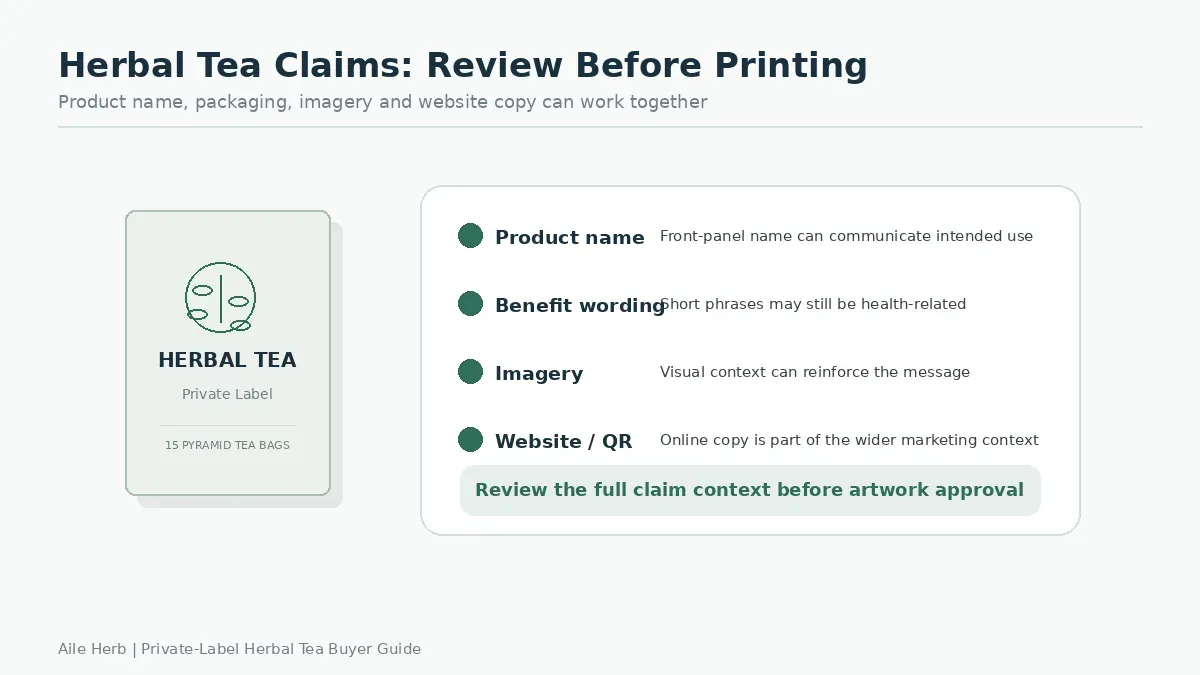
Herbal tea packaging health claims are not limited to one sentence on the back panel. A product name, front-panel wording, imagery and website copy can all contribute to a health or disease claim. In the US, conventional foods and dietary supplements do not use the same structure/function framework, and in the EU and UK markets health claims are subject to specific authorization and transitional rules.
Buyers should review claims before artwork is finalized, because changing printed packaging later is costly.
A private-label herbal tea package usually carries several layers of text: a product name, a subtitle, front-of-pack benefit wording, ingredient descriptions, short benefit bullets and a back-panel product story. Many brands also link to a website or QR code with further content. How these elements fit into the wider packaging process is described in private label packaging.
Compliance risk rarely comes from a single sentence. Regulators can consider the product name, surrounding wording, images, disease references, website claims and the wider advertising context together.
This means a mild-sounding name can still communicate a health claim. A tea called by a benefit, with a picture and website copy that reinforce it, may be interpreted very differently from the same tea sold under a neutral flavor name.
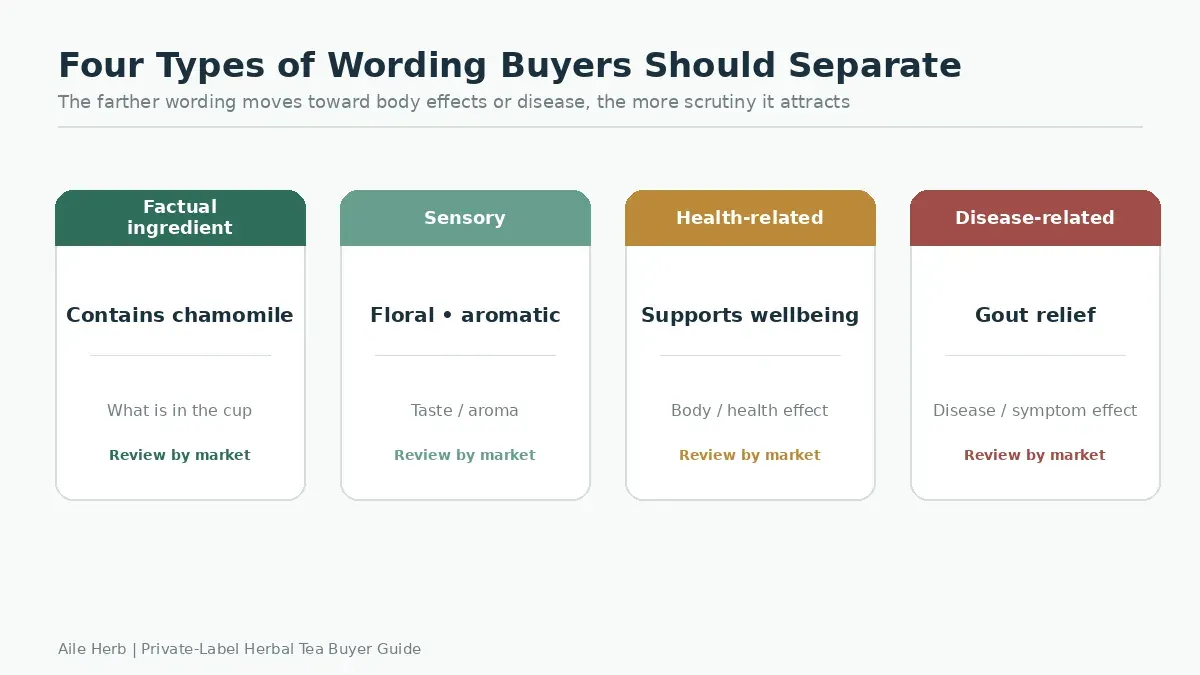
For a buyer reviewing artwork, it helps to separate wording into four broad groups:
| Group | Examples |
|---|---|
| Factual ingredient statements | Contains chamomile; with ginger; made with botanical ingredients |
| Sensory descriptions | Floral; aromatic; refreshing |
| Health-related statements | Supports digestion; supports wellbeing; supports restful sleep |
| Disease or symptom-related wording | Gout relief; menstrual pain relief; lowers blood sugar; treats insomnia |
There is no universal “allowed” and “prohibited” list across these groups. Whether a statement is acceptable depends on the market, the product category, the exact wording, the context and the evidence behind it.
As a general pattern, the further wording moves from describing what is in the cup toward describing an effect on the body—and especially an effect on a disease or its symptoms—the more regulatory scrutiny it attracts.
In the US, “health claim” has a specific regulatory meaning: a statement about the relationship between a food substance and a disease or health-related condition.
Health claims operate through defined FDA pathways rather than as free-form marketing language.
There are three main routes:
The pathways differ, but they all involve a defined FDA review or notification mechanism before use. A brand cannot simply create its own health claim for an herbal tea by choosing softer wording.
For conventional foods, FDA states that structure/function claims may be made without premarket review, but they must be truthful and not misleading, and they must derive from the nutritive value of the food.
FDA examples illustrate this approach:
Each connects a nutrient or nutritive component with a normal body function.
This distinction matters for herbal tea. Many botanical benefit phrases, such as supporting relaxation, restful sleep or women’s wellness, describe effects commonly attributed to plant constituents rather than to nutritive value.
FDA’s published materials do not confirm these botanical phrases as generally acceptable structure/function claims for conventional foods.
Avoiding disease terminology is not, by itself, enough to make a structure/function statement suitable for a conventional food. The question is also where the claimed effect comes from.
This does not mean every botanical function statement is unlawful. It does mean that each one needs to be reviewed against the nutritive-value requirement rather than being assumed acceptable because the wording sounds gentle.
Dietary supplements have a separate structure/function framework under section 403(r)(6) of the FD&C Act and 21 CFR 101.93.
Supplement claims can involve substantiation, notification to FDA and a statutory disclaimer on the label.
Conventional foods do not simply use that notification-and-disclaimer system. Adding the familiar dietary-supplement disclaimer to an ordinary herbal tea does not convert the underlying claim into an acceptable conventional-food claim.
21 CFR 101.93 also sets out criteria used to distinguish disease claims from structure/function claims, such as naming a disease, referring to characteristic symptoms, or suggesting an effect on a disease through a product name, image or reference.
That regulation directly addresses dietary supplements. When FDA assesses whether conventional-food wording suggests diagnosis, mitigation, treatment, cure or prevention of disease, similar concepts can still be relevant.
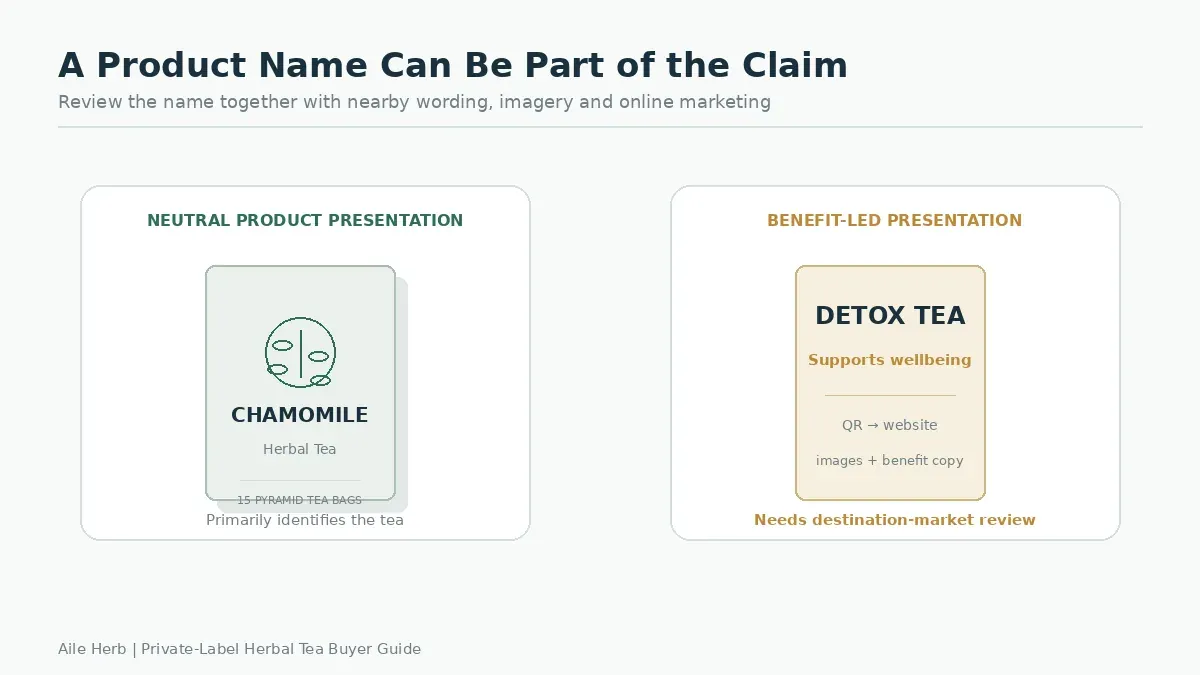
Yes. Buyers often focus on back-label copy and overlook the product name itself.
Names such as:
can communicate an intended benefit or use.
Whether a specific name creates a compliance problem depends on the market and the surrounding context. Regulators may evaluate the name together with nearby statements, imagery, website wording and the product’s intended use.
Official US enforcement provides useful examples.
In 2021, FDA issued a warning letter to TeaTaze, LLC concerning its “Clean Green Energy Detox” tea. FDA found that website statements presented the product as intended to mitigate, prevent, treat, diagnose or cure COVID-19, which resulted in drug-related enforcement concerns.
In 2020, the FTC brought a case against Teami, LLC over detox and “skinny” teas promoted through influencers with weight-loss and disease-related claims. The FTC alleged that health claims were insufficiently substantiated and that paid endorsements were not adequately disclosed.
In both situations, the product name was only one part of the wider marketing context. That is why the name should be reviewed with the same care as the claims around it.
FDA and the FTC focus on different aspects of compliance.
FDA focuses on labels and labeling, including whether a food is misbranded or presented as a drug.
The FTC focuses on advertising and whether health-related marketing is truthful, not misleading and adequately substantiated.
FTC oversight can cover:
Health-related claims should be supported by competent and reliable scientific evidence. The strength of evidence needed depends on the nature and specificity of the claim.
For private-label brands, this means website and social-media copy should be reviewed alongside packaging, not after the package has already been printed.
In the EU, nutrition and health claims on food are governed by Regulation (EC) No 1924/2006.
It distinguishes several important concepts.
Nutrition claim: a claim about beneficial nutritional properties, such as energy or nutrient content.
Health claim: any statement that states, suggests or implies a relationship between a food, food category or ingredient and health.
Reduction-of-disease-risk claim: a health claim stating that a food significantly reduces a risk factor in the development of a disease.
The definition of a health claim is broad. Wording that suggests a relationship between a tea or one of its ingredients and health can fall within the framework.
Authorized health claims are controlled through the EU authorization and register system.
No. This is one of the most important distinctions for herbal tea buyers.
Many botanical health claims were placed “on hold” because the EU evaluation process did not reach a final harmonized decision on them.
They are not formally authorized, but they have also not been formally rejected.
Some may continue to be used under transitional arrangements in Article 28 of Regulation 1924/2006.
Whether a particular claim can be used depends on factors such as:
Their use is therefore conditional and jurisdiction-dependent.
A botanical claim that is tolerated in one EU Member State should not automatically be assumed acceptable throughout the EU.
Yes.
Article 10(3) of Regulation 1924/2006 covers general, non-specific references to overall good health or health-related wellbeing.
Wording such as:
can fall within this category.
Under Article 10(3), a general health reference may only be made when accompanied by an appropriate specific health claim that meets the requirements of the Regulation.
For botanical products, one complication is that many specific botanical claims remain “on hold.”
Whether an on-hold botanical claim can satisfy the requirement for an accompanying specific claim has not been conclusively settled at EU level. This should therefore be treated as jurisdiction-dependent rather than as a blanket rule.
Not automatically.
Two different regulatory routes need to be separated.
EU medicinal-product law provides a traditional-use registration route for certain traditional herbal medicinal products.
That pathway applies to medicinal products. It is not a blanket exemption for conventional foods such as herbal tea.
For a herbal tea sold as food, wording such as:
can still communicate a relationship between the food and health.
No general EU food-law exemption was identified simply because the phrase “traditionally used” is added.
Enforcement practice can differ between Member States, so this type of wording should be treated as jurisdiction-dependent rather than automatically exempt.
No.
Great Britain means England, Scotland and Wales, and it operates its own nutrition and health claims system.
The Department of Health and Social Care maintains the Great Britain Nutrition and Health Claims Register.
Many EU-era authorized claims were retained in the GB system, while new claims can be considered through GB procedures.
Botanical on-hold claims also continue to operate within a transitional framework and guidance, subject to GB rules and enforcement.
General non-specific health claims remain controlled, and product names can also trigger claim requirements.
A well-known example is the 2018 Advertising Standards Authority ruling involving a Pukka Herbs “Detox” tea. The ASA treated “Detox” in the advertising context as a general health claim that needed to be accompanied by an appropriate specific health claim.
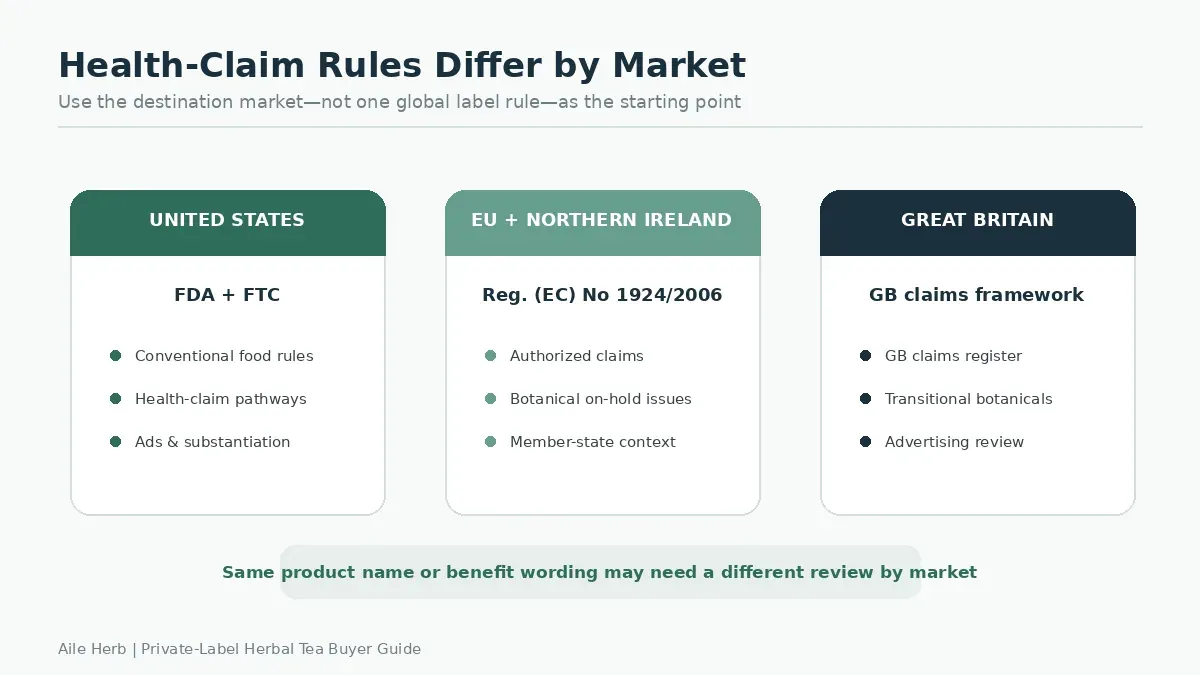
Northern Ireland should be checked separately.
Under current arrangements, Northern Ireland remains more closely linked to the relevant EU nutrition and health claims framework, including Regulation 1924/2006 and the EU Register.
A package reviewed for Great Britain should therefore not automatically be assumed to follow the same claims framework in Northern Ireland.
If a product will be sold in both markets, the claims should be checked for both.
Not every word on a tea box is a health claim.
The practical question is what each statement communicates.
| Wording type | Example | Main question |
|---|---|---|
| Ingredient statement | With chamomile | Is it purely factual? |
| Sensory description | Floral and aromatic | Does it imply a health effect? |
| Wellness statement | Supports wellbeing | Does it trigger health-claim rules? |
| Disease-related wording | Gout relief | Does it imply treatment or mitigation? |
“Caffeine-free” is common on herbal tea products, but there is no single universal definition or threshold across all of these target markets.
Buyers should check the destination-market labeling requirements and confirm that the actual product composition supports the statement, using the product’s quality documents and testing.
Responsibility is market- and role-specific.
United States: labeling responsibilities can attach to the manufacturer, packer or distributor whose name appears on the label, depending on the facts.
EU and Northern Ireland: under Article 8 of Regulation (EU) No 1169/2011, the food business operator under whose name or business name the food is marketed is responsible for food information. Where the relevant operator is not established in the market, importer responsibilities may apply.
Great Britain: a similar model applies, with the relevant brand owner or GB importer often playing a central role.
It is useful to separate four different issues:
Artwork approval is a commercial step.
It does not automatically transfer all legal responsibility from one party to another.
The opposite assumption—that an overseas manufacturer is always solely responsible for the finished private-label wording—is also too simple.
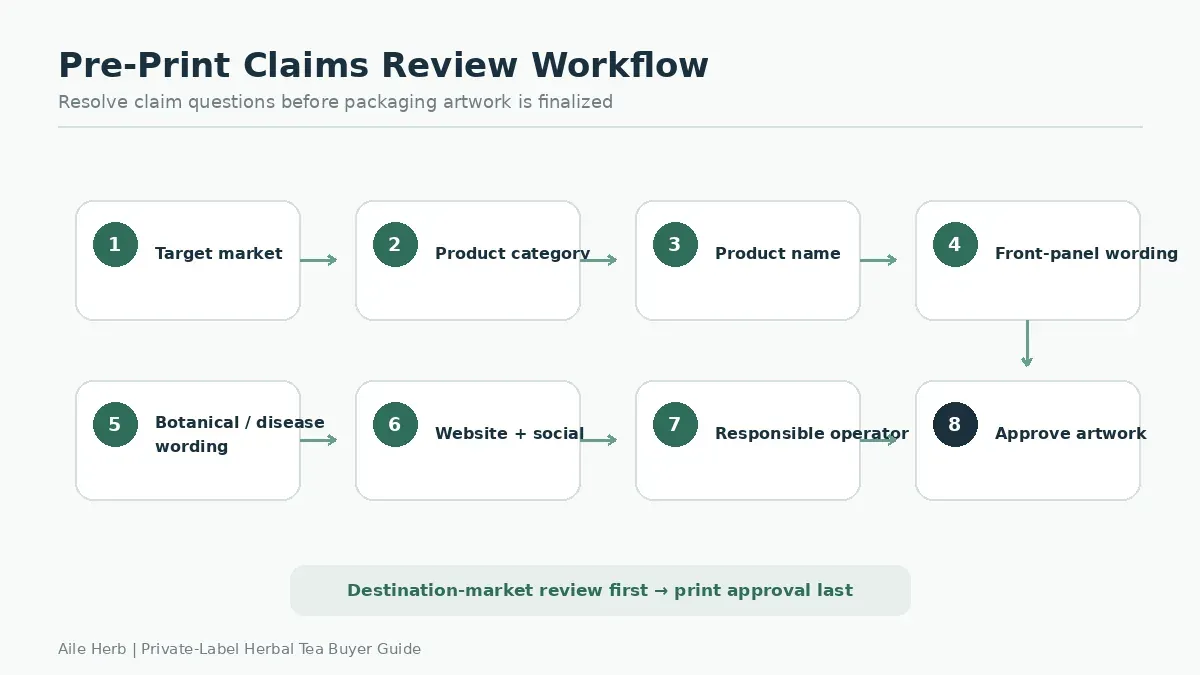
A practical sequence for private-label herbal tea projects is:
For private-label projects, buyers should confirm destination-market claim requirements before artwork is finalized and printed. Claims are one part of packaging compliance; documentation for the tea bag itself is covered in pyramid tea bag filter materials.
At Aile Herb, export private-label packaging is developed for the destination-market project rather than simply reusing domestic-market packaging, and efficacy or disease claims are not added casually to private-label artwork.
For more on how product-development routes affect packaging and sourcing decisions, see Private Label Herbal Tea: Stock Blends vs Custom Formulation.
Before sending packaging to print, confirm:
There is no universal yes or no.
For conventional foods, structure/function claims must derive from nutritive value, and FDA’s published materials do not confirm botanical sleep claims as generally acceptable conventional-food structure/function claims.
The wording, ingredient basis, evidence and overall product context should be reviewed before printing.
A product name can itself communicate a claim.
In the EU and Great Britain, “detox” has been treated as general health wording in regulatory and advertising contexts. In the US, regulators may assess the name together with website claims, surrounding wording and the product’s intended use.
The name should therefore be reviewed for the specific destination market.
No.
They are not formally authorized, but they have also not been formally rejected.
Some may continue to be used under transitional arrangements, subject to the requirements of Regulation 1924/2006 and Member State enforcement.
No automatic exemption was identified for conventional foods.
Traditional-use registration exists for certain herbal medicinal products, but that is a different regulatory pathway from ordinary herbal tea sold as food.
The dietary-supplement structure/function notification and disclaimer framework should not simply be copied onto a conventional food.
Adding the disclaimer does not by itself make the underlying conventional-food claim acceptable.
It depends on the destination market and each party’s legal role.
The relevant parties can include the brand owner, food business operator, importer, manufacturer, packer or distributor.
Contracts can allocate commercial responsibilities, but statutory responsibility is determined by the applicable market rules.
No.
Great Britain has its own Nutrition and Health Claims Register, while Northern Ireland remains more closely linked to the EU framework.
Claims should therefore be checked separately where the product will be sold in both markets.
Not automatically.
Artwork approval is a commercial step. Legal responsibility remains fact-specific and depends on the market and the roles of the parties involved.
To have front-panel wording, product name and artwork reviewed against the destination market before printing, see our private label packaging page and send the draft artwork with the market list.
