Tell Us About Your Project
Share your product, quantity and project requirements. We will review the details and respond with the relevant next steps.

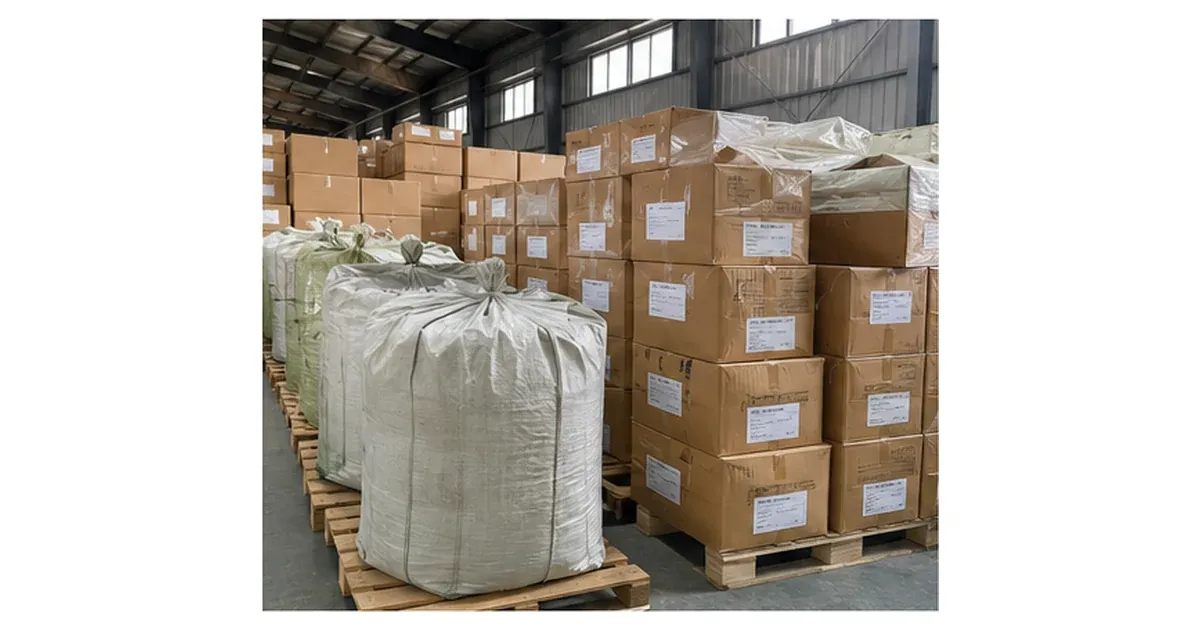
Chinese herbal ingredients storage requirements should be defined before shipment. Buyers should confirm the storage condition, packaging and inner liner, shelf-life reference date, minimum remaining shelf life, batch traceability, shipping evidence and incoming inspection procedure. Terms such as “store in a cool, dry place” are usually too broad to serve as a complete purchase specification.
Do Chinese herbs expire? Dried Chinese herbs do not spoil the way fresh food does, but they lose quality over time through moisture uptake, mould, insect damage and loss of aroma. There is no single shelf life that applies to all herbs. It depends on the herb, how it was processed, its moisture content, and how it is packed and stored. For bulk orders, agree a shelf-life reference date and a minimum remaining shelf life at delivery in your specification.
A storage requirement should give the supplier and receiving team a clear acceptance basis.
Before order confirmation, define:
These requirements should match the specific botanical material, product form, destination market and agreed quality specification.
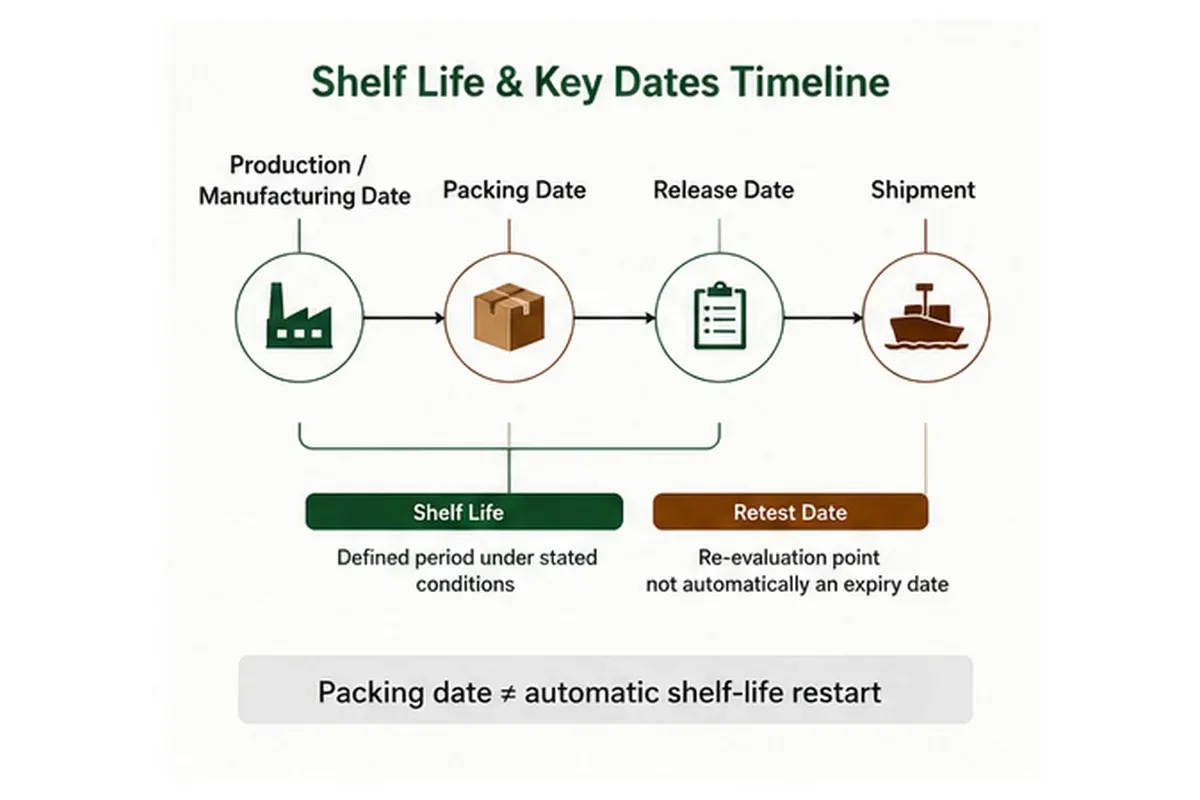
Date terminology should be defined in the purchase specification rather than assumed to have the same meaning across products and markets.
| Term | Typical Meaning | Buyer Verification Point | Important Limitation |
|---|---|---|---|
| Shelf life | Period during which the product is expected to remain within specification under stated storage conditions | Confirm the reference date, storage conditions and supporting basis | Meaning can vary by product and market |
| Expiry / expiration date | Date after which the product should not be used under the applicable system | Confirm the label, COA and intended market | Not interchangeable with a retest date |
| Retest date | Date after which a material should be re-examined before use | Confirm test scope, acceptance criteria and storage history | Passing a retest does not automatically extend a contractual expiry |
| Production / manufacturing date | Date a defined production activity was completed | Define which production event the date represents | May differ from drying, cutting, packing or release date |
| Packing date | Date the material was packed or repacked | Confirm whether it is original packing or repacking and retain batch linkage | Repacking should not automatically restart shelf life |
| Release date | Date the batch was released for distribution | Confirm the release record and linked COA | Does not by itself define the shelf-life start date |
There is no single 24-month, 36-month or other fixed shelf life that applies to every Chinese herbal ingredient.
Shelf-life suitability can depend on:
A supplier quoting a fixed shelf life should be able to identify the basis for that period rather than treating it as an industry-wide default.
The buyer should also define how remaining shelf life will be calculated before shipment.
For example:
Minimum remaining shelf life at shipment:
[buyer-defined requirement]
Shelf-life reference date:
[defined date basis]
Maximum material age at shipment:
[buyer-defined where applicable]
Storage requirements should be based on the actual product and risk rather than one universal temperature or humidity range.
| Risk | What the Buyer Should Control | What Requires Escalation |
|---|---|---|
| Moisture exposure | Appropriate packaging barrier and dry storage | Damp packaging, softened cartons or wet liners |
| High humidity | [buyer-defined storage condition] where required | Conditions outside the agreed range |
| Water ingress | Container, pallet and packaging condition | Water staining, condensation or standing water |
| Direct light | Protection where required by the product specification | Exposure outside the agreed condition |
| Strong odour / cross-contamination | Segregation from odour-emitting or incompatible materials | Product odour inconsistent with specification |
| Mold | Visual and odour screening plus testing where required | Visible mold, musty odour or abnormal clumping |
| Insects | Inspection for insects, larvae, webbing, frass or holes | Confirmed or suspected pest activity |
| Damaged packaging | Outer pack, liner and seal inspection | Torn liner, broken seal or exposed product |
Storage limits should be defined by product, format, applicable standard and destination market rather than applied as one fixed temperature or RH value.
Moisture content and water activity are not interchangeable.
Moisture content measures the total water in a material according to a defined test method.
Water activity reflects the water available for microbial growth and certain deterioration processes.
A COA moisture result confirms the sampled batch result at the time of testing. It does not prove future storage stability, packaging integrity, transit humidity exposure or microbiological condition at arrival.
Where justified by the product and risk assessment, the buyer may also specify water activity, microbial testing or post-arrival testing in addition to the release moisture result.
Visual and odour inspection can identify:
It cannot confirm microbiological compliance.
A material may look normal and still require testing under the agreed specification. Likewise, a minor cosmetic defect does not automatically mean the product has failed.
Product-contact packaging and outer packaging perform different functions and should be specified separately.
| Packaging Element | Buyer Requirement | What It Protects Against | Important Limitation |
|---|---|---|---|
| Product-contact liner | Define material, suitability and clean/new condition | Product contact, dust and some moisture exposure | Material type alone does not define barrier performance |
| Double liner | Specify where the product or route justifies it | Additional protection from puncture or moisture pathways | Not required for every botanical |
| Woven outer bag | Define load rating, liner requirement and closure | Handling and stacking | Usually not the primary moisture barrier |
| Kraft paper bag | Define ply, liner and closure where relevant | Dry handling and presentation | Vulnerable to water exposure without suitable inner protection |
| Carton | Define board grade, inner pack and stacking requirement | Compression, handling and identification | A dry carton does not prove the inner liner remained intact |
| Drum | Define material, liner, closure and tamper evidence | Physical protection and contamination control | Suitability depends on product form and commercial requirements |
| Heat sealing | Define closure method and inspection requirement | Liner integrity and reduced moisture/dust entry | Seal condition must be verified |
| Desiccant | Define type, placement and product separation where used | Reduction of enclosed moisture burden | Does not replace drying, sealing or suitable packaging |
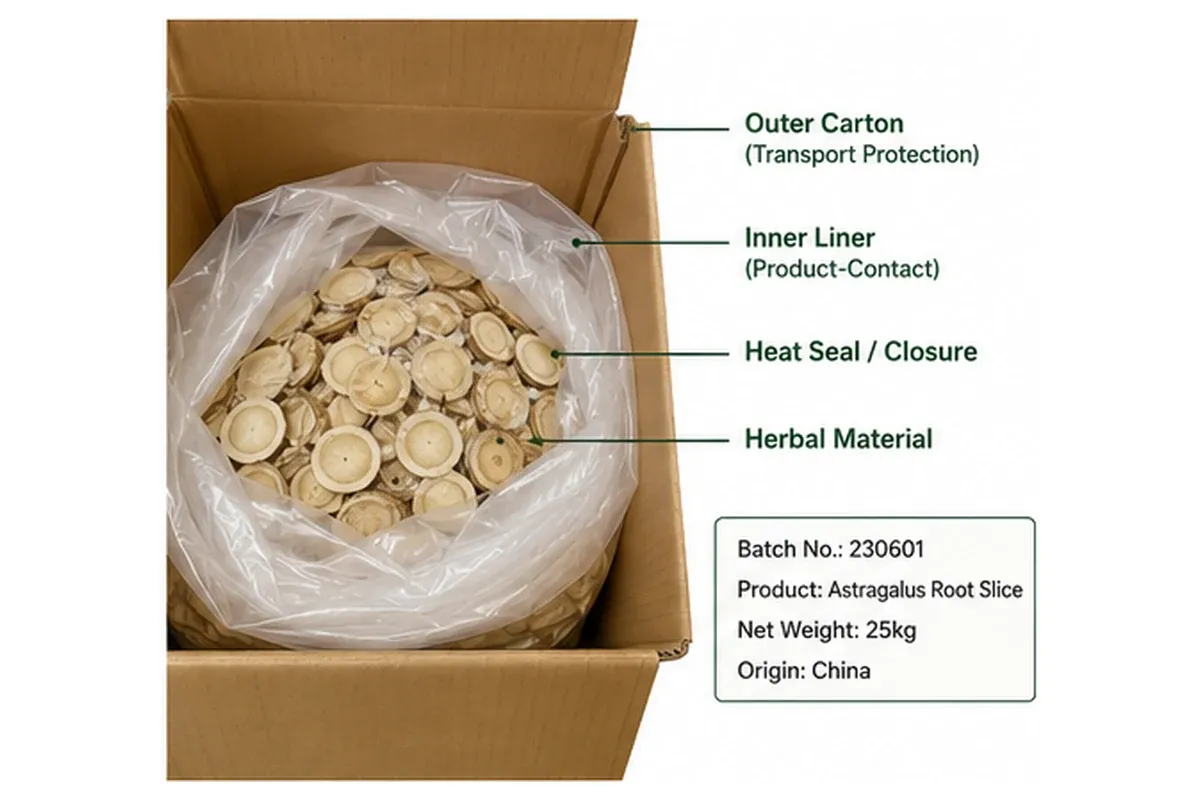
The purchase order should separately identify:
Packaging should be selected according to the product, route and required barrier performance rather than by pack type alone.
For example, a PE liner may be appropriate as part of a packaging system, but the term “PE liner” alone does not define thickness, closure integrity or moisture-barrier performance.
Desiccants may support a defined moisture-control strategy where justified by the product, packaging configuration, shipping route and climate.
They do not replace:
Type, quantity and placement should be assessed for the actual shipment rather than applied as a universal default.
“Container rain” refers to condensation forming on internal container surfaces as temperature and humidity conditions change during transit.
For dried herbal materials, this can expose cartons, bags or pallets to moisture even when the product was dry when loaded.
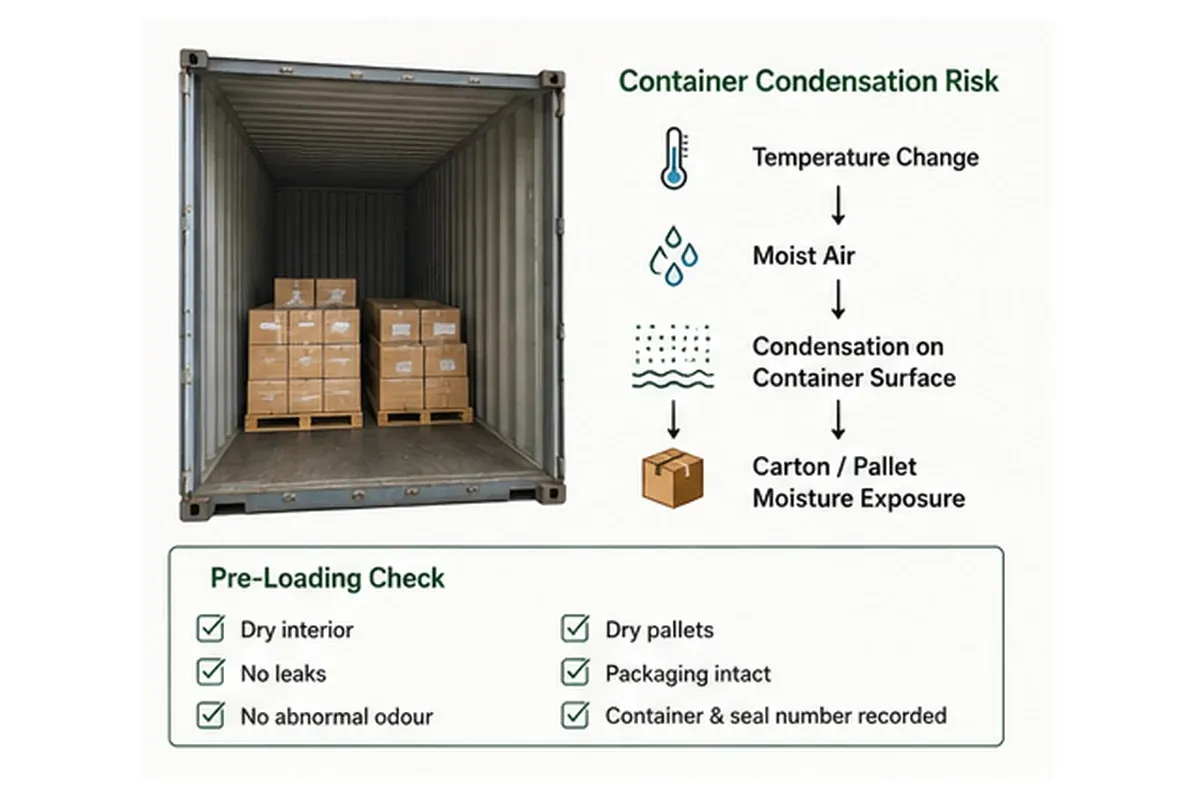
Before loading, confirm:
Loading photos should show the condition of the container and cargo before the doors are closed.
Moisture-control measures should then be selected according to the product, packaging system, route and climate. No single desiccant or container setup is appropriate for every herbal shipment.
For more detail on shipment checks, see Pre-Shipment Inspection for Chinese Herbs.
A finished-batch COA supports the condition of the sampled batch at the time of testing and release.
| COA Can Support | COA Does Not Prove |
|---|---|
| Batch identity | Storage conditions after release |
| Test results | Container dryness during shipment |
| Test methods | Packaging integrity throughout transit |
| Acceptance criteria | Exposure to high humidity or water during shipment |
| Release condition at time of testing | Arrival condition |
| Batch-specific quality results | Full future shelf-life performance |
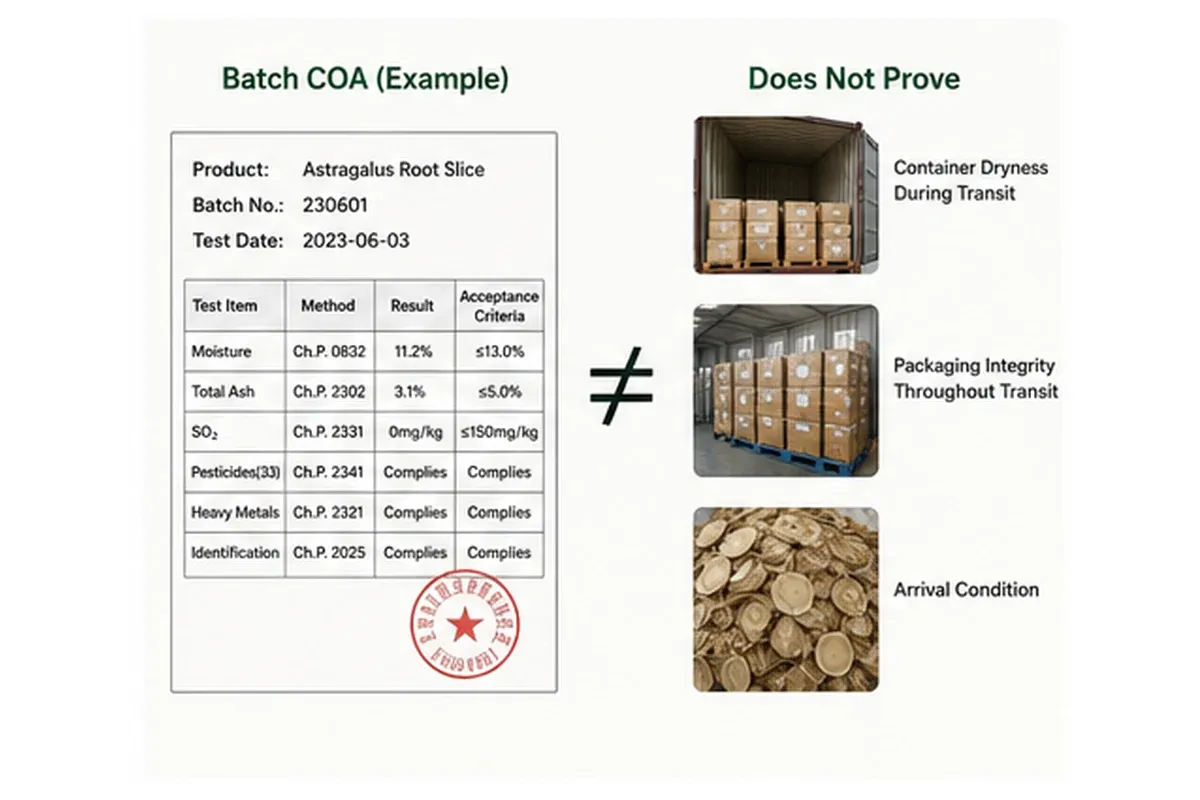
A COA should therefore be reviewed together with packaging, batch and shipment evidence where these factors affect acceptance.
For detailed COA review, see the Certificate of Analysis Chinese Herbs Buyer Guide.
Where contaminant testing is part of the buyer specification, see Pesticide & Heavy Metals Testing.
Receiving inspection should compare the actual shipment against the purchase specification, packing documents and approved batch records.
| Incoming Check | How to Check | Escalation Trigger | Evidence to Retain |
|---|---|---|---|
| Product / batch identity | Match PO, packing list, label and COA | Batch mismatch or missing label | Label photos and receiving record |
| Packaging integrity | Inspect outer pack, liner and closure | Torn liner, broken seal or exposed product | Photos and affected unit count |
| Water exposure | Inspect container, pallets, bags and cartons | Dampness, staining or condensation | Container and cargo photos |
| Mold / abnormal odour | Visual and odour screening | Visible mold, musty odour or abnormal clumping | Photos and quarantine record |
| Insect evidence | Check for insects, larvae, frass, webbing or holes | Confirmed or suspected activity | Photos and pest record |
| Product form / cut | Compare against the approved specification or sample | Wrong form or excessive breakage | Sampling record |
| Net weight | Check according to the agreed receiving plan | Quantity outside agreed tolerance | Weight and receiving records |
| COA | Confirm product, batch, method and results | Missing, incorrect or mismatched COA | Document-control record |
| Remaining shelf life | Calculate from the agreed reference date | Below the contractual minimum | Label, COA and calculation record |
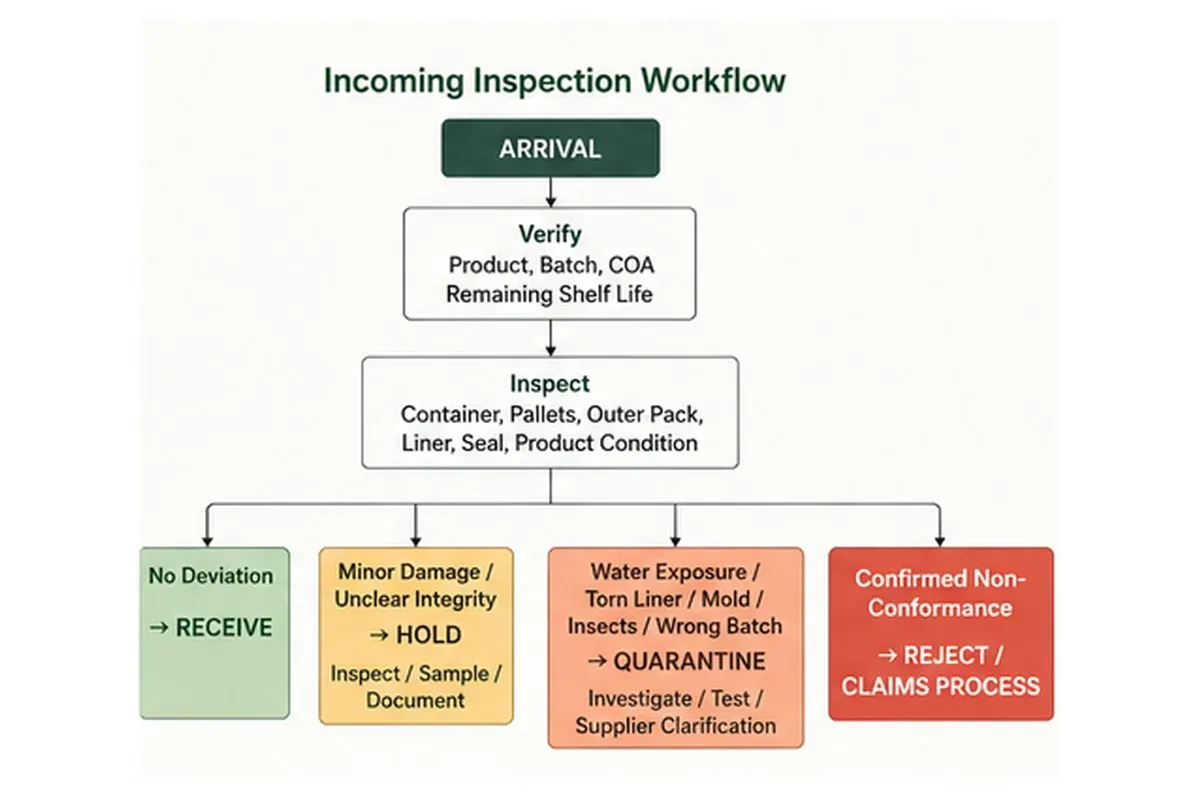
Arrival
↓
Verify product, batch, documents and remaining shelf life
↓
Inspect container, pallets, outer packaging, liner and seal
Then:
No deviation
→ Receive according to buyer SOP.
Minor external damage or uncertain package integrity
→ Hold → document → inspect → sample where required.
Water exposure, torn liner, visible mold or insects, wrong batch or COA mismatch
→ Quarantine → investigate → test or request supplier clarification as appropriate.
Confirmed non-conformance against the agreed specification
→ Reject or handle under the agreed claims procedure.
A damaged outer carton does not automatically require product rejection if the product-contact packaging remains intact. The shipment should instead be inspected and dispositioned according to the buyer’s QA procedure and the agreed specification.
Use the following fields when preparing an RFQ or purchase order.
| Specification Field | Buyer Requirement |
|---|---|
| Product name | [Insert product name] |
| Botanical name | [Insert accepted botanical source] |
| Plant part | [Insert plant part] |
| Product form | [Whole / Slice / Segment / Powder / Other] |
| Batch requirement | [Insert requirement] |
| Storage condition | [Buyer-defined storage condition] |
| Primary packaging | [Liner material / suitability / thickness where relevant] |
| Closure | [Heat seal / other agreed closure] |
| Outer packaging | [Bag / Carton / Drum / Other] |
| Net weight per unit | [Buyer-defined] |
| Pallet requirement | [Buyer-defined] |
| Moisture-control approach | [Product- and route-specific requirement] |
| Batch label | [Required fields] |
| Shelf-life reference date | [Defined reference date] |
| Minimum remaining shelf life at shipment | [Buyer-defined] |
| Maximum age at shipment | [Buyer-defined where applicable] |
| Finished-batch COA | [Required scope] |
| Shipment evidence | [Packing photos / Loading photos / Container number / Seal number / Packing list] |
| Arrival non-conformance handling | [Buyer QA procedure / Agreed claims clause] |
The storage and packaging specification should be agreed before shipment, particularly where remaining shelf life, liner construction or moisture-control requirements affect acceptance.
For supplier-side warehouse handling and lot controls, see Warehousing & Storage.
| Mistake | Procurement Risk |
|---|---|
| Accepting “cool and dry” without defining the requirement | No agreed acceptance basis at arrival |
| Assuming every herb has a 24-month shelf life | Remaining usable life may be overstated |
| Confusing production date with packing date | Incorrect shelf-life calculation |
| No minimum remaining-life requirement | Shipment may arrive with less remaining life than expected |
| Checking COA moisture but ignoring packaging condition | Transit moisture damage may be missed |
| No liner or closure requirement | Packaging may vary between shipments |
| Assuming desiccants eliminate moisture risk | Moisture exposure may remain uncontrolled |
| No incoming-inspection record | Insufficient evidence for investigation or supplier claims |
No. Shelf life depends on the botanical material, plant part, product form, processing status, packaging, storage conditions and supporting evidence. A stated 24-month or other fixed period should be evaluated against the specific product and packaging system rather than treated as a universal industry rule.
Not necessarily. Production or manufacturing date refers to a defined production event, while packing date records when material was packed or repacked. The applicable shelf-life reference date should be defined in the product specification or agreement rather than inferred from either term.
No. A retest date identifies when a material should be re-evaluated before further use. An expiry date represents a different disposition point under the applicable product or market system. A successful retest should not automatically be treated as extending a contractual expiry period.
No. A moisture result describes the sampled batch at the time of testing. It does not prove that packaging remained intact, that the container stayed dry or that the product avoided humidity exposure during transportation. Shipment condition and arrival inspection remain separate controls.
Define the product-contact liner, closure method, outer pack, unit weight and pallet requirements separately. Additional moisture-control measures can then be selected according to the herb, product form, packaging barrier and transport route rather than using one standard packaging configuration for every product.
Hold and document the affected units first. Inspect the liner, seal and product condition before making a disposition decision. Water staining on the outer carton does not prove that the material itself is damaged, but the shipment should not be accepted without appropriate inspection and documentation.
For a specific order, provide:
Aile Herb can review the required packing specification and batch-document scope against the confirmed order requirements.
Discuss Your Requirement
