Tell Us About Your Project
Share your product, quantity and project requirements. We will review the details and respond with the relevant next steps.

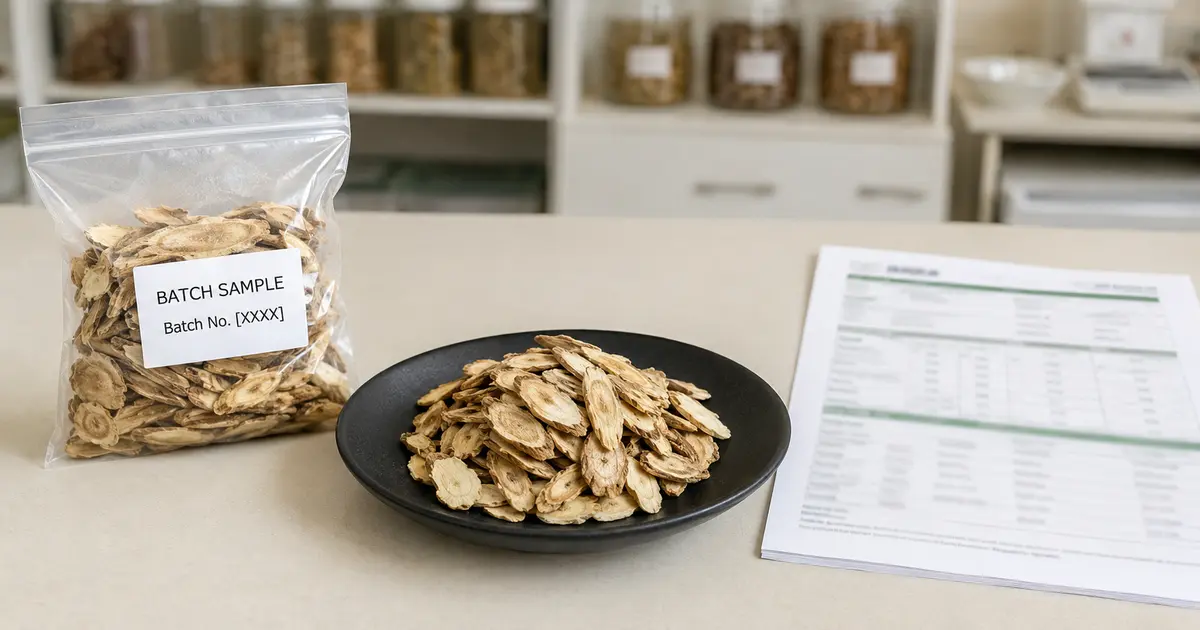
A supplier may describe herbs as “sulfur-free,” but the phrase alone does not tell you whether sulfur fumigation was deliberately avoided, whether the batch you are about to buy was tested, or how the laboratory reported the result. Three very different situations can sit behind the same two words, and only one of them is backed by evidence you can act on.
For a bulk order, that gap matters. The claim on a website or a quotation is a starting point for questions, not a substitute for the documents that travel with the goods.
Short answer: “Sulfur-free” usually means material processed without intentional sulfur fumigation. It does not automatically mean an absolute-zero sulfur dioxide result. Before a bulk purchase, ask for a written processing declaration and a batch-specific sulfur dioxide result, then check the test method, the reporting basis, the acceptance limit, and whether the batch on the report matches the batch you are buying.
This guide is written for procurement. It explains what the terminology can and cannot mean, how to read a sulfur dioxide result on a certificate of analysis, and how to write a specification that removes the ambiguity before an order is placed.
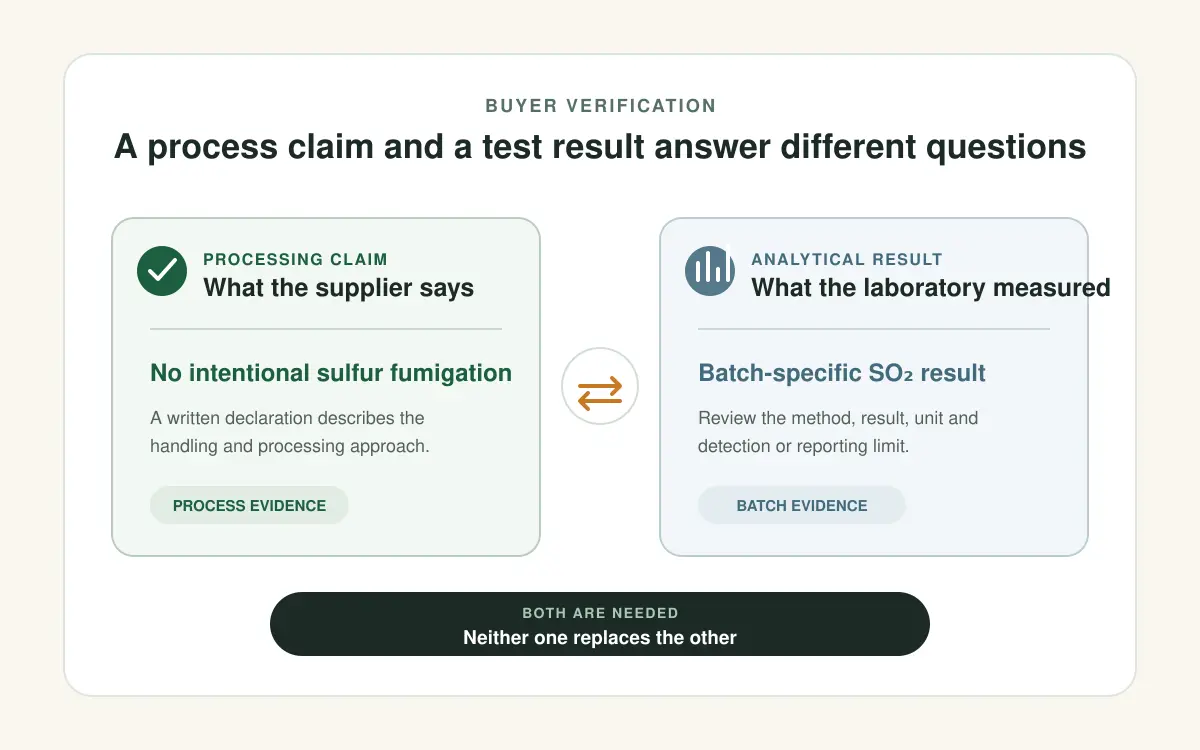
“Sulfur-free” is generally a processing claim: it says the material was handled without intentional sulfur fumigation. It is not, by itself, an analytical statement about how much sulfur dioxide is present in a given batch.
That distinction is the whole point of this article. A processing claim describes what the supplier says they did. An analytical result describes what a laboratory measured in a specific sample. The two support each other, but neither replaces the other, and a claim without a result leaves you with nothing to verify.
Several statements often get treated as interchangeable when they are not:
Note the British spelling “sulphur” appears on many official documents from the United Kingdom and Hong Kong; this guide uses the American “sulfur” throughout, and the two refer to the same element.
The table below maps common phrasings to what each can mean and the evidence worth requesting.
| Term or statement | What it can mean | Evidence to request |
|---|---|---|
| No intentional sulfur fumigation | A process claim about post-harvest handling; strength depends on who controlled processing | Written processing declaration for the specific herb and batch |
| Sulfur-free | Usually shorthand for the above; undefined on its own | A definition in writing plus a batch test report |
| Not detected | Analyte not found at the method’s threshold; not proof of absolute zero | Test method, detection or reporting limit, and unit |
| Below reporting limit | Present below the level the method can quantify | The numerical reporting limit and the method used |
| Passes the agreed specification | Result met a threshold you both agreed | The acceptance limit, the result, and the jurisdiction or product basis behind it |
Reading a claim through this lens turns a vague label into a set of specific documents you can ask for and check.
Sulfur fumigation exists because it is a low-cost, long-established way to address practical post-harvest problems. From a sourcing perspective, it has been used to help with drying, preservation and storage, to limit mold, to control insects, and to keep material looking pale and uniform. Official guidance from Hong Kong’s health authority lists preservation, appearance and pest management among its historical purposes.
Peer-reviewed reviews describe it as easy and inexpensive, which is largely why it persisted, while also noting that it can change a herb’s chemical profile. That trade-off is the reason a buyer cares: the same treatment that made storage convenient can alter the material and leave a residue.
None of this makes fumigation universally present, universally banned, or universally harmful. It is one processing choice among several, and whether it was used on a particular lot is a question of fact for that lot.
That is also why appearance is a weak proxy. Fumigated material can look brighter or more uniform, and an unusually pale, bright or even-colored batch is a reasonable prompt for more questions. But color, odor, texture and moisture vary for many ordinary reasons, and none of them confirm processing history on their own. The next sections deal with the evidence that does.
A defensible sulfur-free claim rests on three layers, and the weakness of any one of them limits how much the others are worth.
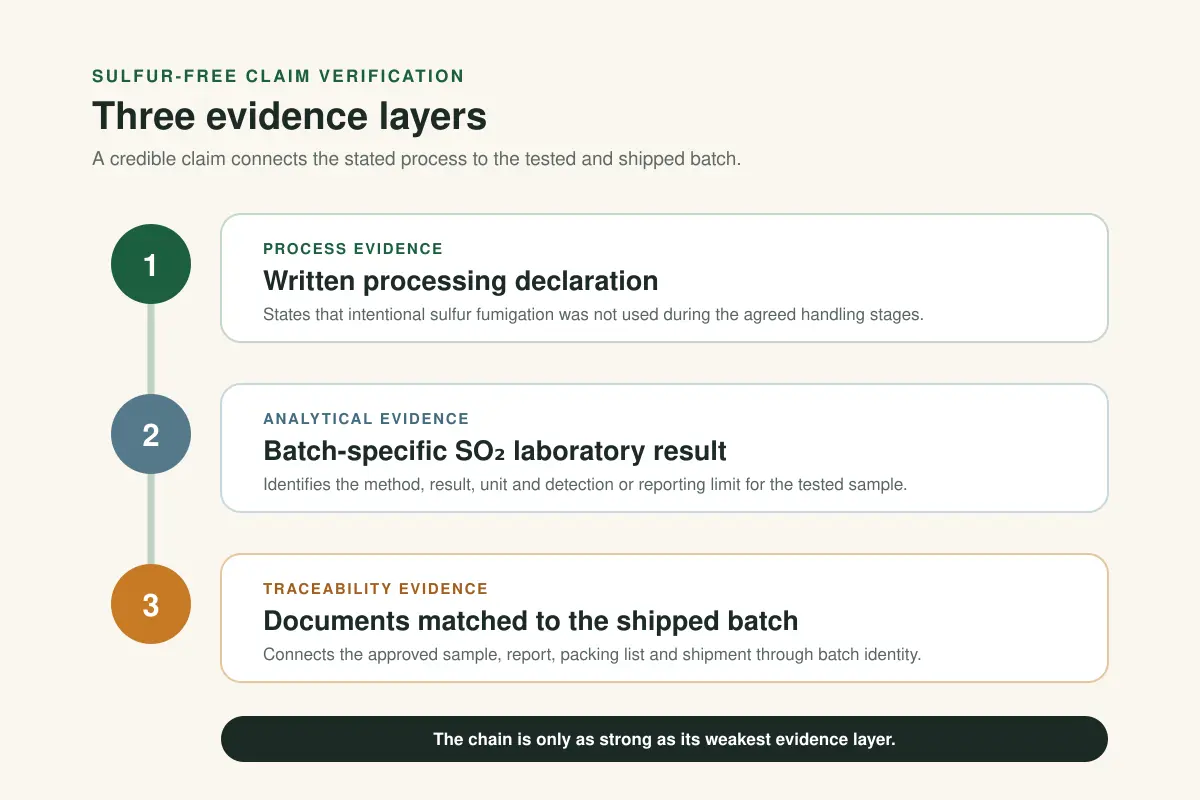
1. A written processing declaration. The supplier states, for the specific herb, that no intentional sulfur fumigation was used during post-harvest handling, drying, processing or storage. This is the process layer, and it is most reliable when the supplier controls the processing rather than buying finished material from an unnamed source.
2. A batch-specific laboratory result. A sulfur dioxide (SO₂) test performed on the batch you are buying, reported with its method and limits. This is the measured layer. A batch-specific result is far more useful than a generic certificate that was issued for a different lot or an earlier season.
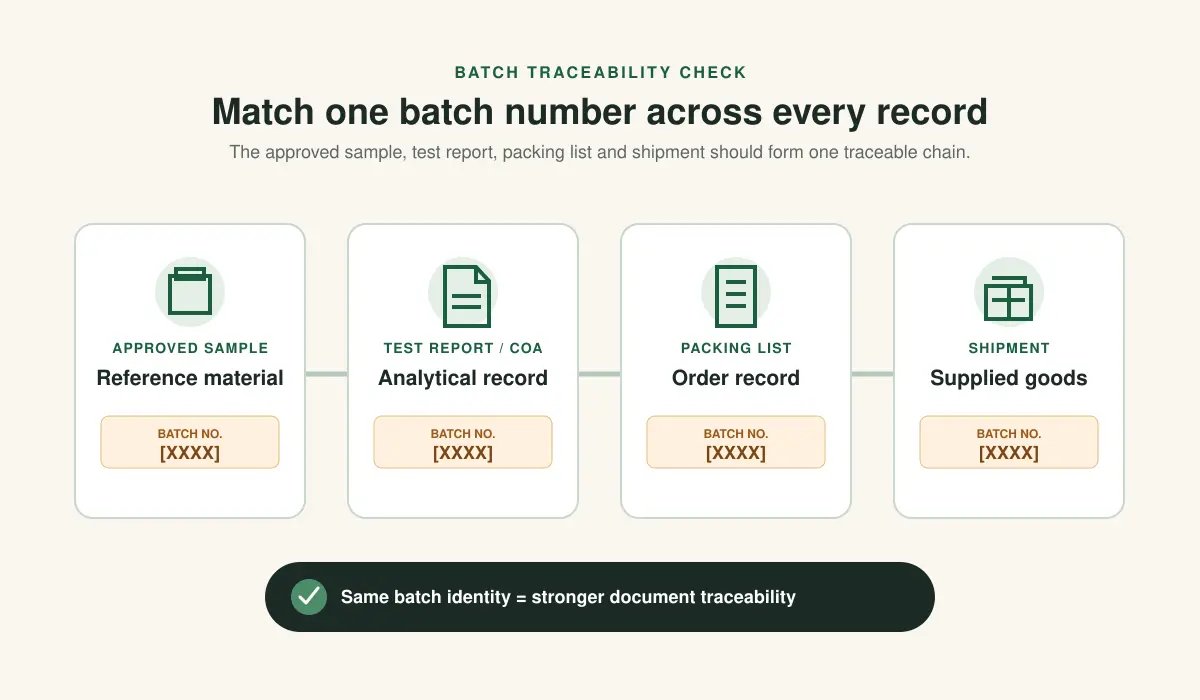
3. Traceable documents that connect to the shipped batch. The processing declaration and the test report should tie to the same batch number that appears on the approved sample, the packing list and the shipment paperwork.
A generic, expired or unrelated certificate of analysis (COA) provides limited assurance because it may describe material you are not receiving. Research on sulfur-fumigated herbs also notes that an SO₂ figure read in isolation can understate the picture, since fumigation can drive chemical changes beyond the residue itself. Read the number together with the processing record rather than as a standalone verdict.
Checking the batch number on the report against the approved sample and the shipment documents is a sensible procurement control. Treat it as prudent practice you build into your own purchasing terms, rather than assuming a single global rule requires it; the exact legal obligations depend on your destination market and product category.
Start with a simple rule: a result you cannot interpret is not a result you can rely on. Work through the report field by field.
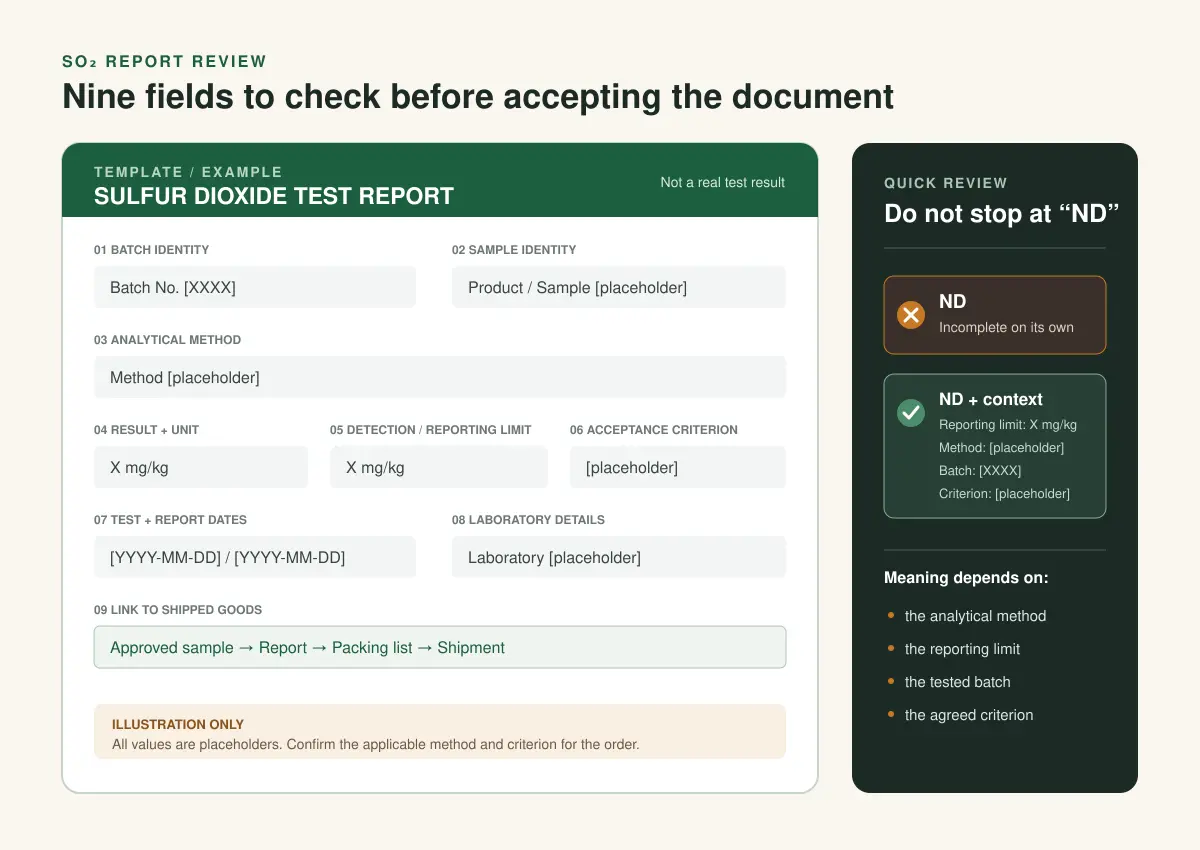
Keep these distinct meanings separate. “Not detected,” “below the reporting limit,” a numerical result, “passes specification,” and “complies with a named requirement” are five different statements. In particular, “not detected” does not necessarily mean absolute zero; it means the method did not find the analyte above its stated limit, and its meaning collapses if that limit is missing.
Consider a short example. A report lists SO₂ as “ND.” On its own, “ND” tells you almost nothing: without a stated reporting limit and method, you cannot tell whether it means below 10 mg/kg, below 30 mg/kg, or something else entirely. The same “ND” becomes usable when the report reads, for instance, “ND (reporting limit X mg/kg, method Y).” (That format is illustrative only and is not a real result from any particular supplier.)
Finally, one test result describes one batch. It is evidence about the lot that was tested, not a guarantee about the processing history of every future batch you may order.
For material bought against the Chinese Pharmacopoeia, the 2025 edition (in force since 1 October 2025, NMPA announcement) gives buyers two concrete reference points: the test methods in General Chapter 2331 and the residue limits set in General Chapter 0212 and individual monographs.
| Item | Ch.P. 2025 reference |
|---|---|
| Test methods (Chapter 2331) | Method 1: acid-base titration after distillation; Method 2: gas chromatography; Method 3: ion chromatography |
| General limit | ≤ 150 mg/kg for medicinal materials and decoction pieces other than minerals |
| Herb-specific limit | ≤ 400 mg/kg for a small number of named herbs, including Codonopsis (Dang Shen) |
| Result unit | mg/kg (µg/g) |
These limits are compliance ceilings, not definitions of sulfur-free. A batch at 120 mg/kg meets the general pharmacopoeial limit but would not satisfy a buyer who specified no sulfur fumigation. When the purchase order asks for sulfur-free material, write a buyer-specific SO₂ limit well below the pharmacopoeial ceiling, name the Chapter 2331 method to be used, and ask for the numerical reporting limit so a “not detected” result can be interpreted. Method choice also matters at low levels: gas and ion chromatography are generally better suited than titration for confirming results close to the reporting limit.
The word “sulfur-free” alone is too vague for a request for quotation or a purchase order. It sets no method, no limit, no reporting basis and no batch link, which leaves every one of those open to interpretation after the goods arrive. Writing the requirement out converts a hopeful label into an enforceable term.
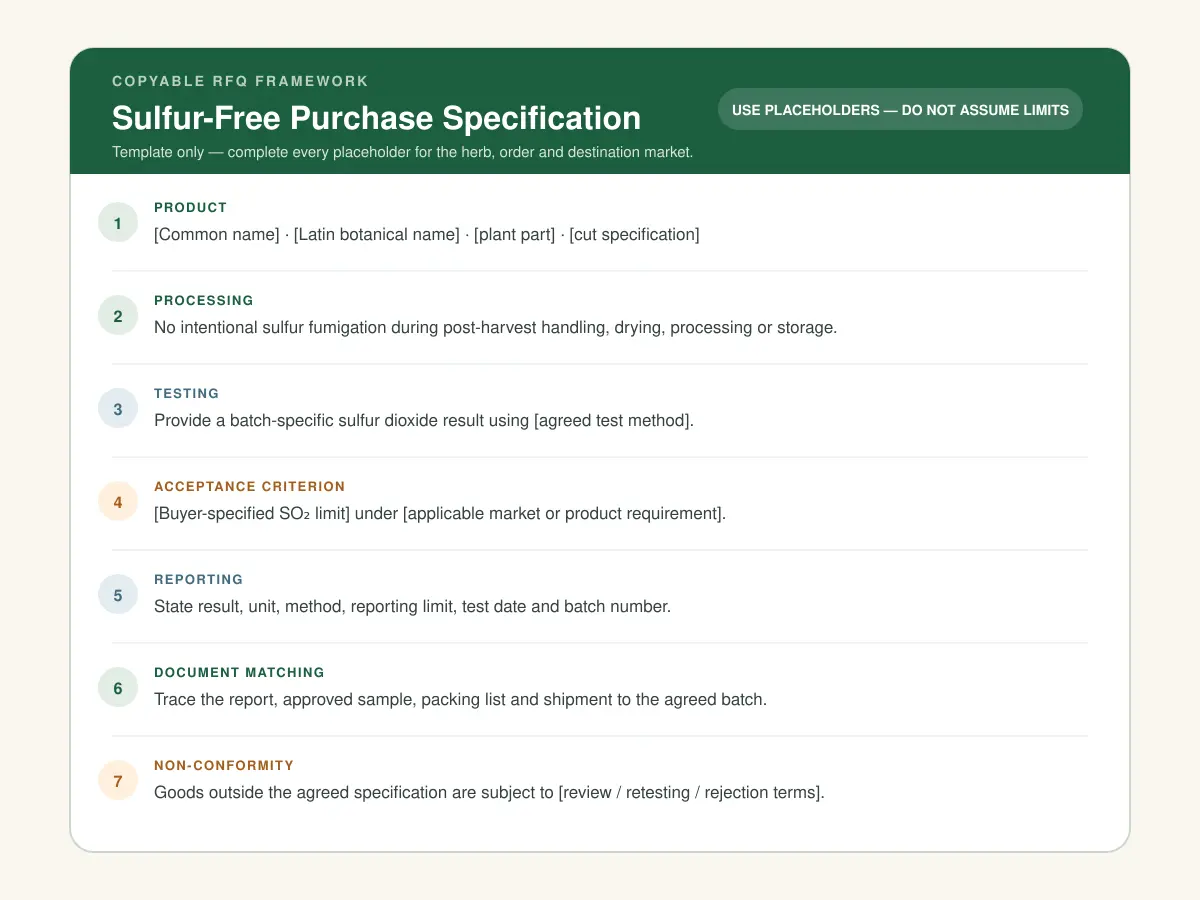
The template below uses placeholders. Fill each one for the specific herb, order and destination market.
Processing: No intentional sulfur fumigation during post-harvest handling, drying, processing or storage. Testing: Provide a batch-specific sulfur dioxide result using [agreed test method]. Acceptance criterion: [buyer-specified SO2 limit] under [applicable market or product requirement]. Reporting: State the numerical result or reporting status, unit, method, detection/reporting limit, test date and batch number. Document matching: The test report, approved sample, packing list and shipment must be traceable to the agreed production batch. Non-conformity: Goods outside the agreed specification are subject to [review, retesting or rejection terms].
Fill each placeholder for the specific herb, order and destination market.
Two placeholders deserve attention. The acceptance criterion should be a number you confirm for your destination market and product category, not a figure copied from a generic source; residue limits and which methods are accepted vary by jurisdiction and by whether the material is a raw herb, a herbal medicine or another category. The applicable market requirement should name the actual rule you are relying on, so both sides know what “compliant” means in the contract.
A compact version can sit inside a purchase order: supply the named product with no intentional sulfur fumigation; provide a batch-specific SO₂ report using the agreed method, meeting the buyer-specified limit for the stated market; and match batch numbers across the COA, packing list and shipment documents.
If you want to align a specification with a supplier’s stated processing capability, it helps to review their sulfur-free Chinese herbal slices processing description alongside the batch documents rather than in place of them.
A short list of direct questions surfaces most problems before money changes hands. Send these to the supplier for the specific herb and order:
The following signs are neutral prompts to slow down and ask for more, not automatic accusations:
Before issuing a purchase order, a buyer can run through a short checklist:
Supplier verification of this kind is consistent with how import authorities frame importer due diligence. U.S. programs such as the Foreign Supplier Verification Programs place responsibility on importers to verify their foreign suppliers and keep records, which is the same discipline that a batch-linked document set supports. For related quality steps, a supplier’s Chinese herb quality control process and its pesticide and heavy metals testing scope are worth reviewing alongside the SO₂ documents, since a single certificate rarely covers every parameter a market expects.
Does sulfur-free mean zero sulfur dioxide? Not necessarily. “Sulfur-free” is generally a processing claim meaning no intentional sulfur fumigation. It does not automatically mean an absolute-zero result, and small amounts of sulfur compounds can occur naturally. To treat it as a measured claim, ask for a batch-specific SO₂ report that states the method, the detection or reporting limit and the unit.
Can the color of Chinese herbs prove they were not sulfur-fumigated? No. Unusually bright, pale or uniform color and a pungent, sour smell can be warning signs, and official guidance lists them as reasons for caution. But appearance varies with species, plant part, region, harvest, drying, storage and age, so it cannot confirm processing history. Compare against the approved sample and confirm with processing and laboratory evidence.
What should an SO₂ test report show? Ideally it identifies the product and batch, the sample, the test date, the analytical method, the result with its unit, the detection or reporting limit, the acceptance criterion, and the laboratory. Those fields let you tell a measured result apart from a generic statement, and let you connect the tested sample to the batch you are buying.
Is “not detected” the same as zero? No. “Not detected” means the method did not find sulfur dioxide above its stated threshold. Without the method and the detection or reporting limit, “ND” cannot be interpreted, and it never proves that nothing is present. Ask for the limit behind any “not detected” or “below limit” statement.
What is the Chinese Pharmacopoeia limit for sulfur dioxide in herbs? Under Ch.P. 2025, medicinal materials and decoction pieces other than minerals are limited to 150 mg/kg SO₂, and a small number of named herbs, including Codonopsis, have a monograph limit of 400 mg/kg. Testing follows General Chapter 2331, which allows acid-base titration, gas chromatography or ion chromatography. Meeting these limits shows pharmacopoeial compliance, not that the material was never sulfur-fumigated.
Are sulfur dioxide limits the same in every country? No. Residue limits, accepted methods, and whether a limit applies to a raw herb, a herbal medicine or another category depend on the destination market and product scope. Hong Kong, for example, enforces limits for Chinese herbal medicines and has recalled batches that exceeded them, but such figures should not be transplanted to other countries or product types. Confirm the requirement for your own market before setting an acceptance limit.
How should buyers verify sulfur-free Astragalus? Treat it like any other herb rather than relying on a “correct” color. Ask for a written processing declaration and a batch-specific SO₂ report with method and reporting limit, then compare the delivered material against the approved sample and match the batch number across the COA, packing list and shipment. No single appearance proves the processing history of sulfur-free Astragalus.
The reliable path is the same for every herb: define the claim, tie it to a batch, and check the documents against the goods. A supplier’s in-house testing laboratory and processing records are most useful when they are read together with the specification you have written for your market.
Aile Herb works with buyers to confirm herb identity and cut specification, processing requirements, available batch documentation, SO₂ testing requirements, destination-market specifications and sample review. Testing scope and documents are confirmed for the specific herb, batch, order and destination market rather than assumed by default.
To discuss a specification or request the documents for a batch, contact the Aile Herb export team.
For herbs processed without sulfur fumigation and supplied with batch SO₂ test results, see our sulfur-free Chinese herbal slices service and request the documents for a specific batch.
