Tell Us About Your Project
Share your product, quantity and project requirements. We will review the details and respond with the relevant next steps.

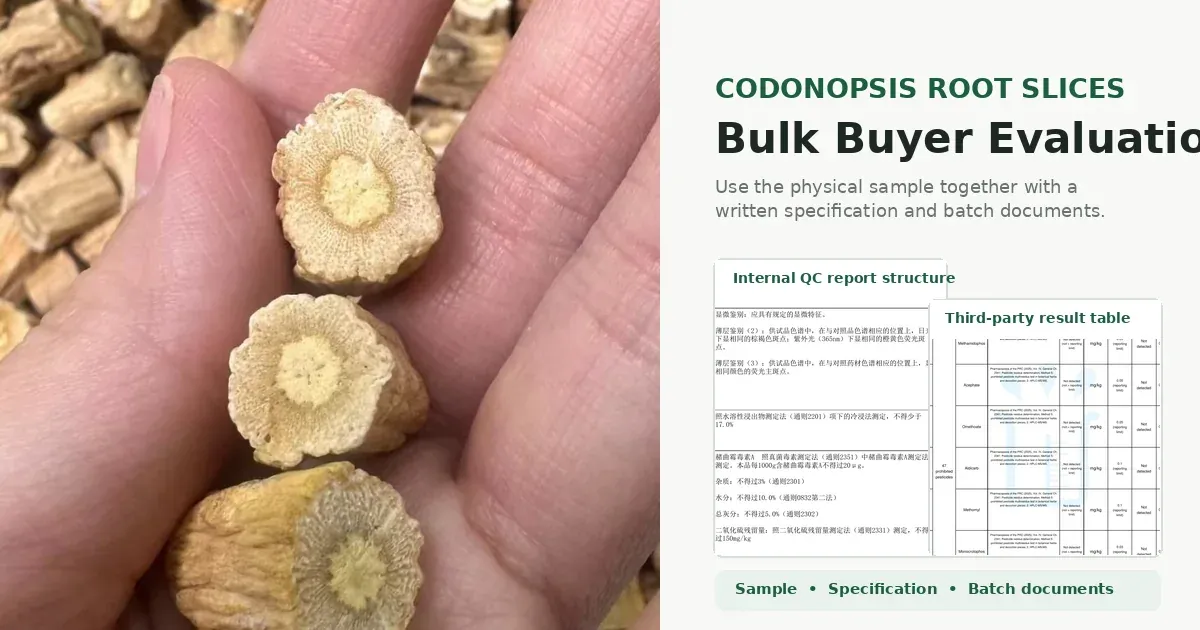
This Codonopsis root buyer guide is written for importers, distributors and manufacturers who need to evaluate Codonopsis (Dang Shen) root slices before placing a bulk order. Buyers should verify the accepted botanical source, plant part, origin, slice dimensions, grade definition, physical condition, processing requirements, batch COA and an approved sample. Appearance and origin are useful screening factors, but they do not replace a written specification and testing.
Before requesting a quote or approving a sample, procurement and QA teams should have clear answers on the following points:
Each of these points is discussed in more detail below. For the broader due-diligence process around supplier vetting, contracts and shipment, see our bulk Chinese herbs sourcing checklist.
Codonopsis is the genus name. Dang Shen is the Chinese trade name commonly used for Codonopsis Radix, the dried root material. In practice, the trade name alone does not identify a single botanical species — buyers who order “Dang Shen” without further specification may receive material from more than one accepted botanical source. For root-slice purchases, state the plant part explicitly as dried root.
Depending on the applicable pharmacopoeial reference or a buyer’s own specification, the following botanical sources may be referenced for Codonopsis Radix:
Not every buyer accepts all three. The accepted botanical source should be defined by the buyer’s applicable pharmacopoeial reference or written specification, rather than assumed from the trade name.
The international standard for this material is narrower than the pharmacopoeial entry. ISO 22585:2022 covers Codonopsis pilosula root only — a single botanical source — while the Chinese Pharmacopoeia entry for Codonopsis Radix recognises three. A batch of C. tangshen or C. pilosula var. modesta can satisfy the pharmacopoeial botanical identity requirement and still fall outside the scope of ISO 22585:2022. A supplier stating “ISO 22585 compliant” is therefore making a narrower identity claim than one stating “Chinese Pharmacopoeia compliant” — and if the delivered material is either of the other two sources, the ISO claim is not available at all. Buyers citing ISO 22585 on a purchase order should confirm the delivered species separately, in writing.
| Trade or Document Name | Botanical Source | Typical Use in Documents | Buyer Verification Point | Important Limitation |
|---|---|---|---|---|
| Dang Shen / Codonopsis Radix | C. pilosula, C. pilosula var. modesta, or C. tangshen under the applicable pharmacopoeial reference | General trade and export documentation | Confirm which botanical source is included in the batch and request the botanical name on the COA | The trade name alone does not identify a single species |
| Codonopsis pilosula | Codonopsis pilosula | COA and technical specification | Confirm that this species is accepted by the buyer’s specification | Acceptance should not be assumed without written confirmation |
| Codonopsis pilosula var. modesta | Codonopsis pilosula var. modesta | COA and technical specification, where applicable | Confirm whether this variety is accepted | Not automatically included in every buyer’s accepted-source list |
| Codonopsis tangshen | Codonopsis tangshen | COA and technical specification, where applicable | Confirm whether this species is accepted | Not automatically included in every buyer’s accepted-source list |
Gansu is one of the main commercial production regions for Codonopsis in China. Other production areas include Shanxi, Shaanxi, Sichuan and other regions.
Origin is a useful reference point, but it is not proof of botanical identity, grade or contaminant compliance on its own. Buyers should request:
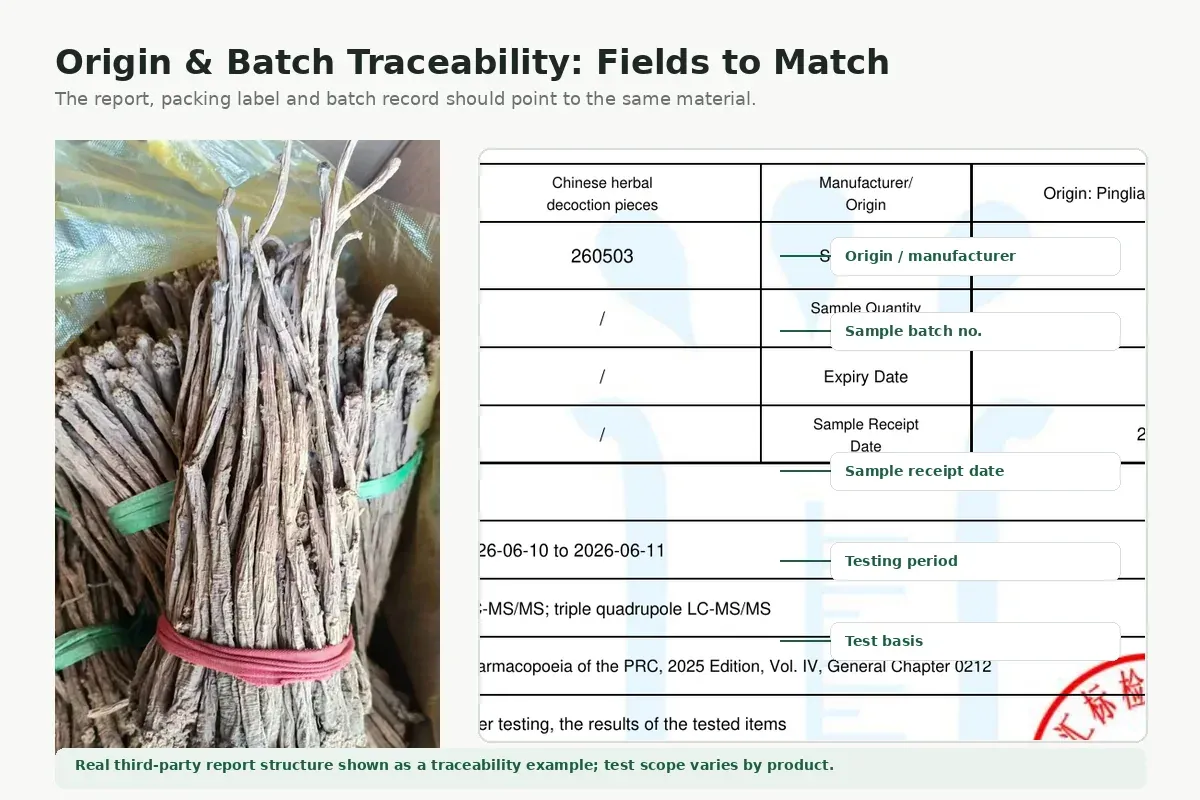
Origin declarations support traceability and a written commercial specification. They do not, by themselves, confirm species identity, grade consistency or compliance with contaminant limits — those require documentation and, where applicable, laboratory testing. See our sourcing and origin page for more on how Aile Herb documents origin across its herb catalog.
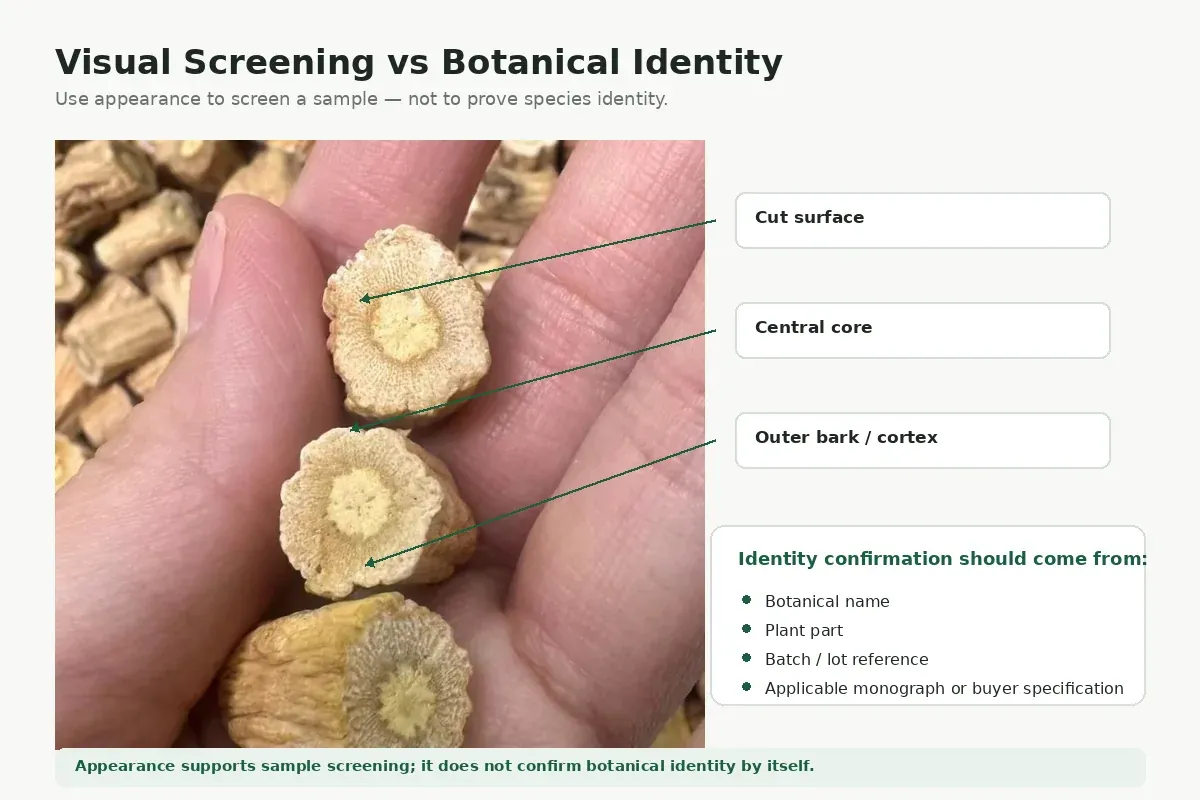
The following characteristics can be assessed by direct inspection of a sample or a representative batch photo:
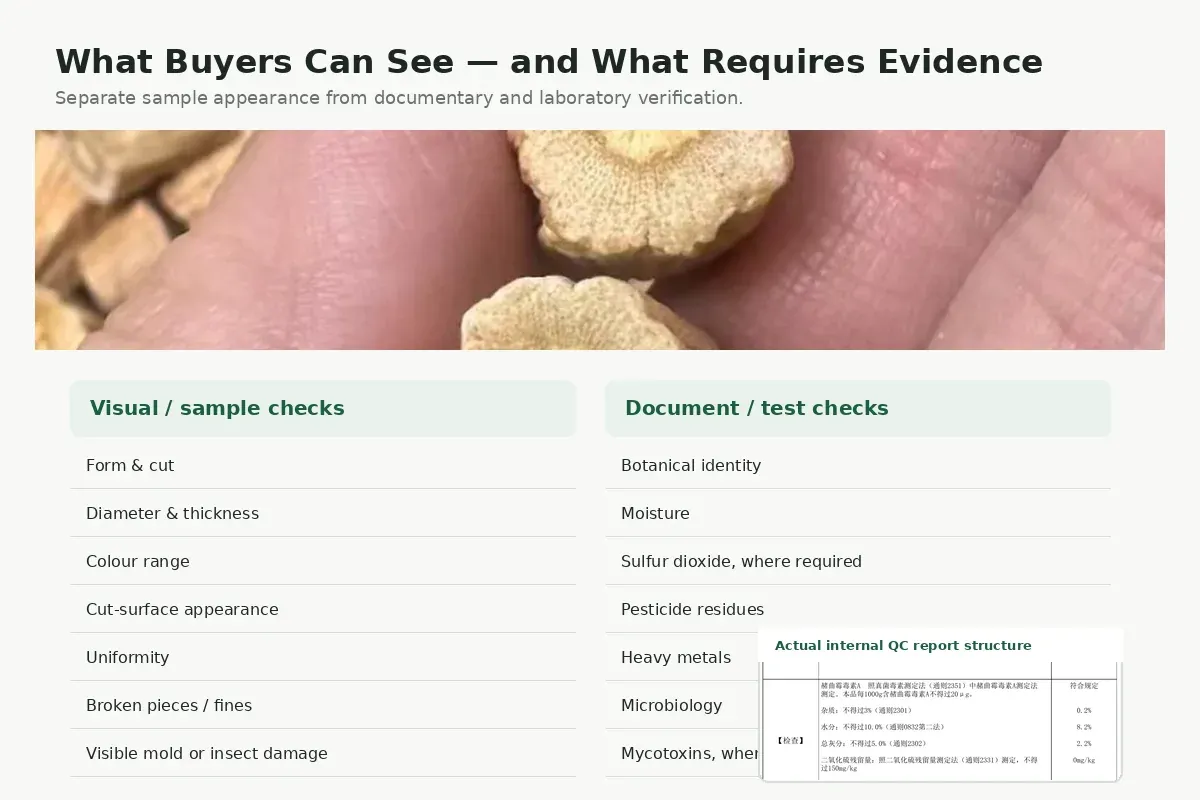
Some variation in these characteristics is normal and can result from differences in origin, botanical source, root size, drying method, storage conditions and cutting method. Colour, sweetness, size and general appearance are useful screening cues, but they are not proof of botanical authenticity or of compliance with any safety limit.
The following cannot be confirmed by visual inspection alone and require documentation or laboratory testing:
Visual inspection is a screening tool, not a substitute for laboratory or documentary evidence. A visually acceptable batch may still fail the written specification after documentary or laboratory review.
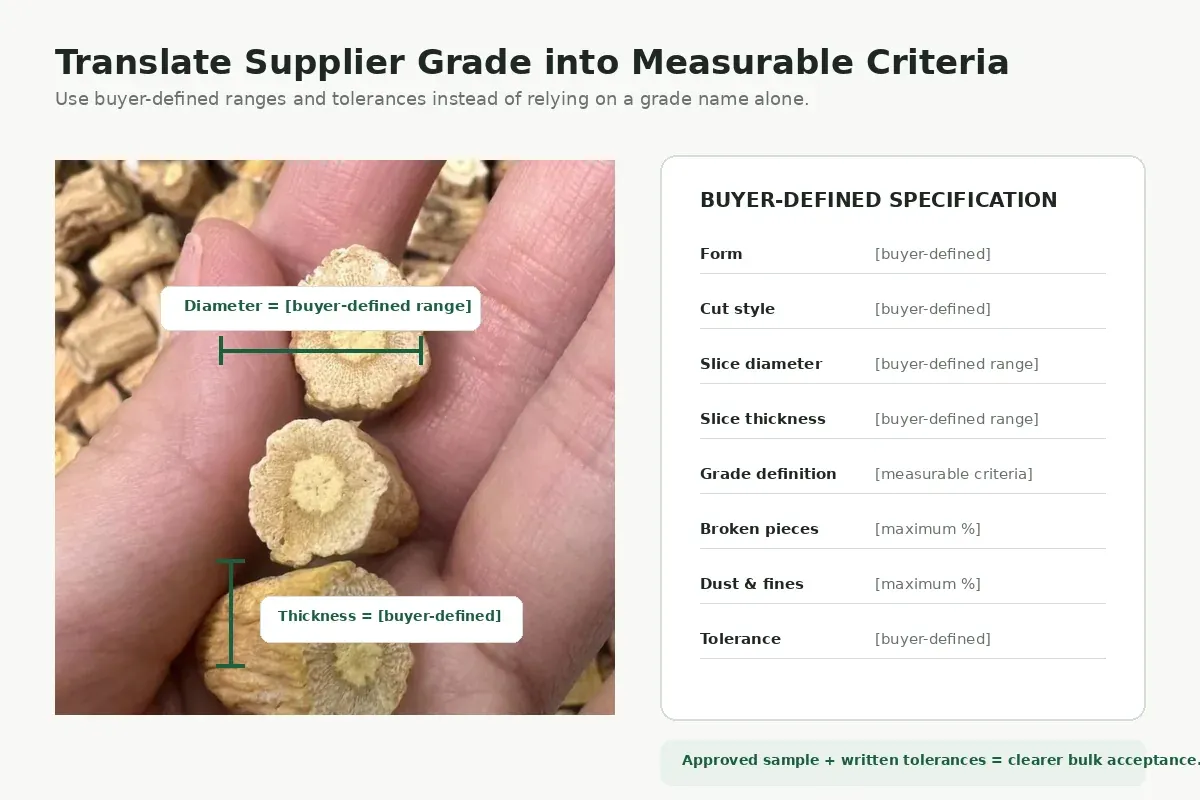
Commercial grade labels for Codonopsis are supplier- or market-defined rather than one universal system. For how to convert grade language into measurable, enforceable purchase-order criteria, see our Chinese Herbal Slice Grades guide.
Excess moisture increases the risk of mold and insect activity during storage and transport. Buyers should define an acceptable moisture limit appropriate to their applicable pharmacopoeial reference or their own specification, rather than relying on a general assumption.
Other storage and processing points to confirm in writing:
Sulfur treatment may be used in some Codonopsis supply chains, but it is not universal, and it should not be assumed to be required or absent without confirmation.
Colour alone cannot prove sulfur-free status, since colour can also be influenced by origin, drying method and age. “Sulfur-free” should be defined precisely in the written purchase specification, and buyers may request sulfur-dioxide testing where their market or application requires it.
Processing claims — such as “unsulfured” or a specific drying method — should relate to the specific batch being supplied, not to the supplier’s product line in general.
When a purchase order names the Chinese Pharmacopoeia, the 2025 edition (in force since 1 October 2025, NMPA announcement) sets the following requirements for Codonopsis Radix. For ordinary Dang Shen slices, the identification, checks and extractives are the same as for the crude root.
| Parameter | Ch.P. 2025 requirement |
|---|---|
| Botanical sources | Codonopsis pilosula (Franch.) Nannf., C. pilosula Nannf. var. modesta (Nannf.) L.T. Shen, or C. tangshen Oliv.; dried root |
| Root size (crude root) | C. pilosula: 10–35 cm long, 0.4–2 cm diameter; var. modesta: 10–35 cm, 0.5–2.5 cm; C. tangshen: 10–45 cm, 0.5–2 cm |
| Slice format | Thick slices (2–4 mm under General Chapter 0213) |
| Moisture | ≤ 16.0% (root and ordinary slices); ≤ 10.0% for rice-fried Dang Shen |
| Total ash | ≤ 5.0% |
| Sulfur dioxide residue | ≤ 400 mg/kg (Chapter 2331) |
| Alcohol-soluble extractives | ≥ 55.0% (45% ethanol, hot extraction, Chapter 2201) |
| Identification | Microscopy and TLC against lobetyolin reference |
| Marker assay | None in the monograph |
| Pesticides | 47 prohibited pesticides (72 analytes) under General Chapter 0212 |
Two points buyers often miss. First, the Codonopsis monograph allows sulfur dioxide up to 400 mg/kg, higher than the 150 mg/kg general limit that applies to many other herbs, so “Chinese Pharmacopoeia compliant” does not mean sulfur-free. A buyer who needs non-sulfured material should state a lower SO₂ limit and a no-fumigation declaration on the PO. Second, the monograph has no quantitative marker assay, so batch-to-batch comparison relies more on identity, physical grade and extractive value than it does for herbs such as Astragalus.
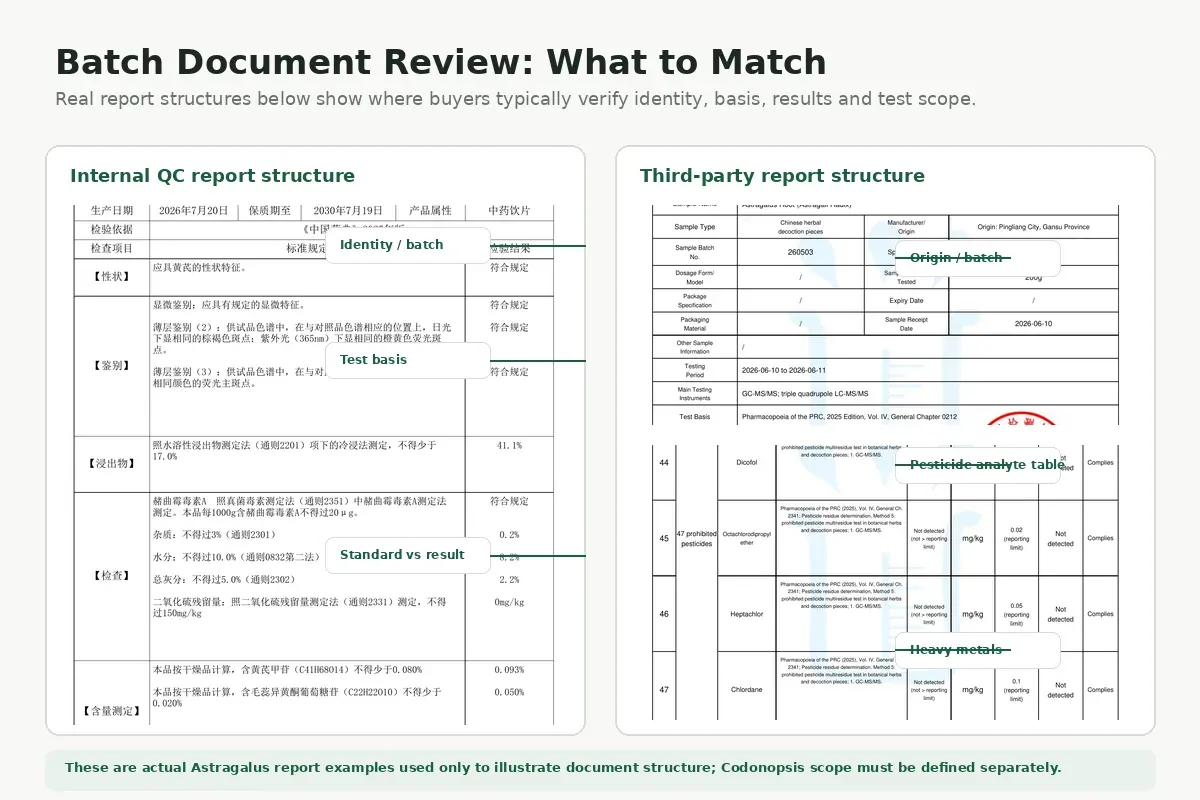
A Certificate of Analysis for Codonopsis root slices is not the same for every buyer or every market. The scope of testing depends on the destination market, the buyer’s own specification and the intended use of the material.
This section focuses on what is specific to Codonopsis. For a general explanation of how to read a COA for Chinese herbs, see our Certificate of Analysis buyer guide.
| Category | Typical Fields |
|---|---|
| Core Identity and Traceability | Product name, botanical name, plant part, origin, product form, batch number |
| Common Quality Fields | Identity test, moisture, ash, extractives, foreign matter |
| Market-Dependent Safety Fields | Pesticide residues, heavy metals, sulfur dioxide, microbiology, mycotoxins where applicable |
| Buyer- or Pharmacopoeia-Dependent Fields | Marker assay, method references, additional contaminants, market-specific acceptance limits |
Not every Codonopsis COA needs to contain the same tests. The appropriate scope should be agreed between buyer and supplier before the order is confirmed, based on the destination market’s regulatory requirements and the buyer’s own quality specification.
For questions on testing capability and scope, see our in-house laboratory and quality control process pages.
A written purchase specification reduces disputes and gives both parties a clear reference for accepting or rejecting a batch. The following template can be adapted for a specific order:
| Product | Codonopsis (Dang Shen) Root Slices |
| Accepted botanical source | [Specify accepted species or variety] |
| Plant part | Dried root |
| Origin | [Accepted origin or origin range] |
| Form | [Whole root / Round slices / Segments / Custom cut] |
| Slice diameter | [Buyer-defined range] |
| Slice thickness | [Buyer-defined range] |
| Grade | [Supplier grade plus measurable definition] |
| Colour and appearance | [Approved range] |
| Texture and odour | [Approved description] |
| Broken pieces | [Maximum percentage] |
| Dust and fines | [Maximum percentage] |
| Foreign matter | [Maximum percentage] |
| Moisture | [Applicable pharmacopoeial or buyer-defined limit] |
| Sulfur requirement | [Defined processing requirement and/or test limit] |
| Pesticide residues | [Required scope] |
| Heavy metals | [Required scope] |
| Microbiology | [Required scope] |
| Packaging | [Material, unit weight and outer packaging] |
| Storage | [Required condition] |
| Documents | [COA, origin declaration, batch photos, packing list and other required documents] |
| Sample approval | [Retained sample and acceptable tolerance] |
An approved sample should be physically retained by the buyer or a third party and compared against the bulk shipment before final acceptance.
Any deviation beyond the agreed tolerance should trigger a QA review rather than automatic rejection or automatic acceptance.
Sample-evaluation checklist:
Each of these points calls for clearer definition or additional evidence. None of them is, by itself, proof of supplier misconduct.
No. Dang Shen is a trade name for Codonopsis Radix and, depending on the applicable pharmacopoeial reference, may be associated with more than one accepted botanical source. Buyers who need a specific species should state this requirement in writing rather than relying on the trade name alone.
No. Gansu is a well-known commercial production region, but origin alone does not guarantee grade, botanical identity or compliance with any safety limit. Origin should be treated as one part of a written specification, supported by batch documentation and, where relevant, testing.
No. Colour and size are useful screening cues but cannot confirm botanical identity, sulfur-free status or contaminant compliance. These characteristics can vary naturally due to origin, drying method and storage. Documented testing is needed to confirm safety-related claims.
Typical fields include the botanical name, plant part, origin, batch number, identity test, moisture, ash and extractives, along with market-dependent safety fields such as pesticide residues, heavy metals and sulfur dioxide where applicable. The exact scope should be agreed with the supplier based on the destination market.
What are the Chinese Pharmacopoeia 2025 specifications for Codonopsis root slices? Ch.P. 2025 accepts three botanical sources (C. pilosula, C. pilosula var. modesta and C. tangshen). Ordinary Dang Shen slices are thick slices and must meet moisture ≤16.0%, total ash ≤5.0%, sulfur dioxide ≤400 mg/kg and 45% ethanol-soluble extractives ≥55.0%. Rice-fried Dang Shen has a tighter moisture limit of ≤10.0%. The monograph has no marker-compound assay.
Since there is no universal grade system for Codonopsis, “Grade I” should be tied to measurable criteria such as diameter range and maximum broken-piece percentage, agreed in writing with the supplier before the order is confirmed.
Not necessarily. The need for sulfur-dioxide testing depends on the buyer’s specification and the requirements of the destination market. Buyers who require a sulfur-free or low-sulfur product should state this explicitly and request the relevant test on the COA. Note that the Ch.P. 2025 limit for Codonopsis is 400 mg/kg, so a pharmacopoeial pass does not by itself show that the material is low-sulfur.
To request a sample and the current batch COA, please provide:
Request a Codonopsis Sample and COA
Product availability, test scope and documentation vary by batch and destination market.
To source Codonopsis (Dang Shen) root slices, review our root and rhizome herbs range and request a sample and COA against your slice specification.
