Tell Us About Your Project
Share your product, quantity and project requirements. We will review the details and respond with the relevant next steps.

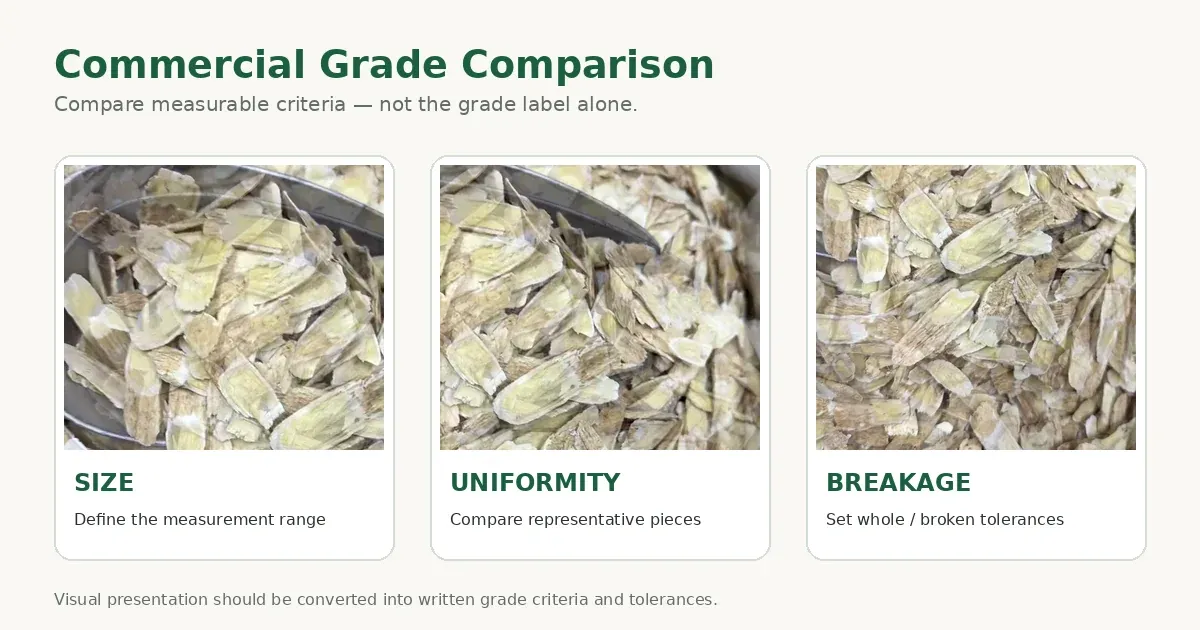
Grade I, Grade II and Premium are commercial grading labels. They do not have one universal meaning across suppliers. Two suppliers may use different sorting criteria for the same grade name. Compare the written grade definition and approved sample before comparing quotations.
A commercial grade is usually a sorting or presentation label based on criteria such as size, uniformity, breakage, visible defects or other product-specific fields.
The meaning depends on the grading system being used.
| Grade Source | What It Means for the Buyer |
|---|---|
| Supplier internal grade | Ask for written criteria |
| Buyer specification | Use agreed tolerances as the acceptance standard |
| Product-specific standard | Confirm the exact herb, edition and scope |
| “Premium / Selected” | Treat as commercial terminology unless defined |
A grade may also reflect origin, processing state or other commercial requirements when these are specifically included in the supplier or buyer specification.
Some herbs have formal commercial grading systems. However, there is no single Grade I definition that applies to all Chinese medicinal materials.
Suppliers may use different physical criteria for the same “Grade I” label. A sliced root also needs different grading criteria from a flower, leaf, fruit or seed.
Treat a grade name as a supplier-specific or standard-specific commercial classification until the underlying criteria are defined in writing.
This is why buyers should ask what grading system is being used before comparing quotations.
In China, commodity grading of medicinal materials does have a formal framework. The commerce-industry standard SB/T 11173-2016 sets the general rules for commodity specifications and grades, and herb-by-herb group standards issued by the China Association of Chinese Medicine (the T/CACM 1021 series) define the actual grade criteria for individual herbs. The criteria change from herb to herb — some grade by root or slice diameter, others by the number of pieces per kilogram — which is why one Grade I definition cannot be carried from one herb to another. Chinese institutional purchasing also commonly uses a simpler two-level split: tonghuo (统货, ungraded commercial goods) and xuanhuo (选货, selected goods). Neither label replaces pharmacopoeial or contaminant testing.
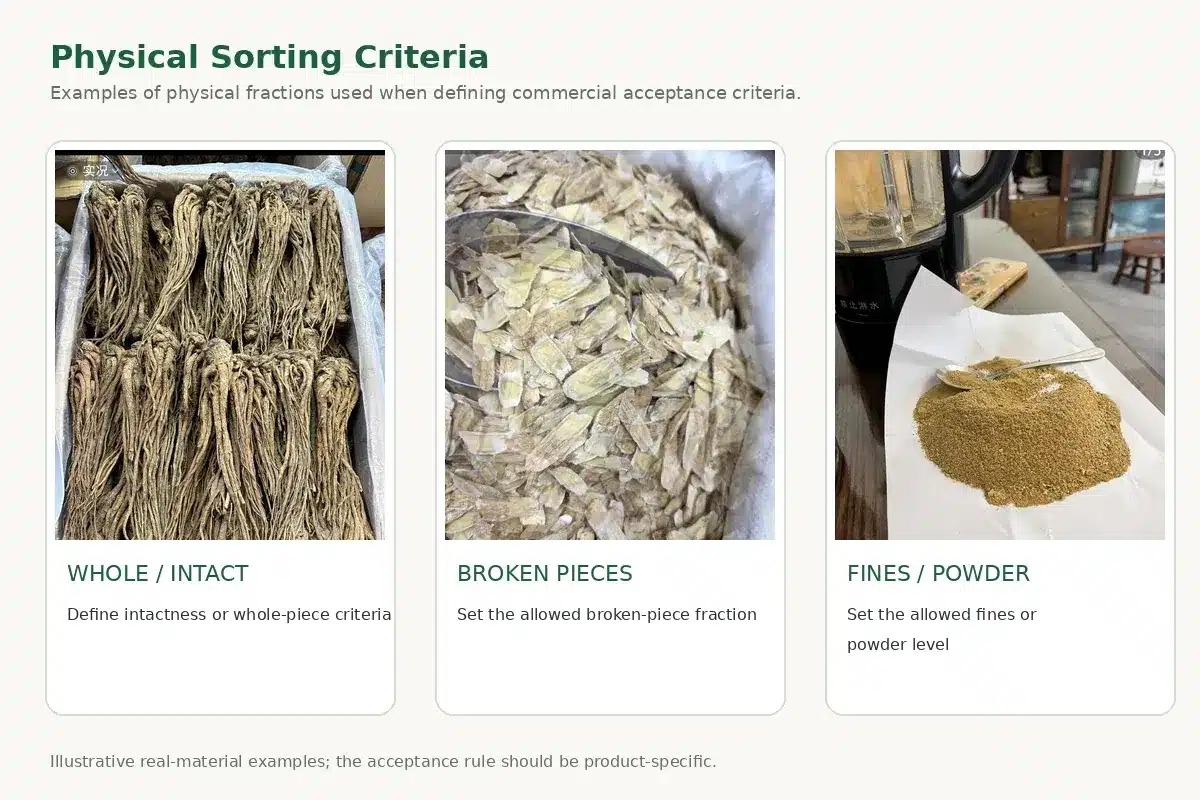
Commercial grading and pharmacopoeial or contractual compliance answer different procurement questions.
| Requirement | What It Controls | Commercial Grade? |
|---|---|---|
| Botanical identity | Correct species and material | No |
| Plant part / product form | What is supplied | No |
| Pharmacopoeial conformity | Applicable identity, quality and test requirements | No, by itself |
| Size / appearance / uniformity | Commercial presentation | Can define grade |
| Whole-piece / broken-piece ratio | Sorting quality | Can define grade |
| Processing status | How material was prepared | Separate specification field |
| Analytical tests | Moisture, SO₂, pesticide residues, heavy metals, etc. | Analytical compliance |
| Packing | Delivery format | Not material grade |
A batch may meet the applicable pharmacopoeial or contractual requirements while being sold in different commercial grades. Commercial appearance and analytical compliance should therefore be evaluated separately.
A higher commercial grade does not automatically mean better analytical results, and a lower commercial grade does not automatically indicate regulatory failure.
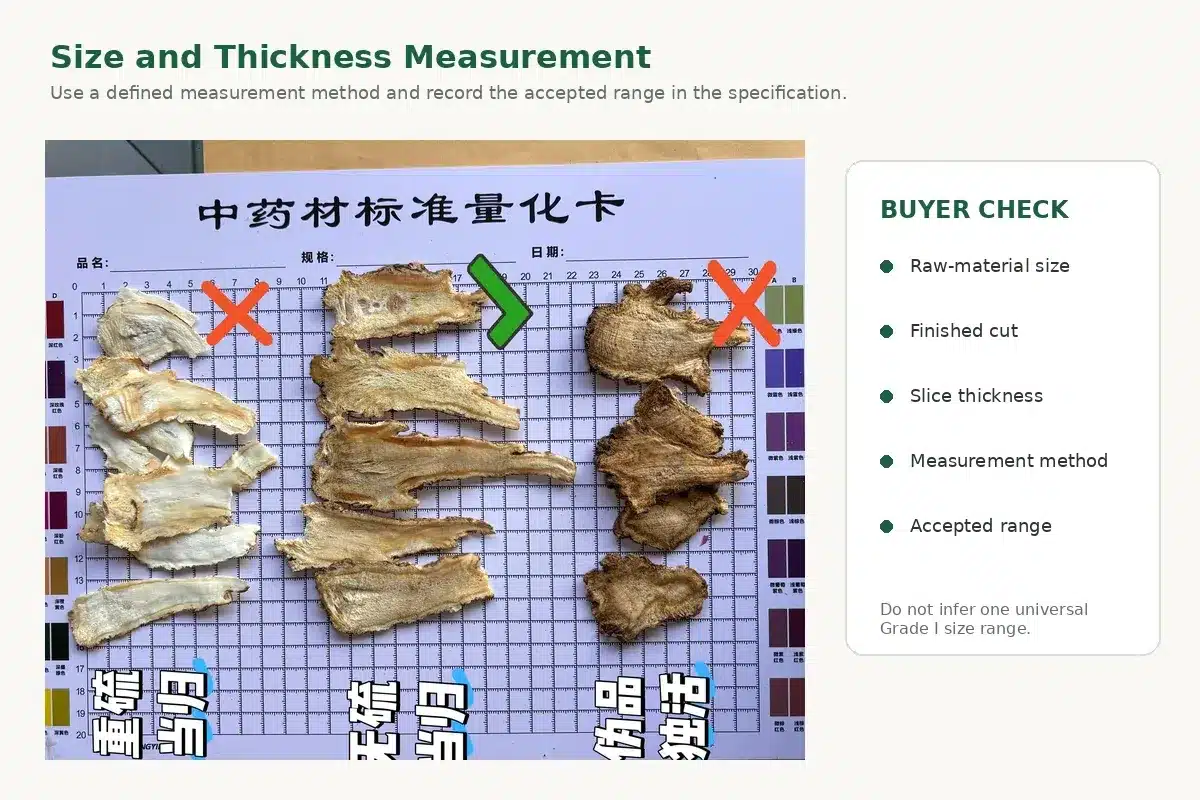
Commercial grade criteria may include:
Buyers should define only the fields relevant to the specific herb and intended use.
Numeric limits should be agreed in the purchase specification rather than assumed from the grade name.
For example:
[agreed range][agreed range][agreed minimum][agreed maximum][agreed maximum]Commercial grade should be kept separate from:
These fields may appear in the same purchase specification, but they should not be assumed from a Grade I, Grade II or Premium label.
Visual inspection can assess visible presentation. It cannot confirm sulfur status, pesticide compliance or heavy-metal compliance.
Astragalus / Huang Qi — Root or slice diameter, cut direction, thickness, uniformity and breakage may be commercially relevant.
Angelica sinensis / Dang Gui — Root form, cut, surface condition and herb-specific morphology may matter more than a generic diameter rule.
Codonopsis / Dang Shen — Root size and slice presentation may matter, but its criteria should not simply copy Astragalus.
Flowers / Leaves — Intactness, colour, fragmentation and foreign matter may be more useful grading criteria.
Fruits / Seeds — Size, maturity, intactness and impurity may matter more than diameter alone.
The grading criteria should therefore follow the material being purchased rather than one fixed Grade I / II / III checklist. Buyers can review the available Chinese herbal slices range after confirming the grade and specification required for each herb.
The example below is illustrative only and does not represent actual Aile Herb specifications.
Supplier A: Grade I Astragalus Slices
vs.
Supplier B: Grade I Astragalus Slices
| Criterion | Supplier A | Supplier B | Buyer Check |
|---|---|---|---|
| Botanical source | [stated / not stated] | [stated / not stated] | Align botanical identity first |
| Origin | [stated origin] | [stated origin] | Decide whether origin is required |
| Raw-material size | [supplier definition] | [supplier definition] | Compare measurement method |
| Finished cut | [cut] | [cut] | Treat separately from raw grade |
| Slice thickness | [agreed range] | [agreed range] | Align finished specification |
| Whole-piece ratio | [agreed minimum] | [not stated] | Require a measurable criterion |
| Broken pieces / fines | [agreed maximum] | [supplier definition] | Align before price comparison |
| Processing status | [defined] | [defined] | Confirm exact commercial form |
| COA scope | [defined scope] | [defined scope] | Compare required analytical evidence |
| Packing | [pack specification] | [pack specification] | Compare delivered basis |
| Approved sample | [reference] | [reference] | Approve before PO |
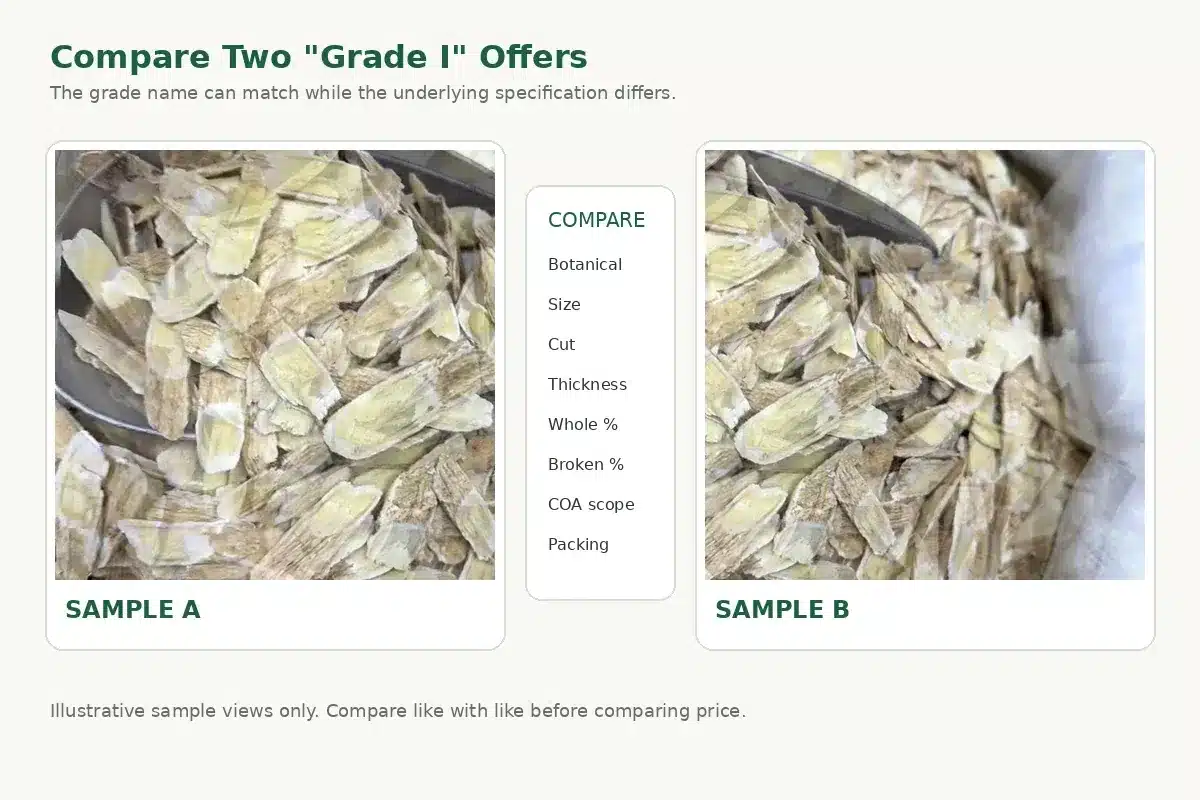
Compare like with like before comparing price.
A lower quotation may simply reflect a different size range, cut, broken-piece allowance, analytical scope or packing specification rather than the same material at a lower price.
Grade Name → Written Grade Criteria → Approved Sample → Signed Specification / PO → Bulk-Batch Verification
The grade name starts the discussion. The written specification and approved sample become the actual acceptance basis.
The written specification should define the measurable commercial fields, processing requirements, analytical scope, packing and documentation expected for the order.
The approved sample provides a physical reference for appearance and presentation, but it should support the written criteria rather than replace them.
Raw-material grade and finished-cut specification are related but separate.
Raw-material size and sorting may be one commercial field. Finished slice thickness, cut direction and dimensions are another.
Custom cutting can change the finished presentation without changing the original raw-material grade. Buyers should therefore avoid assuming that “Grade I” automatically defines slice thickness or cut type.
For the wider specification structure, see the Chinese Herbal Slices Specification Guide.
For specific cutting requirements, see Custom Cutting.
Chinese herbs are agricultural materials, so normal lot-to-lot variation exists.
The objective is defined acceptable variation, not perfect visual sameness.
Useful controls include:
Changes in origin, processing, cut, sorting criteria or packing should be communicated when these fields are contractually controlled.
For repeat purchasing, the buyer should judge whether the new batch remains within the agreed range rather than expect every agricultural lot to look identical.
| Red Flag | Why It Matters | Buyer Follow-Up |
|---|---|---|
| “Premium grade” with no criteria | No measurable comparison basis | Request written definition |
| “Grade I” with no standard reference | Meaning is unclear | Ask what grading system is used |
| Grade changes between quotation and invoice | Commercial scope may have changed | Correct documents before shipment |
| Bulk differs materially from approved sample | Reference is not controlling the shipment | Investigate the deviation |
| Grade defined only by colour | Colour alone is insufficient | Add measurable physical criteria |
| Supplier cannot explain sorting criteria | Grade cannot be verified consistently | Request sorting method and tolerances |
| Grade substitutes for botanical identity | Species or plant-part risk remains | Specify botanical name separately |
| Grade presented as proof of compliance | Commercial sorting is being confused with testing | Request relevant COA or test evidence |
| Same grade covers different cut sizes | Quotations may not be comparable | Separate grade from cut specification |
| Criteria change after sample approval | Repeat-order control is weakened | Require change notification |
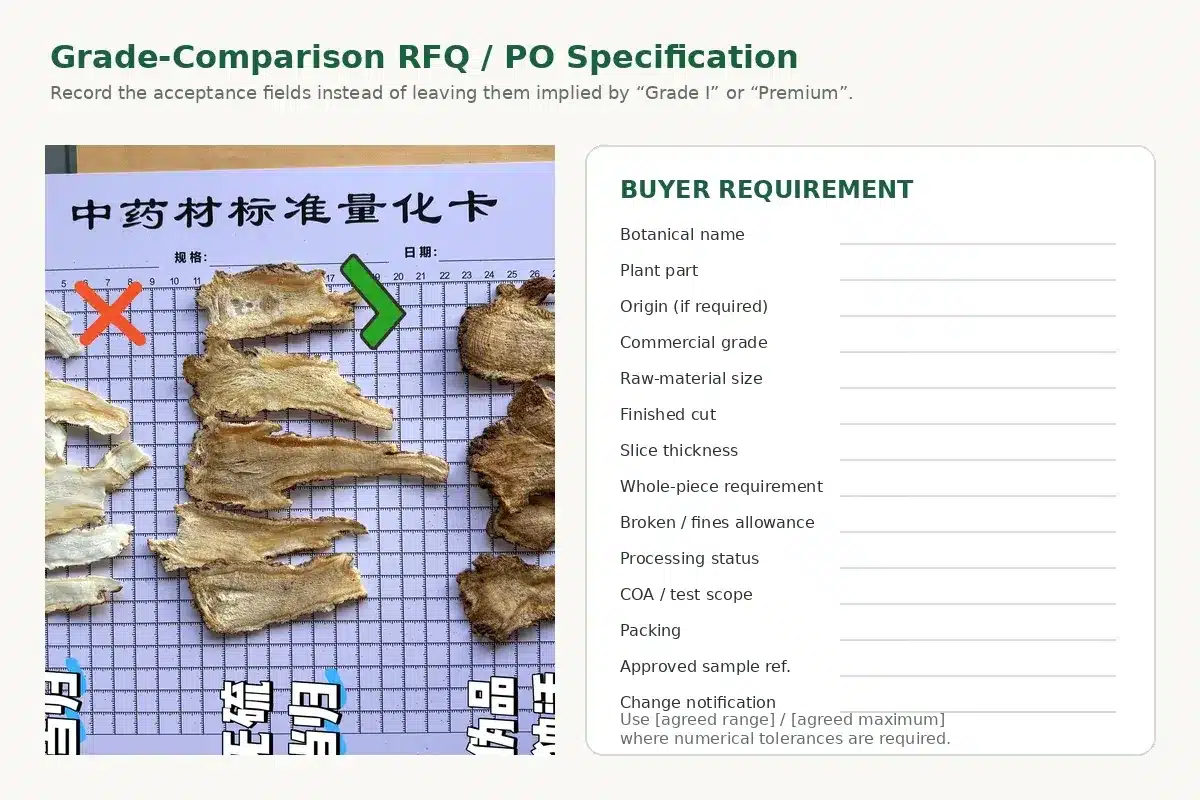
Use the fields below when requesting a quotation or preparing a purchase order so grade, cut, sorting and testing requirements are recorded rather than implied.
| Field | Buyer Requirement |
|---|---|
| Product name | [fill in] |
| Botanical name | [fill in] |
| Plant part | [fill in] |
| Origin requirement | [if applicable] |
| Product form | [fill in] |
| Commercial grade name | [supplier / buyer term] |
| Grade-definition reference | [supplier standard / buyer specification / applicable standard] |
| Raw-material size | [agreed range] |
| Finished cut | [agreed cut] |
| Slice thickness | [agreed range] |
| Whole-piece requirement | [agreed minimum] |
| Broken-piece allowance | [agreed maximum] |
| Fines / powder allowance | [agreed maximum] |
| Foreign matter | [agreed requirement] |
| Colour / visible defects | [agreed criteria] |
| Processing status | [fill in] |
| Sulfur requirement | [requirement + evidence] |
| Moisture / analytical scope | [agreed specification] |
| COA / test scope | [required documents] |
| Approved sample reference | [sample ID / date] |
| Pre-shipment sample / photos | [if required] |
| Packing | [pack specification] |
| Quantity | [fill in] |
| Destination market | [fill in] |
| Batch identification | [required linkage] |
| Change notification | [required / not required] |
For broader sourcing requirements before placing an order, see the Bulk Chinese Herbs Sourcing Checklist.
At receipt, compare the supplied batch with the written specification and approved reference.
Check:
Visual inspection should not be used to determine pesticide, heavy-metal or sulfur compliance.
For analytical documentation, see the Certificate of Analysis Guide.
No. Grade I may refer to a supplier’s commercial sorting system, a buyer specification or a product-specific standard. It is not one classification applied consistently across every Chinese herbal material. Buyers should request the written definition before using the grade for quotation comparison or acceptance.
Is there an official grading standard for Chinese herbal slices? There is a framework, not one universal grade. SB/T 11173-2016 sets general grading rules, and the T/CACM 1021 group standards define grades herb by herb. Buyers should ask which standard and which herb-specific part a supplier’s “Grade I” refers to, then write the measurable criteria into the purchase specification.
Not by name alone. Two suppliers may use different criteria for size, uniformity, breakage, processing or presentation under the same Grade I label. Compare the underlying specification, approved sample, test scope and packing before comparing price.
Not automatically. Commercial grade describes sorting or presentation, while pharmacopoeial conformity addresses applicable identity, quality and test requirements. These should be verified separately according to the agreed product and destination-market requirements.
No. Appearance, size and visible defects can be checked visually, but sulfur status, pesticide residues and heavy metals require appropriate documentation and laboratory testing according to the agreed specification.
Yes. An approved sample provides a useful physical reference for size, cut and appearance. It should be used together with written tolerances, processing requirements and analytical scope so the later bulk shipment can be evaluated consistently.
Define acceptable variation rather than require identical appearance. Use measurable tolerances, a dated reference sample, representative batch photos and pre-shipment samples where appropriate. Require notification when controlled fields such as origin, processing, cut or sorting criteria change.
Send your herb name, botanical name where available, destination market, required cut, commercial grade or sorting criteria, analytical or testing scope, and quantity.
Aile Herb can review the specification before quotation and prepare a representative sample for approval.
To define the grade, cut and sorting criteria before quotation, see our custom cutting and specifications service and request a representative sample for approval.
