Tell Us About Your Project
Share your product, quantity and project requirements. We will review the details and respond with the relevant next steps.

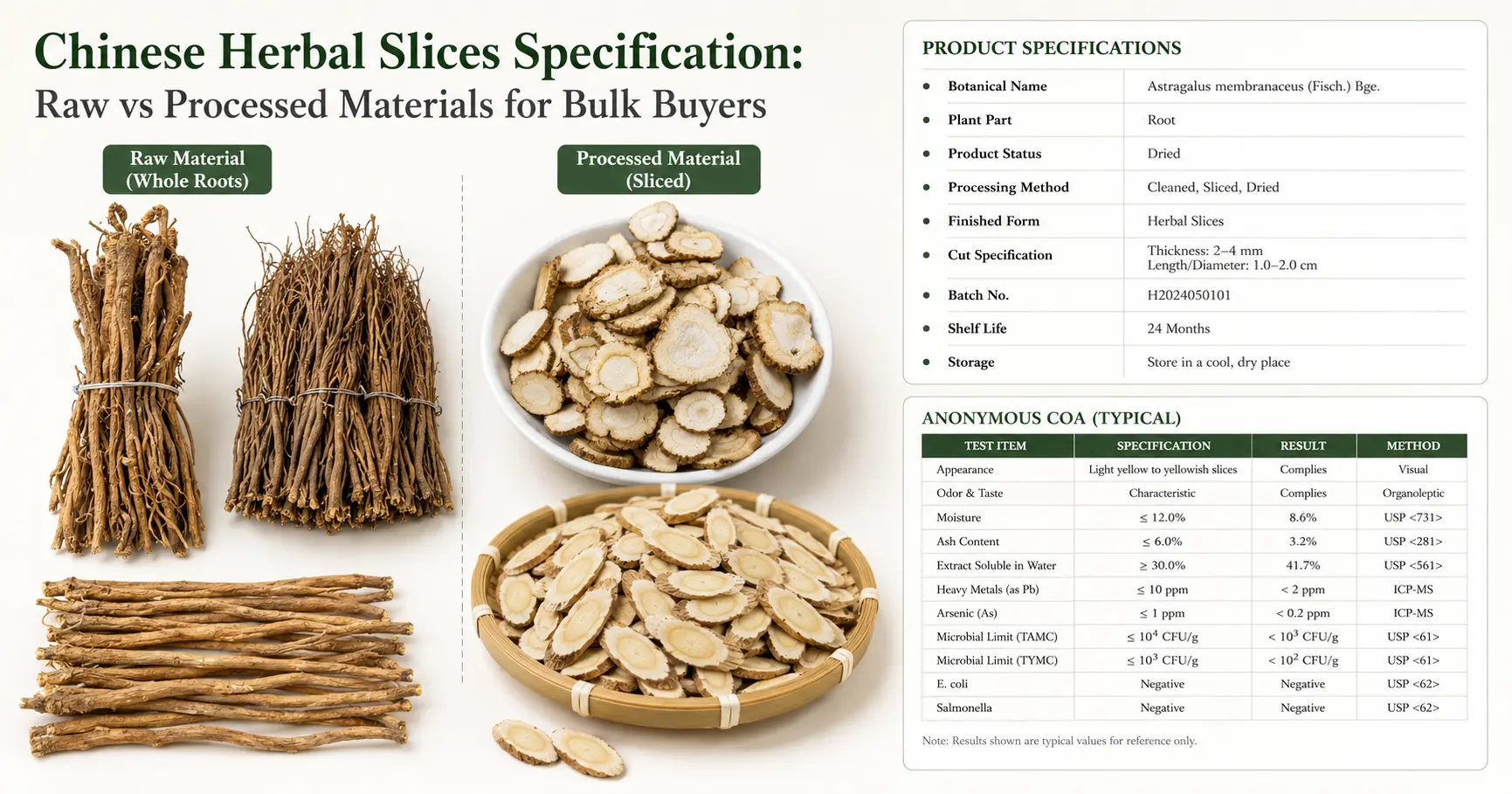
A Chinese herbal slices specification should define more than the herb name. Buyers should confirm the botanical source, plant part, processing status, finished form, cut dimensions and packaging. The specification should also state the required finished-batch COA and traceability information. Cleaning, cutting or further processing can turn the same botanical material into a different purchasing item.
Terms such as raw, cleaned, cut and processed should be defined before an RFQ becomes a purchase order.
A complete specification should normally identify:
If the purchase order lists only the herb name, the finished form remains open to supplier interpretation. Define the processing status, form and dimensions before order confirmation.
For the broader supplier, sample and shipment review process, see the Bulk Chinese Herbs Sourcing Checklist.
Chinese herbal slices can be supplied in several commercial states. In technical and Chinese regulatory contexts, they are also often called Chinese herbal decoction pieces.
These states should be treated as separate specifications where they affect the material being purchased.
| Product State | What Has Physically Happened | What the Buyer Should Specify | Separate Commercial Specification? |
|---|---|---|---|
| Dried raw material | Dried source material, potentially whole or naturally fragmented | Botanical identity, plant part, origin, dried state and cleaning requirement | Yes |
| Cleaned material | Foreign material or non-required plant portions have been removed | Cleaning scope, foreign-matter requirement and whole/cut form | Usually |
| Cut or sliced material | Material has been cut, sliced or segmented and dried | Cut style, dimensions, broken pieces, fines, moisture and approved sample | Yes |
| Processed decoction piece | Material has undergone a named processing operation | Exact method, auxiliary material where applicable, finished form and applicable specification | Yes |
| Powder | Material has been size-reduced | Identity method, particle size or mesh and batch specification | Yes |
| Extract | Material has been extracted and concentrated or dried | Extraction process, ratio or equivalent specification, marker/fingerprint and carrier status where relevant | Yes |
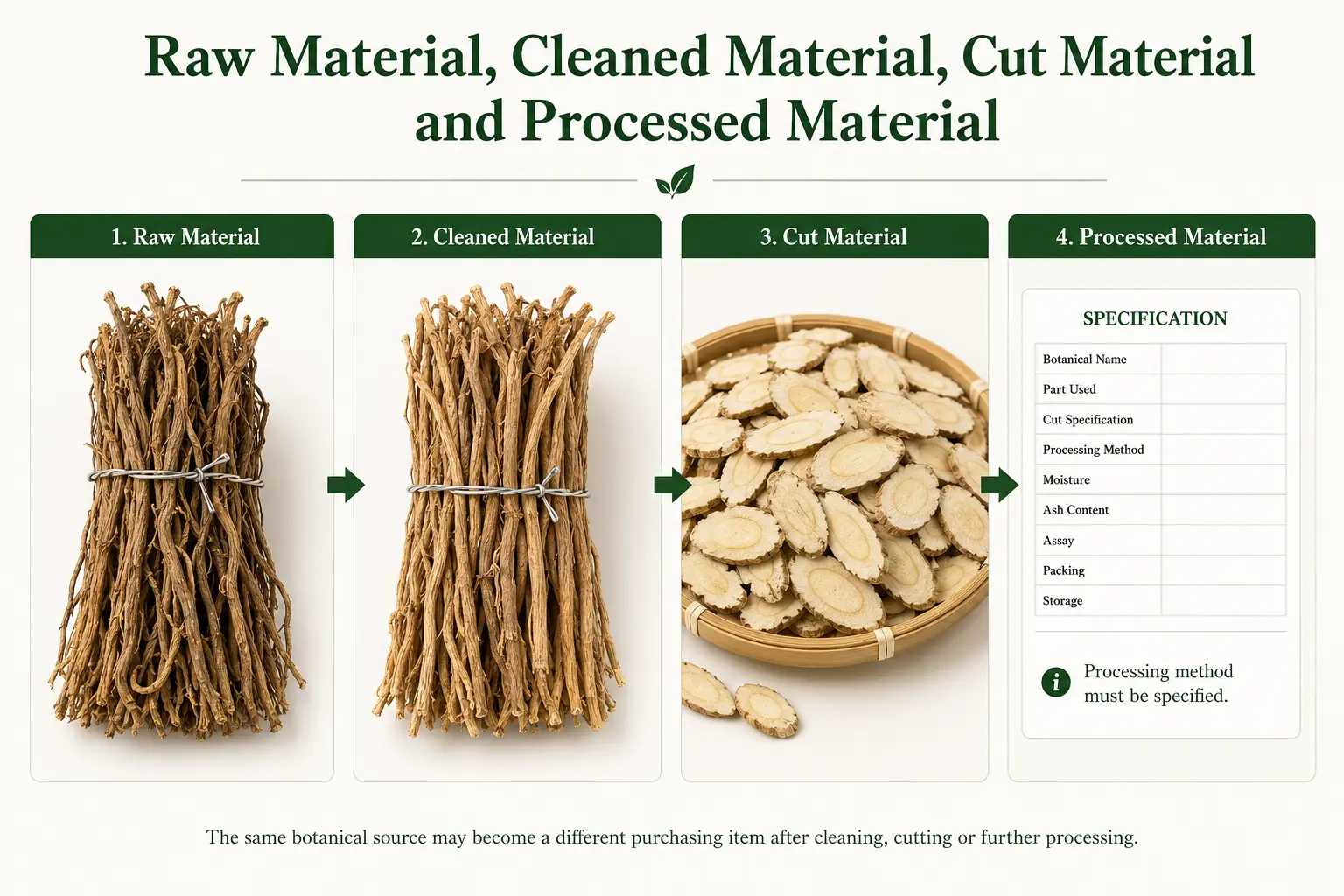
“Raw” should not be interpreted as field-fresh, unwashed or completely untreated. A raw herbal material may already have undergone drying and primary post-harvest handling.
Likewise, “processed” is too broad to stand alone in a purchase specification. It may refer to cleaning and cutting, or to a specific additional processing method.
For available supply forms, see Chinese Herbal Slices. For bulk fruit and seed materials, browse our Fruit & Seed Herbs category.
Chinese processing terms do not always have one direct English manufacturing equivalent. Buyers should focus on what was actually done to the materia
| Term | Buyer-Facing Meaning | What Should Be Specified | Why the Term Alone Is Not Enough |
|---|---|---|---|
| Sheng / 生 | Raw or non-specially-processed form | Physical form, cleaning status and cut status | “Raw” does not automatically mean whole, unwashed or uncut |
| Jingzhi / 净制 | Cleaned | Cleaning scope and foreign-matter requirement | Cleaning procedures can vary by product |
| Qiezhi / 切制 | Cut or sliced | Cut style, dimensions, broken pieces and fines | It identifies cutting, not the complete product specification |
| Paozhi / 炮制 | Processed or prepared | Exact processing method and finished form | It describes a broad processing category |
| Chao / 炒 | Stir-fried | Named method and approved finished appearance | Colour alone does not define the process |
| Mi Zhi / 蜜炙 | Honey-processed | Processing status and auxiliary-material declaration | The auxiliary material becomes part of the processing specification |
| Jiu Zhi / 酒炙 | Wine-processed | Processing status and auxiliary-material declaration | The exact requirement may depend on the product or buyer specification |
| Cu Zhi / 醋炙 | Vinegar-processed | Processing status and auxiliary-material declaration | “Vinegar-processed” alone may not define every required parameter |
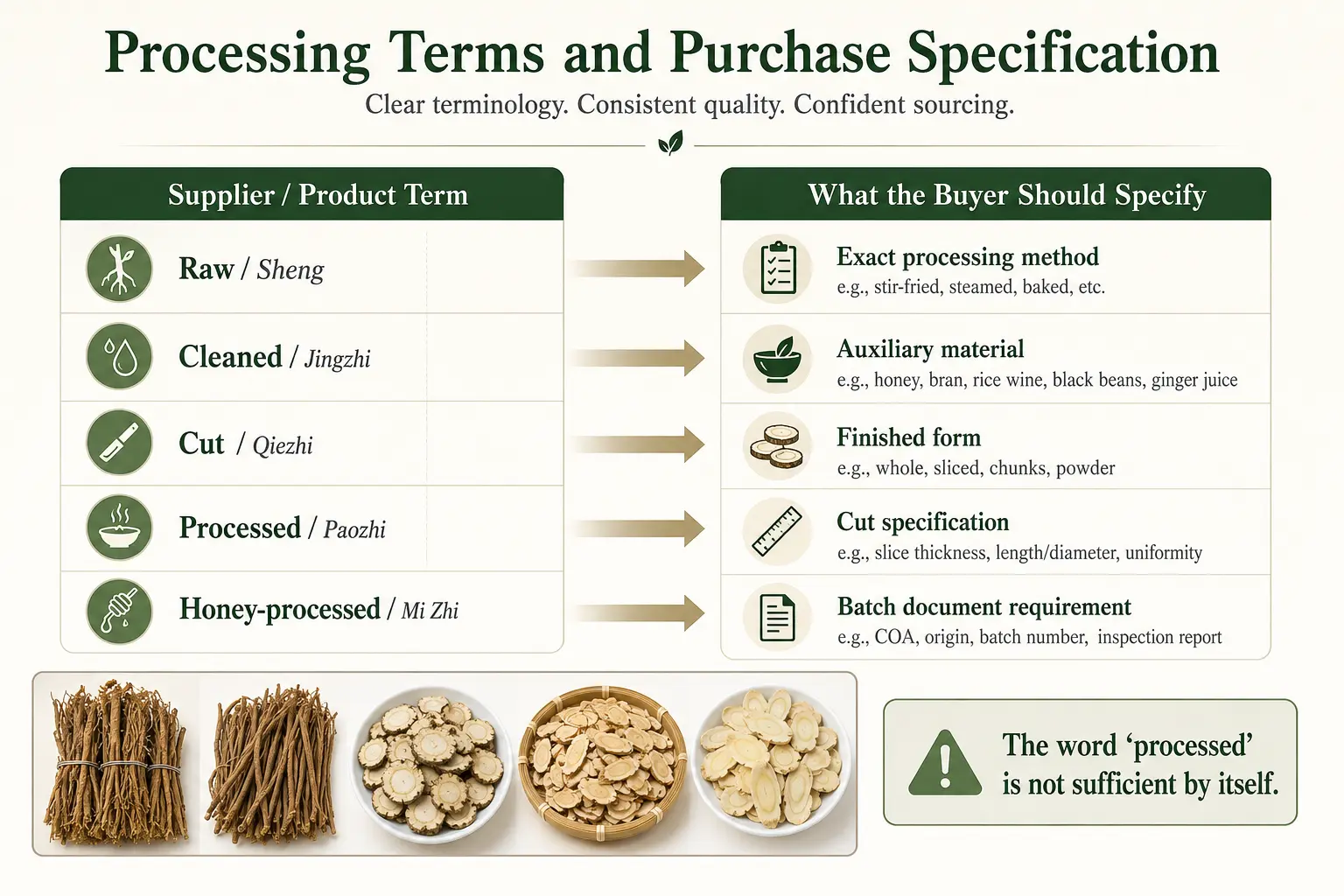
Other herb-specific processes may include steaming, boiling, salt processing or carbonizing. Where relevant, the purchase specification should name the exact process instead of using only the word “processed.”
For a processed material, specify:
A high-level overview of Aile Herb’s processing workflow is available under Processing Equipment & Workflow.
Botanical identity may remain the same while the commercial product changes after cutting or processing.
A practical purchase-order naming structure is:
Product name / Chinese name or pinyin / botanical name / plant part / processing status / processing method / finished form / cut specification / batch-document requirements
For example:
Codonopsis (Dang Shen) Root Slices / accepted botanical source as specified / dried root / cleaned and sliced / no auxiliary-material processing / round slices / buyer-defined dimensions / finished-batch COA required
This is an example of purchase-order structure, not a universal Codonopsis specification.
The principle is simple: botanical identity identifies the material, while processing status and finished form identify what the buyer is actually ordering.
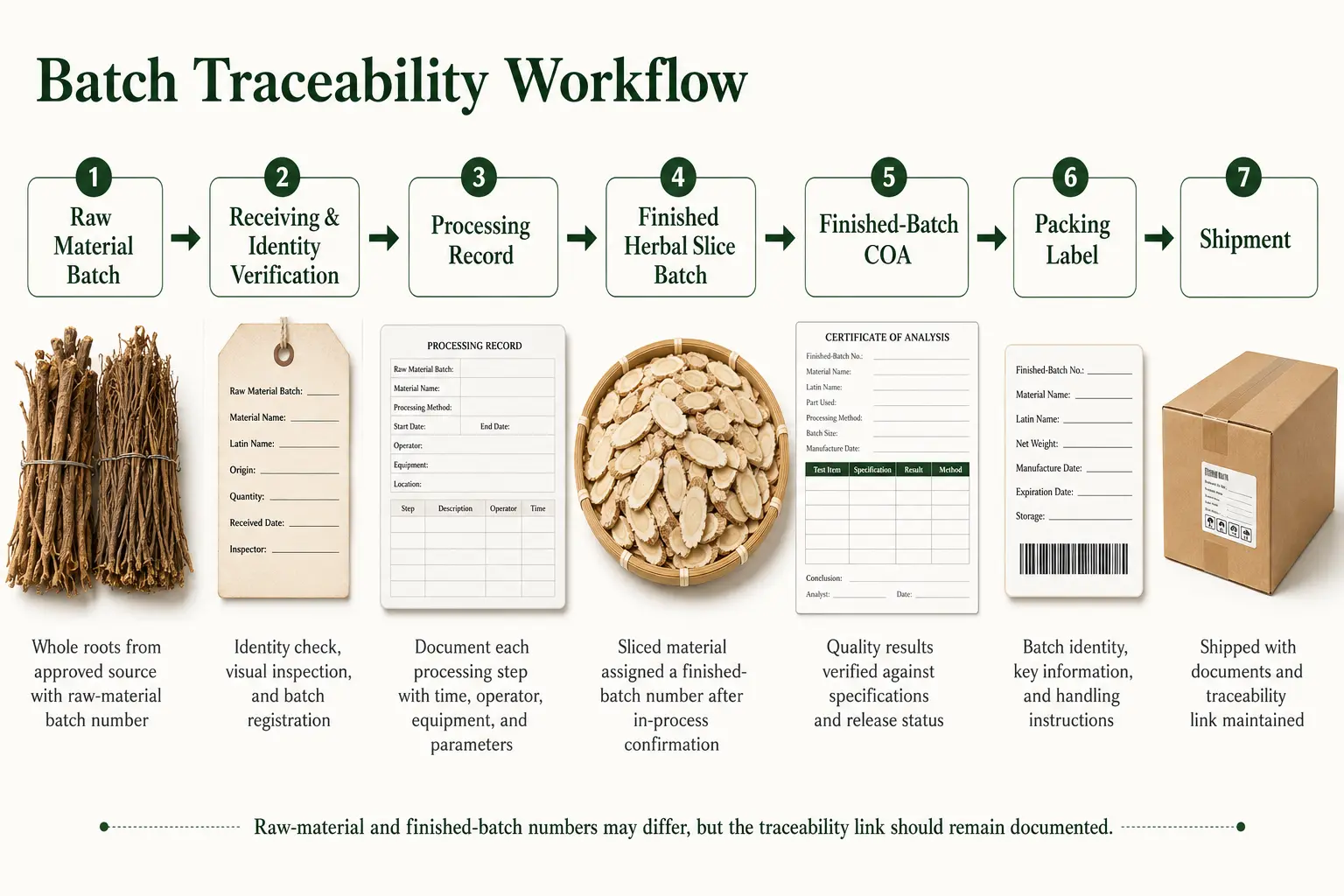
The finished product should remain traceable to its incoming material and processing history.
A practical traceability chain is:
Raw Material Batch
↓
Receiving and Identity Verification
↓
Approved Processing Instruction
↓
Finished Herbal Slice Batch
↓
Finished-Batch QC and COA
↓
Packing Label
↓
Shipment
The following information should remain traceable through this chain:
The raw-material batch number and finished-product batch number do not need to be identical. They need a documented traceability link.
Some information may legitimately change during processing, including:
A raw-material report can support incoming-material history, but it should not automatically be treated as the COA for the finished processed batch.
For routine B2B orders, request the minimum sufficient evidence needed for QA and contractual review. This will commonly include:
Complete batch manufacturing records, supplier qualification files and raw-material receiving records are normally internal documents. They may become relevant during qualified audits or higher-risk programmes, but they are not routine shipment documents.
Physical specifications should be measurable wherever they affect purchasing acceptance.
| Specification Field | Buyer-Defined Requirement | Evidence or Measurement | Risk If Undefined |
|---|---|---|---|
| Product form | [Whole / Slice / Segment / Powder / Other] | Visual inspection and specification | Wrong physical form supplied |
| Cut style | [Buyer-defined cut style] | Approved sample or photos | Sample-to-bulk mismatch |
| Diameter | [Buyer-defined range] | Caliper measurement where relevant | Inconsistent processing or packing |
| Thickness | [Buyer-defined range] | Caliper or micrometer | Inconsistent downstream use |
| Length | [Buyer-defined range] | Measurement against specification | Irregular finished material |
| Broken pieces | [Maximum agreed percentage] | Representative lot inspection | Yield and appearance disputes |
| Dust and fines | [Maximum agreed percentage] | Sieving or agreed inspection method | Handling and packing issues |
| Foreign matter | [Applicable requirement] | Visual inspection or applicable test | Unwanted material in the batch |
| Appearance | [Approved range or reference sample] | Sample comparison | Subjective acceptance disputes |
| Moisture | [Applicable requirement] | COA or agreed test method | Storage and microbial risk |
| Approved sample | [Reference sample / approved image set] | Sample-to-bulk comparison | No clear physical acceptance reference |
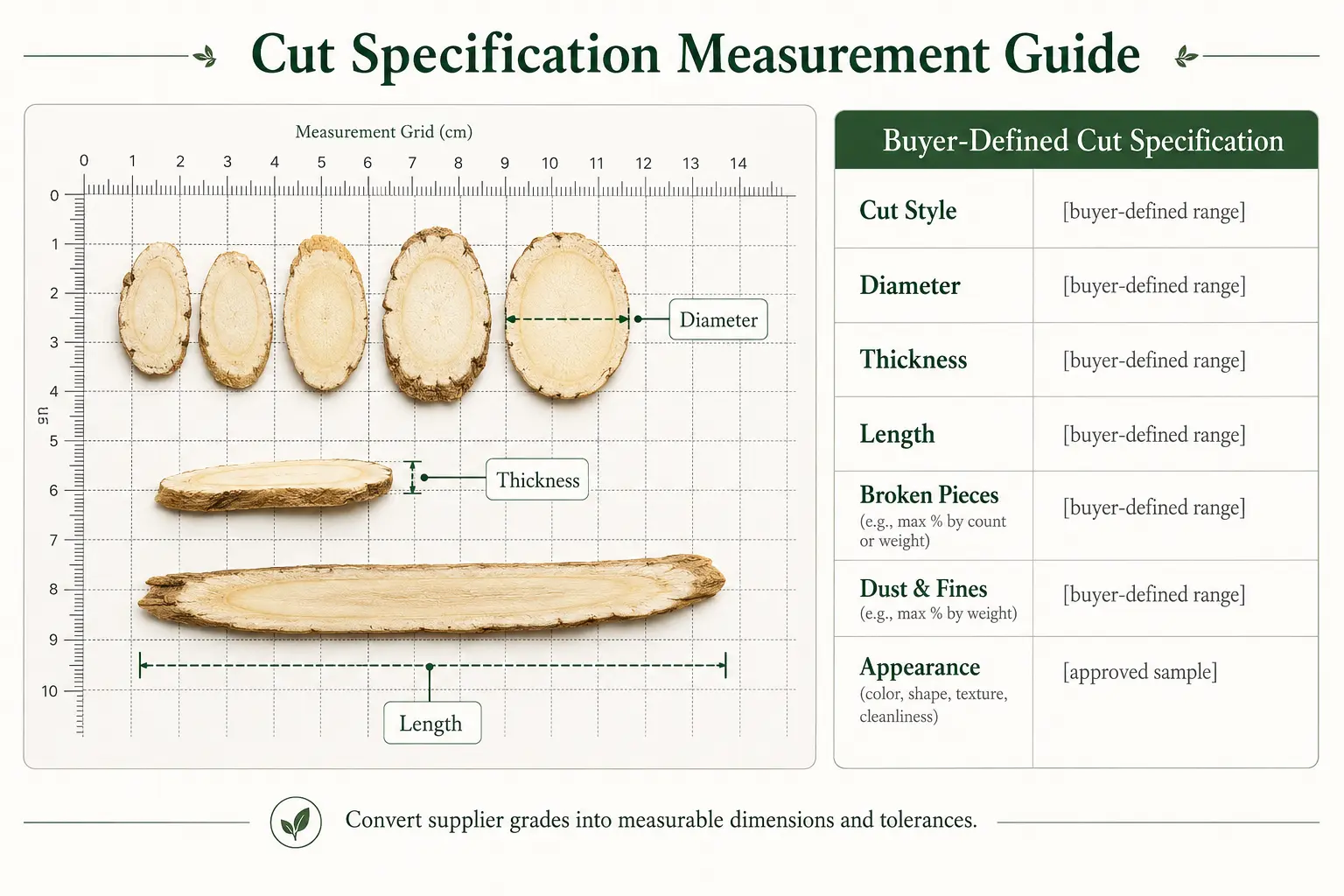
Supplier grade names such as “Grade I,” “Selected Grade” or “Premium Grade” should be converted into measurable criteria before order confirmation.
Colour can be included as part of an approved appearance range, but colour alone should not be used to prove processing history or compliance.
For buyer-defined dimensions, see Aile Herb’s Custom Cutting service.
Different documents serve different purposes. Buyers do not need every internal factory record for every shipment.
| Document | Typical Buyer Use | Usually Supplied? | Important Limitation |
|---|---|---|---|
| Finished-product specification | Defines what is being purchased | Yes | Must be agreed before production or shipment |
| Finished-batch COA | Shows release results for the supplied lot | Yes | Must match the finished batch |
| Packing label | Links physical goods to the batch | Yes | Batch information should match the COA |
| Processing declaration | Confirms processing status and method | Where relevant | Does not replace test evidence |
| Approved sample | Controls physical appearance and cut | Common for custom specifications | Does not replace laboratory testing |
| Origin declaration | Supports origin claims | Where required | Origin alone does not prove identity or compliance |
| Batch photos | Supports visual review | Often available | Photos do not prove processing method or contaminant status |
| Third-party test report | Provides external laboratory evidence | Buyer- or market-dependent | Must match the relevant batch and test scope |
| Raw-material COA | Supports incoming-material history | Buyer-dependent | Not a substitute for finished-batch evidence |
| Raw-material receiving record | Supports internal traceability | Usually internal | A summary or audit review may be more appropriate |
| Full batch processing record | Detailed production history | Usually internal | Normally reviewed during qualified audits rather than routine shipment |
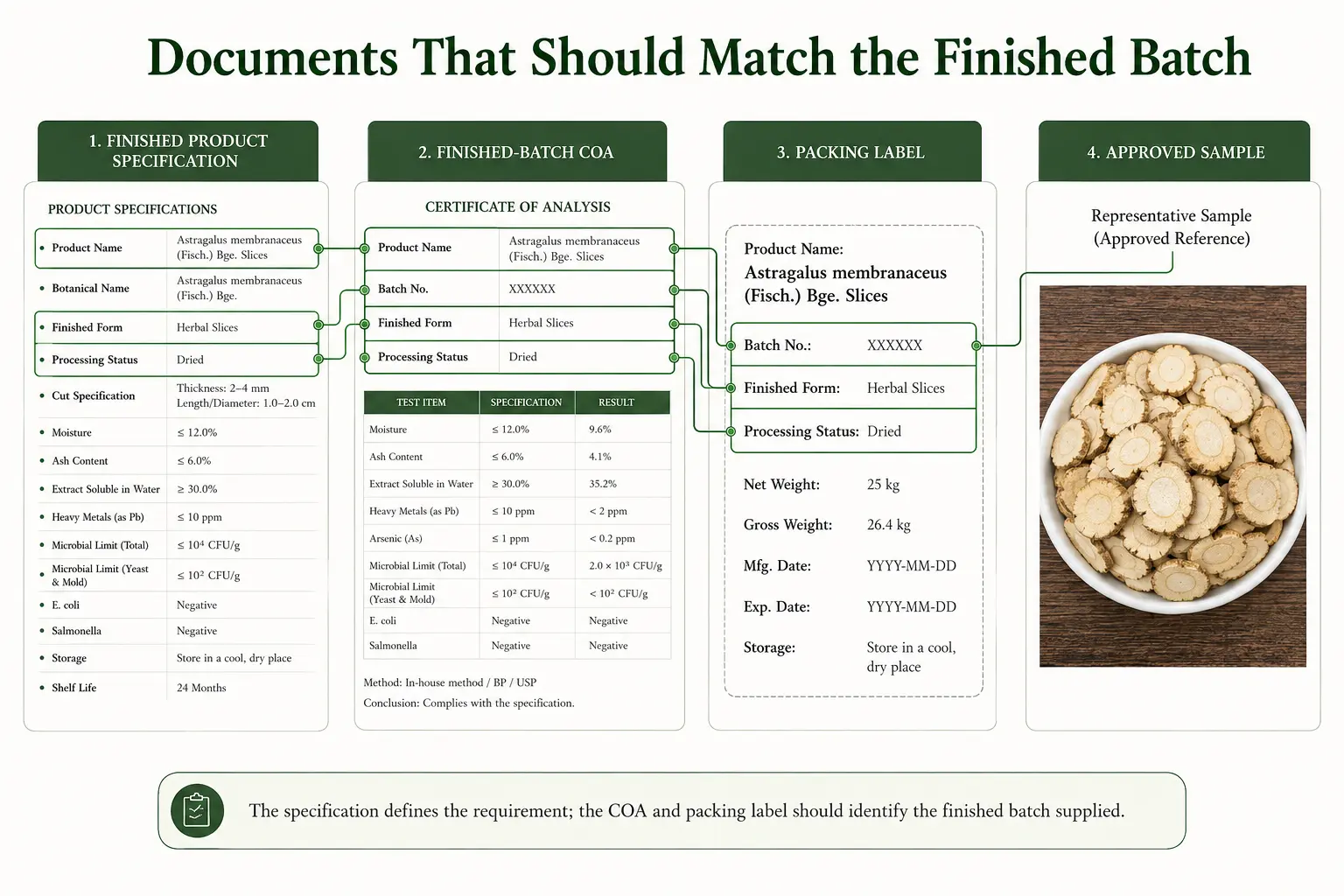
For that reason, a raw-material report should not automatically be represented as the finished-product COA.
Processing can change the finished product’s form, moisture, batch identity and other release characteristics.
This does not mean every test must be repeated after every processing operation. The finished-batch testing scope should be defined according to the product, applicable standard, buyer requirement and destination market.
For general COA review, see the Certificate of Analysis Buyer Guide.
Aile Herb’s broader QA and testing framework is described under Quality Control Process and In-House Laboratory.
A processed Chinese herbal slice COA should identify the finished commercial item and the tests agreed for that batch.
| Field Group | Typical Fields | When Relevant |
|---|---|---|
| Identity and Traceability | Product name, Chinese name where relevant, botanical name, plant part, finished form, batch number | Core |
| Processing-Specific | Raw/processed status, named processing method, auxiliary-material declaration | Where processing is part of product identity |
| Common Quality | Appearance, identification, moisture or loss on drying | Common |
| Pharmacopoeia-Dependent | Ash, extractives, marker assay, fingerprint | Where required by the applicable monograph or specification |
| Market-Dependent Safety | Sulfur dioxide, pesticides, heavy metals, microbiology, mycotoxins | According to market and product requirements |
| Buyer-Defined | Cut dimensions, broken pieces, fines and custom acceptance fields | Where commercially agreed |
| Method and Acceptance Basis | Test method, applicable standard and acceptance criteria | Required wherever results are reported |
Not every Chinese herbal slice requires the same COA scope.
Acceptance criteria should identify the applicable standard, buyer specification and test method rather than relying on an unexplained “pass” result.
A processing declaration records the declared processing status. It does not replace finished-batch quality evidence.
Use the following as a starting point for an RFQ or purchase order.
The final specification should be confirmed before bulk production or shipment, particularly where cut size, processing status or appearance is customized.
| Procurement Issue | What Can Go Wrong |
|---|---|
| Ordering by herb name without defining product state | Raw, cleaned, cut or processed material may be interpreted differently |
| Writing only “processed” | The actual processing method remains undefined |
| Treating raw, whole, sliced and powdered forms as interchangeable | Packing, sampling and downstream processing may not match buyer needs |
| Using supplier grades without measurable criteria | No objective basis for acceptance |
| Using colour alone to define processing or quality | Subjective disputes and incorrect conclusions |
| Accepting a raw-material COA as the finished-batch COA | Report may not describe the supplied commercial item |
| COA does not identify finished form or processing status | Document may relate to a different product state |
| Approved sample is not linked to the production specification | Sample-to-bulk comparison becomes unclear |
| Origin is claimed without traceability | Documentation may not support the commercial origin claim |
| One test scope is used for every destination market | Required tests or acceptance criteria may not match the actual market |
These issues usually require clarification or better documentation. They are not, by themselves, evidence of supplier misconduct.
No. Depending on the product and applicable specification, a decoction piece may be supplied as slices, sections, segments or another finished form. “Chinese herbal slices” is useful buyer-facing terminology, but the exact physical form should still be written into the purchase specification.
Not necessarily. Raw or sheng generally distinguishes the material from a specially processed form. It may still have been dried, cleaned or cut. Buyers should specify cleaning, cutting and finished form separately instead of assuming these from the word “raw.”
Yes. The botanical source and plant part may remain the same while the processing status, finished form, dimensions and batch documentation differ. Raw and processed versions should therefore be treated as separate commercial specifications where those differences affect the order.
Where processing is part of the product identity, identify the raw or processed status, named processing method, auxiliary material where applicable, finished form and batch number. The purchase specification should define the requirement, while the finished-batch COA or supporting documentation should match the material supplied.
A raw-material report can support incoming-material history, but it should not automatically be treated as the finished-batch COA. The finished-batch testing scope should be agreed according to the product, processing status, applicable standard and destination-market requirements.
Use the Chinese or pinyin term only as supporting identification. Also state the buyer-facing status in English. For a processed product, name the actual processing method, auxiliary material where relevant, finished form and required batch documentation instead of writing only Zhi or “processed.”
For a specific order, provide:
Product form, processing scope, testing and documentation should be confirmed according to the specific order and destination market.
If your specification calls for a specific cut size, thickness or packing format, see our custom cutting and specifications service and send the botanical name, plant part and finished form for review.
