Tell Us About Your Project
Share your product, quantity and project requirements. We will review the details and respond with the relevant next steps.

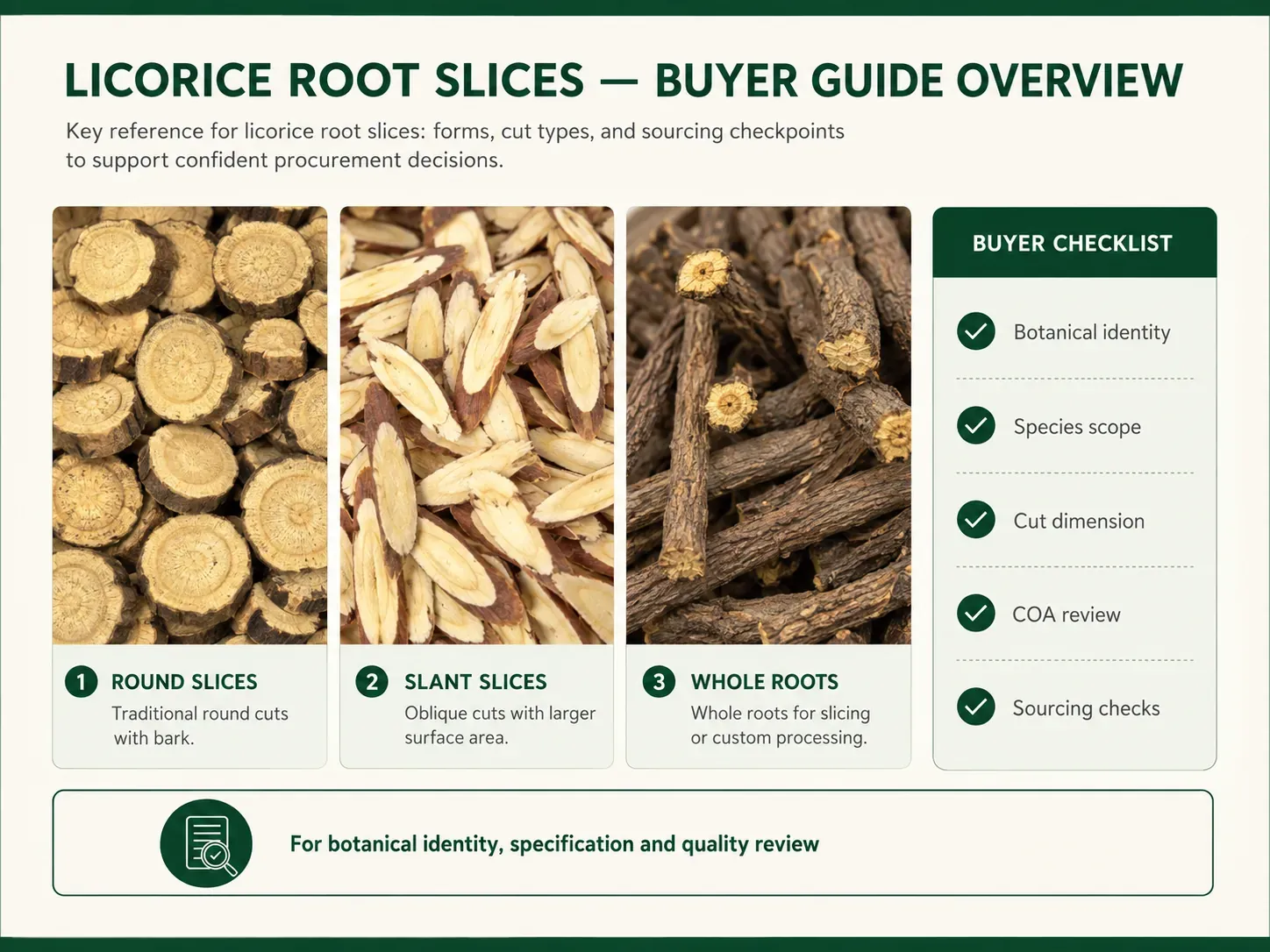
Licorice root slices are among the most widely traded botanical materials in the world. The commercial name, however, does not define the raw material — and for a buyer who has to defend a specification to a regulator or an auditor, that gap is where most sourcing problems begin.
The European Medicines Agency lists the herbal material under the Latin name Liquiritiae radix, with Liquorice Root as the English common name. The botanical name field on that entry does not contain one species. It contains three: Glycyrrhiza glabra L., Glycyrrhiza inflata Bat. and Glycyrrhiza uralensis Fisch.
The current European Union herbal monograph covering all three was published in July 2026 as Revision 1 (reference EMA/HMPC/108399/2024), replacing the version adopted in 2012. Buyers still working from the older document should update their reference.
The practical consequence is direct. A purchase order that says “Licorice Root” has not specified a species — it has named a trade category that spans three of them. If your finished product label, your registration dossier or your internal specification requires one defined source, the contract has to say which one, and the supplier’s documentation has to support it at that level.
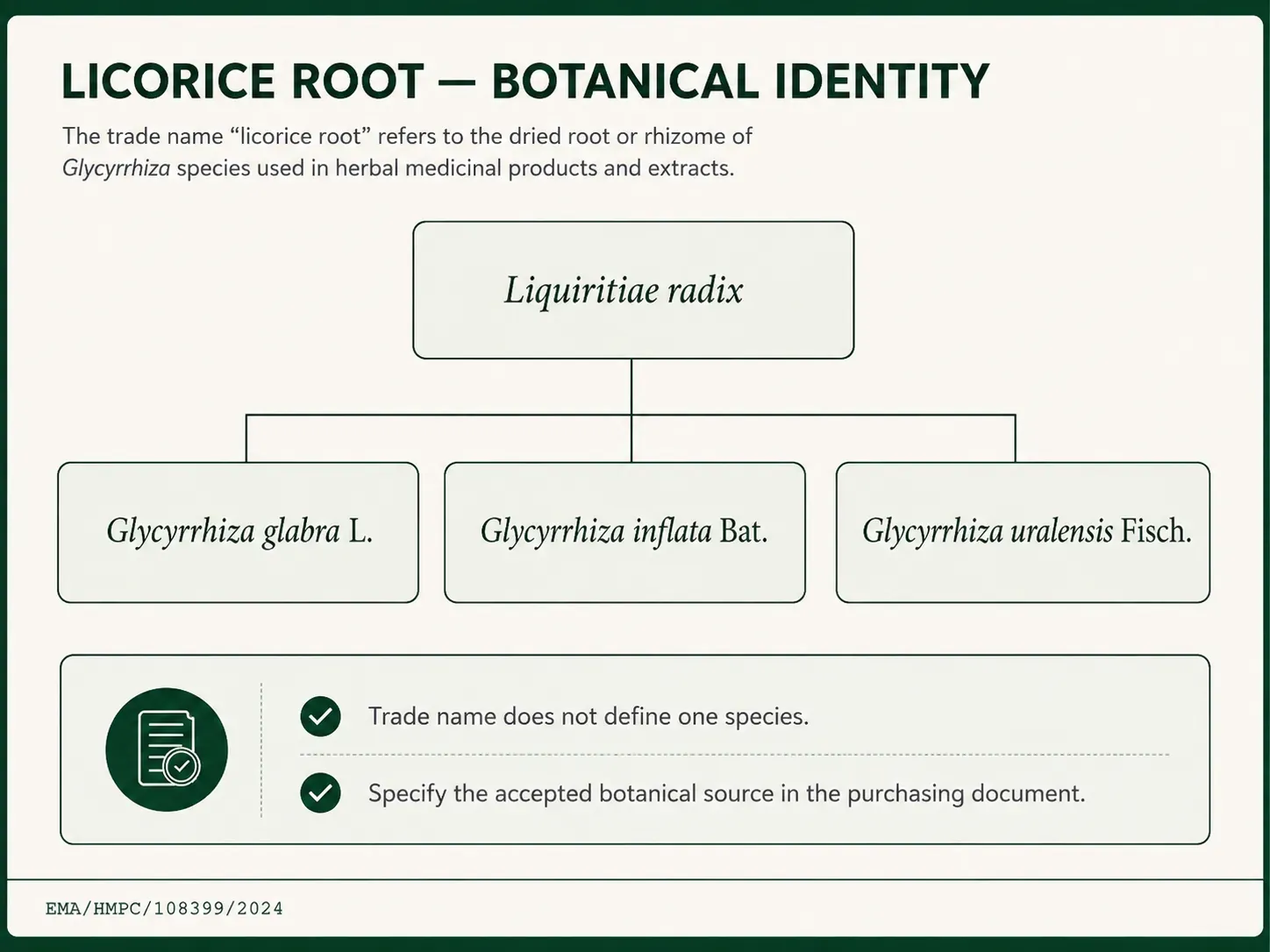
The three species are not interchangeable for every purpose. A registration built on G. uralensis is not satisfied by material that turns out to be G. inflata, even when both are legitimately traded as liquorice root and both sit inside the same EMA monograph. Note also the spelling: European regulatory documents use “liquorice”, while US trade usage is more often “licorice”. They refer to the same material.
Source: EMA — Liquiritiae radix herbal medicinal product
There is an international standard written specifically for this material. ISO 19025:2024, Traditional Chinese medicine — Glycyrrhiza uralensis, Glycyrrhiza inflata, and Glycyrrhiza glabra root and rhizome, specifies quality and safety requirements for root and rhizome derived from those three species. Its stated scope covers material sold and used as natural medicines in international trade, including Chinese materia medica and decoction pieces — the category that licorice root slices and other root and rhizome Chinese herbs fall into. It was published in December 2024 as a first edition of fifteen pages, developed by ISO/TC 249/SC 1.
One thing the publicly available scope does not establish is a universal slice thickness. There is no international “standard thickness” for licorice root slices that a buyer can simply invoke. Cut dimensions are a commercial specification. They have to be agreed between buyer and supplier, with a measurement method and a sampling rule attached — a quotation promising “standard slices” has agreed nothing.
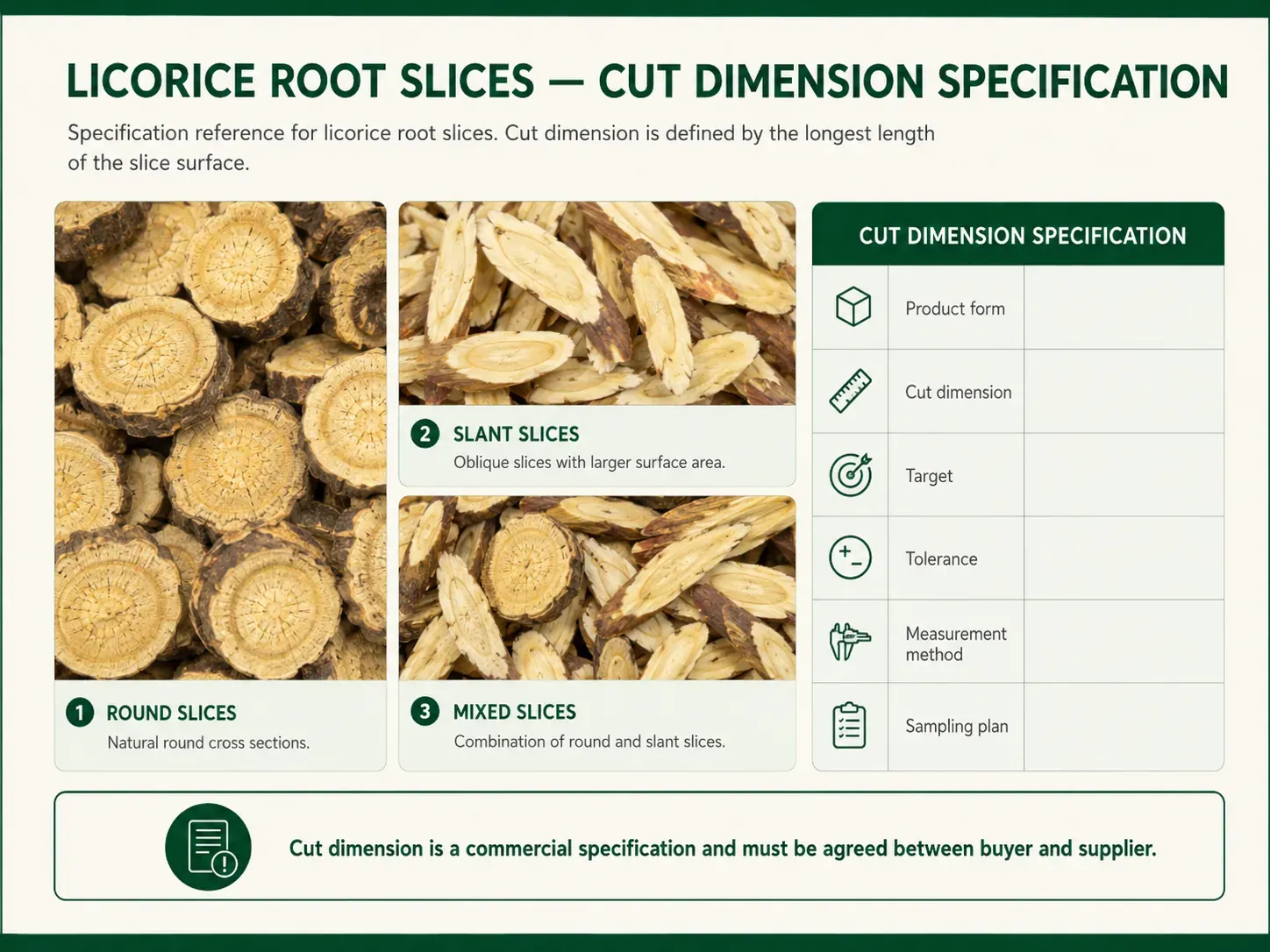
Before an RFQ goes out, these fields should already be decided:
| Specification field | What to state |
|---|---|
| Botanical name | Full name with author, e.g. Glycyrrhiza uralensis Fisch. |
| Species scope | Single species only, or which combinations are acceptable |
| Plant part | Root, rhizome, or both; whether stolons are permitted |
| Surface | Peeled or unpeeled |
| Product form | Whole, cut sections, slices, or powder |
| Cut dimension | Target, tolerance, measurement method, sampling plan |
| Origin | Region, and what documentation supports the claim |
| Processing history | Cleaning, cutting, drying; fumigation status |
Source: ISO 19025:2024
Buyers supplying the US dietary supplement market work to a defined structure, and it is worth reading even outside that market because it is more complete than most RFQs.
Under 21 CFR 111.70(b), a manufacturer must establish, for each component used, three separate things: an identity specification; component specifications necessary to ensure that the purity, strength and composition specifications of the finished supplement are met; and limits on the types of contamination that may adulterate or lead to adulteration of the finished batch.
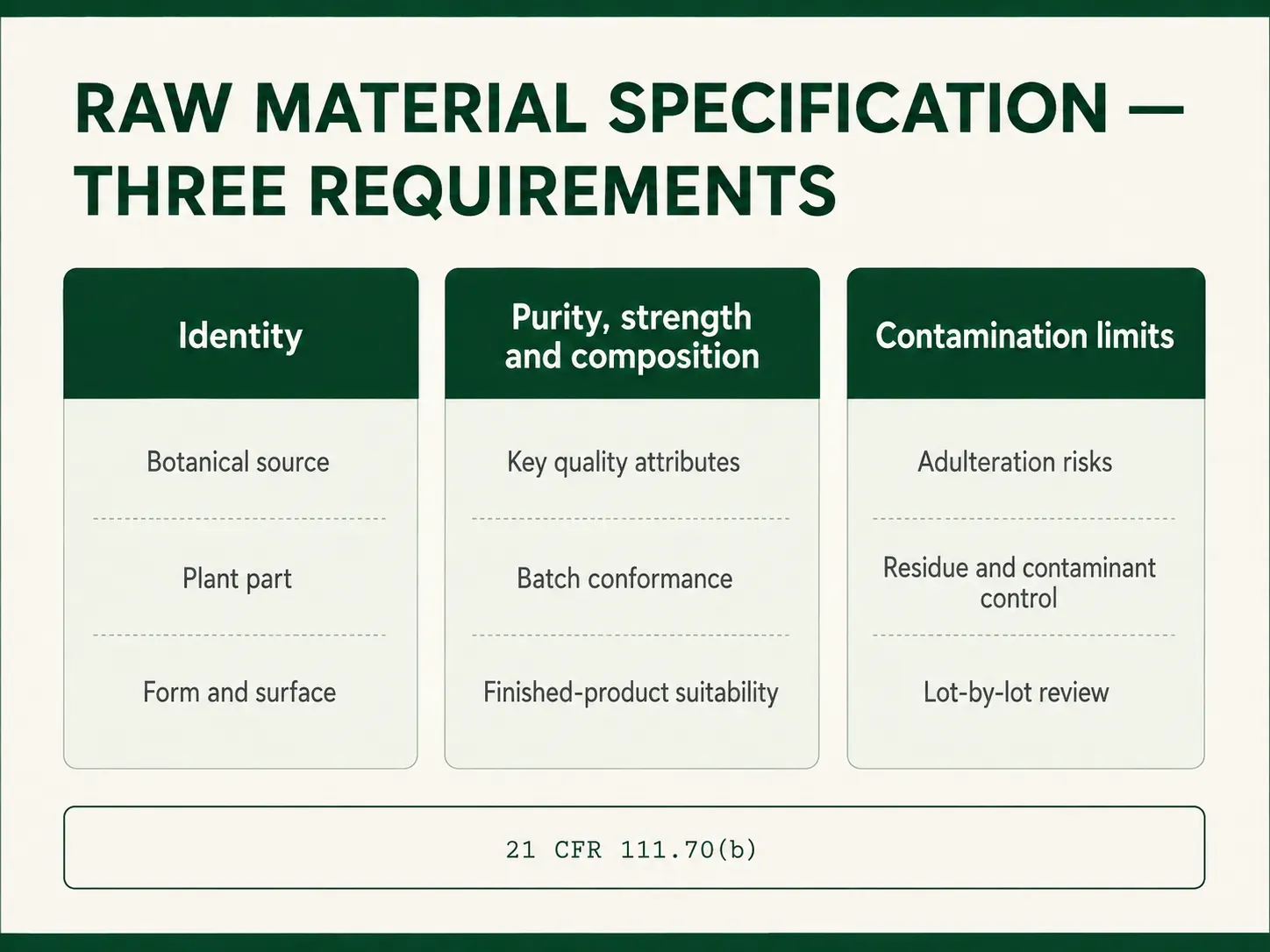
Three requirements, not one. Most incoming-material specifications for botanicals cover appearance and moisture and stop there. Appearance is not an identity specification, and a moisture limit is not a contamination limit.
Where a licorice slice is a single-ingredient product with minimal dilution, the finished-product limits a buyer must meet effectively become the incoming-material limits. That arithmetic is worth doing before a specification is agreed rather than after a shipment lands. See our herbal slices specification guide for how these fields are set out in practice.
Source: 21 CFR 111.70
This is the question buyers ask most often, and the regulation is more specific than the general advice in circulation suggests.
Identity cannot be delegated. Under 21 CFR 111.75(a)(1)(i), a manufacturer must conduct at least one appropriate test or examination to verify the identity of any component that is a dietary ingredient before using it. A supplier certificate does not discharge this obligation, however thorough the certificate is.
For other component specifications, reliance on a supplier COA is available only on conditions. Section 111.75(a)(2)(ii) permits a manufacturer to rely on the supplier’s certificate instead of conducting its own tests, provided that a set of conditions is satisfied together. Among them: the supplier must first be qualified by confirming the results of its own tests or examinations; the certificate must include a description of the methods used, the limits of those tests or examinations, and the actual results; the qualification must be documented, periodically re-confirmed, and reviewed and approved by quality control personnel.
The second of those conditions is worth reading closely. A certificate that reports only “conforms” or “pass”, with no method, limit or measured result anywhere in it, does not carry the information this condition requires. A buyer holding such a certificate has not acquired the option to rely on it, and will need to test.
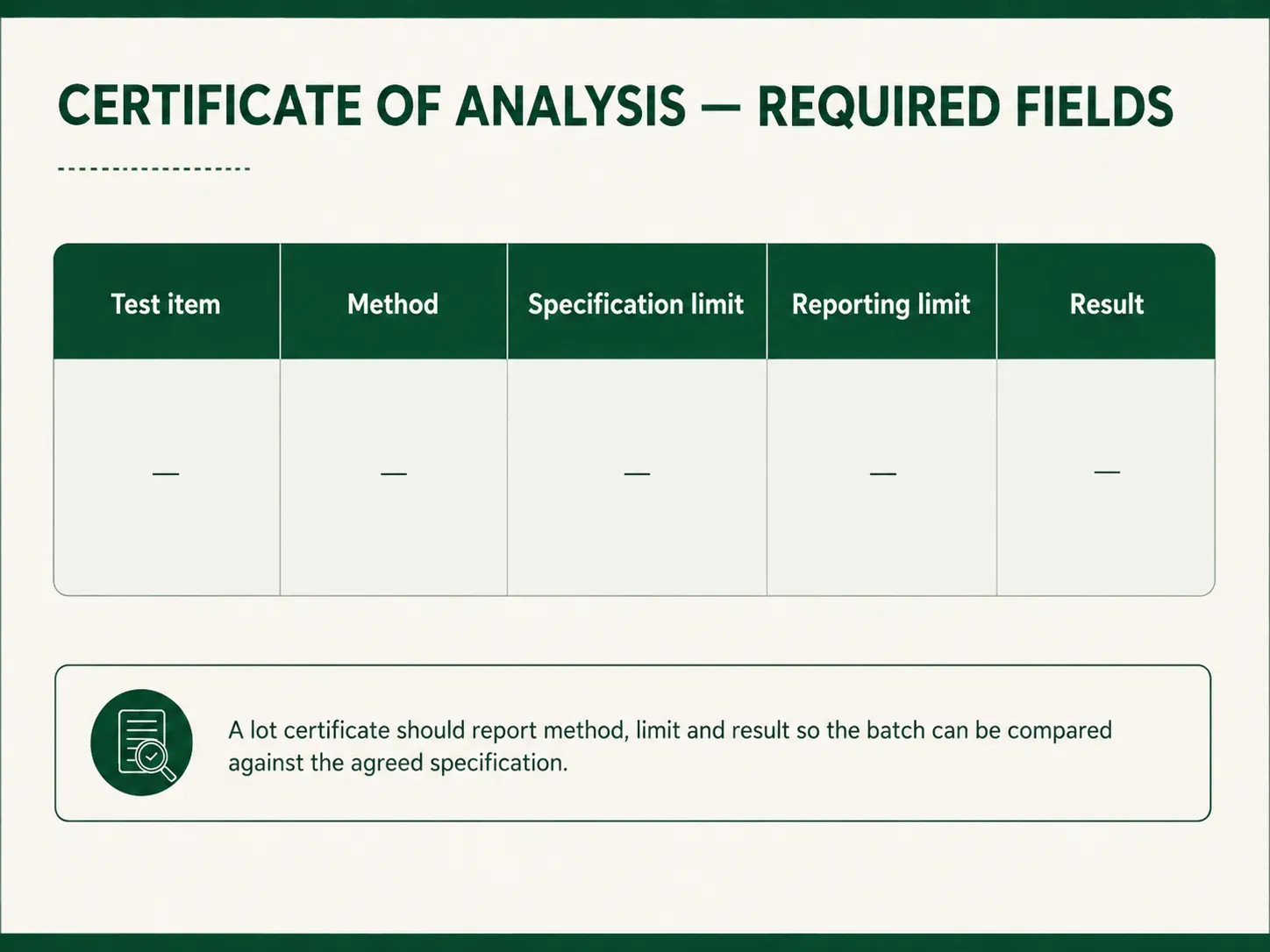
For licorice, this shapes what to ask for. A certificate should carry, per lot: the test item, the method or general chapter applied, the specification limit being judged against, the reporting or quantitation limit, and the measured result as a number. Where a result falls below the detection threshold, the threshold itself should appear — “not detected” without a stated limit of detection cannot be compared against any specification. Our COA guide sets out the full field list.
Source: 21 CFR 111.75
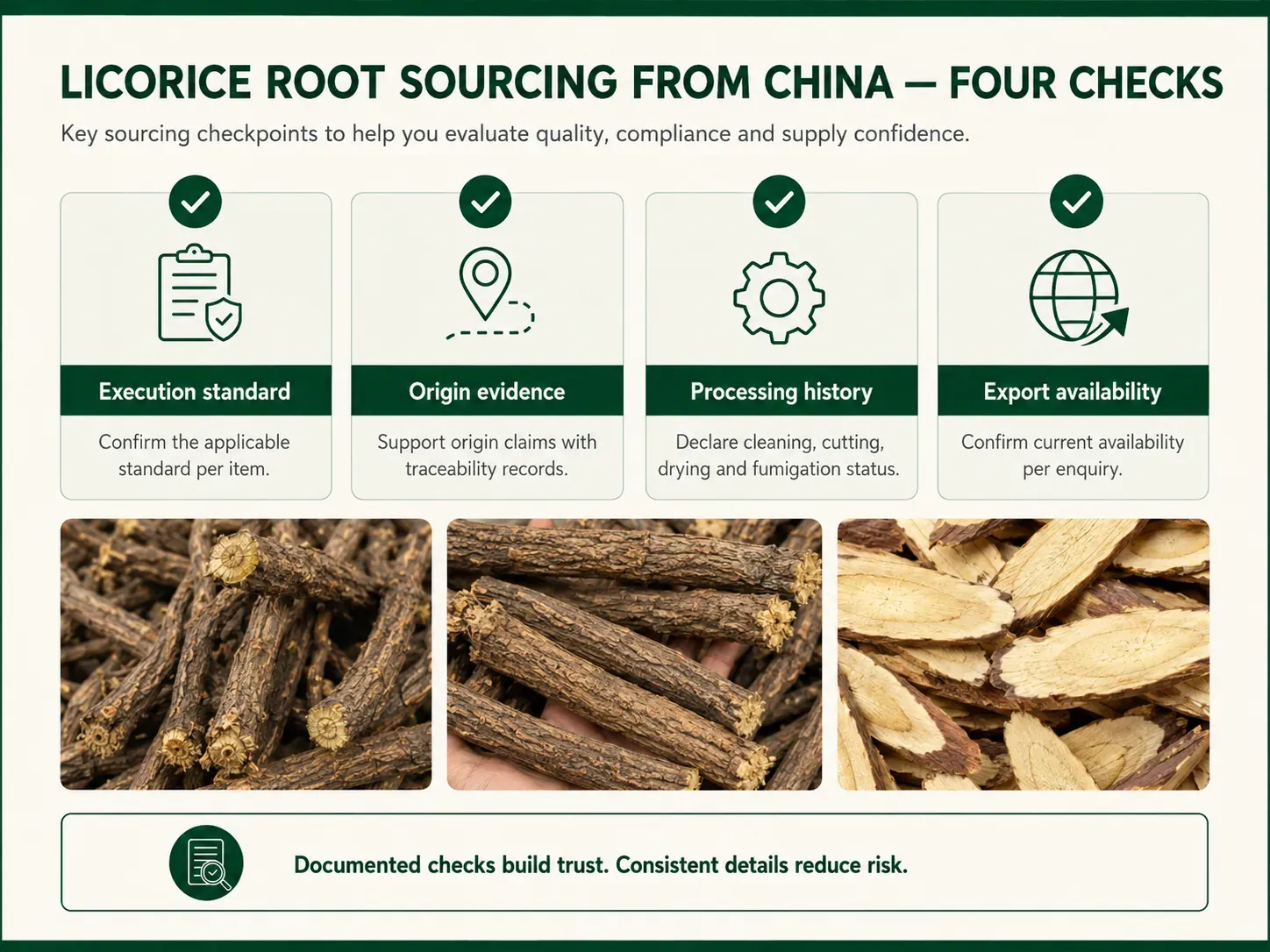
Four points that recur in Chinese herbal supply and are worth building into a purchasing process.
Execution standards vary by item. Chinese decoction pieces are produced against a range of standards — the pharmacopoeia and its supplements, national processing norms, and provincial processing norms — and which one applies can differ between two forms of the same herb. A blanket phrase such as “produced to the Chinese Pharmacopoeia” does not describe a real supply arrangement. Ask for the execution standard per item.
Our licorice root slices product page lists the cut options and packing available for bulk order.
Origin on a laboratory report is a declaration, not a finding. Third-party test reports routinely note that the client, sample name, batch and origin fields were declared by the applicant and not verified by the laboratory. A geographic origin claim has to rest on purchase records, cultivation-side documentation and batch traceability, not on a line in a test report.
Processing history should be declared, not assumed. For licorice slices the relevant variables are cleaning, cutting, drying and sulphur fumigation status. If non-fumigated material is required, the requirement needs a definition, a test method and a threshold; a commercial declaration on its own is not a control.
Confirm export availability per item, at enquiry stage. A catalogue entry records what a factory produces, not what it can currently ship. Some botanical materials are subject to controls that affect export, and those controls are not always visible in a product list — so availability belongs on the same checklist as species, execution standard and cut dimension, confirmed for the specific item at the time of enquiry. A supplier who tells you plainly that an item cannot currently be shipped is giving you better information than one who takes the order and finds out later.
Aile Herb supports bulk sourcing of Chinese herbal slices with documented specifications, lot-linked quality records and customised processing and cut requirements, produced under a licensed manufacturing operation in Gansu Province. Species scope, execution standard and current availability are confirmed per item at enquiry stage. Our quality control process sets out how incoming material, in-process control and pre-shipment inspection are handled.
Licorice is not an ordinary export item in China, and a buyer who does not know this can spend weeks qualifying a supplier that has no legal route to ship.
Under the Catalogue of Goods Subject to Export Licence Administration (2026), jointly issued by China’s Ministry of Commerce and the General Administration of Customs and effective 1 January 2026, licorice sits in the quota-tender category. The catalogue states that to export licorice and licorice products, an exporter applies for the export licence on the strength of a successful quota tender document. The same provision covers artificially cultivated ephedra herb for pharmaceutical use.
Read what that means in practice. An export licence for licorice is not obtained by holding an export licence in general, or by being a registered manufacturer, or by having good documentation. The state releases a fixed volume each year, companies bid for it, and only a company holding a winning tender document can obtain the licence for that volume. A supplier without an allocation cannot ship licorice legally regardless of how much material it holds or how complete its COA is.
What a buyer should ask, before anything else. For this one commodity, the qualification sequence runs in reverse — availability first, specification second:
A supplier that cannot answer these questions is not necessarily acting in bad faith — many suppliers of other herbs have never dealt with a quota-managed commodity and do not know the rule applies. But the answer determines whether a contract can be performed, and it should be settled before samples are sent.
Our own position, stated plainly: Aile Herb processes licorice root slices but does not hold an export quota allocation, and therefore does not offer licorice for export. We have set this guide out in full because the specification and documentation questions above are the ones buyers still have to answer with whichever supplier does hold an allocation. For herbs we can supply, see our product range.
What botanical name should be specified for licorice root slices? State the full name with author, for example Glycyrrhiza uralensis Fisch. If more than one species is acceptable, list each one explicitly rather than writing “Glycyrrhiza spp.” The EMA framework for Liquiritiae radix covers three species, so a generic reference leaves the scope open.
Why is “Licorice Root” alone not enough as a purchasing specification? Because it names a trade category rather than a material. It does not fix the species, the plant part, whether the root is peeled, the product form, or the cut dimension — all of which affect what arrives and whether it fits a registration.
What documentation should a buyer review before a bulk order? A product specification sheet, a lot-specific certificate of analysis reporting method, limit and actual result per parameter, an identity determination with the method stated, a traceability statement linking the export lot back to processing and raw material batches, and a declaration of processing treatments applied.
Can licorice root slices be produced to a customer’s own cut specification? Cut dimensions are a commercial specification rather than a pharmacopoeial one, so they are normally agreed between buyer and supplier. The agreement should state the target, the tolerance, how the dimension is measured and how the lot is sampled — otherwise the specification cannot be verified on receipt.
To source licorice root slices with the botanical identity and cut specification confirmed in writing, review our root and rhizome herbs range and send your requirement for a sample and quotation. Licorice carries an export quota; see the export conditions guide before ordering.
