Tell Us About Your Project
Share your product, quantity and project requirements. We will review the details and respond with the relevant next steps.
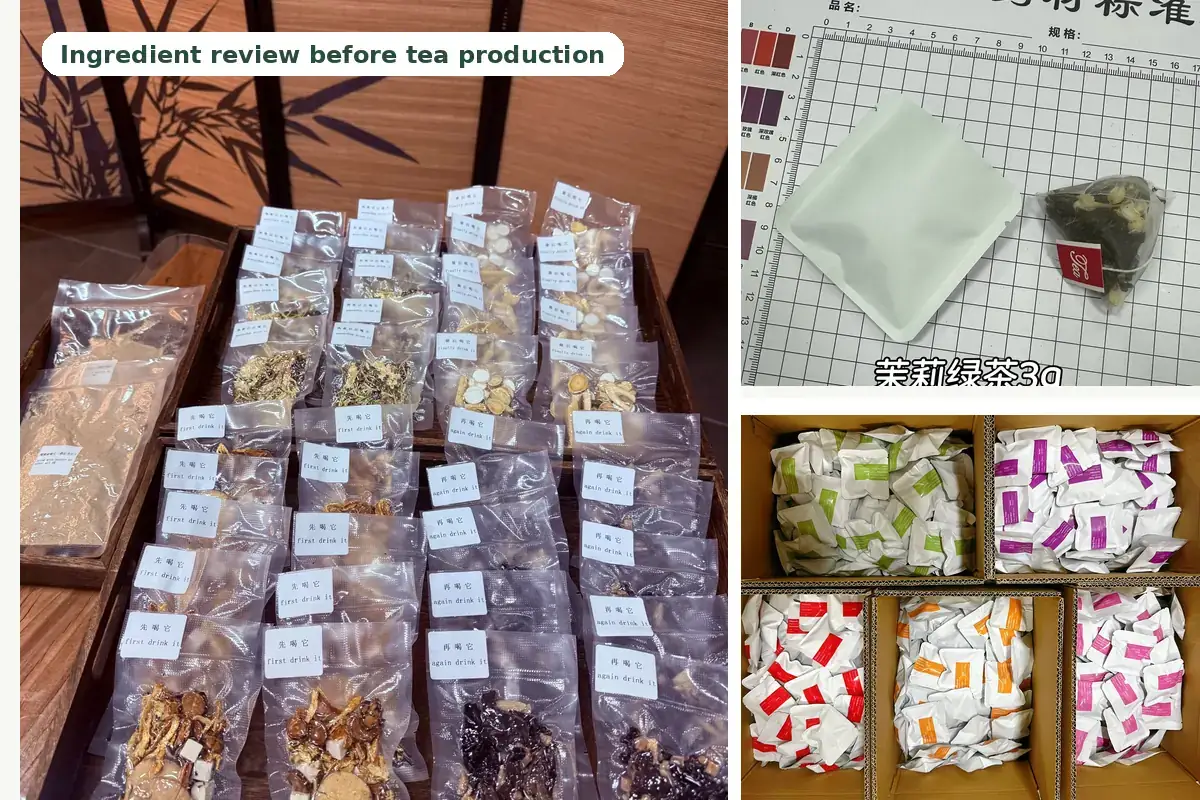
When a botanical is also a Chinese medicinal material, the first question a licensed food factory in China asks is whether it has a lawful food basis. For most medicinal botanicals used in tea, that basis is the national food-medicine homology list. Some others are covered by a specific new food ingredient approval. Ordinary food ingredients with an established food status, such as fruit, flowers and grains, sit outside the list altogether, so absence from the list does not by itself mean an ingredient is prohibited. Availability on the medicinal market, however, never counts as a food basis.
This is the first check we run on every formula a buyer sends, and it is the most common reason a proposed blend has to change before production. The list currently holds 106 substances; the full list is in the appendix at the end of this guide.. This guide explains what it is, which common tea ingredients are on it, which need a different basis, and what happens when a formula includes something that has none.
1. What the list is
Article 38 of China’s Food Safety Law prohibits adding medicines to food, with one exception: substances that are traditionally both food and Chinese medicinal materials. The national health authority (NHC) publishes the list of those substances jointly with the market regulator (SAMR) and revises it from time to time. The management rules issued in 2021 set the bar for adding a substance: it must be in the Chinese Pharmacopoeia and have a documented history of use as food, with safety evidence reviewed before it is added.
| Batch | Entries | Examples relevant to tea | Note |
|---|---|---|---|
| 2002 original list | 87 | Goji berry, red date, chrysanthemum, honeysuckle, tangerine peel, poria, liquorice root, mulberry leaf and fruit, cassia seed, lotus leaf, mint, monk fruit, malva nut, jujube seed, lily bulb, hawthorn, malt, Job’s tears, adzuki bean, ginger, dandelion | The 2002 notice lists Chinese names only; confirm botanical source and edible part before use |
| 2019 | 6 | Angelica sinensis root, turmeric, saffron, tsaoko, sand ginger, long pepper | Spice and seasoning use only |
| 2023 | 9 | Astragalus root, codonopsis root, American ginseng, Dendrobium officinale, reishi, Gastrodia, Cornus fruit, desert cistanche, Eucommia leaf | Formal additions after a trial period |
| 2024 | 4 | Rehmannia root, Ophiopogon root, Asparagus cochinchinensis root, Citrus grandis ‘Tomentosa’ peel | Announcement includes contaminant limits |
Two points matter for buyers. First, the six substances added in 2019, including angelica root (dang gui), turmeric and saffron, are permitted only as spices and seasonings, not as general herbal tea ingredients. Second, do not assume that a related species or another plant part is covered. Mulberry leaf and mulberry fruit are separate entries; ginkgo nut is listed but ginkgo leaf is not. Newer additions specify the botanical source and edible part, and older entries should be checked at the same level before production.
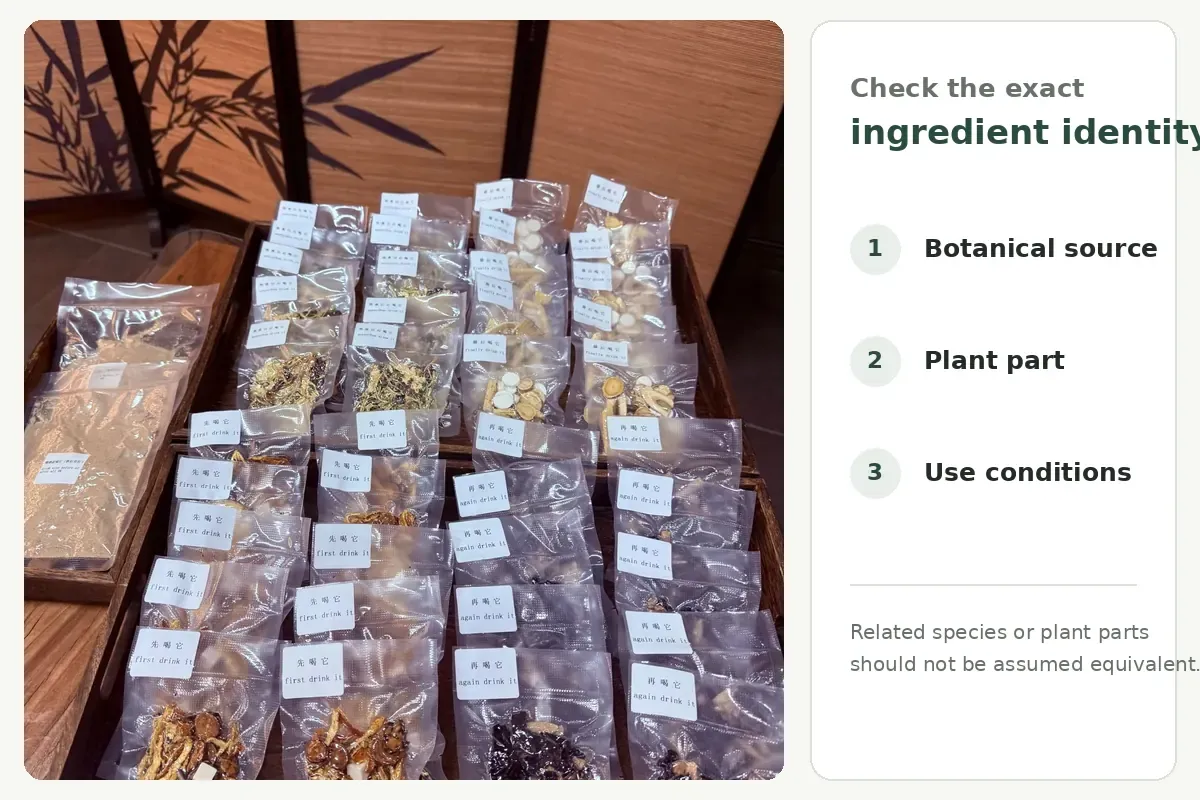
2. Four food-basis checks for botanical ingredients
Being absent from the homology list is not the end of the check. We look for the legal food basis that applies to the exact ingredient. Four situations cover almost every tea formula.
| Category | Basis | Ordinary tea? | Examples |
|---|---|---|---|
| Ordinary food ingredient | Established food status, applicable food standards | Yes | Tea leaves, dried fruit, roselle (hibiscus), osmanthus, grains |
| Food-medicine homology list | Food Safety Law Art. 38; NHC/SAMR list | Yes, for the listed source, part and restrictions | Goji, chrysanthemum, astragalus, codonopsis |
| New food ingredient approval | Individual NHC announcement with conditions | Yes, within the approval conditions | Cultivated ginseng (≤5 years), maca powder, rooibos, Cyclocarya leaf, yerba mate leaf, Cordyceps militaris |
| Medicinal or health-food-only ingredient | Medicinal or health food rules; no ordinary food basis | No | Bai zhu, san qi, he shou wu, ginkgo leaf, Fritillaria |
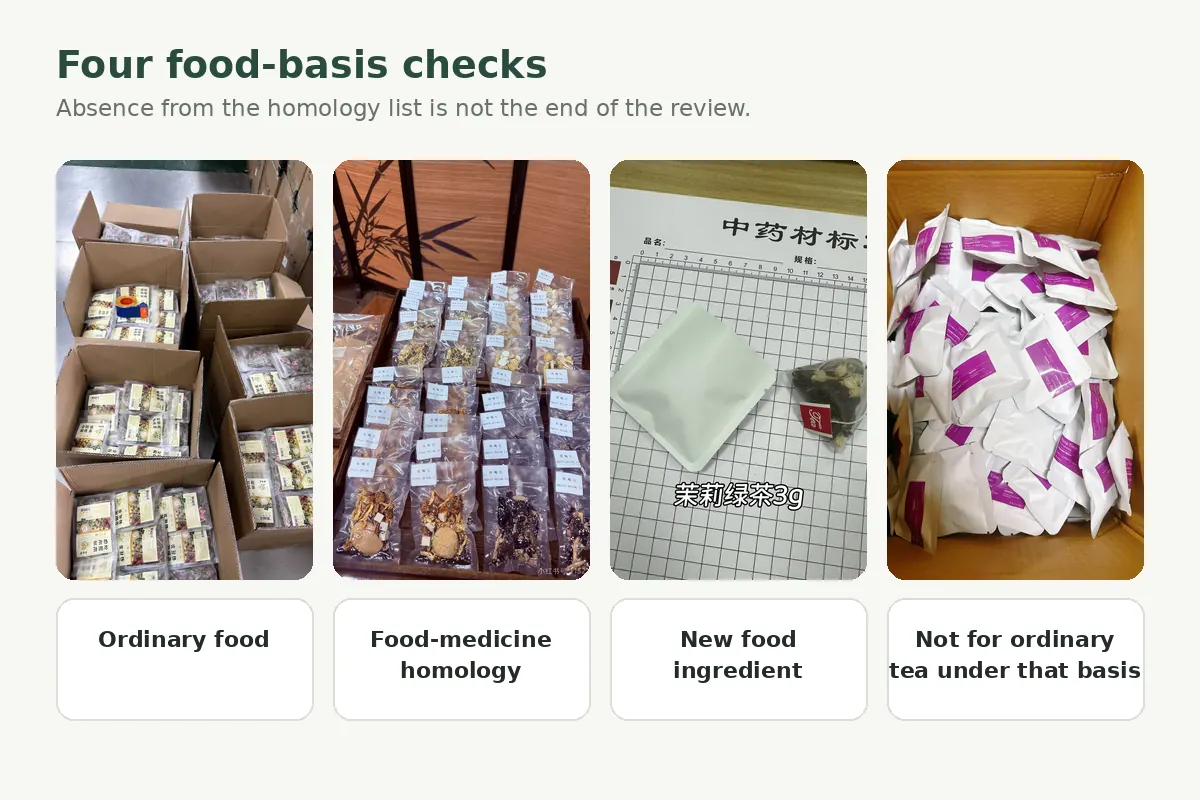
The fourth category catches out many buyers. The 2002 health food ingredient list includes well-known medicinal herbs such as bai zhu (Atractylodes), san qi (Panax notoginseng), he shou wu and ginkgo leaf. Those herbs can be used in registered health food products in China, but a food factory producing ordinary tea cannot use them. Health food registration is a separate regulatory route with its own product approval, and it is not what a private label herbal tea buyer is asking for.
3. Common tea ingredients and their status
| Ingredient | Food basis in China for ordinary tea |
|---|---|
| Dried fruit, roselle (hibiscus), osmanthus, rose (Rosa rugosa cv. Plena), barley, corn | Ordinary food ingredient |
| Goji berry, red date, chrysanthemum, honeysuckle, tangerine peel, poria, mulberry, cassia seed, lotus leaf, mint, monk fruit, malva nut, jujube seed, lily bulb, hawthorn, dandelion, liquorice root | Homology list (2002) |
| Astragalus root, codonopsis root, American ginseng, reishi, Gastrodia, Eucommia leaf, Dendrobium officinale | Homology list (2023) |
| Ophiopogon root, Rehmannia root | Homology list (2024) |
| Angelica sinensis (dang gui), turmeric, saffron | Homology list (2019), spice and seasoning use only |
| Cultivated ginseng, ≤5 years | New resource food (2012); daily intake limit and label wording apply |
| Rooibos (Aspalathus linearis) leaf and fine stem | New food ingredient (2014), for infusion |
| Maca powder, Cyclocarya paliurus leaf, yerba mate leaf, cultivated Cordyceps militaris fruiting body | New food ingredient, within the approval conditions |
| Bai zhu, san qi, he shou wu, ginkgo leaf, Fritillaria (chuan bei mu) | Health food list only; no ordinary food basis |
| Coptis (huang lian), Scutellaria (huang qin), Bupleurum (chai hu), Ophiocordyceps sinensis (dong chong xia cao) | No ordinary food basis |
| Ashwagandha, neem leaf, holy basil, valerian | No national food basis identified; not accepted |
| Chamomile, lemon balm and similar Western herbs | Ingredient-specific check required |
Two entries deserve a note. Cultivated ginseng, which appears in several of our stock blends, is permitted as a new resource food only for artificially cultivated Panax ginseng of five years or younger, with a daily intake limit and required label wording; wild or older ginseng is not covered. And “cordyceps” is not one ingredient: cultivated Cordyceps militaris fruiting body has a new food ingredient approval, while traditional Ophiocordyceps sinensis (dong chong xia cao) does not have an ordinary food basis. The two are not interchangeable.
4. Where buyer formulas usually run into trouble
From formulas we have reviewed over the past year, the ingredients that most often lack a Chinese food basis are:
A formula that relies on ingredients without a food basis for most of its weight is not a formula a Chinese food factory can make. Where they are a minor component, the blend can usually be reworked with covered ingredients that serve a similar role in the cup.
5. A Chinese food basis does not mean cleared for your market
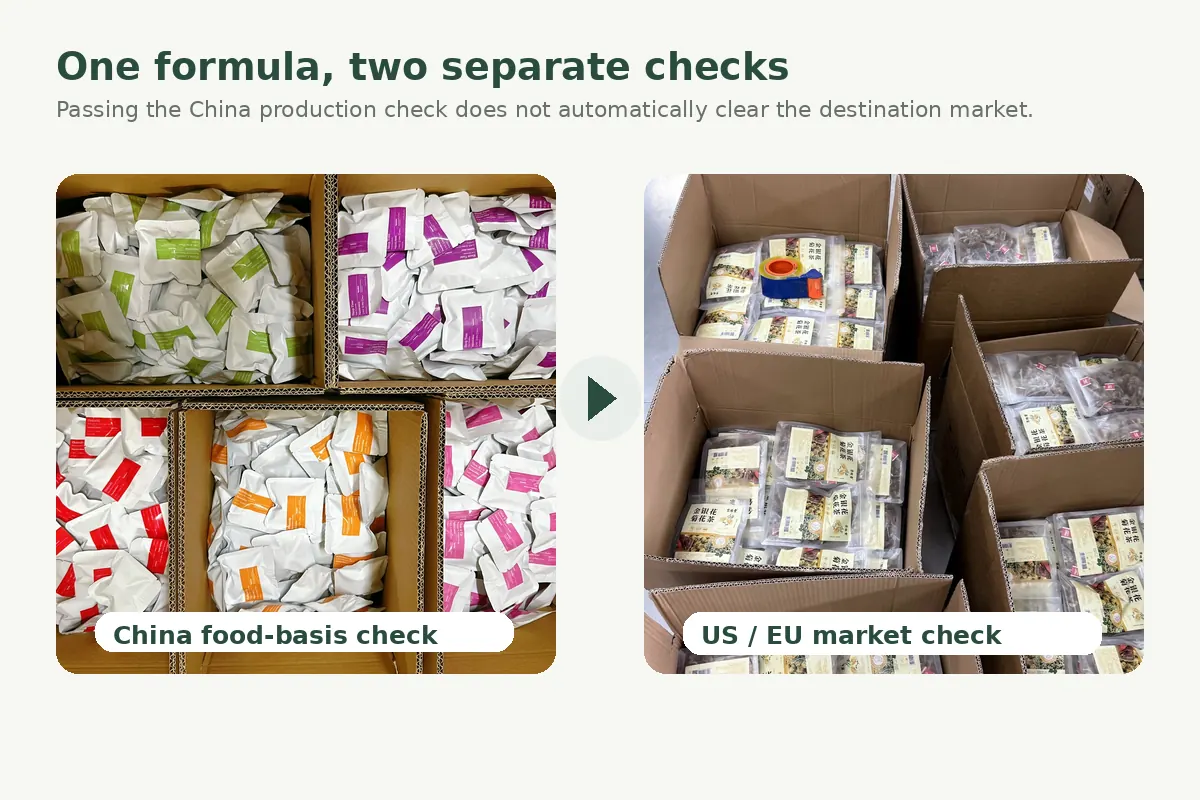
The homology list and the new food ingredient approvals decide what a Chinese food factory may produce. They say nothing about whether the finished tea can be sold in the United States, the European Union or elsewhere.
In the United States, an intentionally added ingredient in a conventional food needs a lawful basis under the FD&C Act, for example a GRAS conclusion for its intended conditions of use, an applicable food additive regulation, or another exclusion from the food additive definition. FDA describes GRAS as a conclusion about safety under specific conditions of use, not a status conferred by another country’s list. In the European Union, Regulation (EU) 2015/2283 allows a novel food on the market only once it is authorised on the Union list, and whether a Chinese herb counts as novel in the EU is assessed separately. A blend can pass the Chinese check and still fail at the destination. For how the US classification works in practice, see our guide to functional herbal tea in the US as conventional food or dietary supplement. For a US-specific, ingredient-by-ingredient check, see our guide to US herbal tea ingredient compliance.
We check the Chinese side. Destination-market clearance is confirmed with the buyer, and the testing and document requirements by market are set out in our guide to herbal tea ingredient testing by destination.
6. How a formula is checked
When a buyer sends a formula, it goes to the factory’s R&D team before sampling or a final production quotation. Each ingredient is checked for its food basis, including the specified species, plant part and any use restriction. The outcome is one of three:
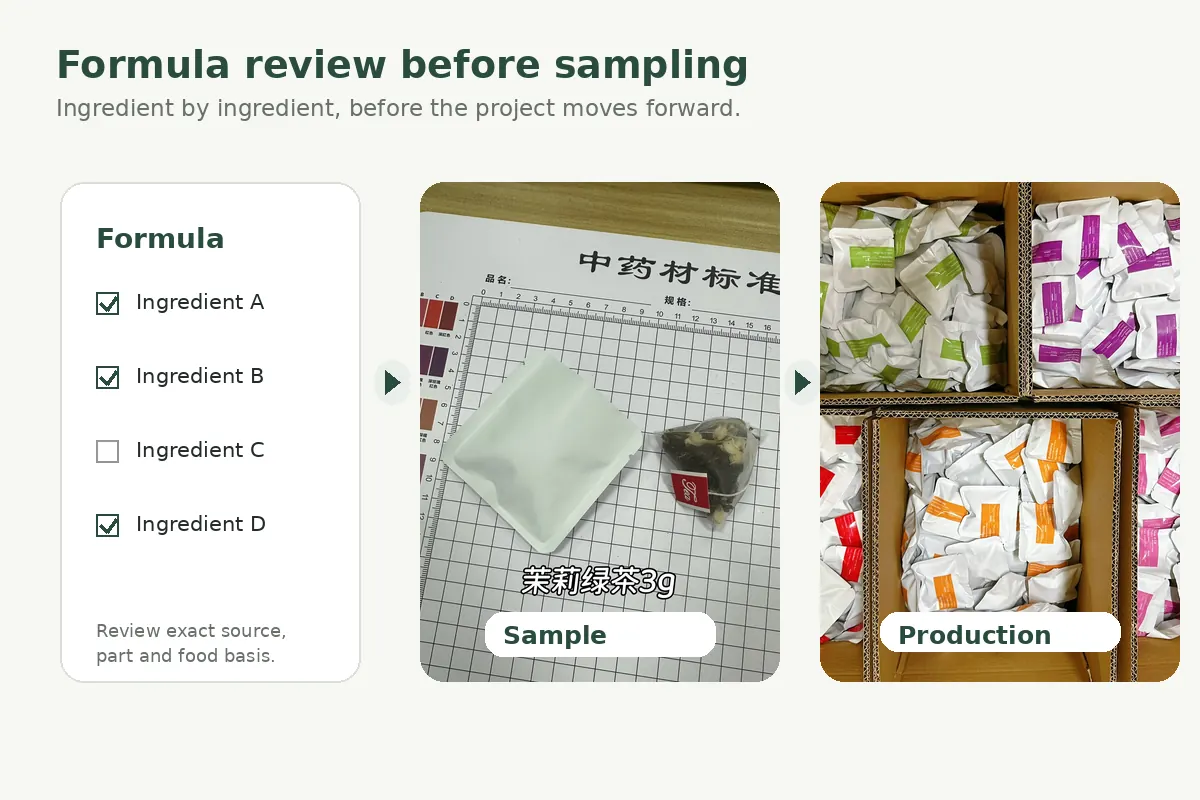
Both of the last two outcomes have happened. Some buyers reworked the formula and went into production; others considered the original ingredient essential and sourced elsewhere. Either is a reasonable result, and it is better reached before samples are made than after.
7. Checking a formula before you send it
For each ingredient, note the Chinese name if you know it, the botanical name and the plant part. Ingredients from the Western herbal tradition (chamomile, lemon balm, hibiscus) and from Ayurveda (ashwagandha, tulsi, neem) should be flagged for a check rather than assumed either way. Blends built from fruit, flowers and common Chinese herbal ingredients, such as those in our stock herbal tea range, are the least likely to need changes. If in doubt, send the formula before sampling; we can first identify which ingredients need a regulatory or factory review.
| Batch | Chinese name | English common name |
|---|---|---|
| 2002 | 丁香 | Clove |
| 八角茴香 | Star anise | |
| 刀豆 | Sword bean | |
| 小茴香 | Fennel seed | |
| 小蓟 | Field thistle (Cirsium) | |
| 山药 | Chinese yam | |
| 山楂 | Hawthorn fruit | |
| 马齿苋 | Purslane | |
| 乌梢蛇 | Black-striped snake (animal) | |
| 乌梅 | Smoked plum (mume) | |
| 木瓜 | Chinese quince (Chaenomeles), not papaya | |
| 火麻仁 | Hemp seed | |
| 代代花 | Bitter orange flower (daidai) | |
| 玉竹 | Solomon’s seal rhizome (yuzhu) | |
| 甘草 | Liquorice root | |
| 白芷 | Angelica dahurica root | |
| 白果 | Ginkgo nut | |
| 白扁豆 | White hyacinth bean | |
| 白扁豆花 | Hyacinth bean flower | |
| 龙眼肉(桂圆) | Longan | |
| 决明子 | Cassia seed | |
| 百合 | Lily bulb | |
| 肉豆蔻 | Nutmeg | |
| 肉桂 | Cinnamon bark (cassia) | |
| 余甘子 | Emblic (amla) | |
| 佛手 | Finger citron | |
| 杏仁(甜、苦) | Apricot kernel (sweet, bitter) | |
| 沙棘 | Sea buckthorn | |
| 牡蛎 | Oyster shell (animal) | |
| 芡实 | Gorgon fruit (euryale seed) | |
| 花椒 | Sichuan pepper | |
| 赤小豆 | Adzuki bean | |
| 阿胶 | Donkey-hide gelatin (animal) | |
| 鸡内金 | Chicken gizzard lining (animal) | |
| 麦芽 | Malt (barley sprout) | |
| 昆布 | Kelp | |
| 枣(大枣、酸枣、黑枣) | Jujube (red date, sour jujube, black date) | |
| 罗汉果 | Monk fruit | |
| 郁李仁 | Bush cherry seed | |
| 金银花 | Honeysuckle flower | |
| 青果 | Chinese olive | |
| 鱼腥草 | Houttuynia | |
| 姜(生姜、干姜) | Ginger (fresh, dried) | |
| 枳椇子 | Raisin tree seed (Hovenia) | |
| 枸杞子 | Goji berry | |
| 栀子 | Gardenia fruit | |
| 砂仁 | Amomum fruit (sha ren) | |
| 胖大海 | Malva nut | |
| 茯苓 | Poria | |
| 香橼 | Citron | |
| 香薷 | Elsholtzia | |
| 桃仁 | Peach kernel | |
| 桑叶 | Mulberry leaf | |
| 桑椹 | Mulberry fruit | |
| 桔红 | Red tangerine peel (ju hong) | |
| 桔梗 | Platycodon root | |
| 益智仁 | Alpinia oxyphylla fruit (yi zhi ren) | |
| 荷叶 | Lotus leaf | |
| 莱菔子 | Radish seed | |
| 莲子 | Lotus seed | |
| 高良姜 | Galangal | |
| 淡竹叶 | Lophatherum leaf | |
| 淡豆豉 | Fermented soybean (dan dou chi) | |
| 菊花 | Chrysanthemum flower | |
| 菊苣 | Chicory | |
| 黄芥子 | Yellow mustard seed | |
| 黄精 | Polygonatum rhizome (huang jing) | |
| 紫苏 | Perilla leaf | |
| 紫苏籽 | Perilla seed | |
| 葛根 | Kudzu root | |
| 黑芝麻 | Black sesame | |
| 黑胡椒 | Black pepper | |
| 槐米 | Sophora flower bud | |
| 槐花 | Sophora flower | |
| 蒲公英 | Dandelion | |
| 蜂蜜 | Honey | |
| 榧子 | Torreya nut | |
| 酸枣仁 | Jujube seed (suan zao ren) | |
| 鲜白茅根 | Fresh imperata rhizome | |
| 鲜芦根 | Fresh reed rhizome | |
| 蝮蛇 | Pit viper (animal) | |
| 橘皮 | Tangerine peel | |
| 薄荷 | Mint | |
| 薏苡仁 | Job’s tears (coix seed) | |
| 薤白 | Chinese chive bulb (Allium macrostemon) | |
| 覆盆子 | Chinese raspberry (Rubus chingii) | |
| 藿香 | Agastache (huo xiang) | |
| 2019 (spice and seasoning only) | 当归 | Angelica sinensis root (dang gui) |
| 山柰 | Sand ginger (Kaempferia galanga) | |
| 西红花(藏红花) | Saffron | |
| 草果 | Tsaoko fruit | |
| 姜黄 | Turmeric | |
| 荜茇 | Long pepper | |
| 2023 | 党参 | Codonopsis root |
| 肉苁蓉(荒漠) | Desert cistanche | |
| 铁皮石斛 | Dendrobium officinale | |
| 西洋参 | American ginseng | |
| 黄芪 | Astragalus root | |
| 灵芝 | Reishi (Ganoderma) | |
| 山茱萸 | Cornus fruit | |
| 天麻 | Gastrodia rhizome | |
| 杜仲叶 | Eucommia leaf | |
| 2024 | 地黄 | Rehmannia root |
| 麦冬 | Ophiopogon root (mai dong) | |
| 天冬 | Asparagus cochinchinensis root (tian dong) | |
| 化橘红 | Citrus grandis ‘Tomentosa’ peel (hua ju hong) |
FAQ
What is China’s food-medicine homology list?
It is the national list, published by the health authority NHC with the market regulator SAMR, of substances that are traditionally both food and Chinese medicinal material. Under Article 38 of the Food Safety Law, only these substances may be used as medicinal-type ingredients in ordinary food. The list currently has 106 entries.
Can a Chinese food factory use any herb that is in the Chinese Pharmacopoeia?
No. Pharmacopoeia inclusion is a condition for being added to the list, not a substitute for it. Many pharmacopoeial herbs, such as Coptis, Scutellaria and Fritillaria, are not permitted in ordinary food.
Is ashwagandha allowed in herbal tea made in China?
Ashwagandha is not on the homology list, and we have not identified a national approval covering its use in ordinary tea. It cannot be used in food-grade tea blends produced by our partners.
Is rooibos allowed?
Yes. Rooibos (Aspalathus linearis) leaf and fine stem was approved as a new food ingredient in 2014, with infusion as the specified use.
Are astragalus and codonopsis allowed?
Yes. Both were formally added to the homology list in 2023, for the botanical sources and parts specified in the announcement.
If an ingredient has a Chinese food basis, can I sell the tea in the US or EU?
Not automatically. US GRAS status and EU novel food authorisation are separate assessments. The Chinese rules govern production in China only.
To check a tea formula against the homology list and the destination-market rules before quotation, send the ingredient list through our private label herbal tea bags page.
