Tell Us About Your Project
Share your product, quantity and project requirements. We will review the details and respond with the relevant next steps.

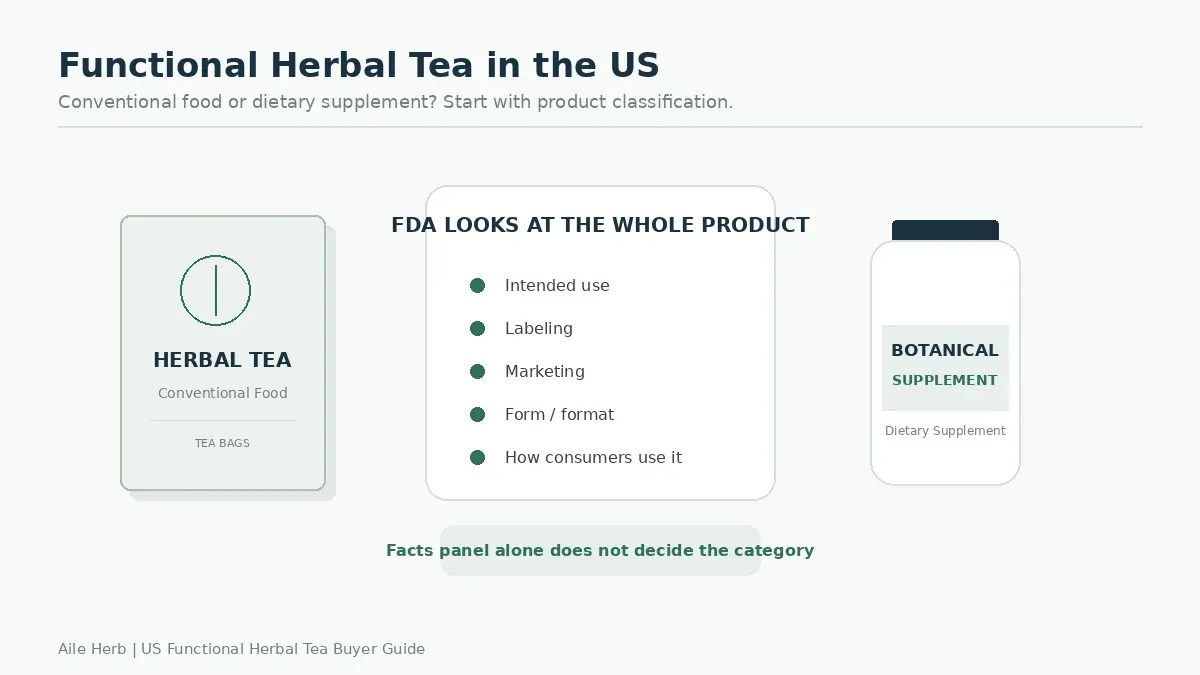
Under functional herbal tea US regulations, a product is not classified only by whether it carries a Nutrition Facts or a Supplement Facts panel. FDA looks at the product’s overall presentation, including its intended use, labeling, marketing, form and how consumers are expected to use it.
A botanical that can be sold as a dietary supplement ingredient is not automatically lawful as an added ingredient in a conventional tea or beverage. Buyers should determine the product category first, then verify the legal basis for each ingredient in that category.
A typical private-label request sounds like this: “I want a functional tea for sleep, stress, energy, women’s wellness or focus. Can you make it for the US?”
Before the formula, claims, dosage, packaging or facts panel are finalized, the brand should determine how the planned product is likely to be classified under US law based on its formulation, intended use, labeling, marketing, form and consumption pattern.
That classification can affect ingredient legality, labeling, the claims framework, manufacturing requirements, notification obligations and import responsibilities.
Choosing ingredients before resolving the product classification and the food-use basis for those ingredients can lead to reformulation later.
Under the Federal Food, Drug, and Cosmetic Act, 21 U.S.C. § 321(ff), a dietary supplement is a defined category, not a label style.
In practical terms, a dietary supplement must:
Herbs and other botanicals can be dietary ingredients. Amino acids can also be dietary ingredients.
Being a dietary ingredient, however, does not mean the same substance is automatically lawful as an ingredient in a conventional beverage. The two questions are answered under different parts of the law.
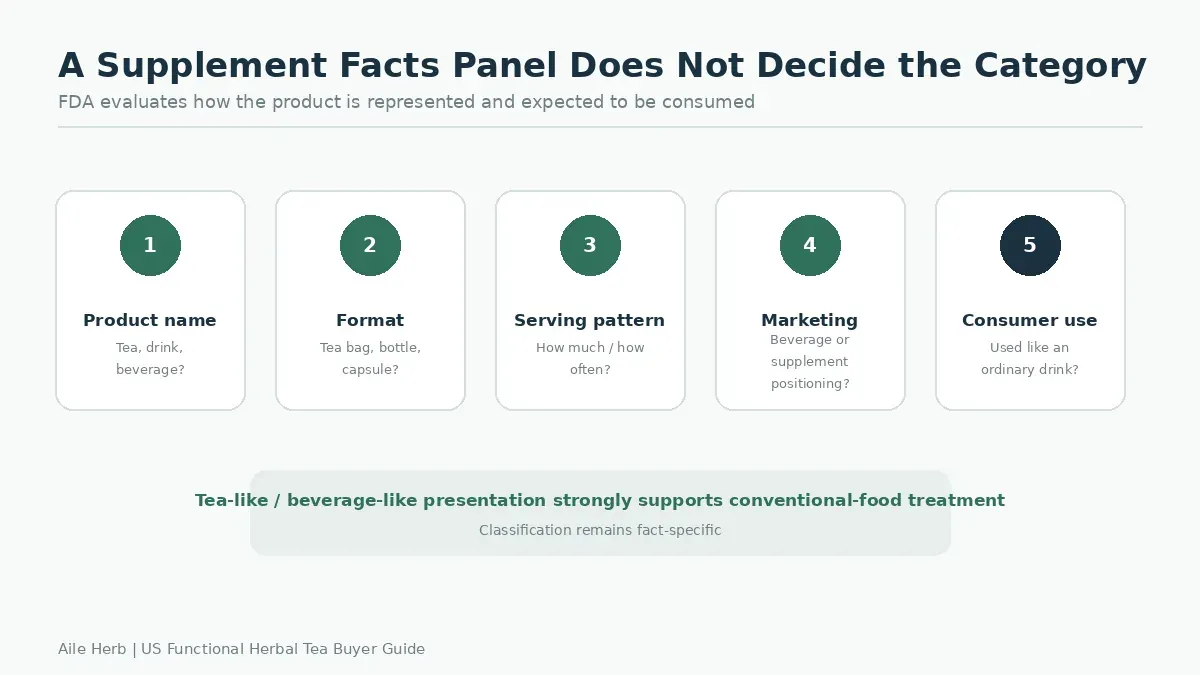
Printing a Supplement Facts panel does not by itself turn a conventional beverage into a dietary supplement.
The statutory definition includes a separate condition: the product must not be represented for use as a conventional food.
In its guidance on distinguishing liquid dietary supplements from beverages, FDA states that beverages are conventional foods.
FDA looks at the whole presentation, which can include:
Tea-like or beverage-like presentation strongly supports conventional-food classification, but classification remains fact-specific.
There is no blanket yes or no.
Not every tea bag is automatically a conventional food, but ordinary tea presentation strongly supports conventional-food treatment.
This is especially the case when the product is called tea, is brewed and consumed like ordinary tea, uses conventional beverage serving patterns and is marketed as a drink.
The practical takeaway is not to choose a Supplement Facts panel first and assume the classification question is solved. Classification should be reviewed from the complete product concept.
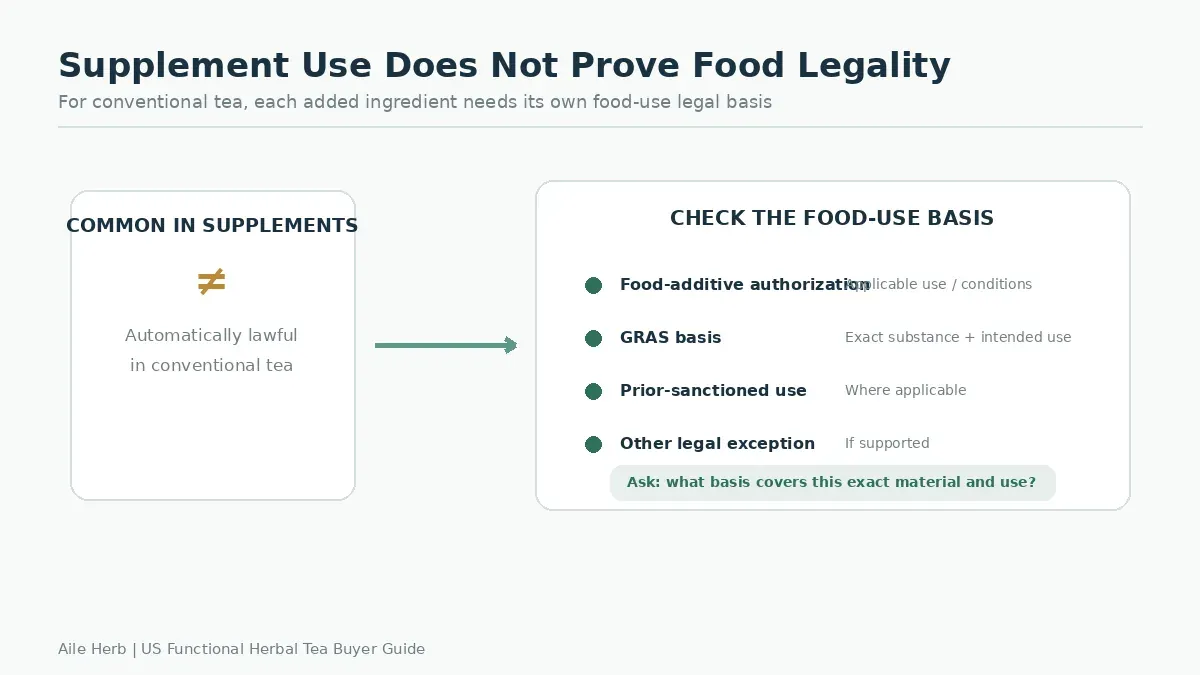
No. This is the most important ingredient rule in this article.
A botanical may fit the definition of a dietary ingredient in a supplement. That does not establish a lawful basis for adding it to a conventional tea or beverage.
FDA’s guidance on substances added to foods, including beverages addresses this distinction directly.
For a conventional food, an added substance generally needs an appropriate food-use legal basis, such as:
Where no such basis exists, FDA may treat the substance as an unsafe food additive, and the food may be considered adulterated. Which specific botanicals have a GRAS basis for tea, and which do not, is covered in our ingredient compliance check.
“Common in supplements” is not a US conventional-food regulatory category.
The relevant question is not whether an herb is sold in America, but what the legal basis is for this exact substance, form and intended use in this food category.
GRAS — generally recognized as safe — is not the same as natural, traditional, long-used, supported by a COA, sold online, or common in supplements.
A GRAS conclusion applies to a specific substance under specific intended conditions of use.
Relevant details can include:
A GRAS conclusion for one extract does not automatically cover another plant part, another extraction process, another supplier, another purity, another dose or another food category.
Under FDA’s current regulatory framework for GRAS, GRAS notification is voluntary.
A company may reach an independent GRAS conclusion without filing a notice.
That does not mean no evidence is needed. The company must still have an adequate scientific and legal basis for its conclusion, and FDA may challenge an independent GRAS conclusion.
FDA also publishes post-market determinations that a use is not GRAS.
Two terms are often misused.
FDA does not issue “GRAS certificates”.
An FDA “no questions” letter means FDA did not question the notifier’s GRAS conclusion for the specified substance and notified conditions of use. It is not a universal approval of the ingredient.
No.
21 CFR 182.10 lists certain spices and other natural seasonings and flavorings.
21 CFR 182.20 lists certain essential oils, solvent-free oleoresins and natural extractives.
They are not a complete list of botanicals allowed in US food.
A botanical that is not listed is not automatically prohibited, and one that is listed is not automatically allowed in every form and dose.
In particular, appearing in a seasoning or flavoring context does not automatically authorize:
Intended use and exposure still matter.
China’s food-and-medicine-homology list (药食同源) is a Chinese regulatory concept.
We have not located any official FDA recognition of China’s food-and-medicine-homology list as a US food-use authorization.
It should therefore not be treated as:
A Chinese supplier or US brand should not use “listed as food-and-medicine homology in China” as the sole legal basis for a US conventional-food ingredient. The Chinese list governs what a licensed food factory in China may produce; what it contains and how we apply it is explained in our guide to China’s food-medicine homology list.
Each ingredient still needs to be assessed under US law for its intended use.
Ashwagandha is widely seen in the US supplement market. That presence does not establish conventional-food legality.
We did not locate an FDA “no questions” GRAS notice establishing a general conventional-food basis for ashwagandha.
In addition, FDA Import Alert 99-45 contains entries stating that conventional food products containing ashwagandha appear to be adulterated because the use of ashwagandha in those products appears to be an unsafe food additive.
This is an FDA enforcement example and a strong risk signal for conventional-food positioning.
It is not a blanket statutory prohibition covering every conceivable use.
In a 2012 scientific memorandum, FDA concluded that available information on Ginkgo biloba extract raised safety concerns and did not support a GRAS basis for its use in conventional foods.
FDA identified no applicable food-additive regulation or prior sanction and treated the extract as an unapproved food additive for that use.
The memorandum reviewed Ginkgo biloba extract in conventional foods.
It should not be extended automatically to every ginkgo plant material, every manufacturing form or every possible use, but it is highly relevant to functional tea or beverage formulas that include ginkgo extract.
L-theanine offers a useful contrast.
The FDA GRAS Notice Inventory lists several L-theanine notices that received “FDA has no questions” responses:
These should not be described as “FDA approval of L-theanine”.
Each notice covers a specific substance, source, manufacturing route, specification and set of intended uses.
Tea-derived and chemically synthesized L-theanine, for example, rely on different submissions.
Another notice, GRN 1311, was listed as pending as of September 2026 and should not be presented as cleared.
The useful buyer question is:
Which exact regulatory basis applies to this exact L-theanine material and use?
21 CFR 184.1408 directly addresses licorice and licorice derivatives, including ammoniated glycyrrhizin.
This does not mean licorice can be used without limit in every tea.
Licorice, licorice extract, glycyrrhizin and ammoniated glycyrrhizin need to be distinguished, and the specific uses, food categories and restrictions should be checked against the current CFR text for the intended product.
Licorice sourced from China can also involve separate supply-side considerations; see export-restricted Chinese herbs.
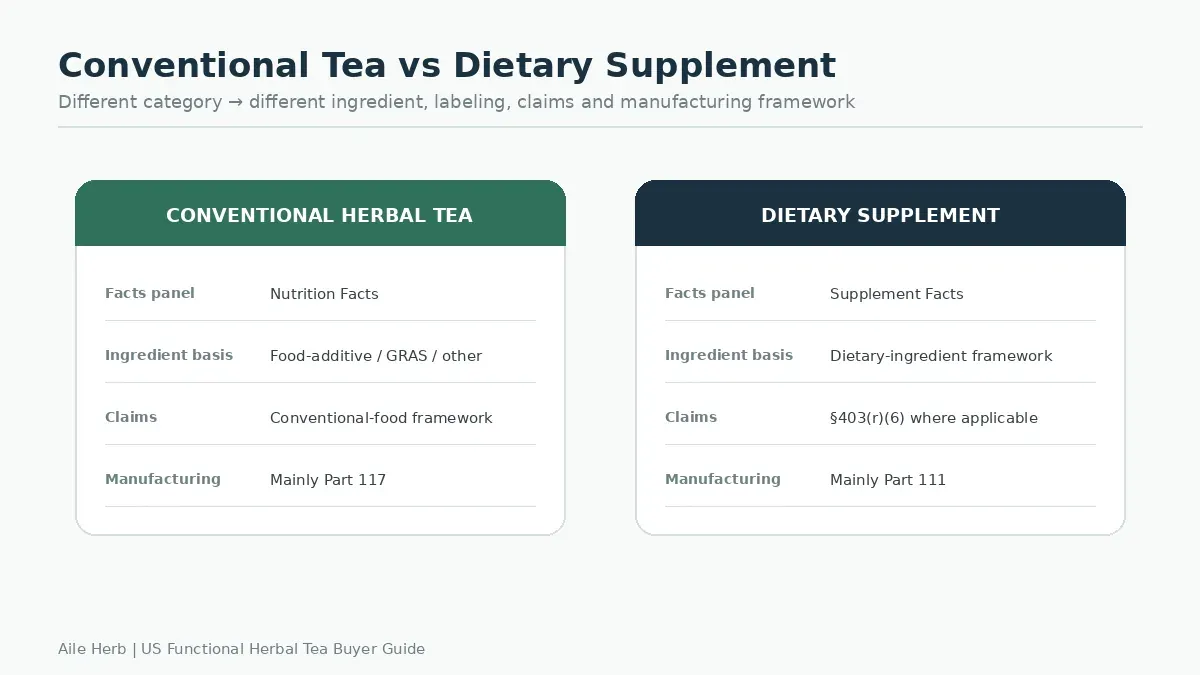
| Topic | Conventional Herbal Tea / Beverage | Dietary Supplement |
|---|---|---|
| Basic classification | Conventional food or beverage | Must meet § 321(ff) |
| Facts panel | Nutrition Facts, where applicable | Supplement Facts |
| Ingredient legality | Food-additive, GRAS or other food-use basis | Dietary-ingredient framework plus other requirements |
| Botanicals | Supplement use does not prove food legality | Herbs and botanicals can be dietary ingredients |
| Structure/function claims | Separate conventional-food framework | § 403(r)(6) framework |
| Claim notification | No supplement-specific 30-day rule | 30-day notification for applicable claims |
| Disclaimer | Do not copy the supplement disclaimer | Required for applicable § 403(r)(6) claims |
| Manufacturing | Mainly 21 CFR Part 117 | Mainly 21 CFR Part 111, with some Part 117 interaction |
| New dietary ingredients | Not applicable | May apply |
| FSVP | Standard food framework where applicable | Modified rules may apply to finished supplements |
No.
For dietary supplements, structure/function claims under section 403(r)(6) require substantiation, a statutory disclaimer, and notification to FDA no later than 30 days after first marketing with the claim.
Conventional foods do not use this supplement-specific system.
Adding a Supplement Facts panel and the supplement disclaimer does not solve a claims question for a conventional tea.
Neither conventional foods nor dietary supplements can freely make disease treatment or prevention claims without raising drug issues.
For packaging wording, see herbal tea packaging health claims.
Conventional foods are primarily subject to 21 CFR Part 117, covering current good manufacturing practice and, where applicable, hazard analysis and risk-based preventive controls.
Dietary supplements are primarily subject to 21 CFR Part 111.
Part 111 includes supplement-specific requirements such as:
These requirements are described in FDA’s small entity compliance guide.
Supplement facilities are not fully exempt from Part 117.
According to FDA’s FSMA FAQs, when the relevant conditions are met, Part 117 Subparts C and G do not apply to certain supplement operations, while other Part 117 provisions can still apply.
FDA also does not issue a generic “Part 111 certificate”.
Part 111 is a set of regulatory obligations.
For dietary supplements, an ingredient may be a new dietary ingredient (NDI) if it was not marketed in the US as a dietary ingredient before October 15, 1994, subject to applicable exceptions.
Where notification is required, it must generally be submitted at least 75 days before the supplement is introduced into interstate commerce.
An herb being widely sold does not by itself rule out NDI status.
The analysis can depend on:
These roles are often confused in private-label projects.
A U.S. agent is not automatically the FSVP importer.
FSVP treatment can also differ between conventional foods, finished dietary supplements and supplement components.
No.
Proposition 65 is California state law requiring clear and reasonable warnings before certain exposures to listed chemicals.
It is not:
Businesses with fewer than 10 employees are generally exempt from the warning requirements.
For lead, the analysis is exposure-based.
A product’s lead concentration in ppm should not be compared directly with a safe-harbor value expressed in micrograms per day.
Exposure assessment can involve:
A laboratory result in ppm does not, by itself, answer the Proposition 65 warning question.
Potential roles can include:
Under the warning regulations, primary responsibility is generally placed on upstream businesses, with defined mechanisms for passing warning materials down the supply chain.
Contracts can allocate:
A contract does not, however, automatically erase statutory obligations.
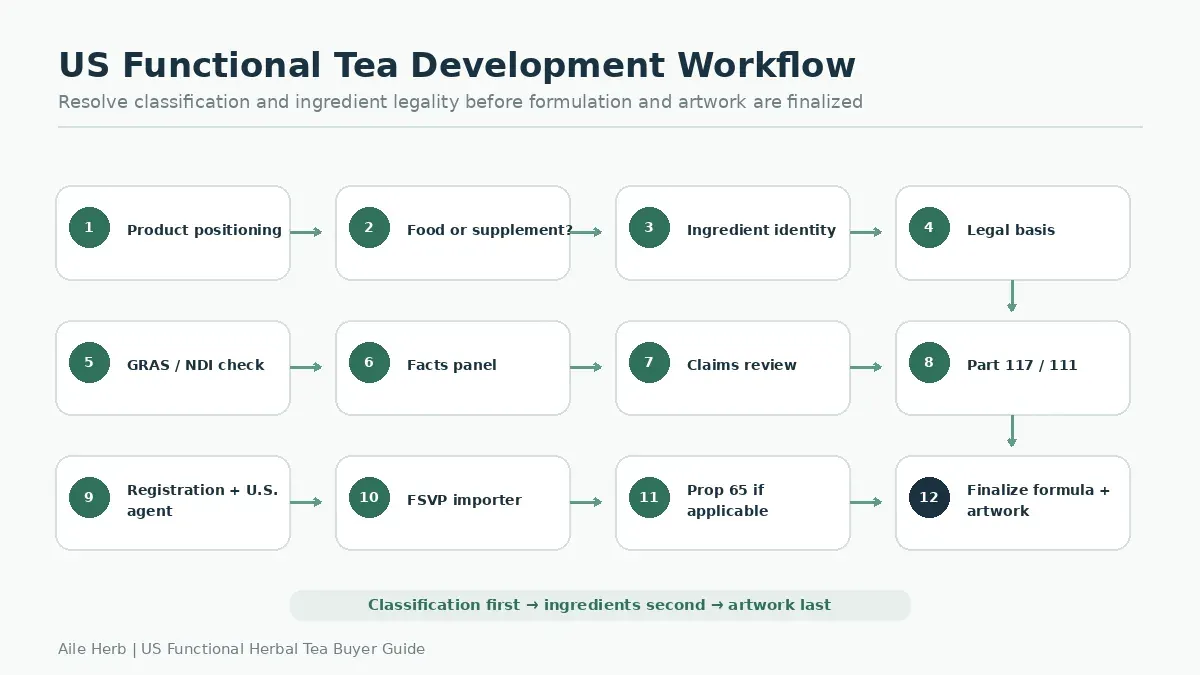
For US functional-tea projects, ingredient selection should begin with the intended product category and destination-market regulatory requirements rather than with a list of botanicals commonly used in supplements.
Where a buyer proposes a functional botanical formula, the exact ingredient identity, plant part, processing form and intended US use should be confirmed before the formula is finalized.
Testing and documentation for the ingredients themselves are covered in herbal tea ingredient testing requirements, and route options for tea projects are explained in Private Label Herbal Tea: Stock Blends vs Custom Formulation.
Before developing a functional tea for the US, confirm:
Possibly, depending on the full facts.
Format alone is not decisive, and a product represented as a conventional beverage may not qualify as a dietary supplement.
No.
Classification depends on the statutory definition and the product’s full presentation, not on the panel alone.
Not automatically.
Conventional-food ingredient legality needs its own basis, such as GRAS status, an applicable food-additive authorization or another valid food-use basis for the intended use.
No.
GRAS applies to a specific substance under specific conditions of use.
An FDA “no questions” letter responds to a particular notifier’s GRAS conclusion and notified conditions rather than approving the ingredient generally.
No.
Under FDA’s current framework, notification is voluntary.
The company still needs a supportable scientific and legal basis for its GRAS conclusion, and FDA can challenge that conclusion.
We have not located any official FDA recognition of that Chinese list as a US food-use authorization.
US food legality still needs to be evaluated under the applicable US regulatory framework.
We have not located any general FDA approval for that use.
FDA Import Alert 99-45 contains adverse enforcement language concerning conventional foods containing ashwagandha.
That is a strong risk signal for tea or beverage use, but it should not be described as a blanket ban covering every possible use.
That wording is inaccurate.
Specific GRAS notices received “FDA has no questions” responses for specified L-theanine substances and conditions of use.
The actual material used in a product should be matched to the relevant regulatory basis.
No.
It is a separate California exposure-warning law.
For lead, the analysis is exposure-based rather than determined by one simple product ppm threshold.
No.
The U.S. agent is a role connected with foreign food facility registration, while the FSVP importer is a separate role responsible for foreign supplier verification.
To develop a US tea product on either route with the ingredient and label checks built in, see our private label herbal tea bags service and send the formula, serving weight and intended claims.
