Tell Us About Your Project
Share your product, quantity and project requirements. We will review the details and respond with the relevant next steps.

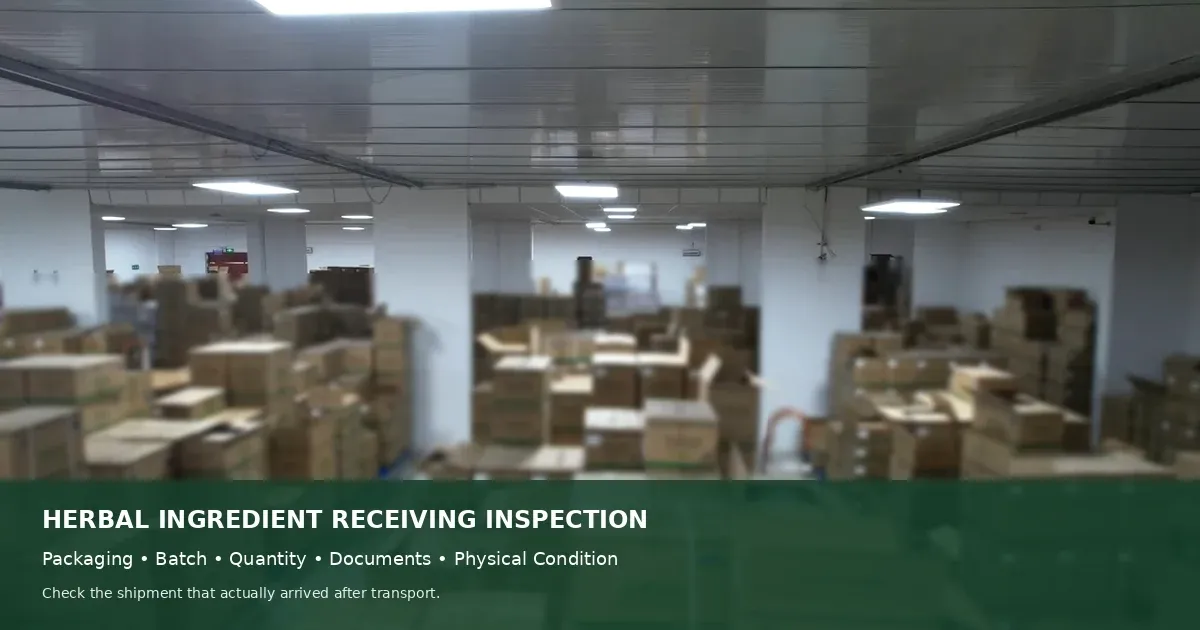
Herbal ingredient receiving inspection checks what physically arrived, not only what was approved before dispatch. Buyers should verify packaging integrity, moisture or contamination signs, labels, batch linkage, quantity, documents and visible product condition before release. A COA supports batch evidence, but it cannot prove that the shipment remained in acceptable condition during transport.
Receiving inspection should confirm:
Receiving inspection establishes whether the delivered shipment can proceed, be held, or needs further investigation under the buyer’s agreed controls.
| Receiving Check | Laboratory / Analytical Review |
|---|---|
| Confirms what physically arrived | Evaluates attributes requiring testing |
| Checks packaging, labels, quantity and batch linkage | May assess moisture, contaminants, microbiology, assay or other agreed tests |
| Uses visual review, count, document reconciliation and photos | Uses defined analytical methods |
| Can trigger hold or investigation | Supports analytical release where required |
| Does not prove analytical compliance | Does not replace correct receiving checks |
Before packages are opened, receiving staff should check what is externally visible.
| External Check | Why It Matters | Buyer Action |
|---|---|---|
| Supplier, PO and shipment reference | Establishes the expected consignment | Record before unloading or opening |
| Pallet and package count | Detects short, excess or mixed shipments | Compare with packing list |
| Crushed or punctured cartons, torn film or broken straps | May affect package integrity or create mix-up risk | Photograph and identify affected packages |
| Wet cartons, damp pallets, staining or leakage | May indicate water exposure | Segregate affected units and inspect further |
| Visible insects, webbing or abnormal odour | May indicate pest or contamination risk | Hold affected units pending assessment |
| Truck or container condition where relevant | Helps document visible transport issues | Photograph relevant observations |
| Overall shipment photos | Preserves evidence of arrival condition | Photograph before or immediately after unloading |
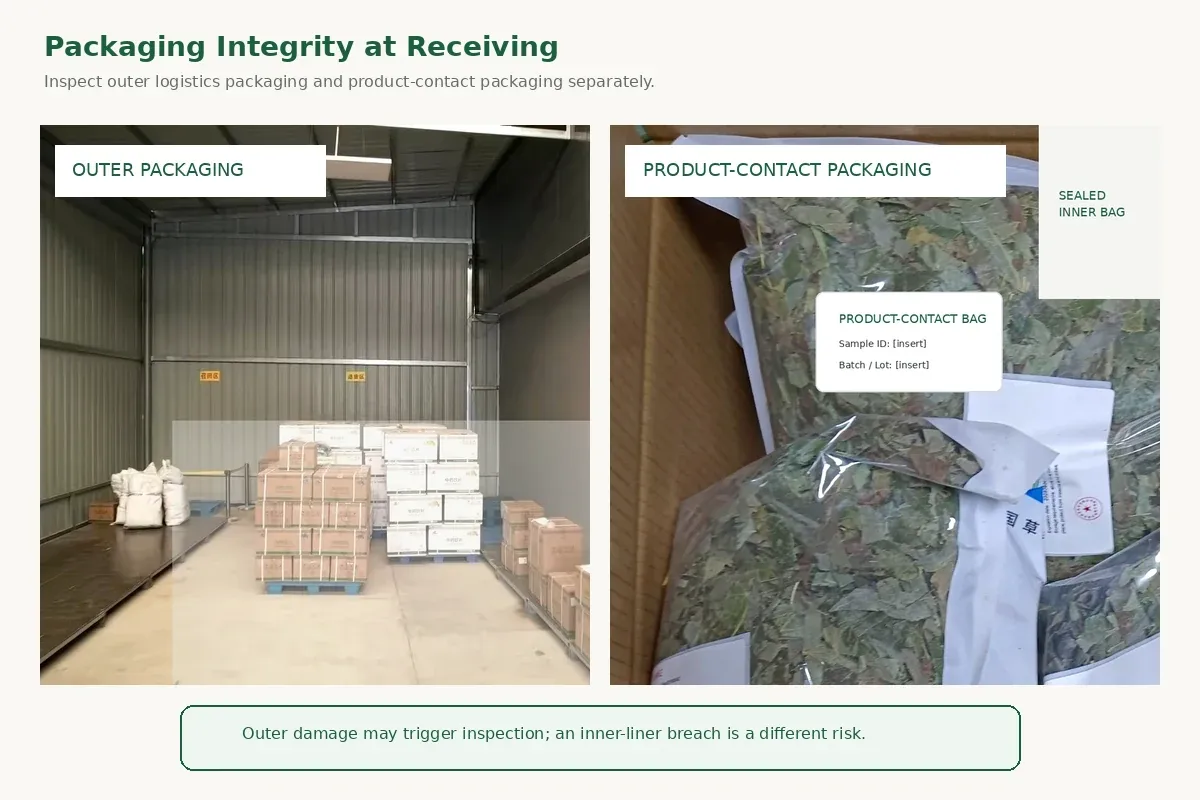
Not all packaging damage carries the same risk.
Outer packaging damage, such as a crushed carton, torn carton, broken pallet or loose strap, may justify further inspection but does not automatically mean the botanical material inside is unacceptable.
Product-contact packaging failure, such as a torn inner liner, punctured vacuum pouch, open closure, broken drum seal, leakage or moisture inside the liner, is more significant because the material itself may have been exposed.
| Arrival Scenario | Initial Risk | Buyer Follow-Up |
|---|---|---|
| Crushed carton, inner liner intact | Low to moderate | Photograph, identify the unit and inspect liner and product |
| Torn carton, sealed inner bag intact | Low to moderate | Document damage and inspect the inner bag and label |
| Wet carton, liner apparently dry and intact | Moderate | Segregate and inspect more closely |
| Broken pallet, packages intact | Low to moderate | Recount and inspect affected packages |
| Condensation outside an intact liner | Moderate | Verify there is no water ingress |
| Torn inner liner | High | Hold affected package and assess exposure |
| Water droplets inside product-contact packaging | High | Hold, inspect additional units and consider testing |
| Visible mold, insects or contamination | High | Hold and investigate |
Visible dryness is not a moisture-compliance result.
Arrival red flags can include:
Depending on the situation, the buyer may photograph and segregate affected units, inspect additional packages, review transport evidence, notify the supplier, or conduct targeted moisture or other testing.
There is no single moisture or humidity limit that applies to every herbal ingredient.
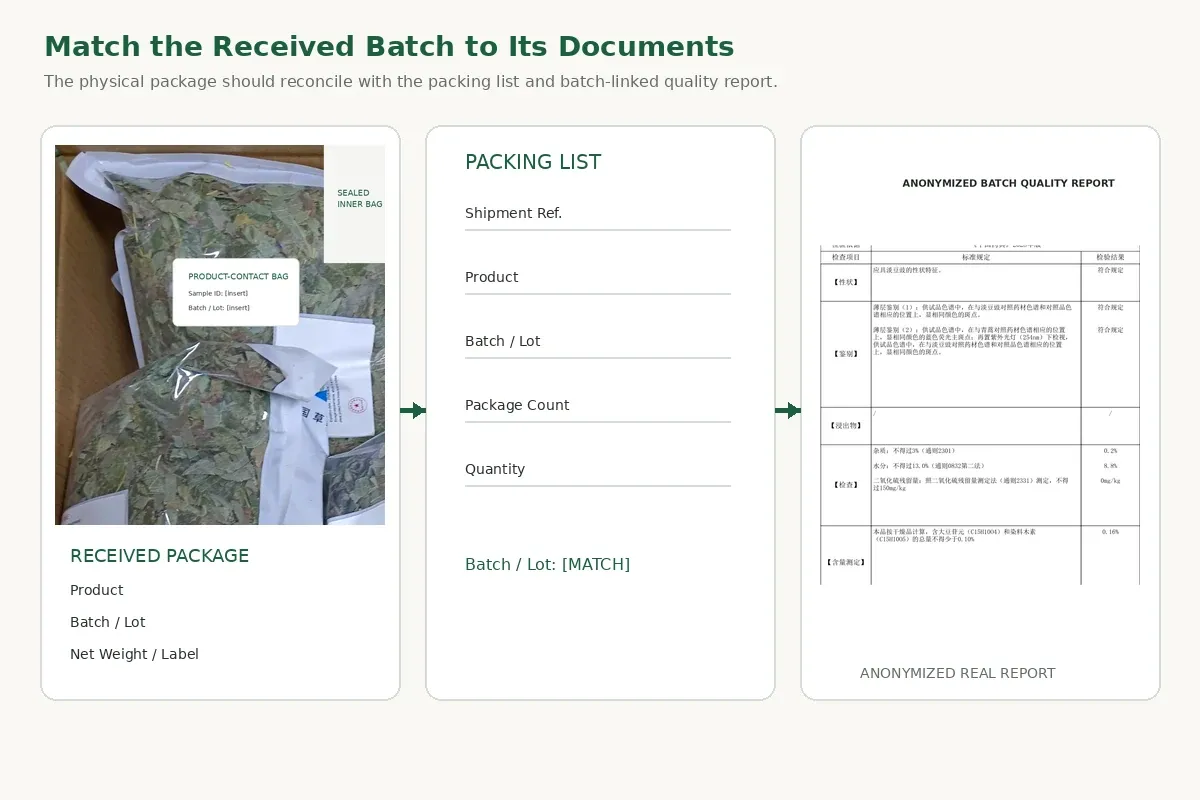
A practical receiving sequence is:
PO / Specification → Packing List → Package Label → COA / Reports → Physical Product
| Check Point | What Should Match or Reconcile |
|---|---|
| PO / specification | Product, botanical name, plant part, form, cut, grade, pack format and controlled origin |
| Packing list | Shipment reference, package count, quantity and batch / lot |
| Package label | Product identity, batch / lot, net weight and applicable dates |
| COA / reports | Same product and batch, with the agreed analytical scope |
| Physical product | Form, cut and practical appearance consistent with the specification |
The received packages should be traceable to the supporting batch documents.
If the batch number on the COA does not match the received packages, hold the affected shipment and reconcile the discrepancy before release.
Keep commercial quantity issues separate from product-quality issues.
A commercial quantity discrepancy may include:
A product-quality non-conformance may include:
Receiving staff can count pallets and packages, compare marked net weight, weigh selected units where justified, and record leaking or damaged packages.
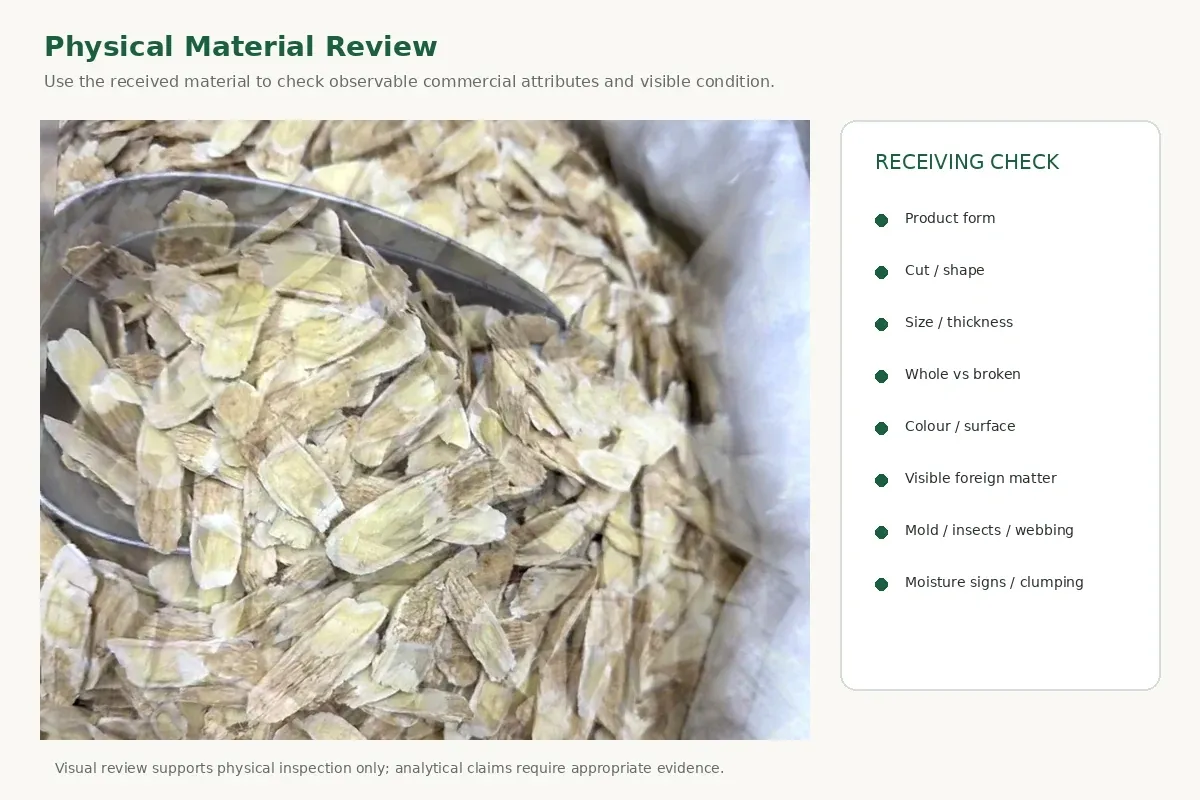
| Attribute | Receiving Method | What the Review Can Establish |
|---|---|---|
| Product form / plant part | Visual comparison | Practical receiving confirmation |
| Cut / length / thickness / shape | Compare with specification and sample | Physical conformity within agreed tolerance |
| Whole pieces / breakage / fines | Representative visual review | Commercial presentation |
| Colour / surface condition | Visual comparison | Visible condition within expected variation |
| Odour | Sensory observation | Can identify an abnormal condition |
| Foreign matter | Visual inspection | Can identify visible foreign material |
| Mold / insects / webbing | Visual inspection | Can identify visible concerns |
| Moisture signs / clumping | Visual review | Can trigger further investigation |
| Sulfur-free status | Not visual | Requires evidence or testing |
| Pesticides / heavy metals / microbiology | Not visual | Requires analytical evidence |
| Organic status / farm origin | Not visual | Requires documentation |
Visual receiving checks are useful for physical condition and obvious defects; they do not replace analytical or certification evidence.
Compare the received material against the approved sample plus written tolerances for:
An approved sample does not require exact visual identity. Herbal materials are agricultural products and can show normal variation in colour, size and texture between batches.
Investigate differences that affect product form, grade, usability, processing suitability, controlled physical specifications, likely identity or visible contamination.
The botanical ingredient sample approval process provides the reference and written criteria used for comparison at receiving.
Sampling should be risk-based and appropriate to the material, lot size, supplier history, intended market, specification and question being investigated.
Buyer-level controls may include:
There is no universal number of bags or sample weight suitable for every botanical material.
A compliant COA does not itself prove that:
The COA supports batch evidence; receiving inspection verifies the condition and identity of what actually arrived.
For analytical-document review, see the Certificate of Analysis Guide.
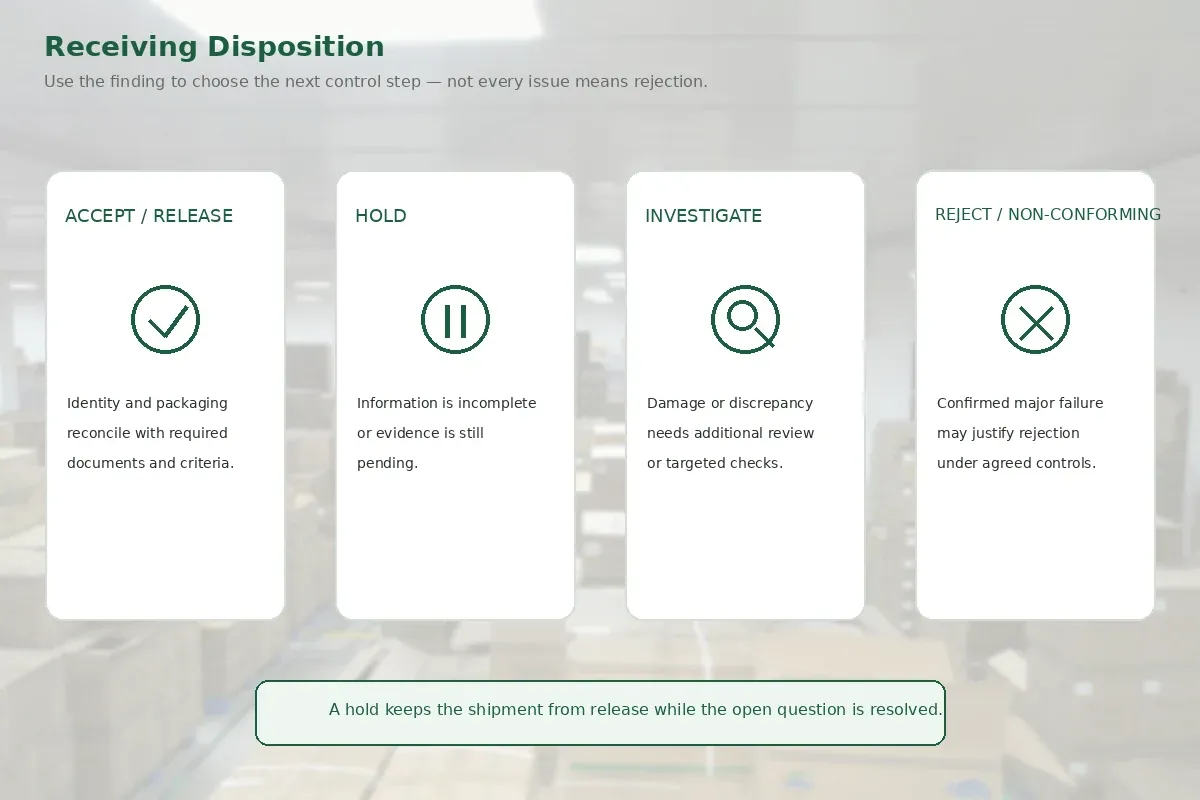
| Finding | Initial Status | Next Step |
|---|---|---|
| Identity, quantity, documents, packaging and physical review reconcile with requirements | Accept / release | Record the decision and retain evidence |
| Required document missing, batch linkage unclear, test evidence pending or damage requires assessment | Hold | Segregate or prevent use pending review |
| Localized outer-carton damage, uncertain moisture exposure, possible natural variation or label discrepancy | Investigate | Photograph, inspect additional units, reconcile documents and test if justified |
| Wrong product, unreconcilable batch identity, major visible contamination, severe product-contact packaging failure or confirmed specification failure | Reject / non-conforming | May justify rejection; notify supplier and follow the buyer’s non-conformance process |
A hold is not the same as rejection. It keeps the material from being released until an unresolved question has been assessed.
Useful receiving photos include:
Photos support supplier communication, internal non-conformance review and repeat-order comparison.
| Pre-Shipment Inspection | Receiving Inspection |
|---|---|
| Before dispatch | After transport |
| Supplier, factory or third-party location | Buyer receiving location |
| Reviews finished goods before transport risk | Reviews actual delivered condition |
| Confirms packing and documents before shipment | Detects transport damage, shortage and arrival discrepancies |
| Cannot show what happens during transit | Captures actual condition on receipt |
See the Pre-Shipment Inspection Guide for the pre-dispatch checkpoint.
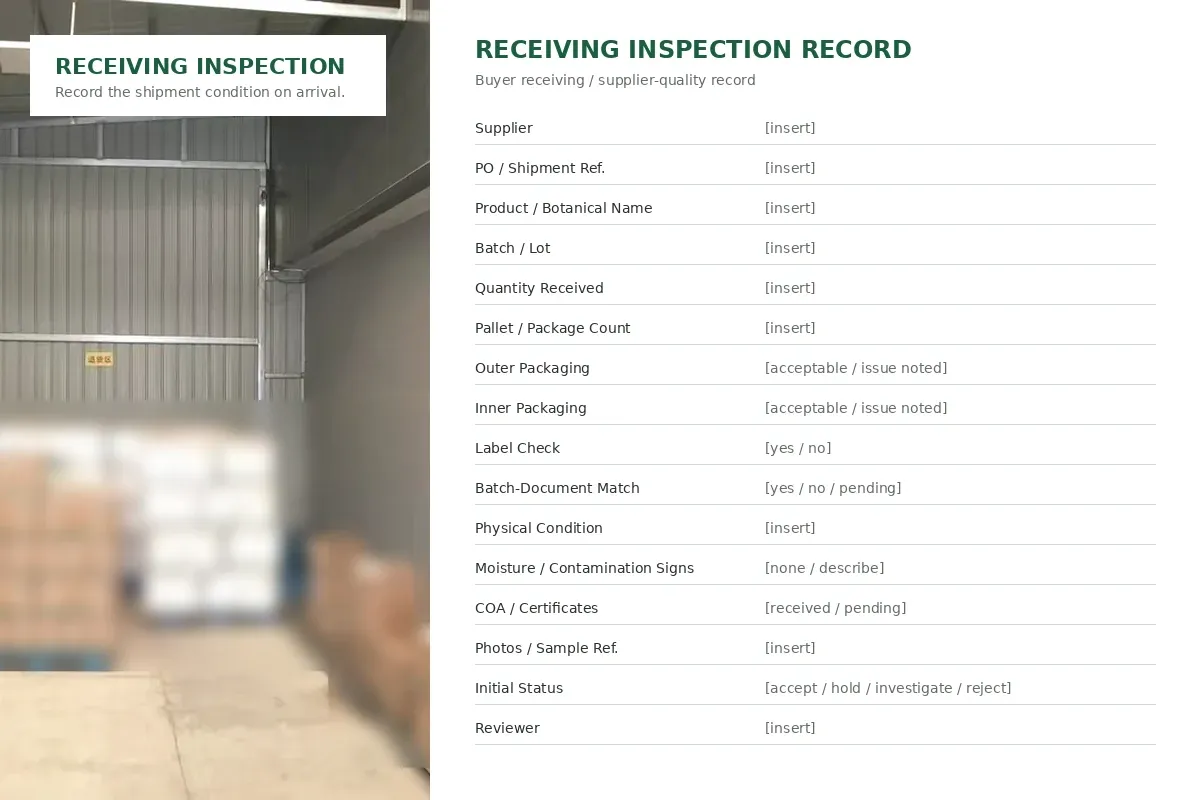
| Field | Record |
|---|---|
| Supplier | [insert] |
| PO number | [insert] |
| Shipment / receiving reference | [insert] |
| Product name | [insert] |
| Botanical name | [insert] |
| Plant part | [insert] |
| Product form / cut / grade | [insert] |
| Batch / lot number | [insert] |
| Date received | [YYYY-MM-DD] |
| Quantity ordered | [insert] |
| Quantity received | [insert] |
| Pallet count | [insert] |
| Package count | [insert] |
| Outer packaging condition | [acceptable / issue noted] |
| Inner packaging condition | [acceptable / issue noted] |
| Closure / seal condition | [acceptable / issue noted] |
| Label check completed | [yes / no] |
| Batch-document match | [yes / no / pending] |
| Product form / cut review | [insert] |
| Appearance / odour observation | [insert] |
| Visible contamination / mold / pest evidence | [none / describe] |
| Moisture / condensation observation | [none / describe] |
| COA received and batch-linked | [yes / no / pending] |
| Required certificates received | [yes / no / N/A] |
| Sample taken | [yes / no] |
| Photos / evidence reference | [insert] |
| Initial status | [accept / hold / investigate / reject] |
| Reviewer | [insert] |
| Comments / non-conformance reference | [insert] |
| Supplier notification required | [yes / no] |
A first order may justify a more detailed receiving review because supplier consistency, packaging robustness and normal material variation are not yet established.
Stable repeat orders can follow an agreed risk-based receiving plan informed by supplier performance, specification stability, packaging history, documentation history and previous receiving results.
This does not mean every first order requires 100% inspection or every repeat order should receive reduced inspection.
No. A COA supports batch evidence from testing, but it does not confirm the condition in which the shipment arrived. Packaging integrity, quantity, labels, physical condition and batch linkage still need to be reviewed according to the buyer’s receiving controls.
Not automatically. Outer packaging damage should be assessed against the condition of the product-contact packaging inside. If the inner liner remains intact and the material has not been exposed or damaged, the carton condition alone may not justify rejection.
Product identity and batch or lot number should reconcile across the relevant documents and received packages. Package count and quantity should match the packing list, while the COA should correspond to the same batch and agreed analytical scope.
No. Visible dryness is not a moisture-compliance result. Visual inspection can identify concerns such as condensation, clumping or mold-like odour, but confirming moisture content against an agreed specification requires appropriate testing.
A hold may be appropriate when a required document is missing, batch linkage is unclear, analytical evidence is pending, packaging damage needs assessment, or an arrival-condition concern requires additional inspection. Holding the material prevents release while the issue is being resolved.
Compare product form, cut, size, thickness and commercial appearance against the approved sample together with written tolerances. Normal agricultural variation should be allowed. Further investigation is appropriate when differences affect grade, usability, controlled specifications or likely product identity.
Share your product specification, approved sample criteria, packaging requirements and required batch documents before production.
Aile Herb can align product identification, packing and documentation so the received shipment is easier to verify against your purchasing requirements.
To reduce discrepancies at receiving, arrange a pre-shipment inspection: product identification, packing, labels and batch documents are reviewed against your specification before the goods leave the facility.
