Tell Us About Your Project
Share your product, quantity and project requirements. We will review the details and respond with the relevant next steps.

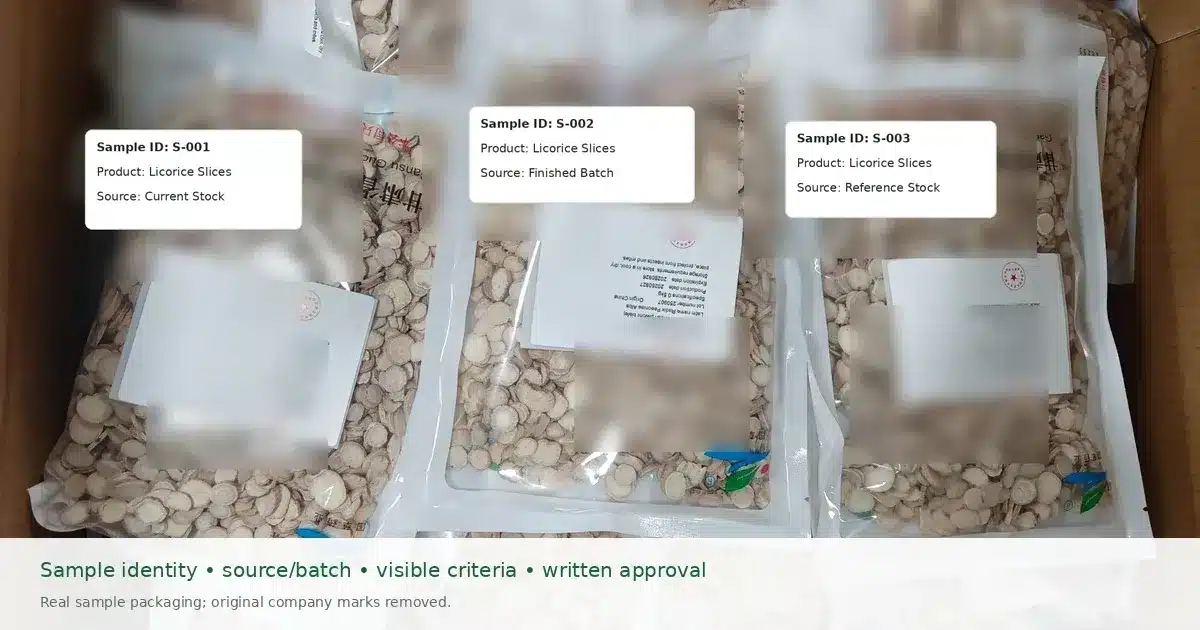
Botanical ingredient sample approval gives buyers and suppliers a shared reference for product form, cut, size and visible condition before a bulk order. It does not prove that the later shipment will be identical. The practical step is to convert sample observations into written acceptance criteria and verify the actual finished batch against those requirements.
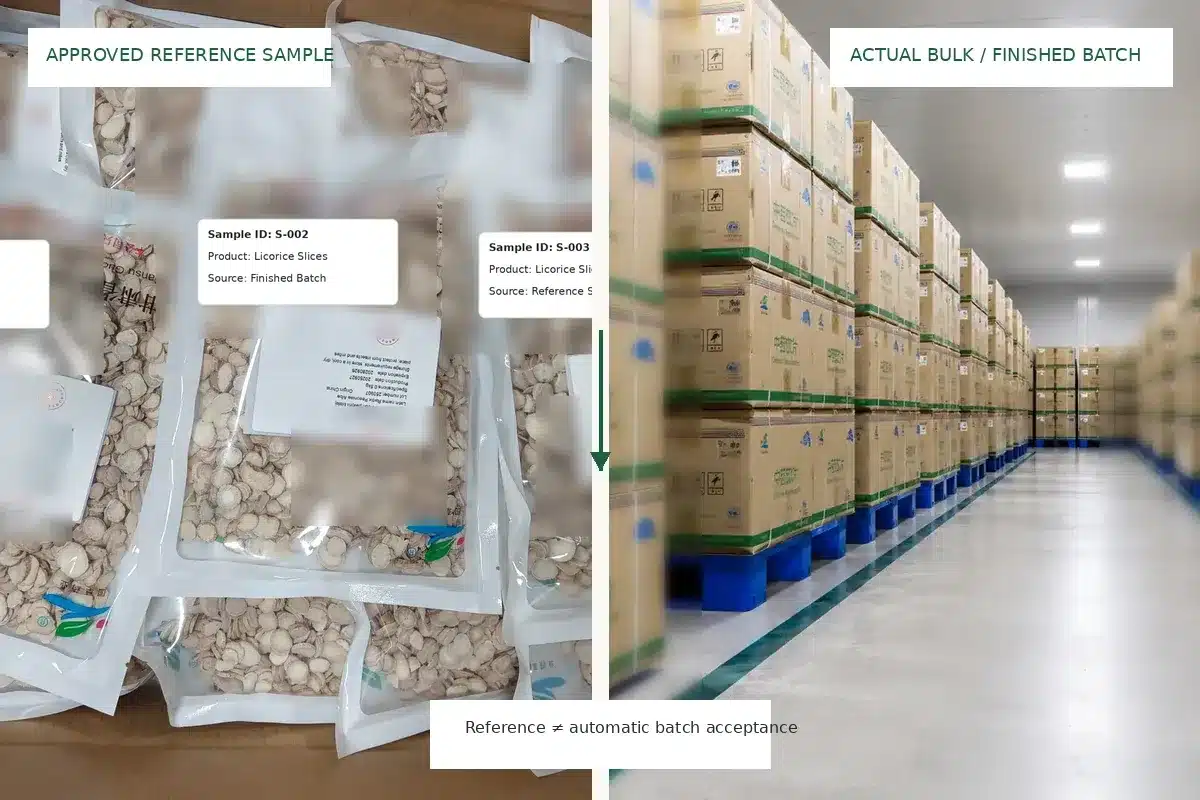
An approved sample is useful for confirming:
It cannot, by itself, establish:
These require evidence linked to the actual supplied batch.
Sample approval defines the reference; bulk acceptance applies to the actual supplied batch.
Sample terminology varies between suppliers and industries. For B2B purchasing, the following working definitions are useful:
| Sample Type | Best Use | Main Limitation |
|---|---|---|
| Inquiry / catalogue sample | Initial product and supplier screening | May not represent current stock |
| Pre-order sample | Confirm proposed form, grade, cut and appearance | May come from prior or reference stock |
| Approved reference sample | Retain an agreed physical reference | Does not prove future batch conformity |
| Finished-batch sample | Review the actual completed lot | Useful only when linked to the finished batch |
| Pre-shipment sample | Final risk-based review before dispatch | May still be unrepresentative if sampling is weak |
| Retained sample | Later comparison or complaint investigation | Does not prove transport condition |
Before approving a sample, ask what stock or batch it came from and what purpose it is intended to serve.
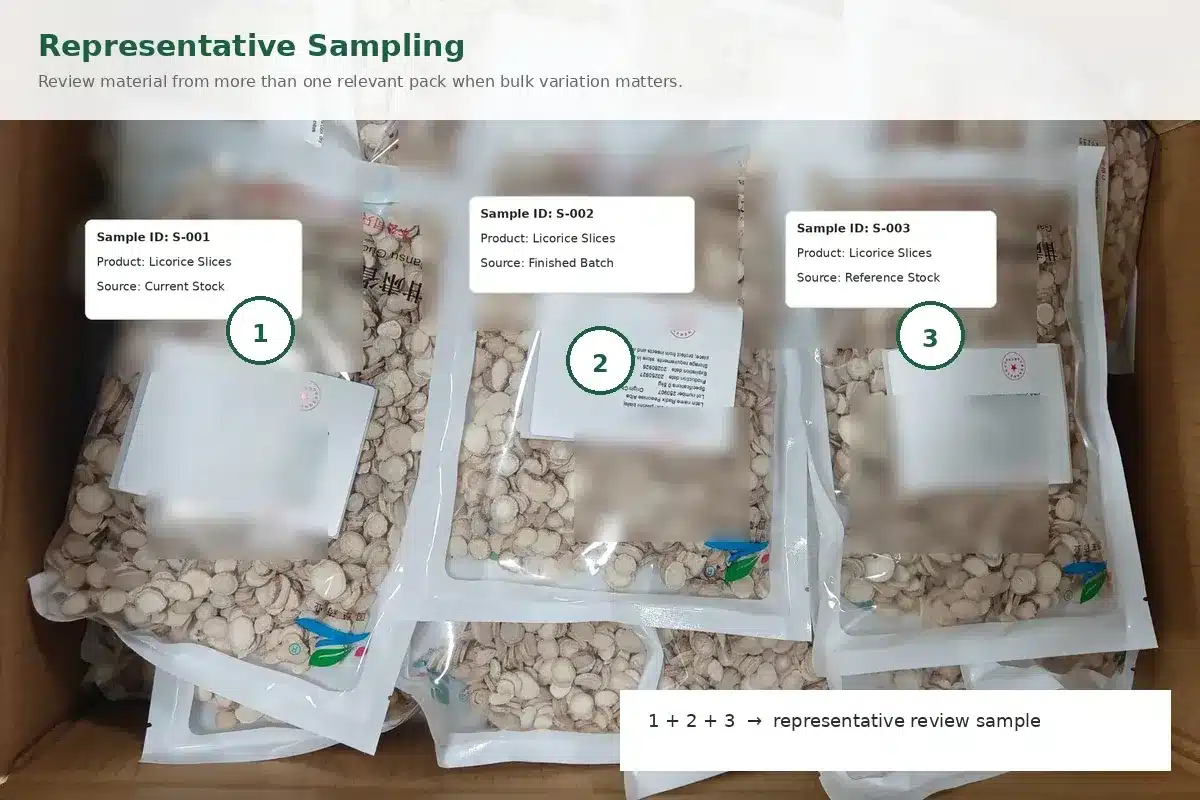
There is an important difference between a representative sample and a supplier-selected appearance sample.
A selected appearance sample can be useful for showing a visual target. It should not automatically be treated as evidence of average bulk quality.
A representative sample carries more weight when:
There is no single sampling plan suitable for every botanical material. The method should reflect the herb form, lot variability, packaging and intended evaluation.
For purchasing purposes, three questions are usually enough to improve sample quality:
| Attribute | Physical Sample Can Support? | Buyer Method |
|---|---|---|
| Product form | Yes | Visual review |
| Plant part | Yes, basic review | Visual review |
| Cut direction / style | Yes | Visual review |
| Slice thickness | Yes | Measurement |
| Size distribution | Yes | Measurement / defined comparison |
| Uniformity | Yes | Representative visual review |
| Whole pieces | Yes | Count or weight basis if defined |
| Broken pieces / fines | Yes | Defined count, mass or sieve basis |
| Colour / visible defects | Yes | Visual comparison |
| Odour | Yes, limited sensory check | Check for abnormal odour |
| Visible foreign matter | Yes | Visual inspection |
| Moisture compliance | No, not reliably | Test / COA |
| SO₂ / sulfur status | No | Test / documentation |
| Pesticides | No | Batch test evidence |
| Heavy metals | No | Batch test evidence |
| Microbiology | No | Batch test evidence |
| Marker / assay | No | Analytical result |
| Origin / organic status | No | Documentary evidence |
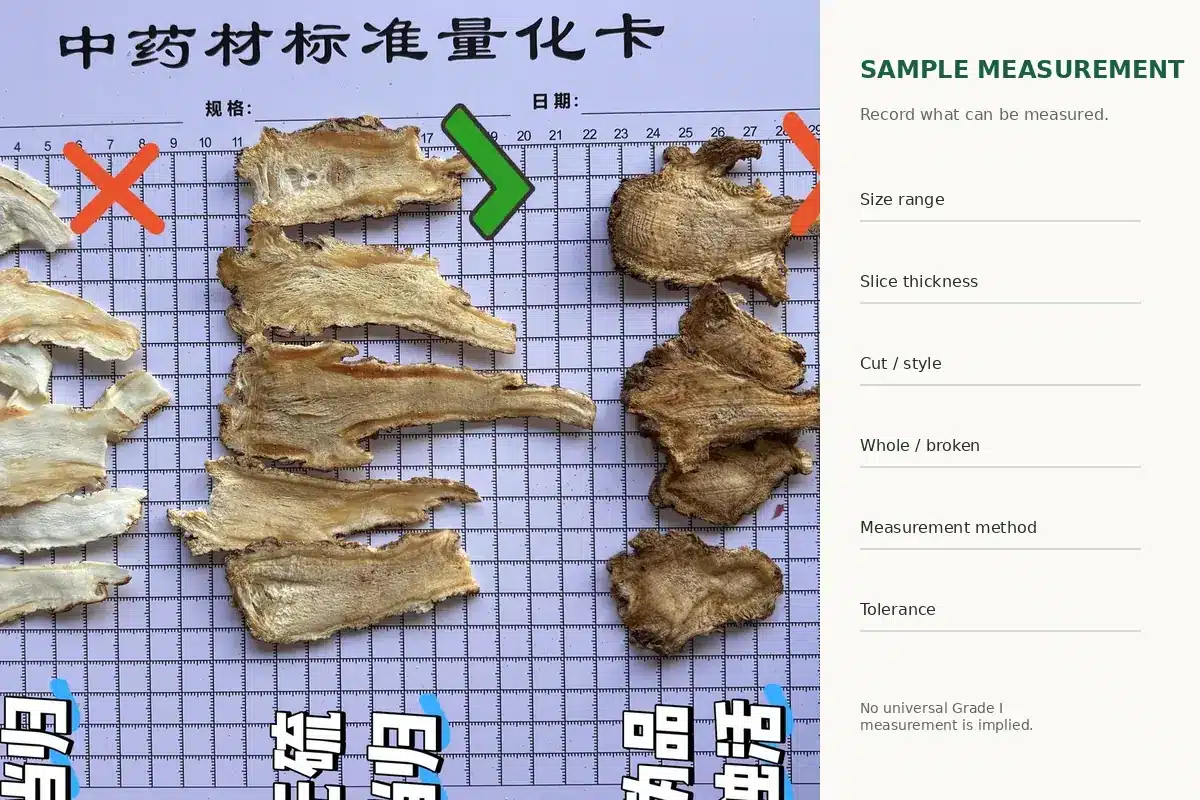
Physical review is strongest for observable and measurable commercial attributes. Analytical, origin and certification claims require appropriate batch records, test reports or certificates.
For contaminant testing requirements, review pesticide and heavy metals testing for Chinese herbs.
For detailed analytical evidence, see the Certificate of Analysis Guide and How to Read Chinese Herb Test Reports.
Sample approval becomes useful for bulk purchasing when observations are converted into a written record:
Supplier Sample → Buyer Review → Written Acceptance Criteria → Approved Reference Sample → PO / Specification → Finished Bulk Batch → Batch Verification
Fields commonly recorded include:
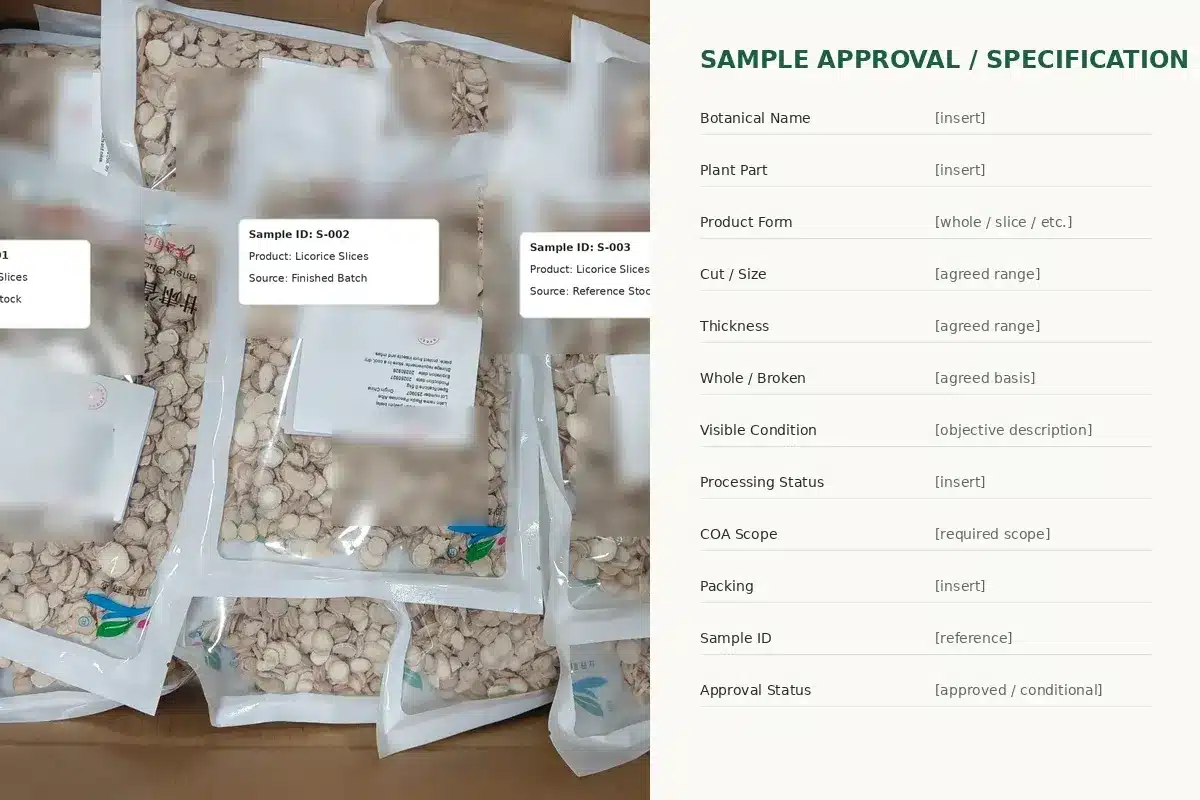
The Chinese Herbal Slices Specification guide covers the wider specification structure. At the sample stage, the key point is to convert what the buyer approved into criteria that can later be checked.
A physical reference is useful for:
A written specification defines:
The physical sample shows the target; the written specification defines the acceptance boundary.
For custom cuts, a trial sample can confirm cut direction, thickness, segment length, granulation, powder size or general processing capability.
The final requirement should still define the relevant dimensions, tolerances, measurement method, botanical material, grade, processing status and finished-batch acceptance criteria.
See Custom Cutting for related options.
| Approved Sample | Bulk-Batch Acceptance |
|---|---|
| Establishes an agreed reference | Applies to the actual supplied batch |
| Usually approved before order or production | Occurs after the finished batch exists |
| Supports visible and physical criteria | Uses specification, tolerances and batch evidence |
| May come from existing or pre-production stock | Must identify the actual supplied lot |
| Helps define expectations | Determines whether the shipment meets expectations |
| Does not prove analytical compliance | Uses COA / test evidence where required |
Before accepting the shipment, the buyer should be able to connect the finished batch to its COA, labels and shipment documents. A step-by-step comparison method is set out in the sample-to-bulk evaluation checklist.
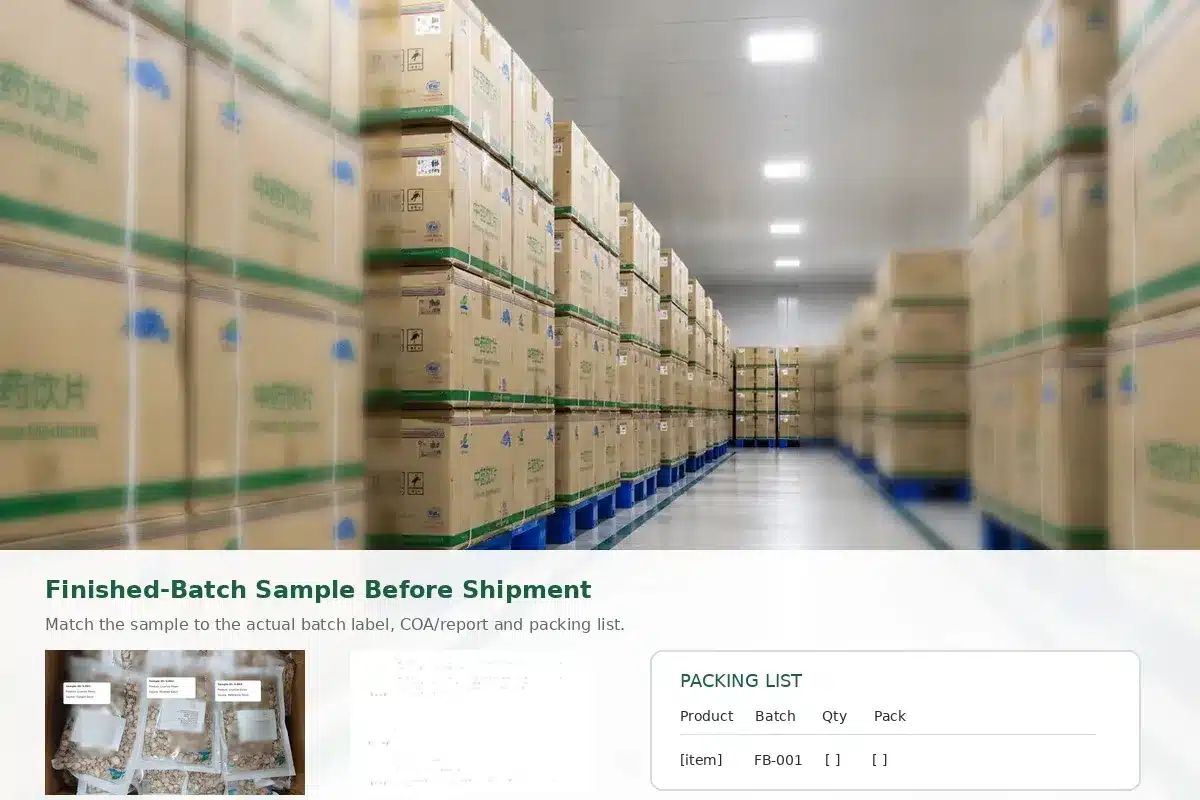
A pre-shipment sample is most useful when:
It may add less value when:
For the broader dispatch review, see Pre-Shipment Inspection.
A complete new sample-approval cycle is not necessary for every repeat batch.
A practical repeat-order framework is:
Approved Specification + Reference Sample + Defined Tolerances + Batch Verification
Reapproval or buyer confirmation may be appropriate when:
Physical reference samples can also change over time through fading, moisture change, odour loss, oxidation or handling damage.
Keep the physical sample together with:
This provides a more reliable reference than the physical sample alone. For planned changes to controlled product, processing, packaging or documentation fields, see our Herbal Ingredient Supplier Change Notification guide.
| Red Flag | Why It Matters | Buyer Follow-Up |
|---|---|---|
| Sample has no ID or label | Source becomes unclear | Assign sample ID and record source |
| Botanical name is missing | Common name may be ambiguous | Confirm botanical name and plant part |
| Sample batch is unknown | May be catalogue or historical stock | Ask what stock or batch it came from |
| Supplier cannot confirm whether the sample is current stock | Predictive value is limited | Treat it as a display or capability sample |
| Approved sample has no written specification | Visual memory becomes the control | Convert observations into written criteria |
| Grade exists only in messages | Acceptance criteria are unclear | Put the grade definition in the specification or PO |
| Pre-shipment sample has no batch link | Cannot support shipment verification | Link it to the finished batch and documents |
| COA belongs to another batch | Analytical evidence may not apply | Resolve batch linkage |
| Sample quantity cannot show material variation | Evaluation may be incomplete | Define quantity by review purpose |
| Origin, cut or processing changes without notification | Commercial requirements may have changed | Require review or reapproval where agreed |
For the wider order sequence, see the Bulk Chinese Herbs Sourcing Checklist.
| Field | Entry |
|---|---|
| Product name | [insert] |
| Botanical name | [insert] |
| Plant part | [insert] |
| Supplier | [insert] |
| Sample ID | [insert] |
| Date received | [YYYY-MM-DD] |
| Sample source / batch | [catalogue / current stock / lot / finished batch] |
| Origin | [if required] |
| Commercial grade | [defined grade + criteria] |
| Product form | [whole / slice / segment / granule / powder] |
| Cut direction / style | [insert] |
| Size | [range / method / tolerance] |
| Thickness | [range / method / tolerance] |
| Whole-piece requirement | [criterion] |
| Broken-piece allowance | [criterion] |
| Fines allowance | [criterion] |
| Colour / visible condition | [objective description / photo reference] |
| Processing status | [insert] |
| Sulfur requirement | [requirement + evidence] |
| COA / analytical scope | [required scope] |
| Packing reference | [insert] |
| Buyer comments | [insert] |
| Approval status | [approved / conditional / rejected / pending] |
| Approved by | [insert] |
| Approval date | [YYYY-MM-DD] |
| Specification revision | [document ID / revision] |
| Change notification | [required triggers] |
No. It establishes an agreed reference for appearance and physical attributes. The actual shipment must still be checked against the written specification, finished-batch identity and any required batch-linked analytical evidence.
A pre-order sample is useful for confirming proposed form, grade, cut and appearance before commitment. A finished-batch sample is more relevant when the buyer needs to review the actual lot intended for shipment.
No. Sulfur or SO₂ status cannot be reliably confirmed by appearance or sensory review. It requires appropriate analytical evidence or documentation linked to the relevant batch.
There is no universal quantity. The amount should reflect the herb form, material variability, intended visual review, measurements, required laboratory testing and whether a reference sample needs to be retained. When the sample will go to your own laboratory, see paid samples for lab testing for how to link the sample, batch COA and later bulk shipment.
No. It is most useful for first orders, new materials, custom processing, tight tolerances, high-value orders or previous consistency problems. Stable repeat orders may rely on written specifications, batch QC and incoming inspection.
Reapproval is appropriate when controlled characteristics change, such as botanical source, required origin, product form, processing, grade, cut, dimensions or packing, or when variation exceeds the agreed specification.
Send your product requirements and intended market before sample approval.
Aile Herb can align the physical sample, written specification and required batch documentation before bulk quotation and production.
To link an approved sample to written acceptance criteria before bulk production, see our samples and product development page and send your herb, form, grade and testing scope.
Please provide:
Discuss Your Sample Requirements
