Tell Us About Your Project
Share your product, quantity and project requirements. We will review the details and respond with the relevant next steps.

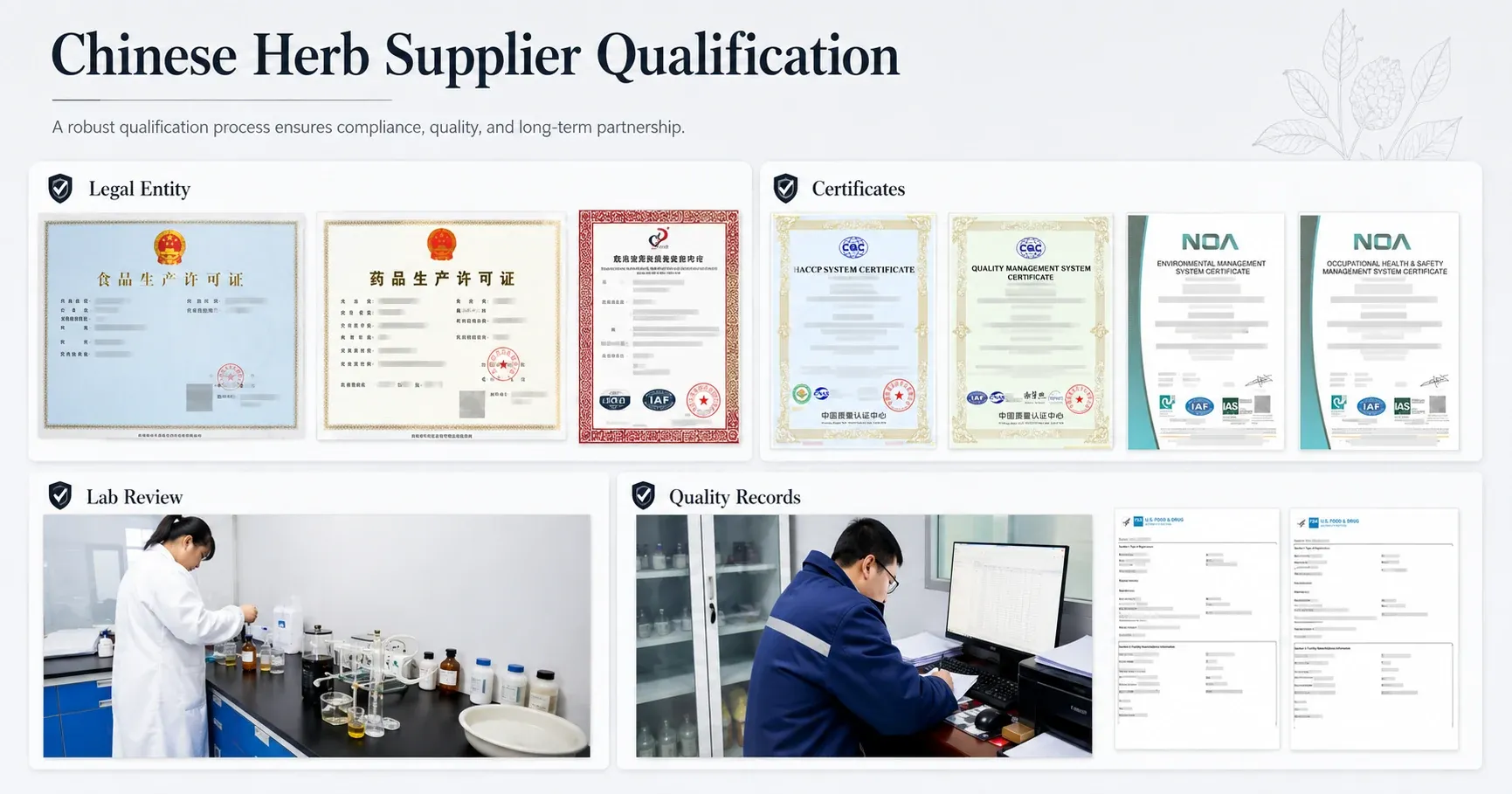
Chinese herb supplier qualification should confirm whether a supplier can support your actual order requirements. Check the legal entity, manufacturing and supply roles, product capability, certificate scope, quality system, testing, batch traceability and trial-order performance. Do not rely on a single certificate, sample or company claim.
Supplier qualification sits inside a broader sequence, and each stage answers a different question:
| Stage | Buyer Purpose |
|---|---|
| Supplier Discovery | Find possible suppliers |
| Supplier Verification | Confirm the company, facility and documents are genuine |
| Supplier Qualification | Decide whether the supplier can meet the buyer’s defined requirements |
| Supplier Approval | Buyer’s internal decision to authorize commercial purchasing |
| Supplier Monitoring | Review actual performance after orders begin |
Supplier qualification is more than checking whether a company exists. The goal is to confirm that the supplier can meet the buyer’s product, specification, documentation and market requirements.
Different buyers and industries may use these terms differently, so this is a practical procurement framework rather than a universal standard.
A supplier cannot be meaningfully qualified without knowing what it is being qualified to supply. If you are still defining the product scope, review Aile Herb’s available Chinese herbal product range before starting supplier qualification.
Before starting qualification, define at minimum:
For product-level requirements, see the Chinese Herbal Slices Specification Guide.
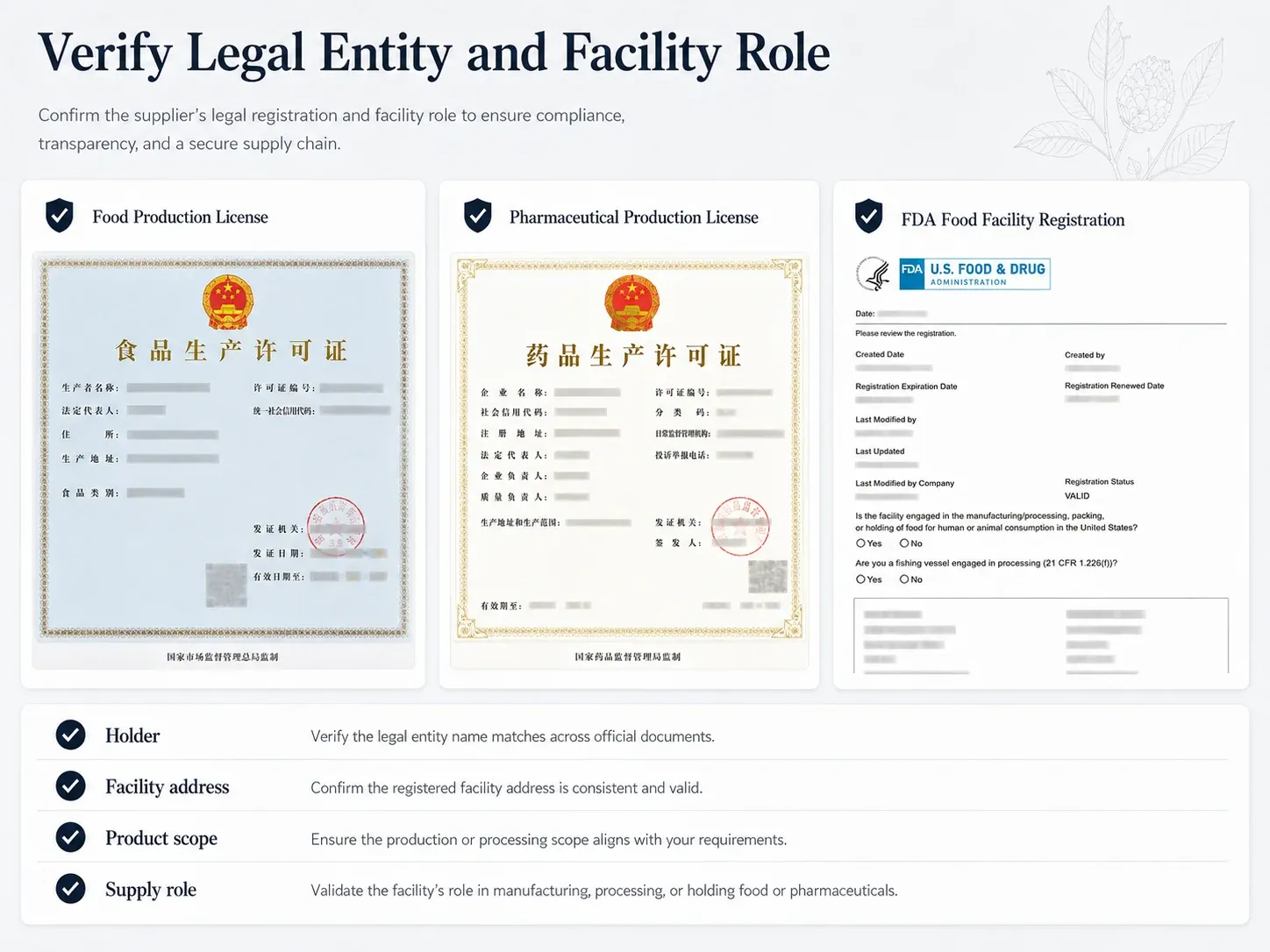
| Evidence | What It Helps Verify | What It Does Not Establish |
|---|---|---|
| Chinese legal company name | Registered legal entity | Production capability |
| Unified Social Credit Code (USCC) | Company registration identity | Product quality |
| Business license | Registered address and business scope | Batch consistency |
| Registered address | Legal registration location | Actual manufacturing site |
| Manufacturing license, where applicable | Licensed activity and scope | Day-to-day production performance |
| Contracting / payment entity | Who the buyer is legally dealing with | Relationship to the factory unless documented |
A Chinese business license can help confirm legal existence, registered name, registered address and business scope. It does not establish actual production capability, testing capability or finished-batch quality.
Company registration information can generally be cross-checked through China’s National Enterprise Credit Information Publicity System (GSXT / 国家企业信用信息公示系统).
For U.S.-bound material, also search FDA’s import alert lists for the legal manufacturer and its production address, not only the exporter’s trading name. Some alerts apply directly to botanicals: Import Alert 54-10, for example, covers products that may contain aristolochic acid, a risk linked to substitution between certain plants used in traditional Chinese medicine. A similar company name is not a match, so compare the exact facility name and address before drawing conclusions.
The company manufacturing the product and the company signing the export contract may legitimately be different legal entities.
A typical structure may look like:
Manufacturing Facility → Export / Contracting Entity → Overseas Buyer
Before proceeding, the buyer should understand:
Different company names do not automatically indicate a problem, but the relationship between the entities should be transparent and explainable.
For more detail on supply structures, see Chinese Herb Manufacturer vs Trading Company.
The relevant question is not simply whether a supplier has a factory.
The buyer needs to establish whether the identified facility can manufacture the specific product and specification required.
| Evidence | What It Supports | Limitation |
|---|---|---|
| Manufacturing license / facility address | Legal manufacturing location and scope | May not establish product-specific capability |
| Production-line photos / live facility video | General facility and equipment conditions | Does not prove GMP compliance |
| Equipment list | Available processing methods | Does not establish finished-product quality |
| Process flow | How the product is processed | Does not establish batch-to-batch consistency |
| Product-category scope | What the facility normally produces | May not cover every cut, grade or process |
| Custom cutting capability | Ability to support specific physical requirements | Must still be verified through sample and production |
| Packaging capability | Available packing formats | Separate from manufacturing capability |
Equipment alone does not prove product quality. Factory photos do not prove GMP compliance, and a large facility does not automatically provide better consistency.
Likewise, headline annual capacity should not replace a practical discussion about the buyer’s required batch size, MOQ and lead time.
Aile Herb’s own manufacturing information is available on the Factory Overview page.
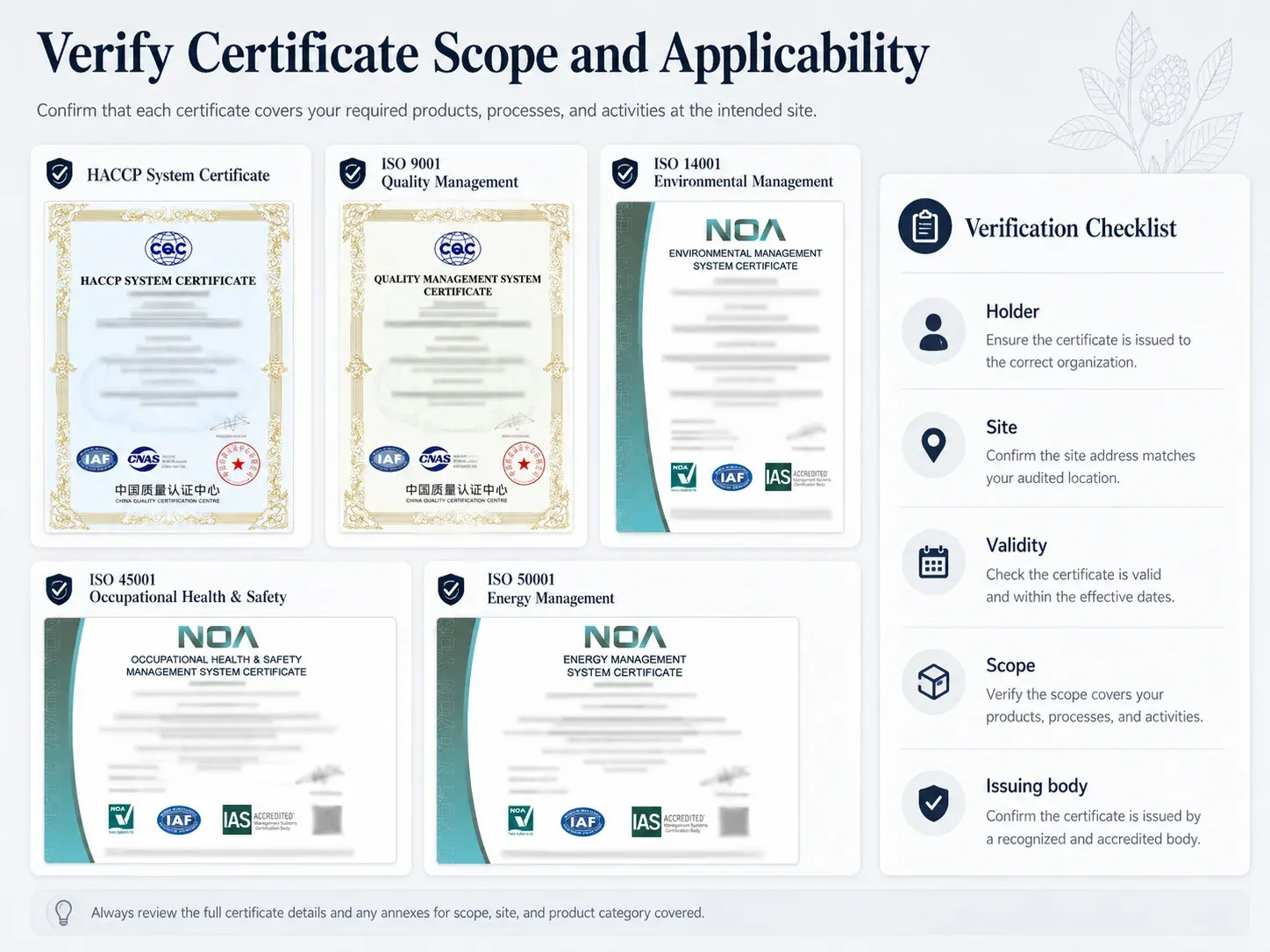
Verify the holder, site, validity and scope — not just whether a certificate PDF exists.
| Document / Certificate | Buyer Should Verify | Common Mistake |
|---|---|---|
| Manufacturing license, where applicable | Holder, site and licensed activity | Assuming it covers all products |
| China Food Production License, where applicable | Production site and product scope | Confusing food manufacturing with pharmaceutical manufacturing |
| Pharmaceutical manufacturing / GMP documentation, where applicable | Applicability to the actual product and site | Applying pharmaceutical requirements to ordinary food materials |
| ISO 9001 | Certified entity, site, scope and validity | Treating it as a product-quality guarantee |
| ISO 22000 / HACCP, where relevant | Food-safety management scope | Assuming every site or product is covered |
| Organic certification | Operator, site, product scope, validity and certifier | Assuming everything sold by the company is organic |
| FDA food facility registration, where relevant | Facility registration status | Describing registration as FDA approval |
Pharmaceutical and Kampo buyers can review our Chinese herbs for pharmaceutical companies supply scope when qualifying Aile Herb for medicinal-herb sourcing.
FDA food facility registration is registration, not FDA product or facility approval.
Avoid descriptions such as:
when the evidence is only food facility registration.
ISO 9001 indicates a certified quality-management-system scope. It does not independently confirm that every product or every batch meets the buyer’s specification.
Organic status should be checked against the specific:
A company holding an organic certificate does not automatically make every product it sells organic.
See Aile Herb’s current documentation on the Certifications page.
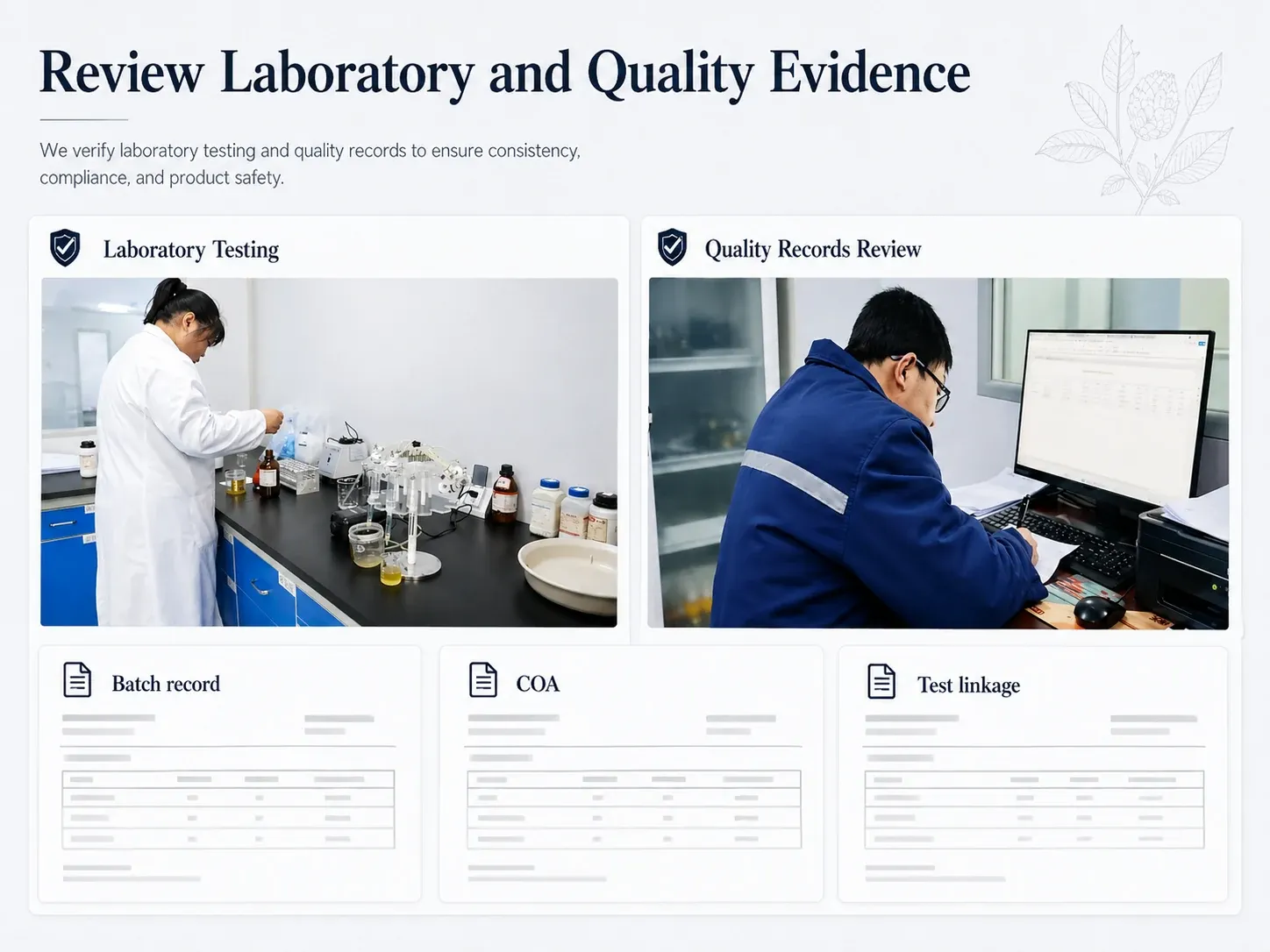
The buyer should be able to understand how one finished batch moves through the supplier’s system:
Incoming Raw Material → Batch Number → Processing → Testing → Finished-Batch Release → COA → Label → Shipment
Useful qualification evidence may include:
The buyer does not need to turn initial supplier qualification into a full GMP audit.
A simpler question is:
Can the supplier explain how one finished batch is identified, tested, released and linked to the shipment?
For an example of a documented QC structure, see the Quality Control Process.
Do not ask only:
Do you have a laboratory?
Instead, confirm:
In-house testing and third-party testing can both be appropriate.
What matters is whether the testing arrangement supports the required scope and produces evidence linked to the actual supplied batch.
See Aile Herb’s In-House Laboratory page for its current testing capability.
Request a representative real historical batch COA, not only a blank template.
Review:
A historical COA demonstrates previous document structure and testing capability. It does not guarantee that a future commercial batch will produce the same results. For U.S. dietary supplement manufacturers this is also a regulatory point: under 21 CFR 111.75, a supplier’s COA can be relied on for certain specifications only after the supplier has been qualified, including by confirming its results through the buyer’s own testing.
For field-by-field review, see the Chinese Herb COA Guide.
A practical traceability chain is:
Raw Material / Source → Incoming Lot → Processing Batch → Finished Batch → COA → Package Label → Shipment
Buyers do not necessarily need access to every internal supplier record.
The goal is sufficient evidence that the supplier can maintain batch linkage.
Possible evidence includes:
For origin control, ask:
One growing region does not automatically mean higher quality.
Check whether the supplier can provide a clearly identified sample with:
A good sample helps evaluate product form and supplier capability, but it does not by itself qualify the supplier or prove future batch consistency.
For the full workflow, see Botanical Ingredient Sample Approval.
Qualification should also confirm whether the supplier can support:
Being able to manufacture the material is not the same as being ready to prepare it for an international order.
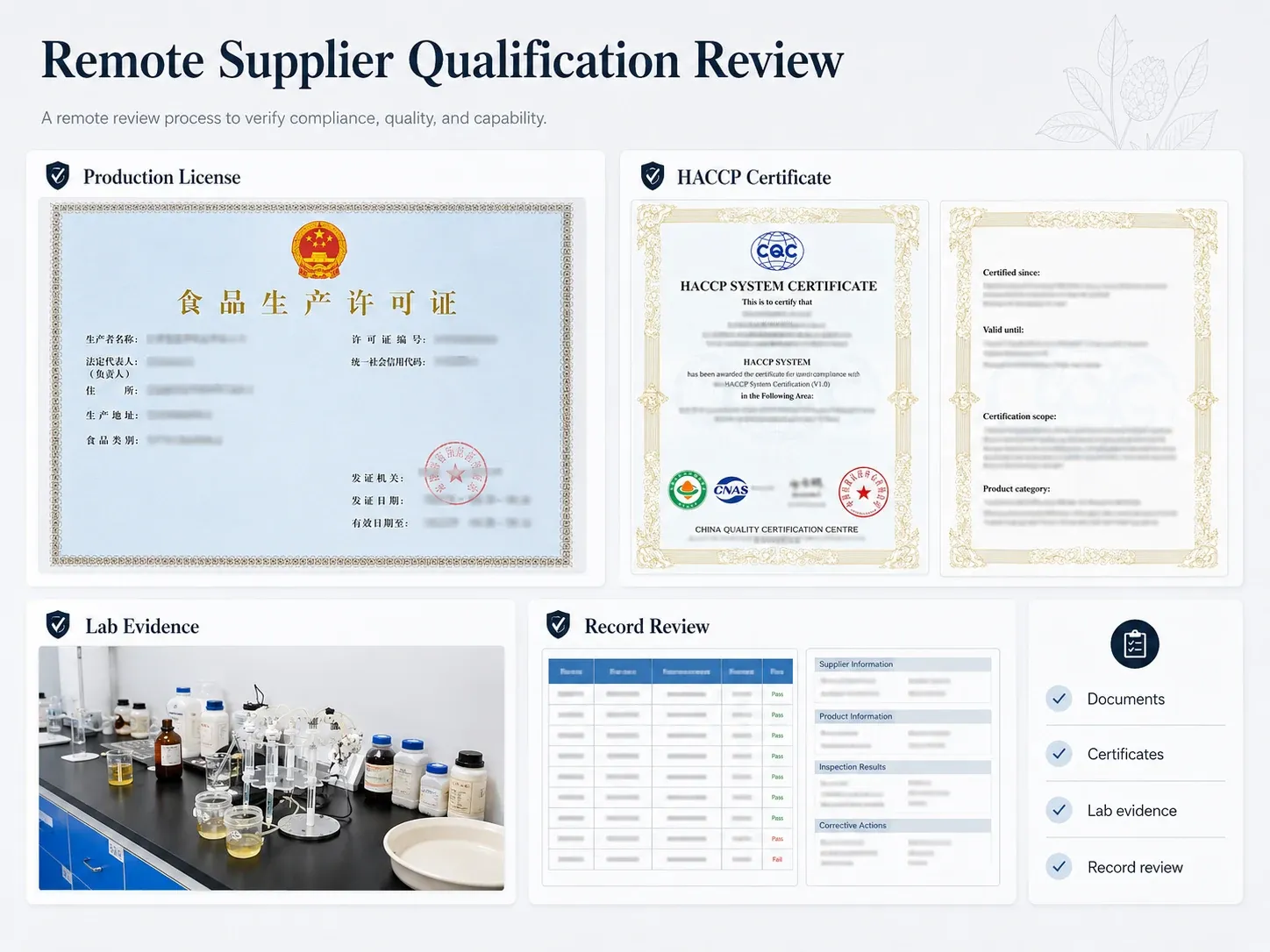
Much of the first qualification stage can be completed remotely.
| Remote Evidence | What It Can Support | What It Cannot Establish |
|---|---|---|
| Company / license verification | Legal existence and declared scope | Actual operating conditions |
| Certificate review | Holder, validity and scope | Ongoing product compliance |
| Supplier questionnaire | Supplier’s stated processes and capability | Independent confirmation |
| Real batch COA | Testing and documentation structure | Future batch consistency |
| Factory / warehouse photos | General facility conditions | Live operating practices |
| Live video walkthrough | Real-time facility verification | Complete audit coverage |
| Sample | Product form and commercial presentation | Bulk consistency |
| Trial order | Actual commercial performance | Long-term reliability |
Remote qualification can establish significant evidence, but it is not equivalent to an on-site audit.
A deeper on-site review may be justified for:
A full audit may be less necessary at the initial stage for a small controlled trial order involving standard commercial material, lower risk and strong documentary evidence.
Not every Chinese herb supplier requires an on-site audit. The appropriate depth should be risk-based.
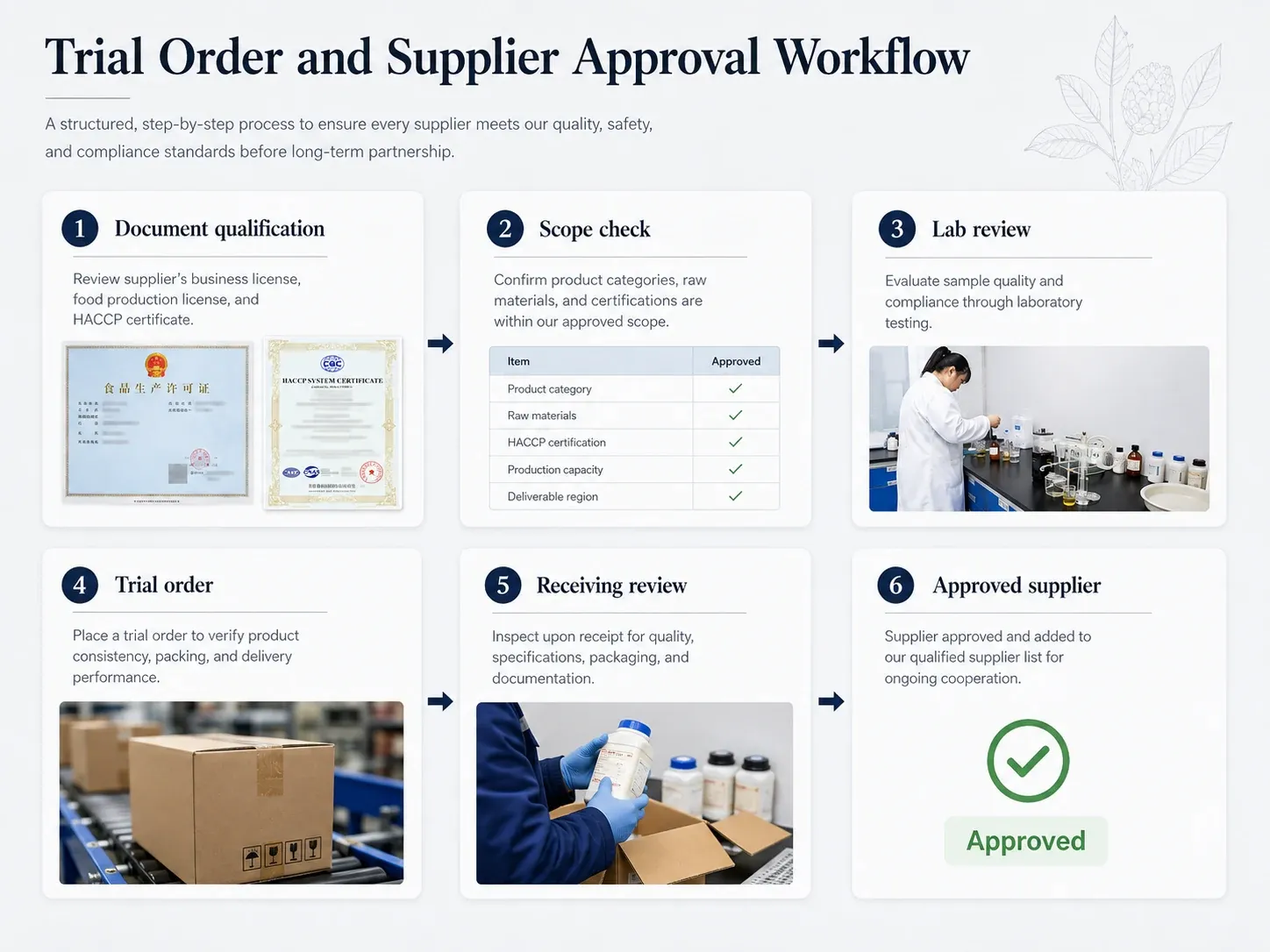
A practical qualification path is:
Document Qualification
↓
Sample Approval
↓
Trial Order
↓
Pre-Shipment Review
↓
Receiving Inspection
↓
Performance Review
↓
Approved Supplier
A trial order moves supplier qualification from documentation to actual commercial performance.
It can reveal:
There is no universal trial-order quantity.
One successful trial order also does not guarantee permanent reliability. It provides evidence for the buyer’s next approval decision.
| Red Flag | Why It Matters | Buyer Follow-Up |
|---|---|---|
| Legal company cannot be verified | No confirmed legal counterparty | Request registration details and re-check the entity |
| Factory / contracting entity relationship is unclear | Responsibility for supply is unclear | Request written clarification of entity roles |
| Certificate holder does not match the facility | Certificate may not apply to the actual site | Verify holder, address and scope |
| Certificate scope does not cover the relevant activity | Document may not support the required product or process | Request applicable evidence |
| Key document has expired | Current status cannot be confirmed | Request an updated valid document |
| Supplier cannot provide a real batch COA | Testing history cannot be reviewed | Request a representative historical COA |
| COA has no batch or lot linkage | Document may not represent a specific production batch | Request batch-linked reporting |
| Supplier cannot explain who manufactures, tests or packs | Supply-chain roles are unclear | Request a role breakdown |
| Sample source is unknown | Sample may not represent commercial production | Request a source- or lot-linked sample |
| Testing scope changes between quotation and documents | Commercial and QA requirements may not be aligned | Confirm final testing scope in writing |
No single red flag automatically proves fraud. Each should trigger clarification, evidence review or deeper qualification.
| Qualification Area | Priority | Evidence | Status |
|---|---|---|---|
| Legal identity | Critical | Business license / USCC verification | |
| Product scope | Critical | Product and process capability | |
| Manufacturing capability | Critical | Facility / license / process evidence | |
| License / certificate scope | Critical | Holder / site / validity / scope | |
| Quality system | Major | Batch control / release / non-conformance | |
| Laboratory / testing | Major | Test scope / in-house / outsourced | |
| Real batch COA | Major | Batch-linked example | |
| Traceability | Major | Lot → batch → shipment linkage | |
| Change notification | Major | Supplier change process | |
| Sample quality | Supporting | Sample source / form / labeling | |
| Packing capability | Supporting | Packing specification / examples | |
| Export documentation | Supporting | Required export documentation | |
| Capacity / lead time | Supporting | MOQ / practical production capacity | |
| Communication | Supporting | Technical and document consistency | |
| Trial-order performance | Critical | Actual order performance |
Status options: Pass / Conditional / Open / Not acceptable
| Field | Supplier Response |
|---|---|
| Legal company name | |
| Unified Social Credit Code | |
| Registered address | |
| Contracting entity | |
| Manufacturing entity | |
| Export entity | |
| Facility address | |
| Product categories supplied | |
| Relevant manufacturing license | |
| Processing capabilities | |
| Custom cutting capability | |
| Typical MOQ | |
| Normal lead time | |
| Batch numbering system | |
| Finished-batch release process | |
| In-house tests | |
| Outsourced tests | |
| Real batch COA available | |
| Traceability approach | |
| Main sourcing regions | |
| Origin records available | |
| Change notification process | |
| Inner / outer packing options | |
| Relevant licenses / certificates | |
| Certificate scope and validity | |
| Required export documents |
Core documentary qualification is complete, but actual commercial performance has not yet been demonstrated.
Minor open items remain and can be controlled during a trial order.
Important evidence is incomplete, unclear or inconsistent.
Critical requirements cannot be demonstrated.
This is a practical procurement framework rather than a universal regulatory decision system. Qualification depth should still reflect buyer type, destination market, end use and product risk.
Supplier verification confirms that the company, facility and documents are genuine. Supplier qualification goes further by assessing whether that verified supplier can meet the buyer’s specific product, quality, testing, documentation, packing and commercial requirements before an initial commercial order.
No. On-site audits are more justified for high spend, regulated applications, higher-risk materials, custom processes or strategic relationships. For smaller trial orders involving standard commercial material, strong remote evidence combined with sample and trial-order review may be sufficient initially.
At minimum, request legal company details, relevant manufacturing licenses or certificates, certificate scope information, a real historical batch COA, testing information, traceability evidence and details of packing and export-document capability that relate to your specific product requirement.
Chinese company registration details can generally be checked through the National Enterprise Credit Information Publicity System. This can help confirm the registered company name, address and business scope, but it does not independently establish manufacturing capability or product quality.
No. ISO 9001 indicates that the named organization has a certified quality-management-system scope. It does not independently prove that every herbal product meets specification, that every batch is compliant, or that every facility operated by the company is covered.
Document review shows what the supplier can demonstrate before ordering. A trial order provides evidence of actual batch consistency, packing, COA quality, documentation, lead time and communication, helping the buyer evaluate real commercial performance before granting broader supplier approval.
Before placing a commercial order, define the product specification, required testing, documentation, packing and destination-market requirements.
Aile Herb can provide company, manufacturing, quality, laboratory, batch-document and sample information for buyer qualification review.
To run this qualification on Aile Herb, start from our certifications page for licence numbers, scope and validity, then request the manufacturing, laboratory and batch-document information for your review.
Please provide:
Discuss Your Supplier Requirements
