Tell Us About Your Project
Share your product, quantity and project requirements. We will review the details and respond with the relevant next steps.

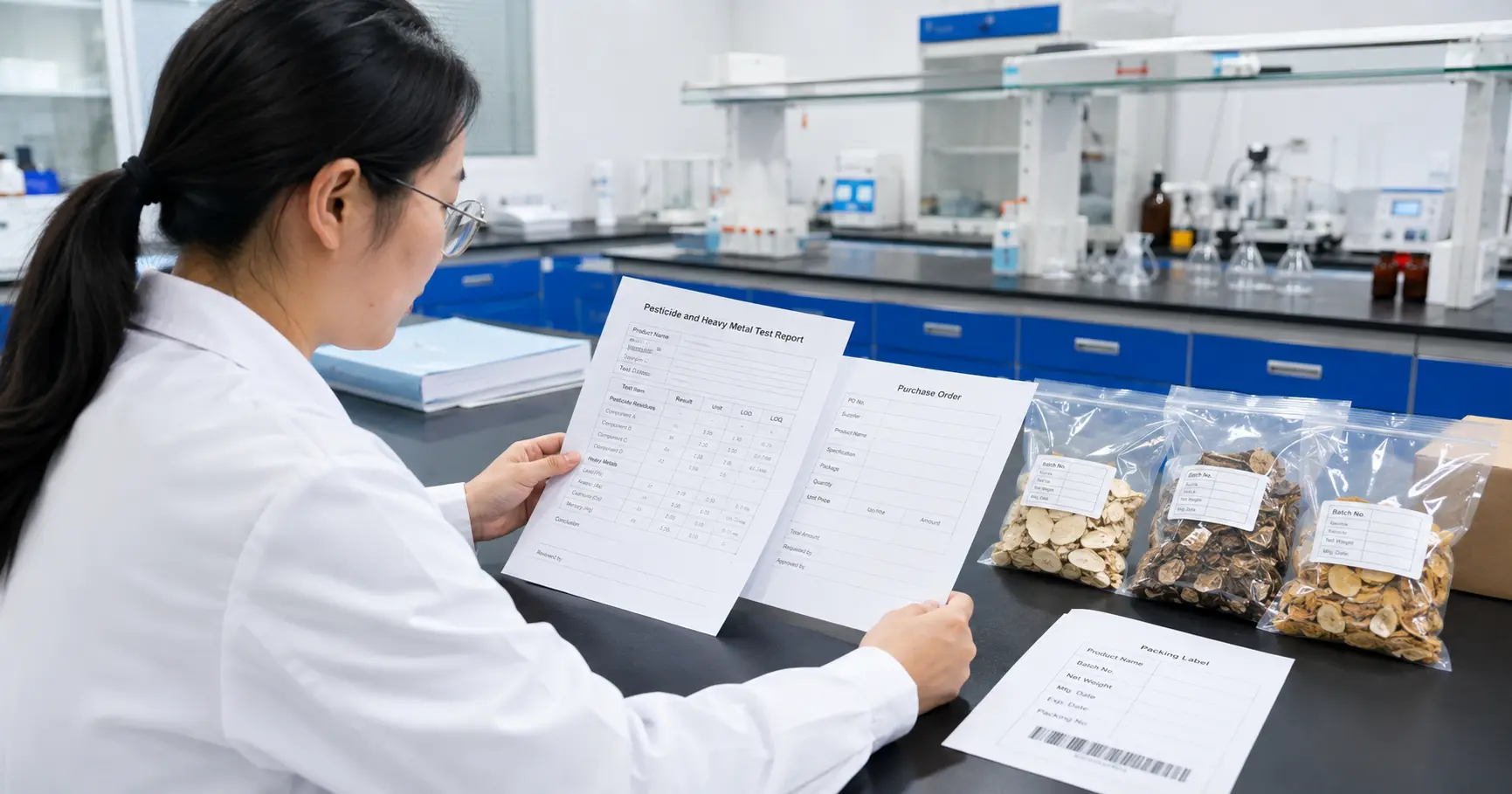
How to read Chinese herb test reports starts with identity: confirm that the product name, botanical name, plant part, product form and batch or lot number match the goods. Then review the laboratory, test method, analyte list, results, units, LOD, LOQ and the acceptance limits applied. Requirements differ by product classification and destination market.
A “pass” statement alone is not sufficient for batch approval. Before a batch is released, the buyer should be able to answer six questions from the document itself:
If these details are missing, the report is insufficient for an informed batch-approval decision.
Test-report review sits inside a wider procurement process. For the surrounding supplier-qualification steps, see the bulk Chinese herbs sourcing checklist. For supplier-level capability checks, see our Chinese herb supplier qualification guide.
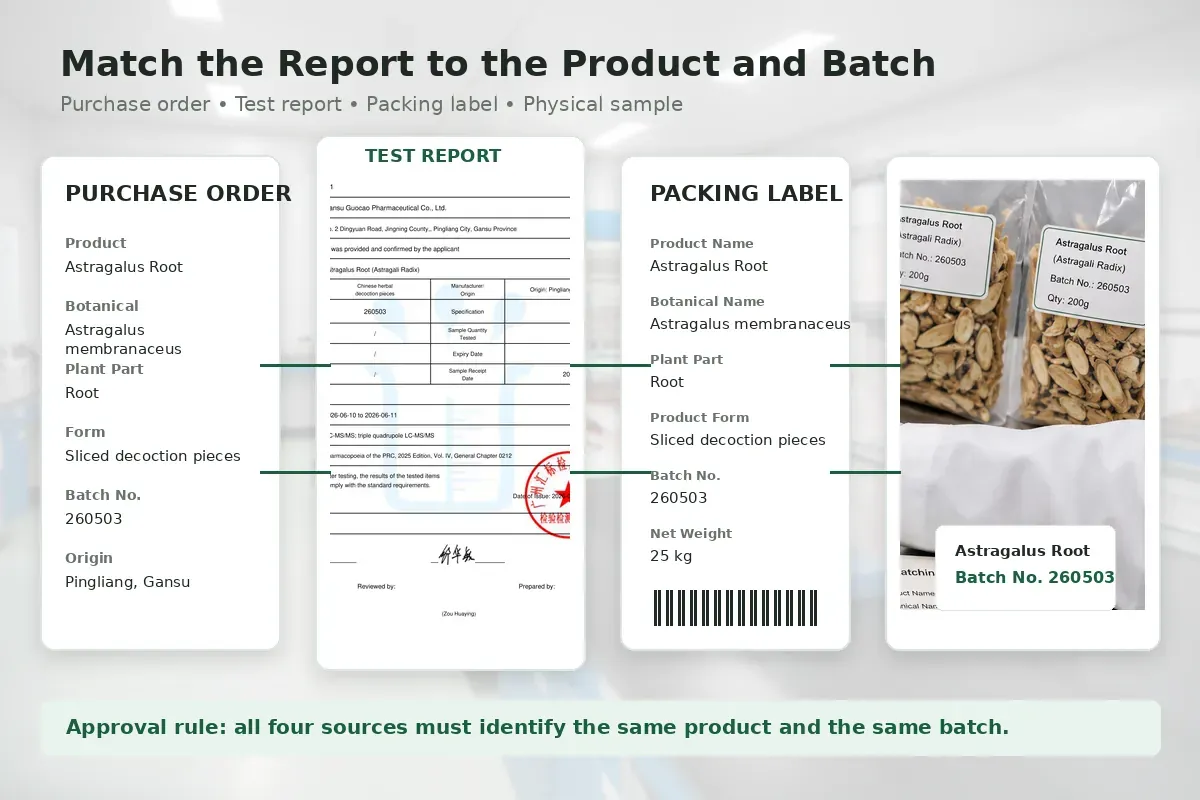
Before interpreting the results, confirm that the report belongs to the supplied batch. Compare it against the purchase order, packing label and shipping documents.
Batch-matching steps
Differences are not automatically evidence of a defective or falsified document. Trading structures, separate processing sites, translated names and internal lot conventions can all produce legitimate variations.
Any mismatch requires clarification and supporting records before approval.
Not every report contains every field, and not every field is required for every product. The table below separates fields that should normally be present from those that are useful or context-dependent.
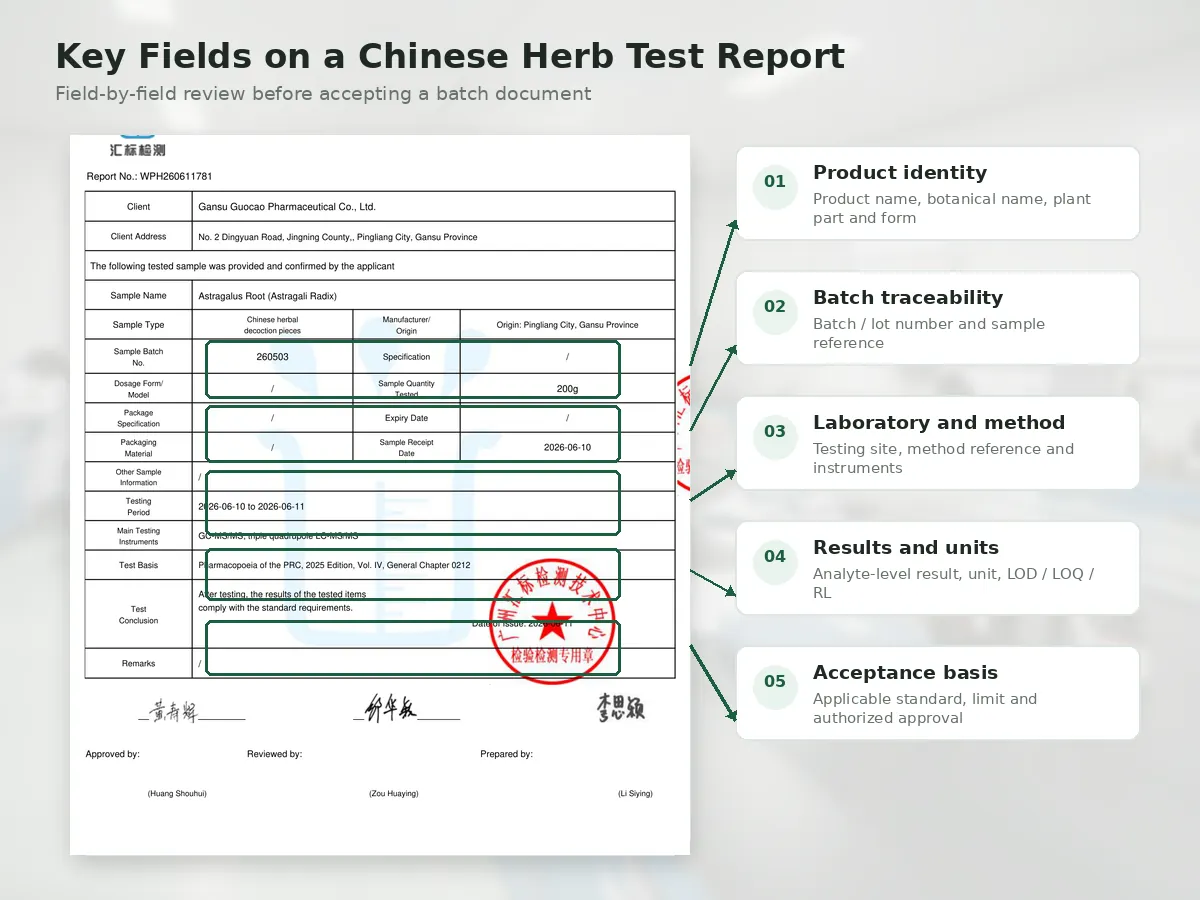
| Field | Why It Matters | What the Buyer Should Check | Warning Sign |
|---|---|---|---|
| Essential fields | |||
| Product name | Links the report to the ordered item | Matches the purchase order and packing label | Generic wording such as “herb sample” |
| Botanical name | Confirms species identity | Genus and species stated and consistent with the order | Common name or pinyin only |
| Plant part | Contaminant profiles can differ between plant parts | Stated explicitly and matching the ordered part | Not stated or inconsistent |
| Product form | Affects sampling, preparation and interpretation | Whole material, slices, segments, powder or extract identified | Form differs from the goods supplied |
| Batch or lot number | Ties results to a defined production quantity | Identical to the packing label and shipping documents | Missing, handwritten or amended without explanation |
| Laboratory name | Identifies who performed the analysis | Full legal name and address of the testing site | Logo or trade name only |
| Test method | Determines what the result can demonstrate | Method reference stated for each analytical group | “Standard method” with no reference |
| Analyte list | Defines what was actually tested | Every pesticide or element listed with its own result | Summary category in place of an analyte list |
| Result | Shows the measured outcome for each analyte | Numerical value or ND with a stated limit | Pass/fail wording in place of data |
| Unit | Determines the scale of each result | mg/kg, µg/kg or ppm used consistently | Units mixed between sections or omitted |
| LOD | Shows the detection capability achieved | Stated per analyte or method group | Missing where ND results are reported |
| LOQ or reporting limit | Shows quantification or reporting capability | Low enough for the applicable requirement | Higher than the limit being evaluated |
| Acceptance limit or specification | Gives the result context | Applied MRL, monograph or specification is named | “Compliant” with no reference |
| Dates | Place the report within the batch history | Sampling, testing and issue dates are present and follow a plausible sequence | Dates do not follow a plausible sequence for the document type or batch history |
| Useful fields | |||
| Accreditation and applicable scope | Indicates assessed competence for the method | Accreditation body, certificate number and relevant scope entry | Accreditation claimed without a scope reference |
| Pass/fail conclusion | Summarises the laboratory’s judgement | Standard or specification used for the judgement is named | Conclusion with no named standard |
| Authorized signature | Shows formal release of the report | Name, position and date of approval | Unsigned or approved by an unnamed party |
| Page numbering and amendments | Helps confirm that the document is complete | “Page x of y” and any amendment note | Individual extracted pages circulated without the complete report |
| Context-dependent fields | |||
| Sampling procedure | Affects how representative the result is of the lot | Sampling plan or reference where required | Usually documented separately |
These four terms carry much of the interpretation risk in a contaminant report. Definitions of detection and quantitation used in regulatory analysis are set out in the EPA detection and quantitation procedures documents.
ND normally means that the analyte was not detected above the stated detection limit of the method used on that sample.
It does not mean absolute zero, and it describes only the sample tested.
Read every ND entry together with the applicable LOD or reporting limit. Where these values are not printed, request them before accepting the result.
The limit of detection concerns detection only. It is the lowest concentration at which the method can distinguish the analyte from background under the stated conditions.
A signal at or near the LOD may indicate detection, but it is not a reliably quantified result and should not be compared numerically against an acceptance limit.
The limit of quantification is the lowest concentration that can be quantified with acceptable performance under the stated method and matrix.
Results at or above the LOQ can be compared numerically against an acceptance limit. Results between the LOD and LOQ may be expressed as “<LOQ” rather than as a precise numerical value.
The reporting limit is the threshold the laboratory applies when issuing results.
It may sit at the LOQ, above it or follow the laboratory’s internal reporting policy. It is not always identical to the LOD or LOQ.
Where a report uses “<RL,” ask how the reporting limit was derived and whether it was validated in the same matrix as the supplied product.
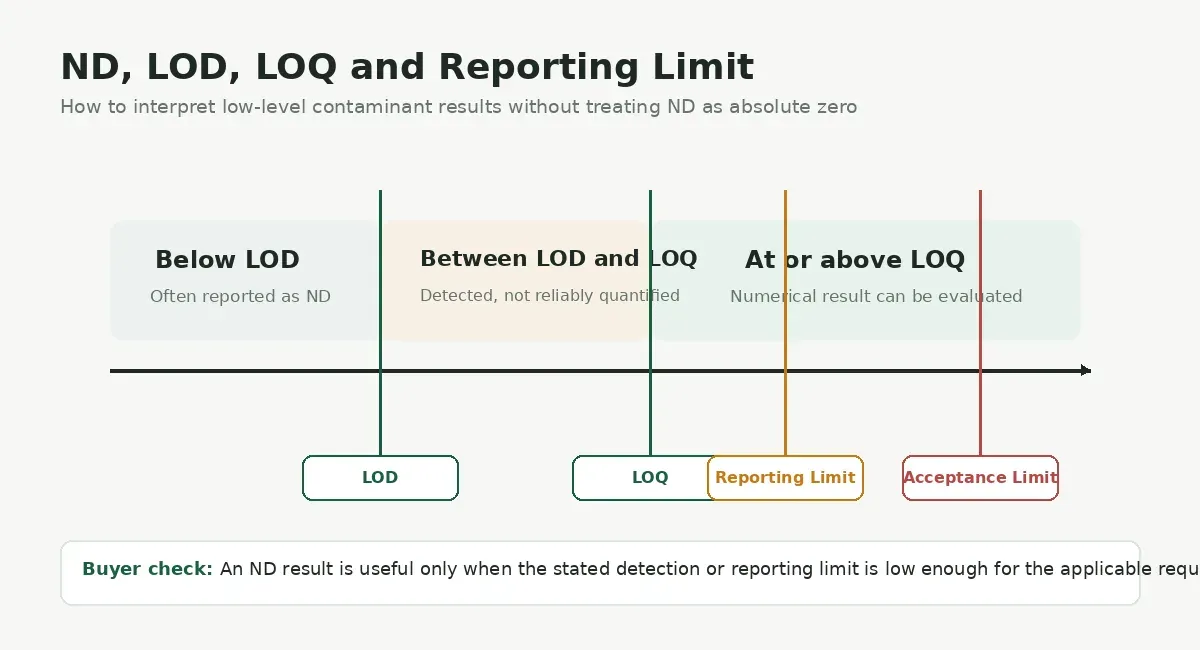
An ND result is useful only when the reporting capability is low enough for the requirement being evaluated.
If the applicable limit sits below the laboratory’s reporting limit, the report cannot demonstrate conformity with that limit, regardless of how many ND entries it contains.
Reporting limits may also vary between analytes in the same report, so buyers should check them at analyte level rather than relying on one general statement.
Use the following process when reviewing a pesticide residue report:
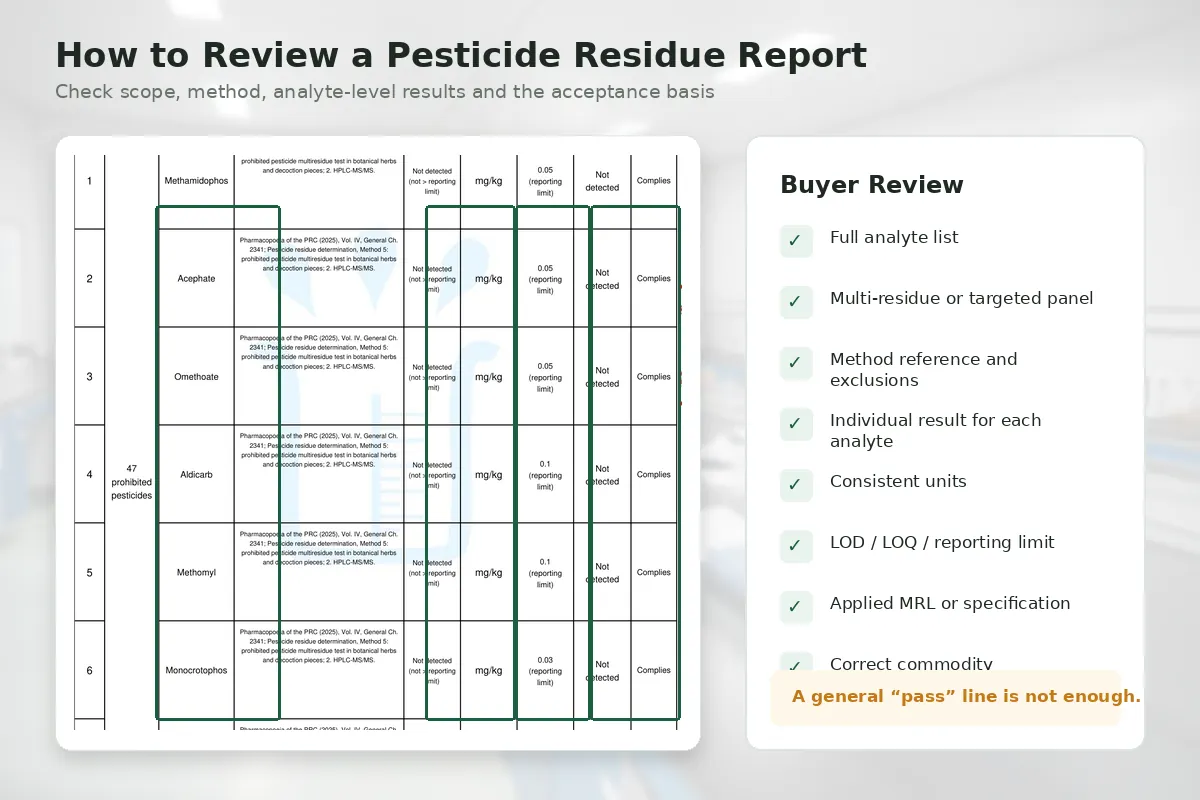
A multi-residue panel does not automatically cover every pesticide. Coverage depends on the method scope and on which compounds the technique can detect in the relevant dried botanical matrix.
Some substances require dedicated single-residue methods and may be excluded from general screens by design.
A statement such as “pesticides passed” is not sufficient for buyer review without:
Screening and quantitative results are also not equivalent.
A screening result indicates whether a compound appears above a screening threshold. Confirmation and reliable quantification may require an additional analytical step. Where a report contains both screening and quantitative results, check how each result has been classified.
EU pesticide MRLs are substance- and commodity-specific, and the correct value depends on the commodity code applied.
Not every Chinese herb falls under the herbal-infusion category. The same botanical species may be classified differently depending on its intended use and how it is placed on the market.
The EU Pesticides Database is a practical search tool for locating current values, but legally authoritative information is published through official EU legislation on MRLs.
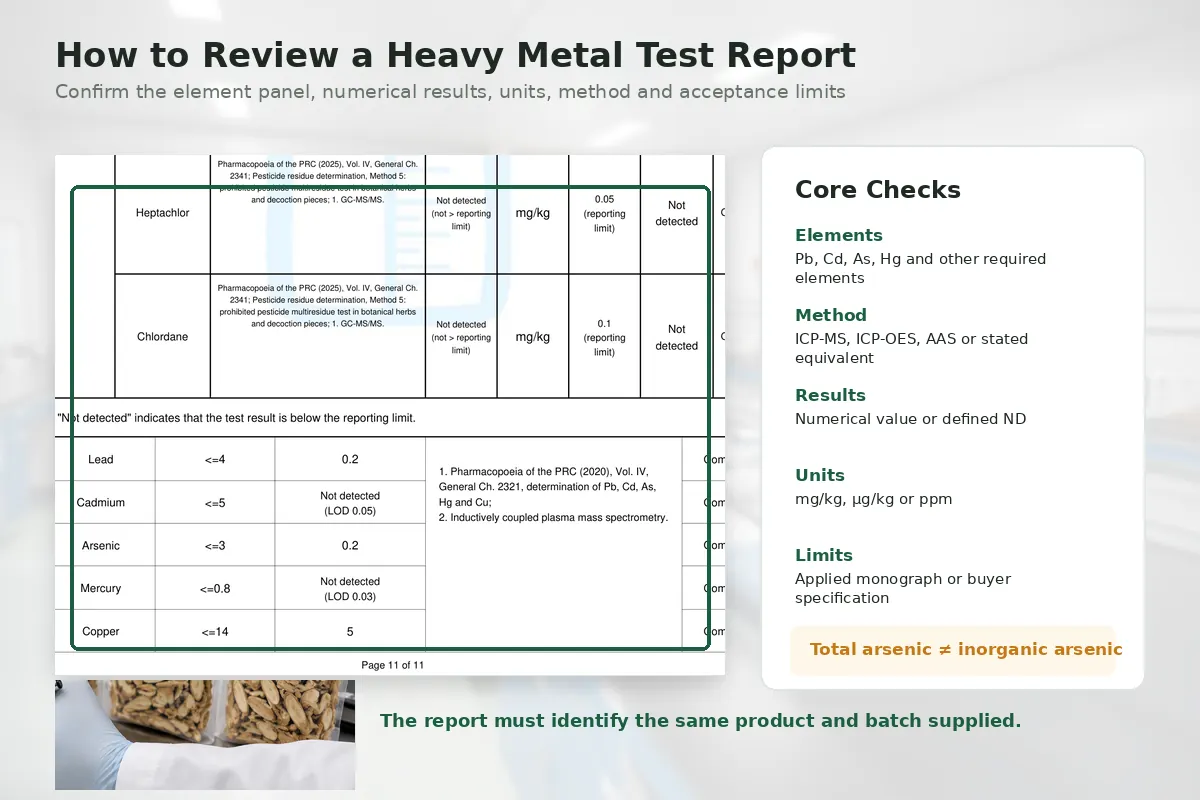
For elemental contaminants, check:
Lead, cadmium, arsenic and mercury are commonly reviewed for herbal materials. General background on these contaminants is published by the FDA on environmental contaminants in food.
However, the correct element panel is not universal.
Copper, nickel, chromium or other elements may also be required where the selected framework, identified product risk or agreed specification calls for them.
An element absent from the report has not been assessed by that report; its compliance has not been demonstrated.
Method information also matters.
ICP-MS, ICP-OES and atomic absorption techniques differ in the detection capability they can achieve. Sample preparation, particularly the digestion procedure, can also affect recovery.
Mercury may be prone to loss during sample preparation and is sometimes determined using a dedicated method. Where several elements appear under one method reference, confirm that the stated method covers all of them.
Numerical results are useful for comparing batches and monitoring trends.
ND results can also support review, but only when the stated detection or reporting limit is sufficiently low for the applicable requirement.
A heavy-metal result in mg/kg describes the herb, not the person using it. Because 1 mg/kg equals 1 µg/g, daily intake from a single herb can be estimated in one step:
Daily intake (µg/day) = result (mg/kg) × daily amount of herb (g/day)
For example, a lead result of 0.5 mg/kg in an herb used at 9 g/day gives about 4.5 µg of lead per day from that herb. Two published references are commonly used alongside this calculation:
| Element | Ch.P. 2025 General Chapter 0212 (concentration in the herb) | AHPA guidance (daily intake from a finished product) |
|---|---|---|
| Lead (Pb) | ≤ 5 mg/kg | 6 µg/day (3 µg/day for children’s products) |
| Cadmium (Cd) | ≤ 1 mg/kg | 4.1 µg/day |
| Arsenic (As) | ≤ 2 mg/kg (total) | 10 µg/day (inorganic arsenic) |
| Mercury (Hg) | ≤ 0.2 mg/kg (total) | 2.0 µg/day (methylmercury) |
| Copper (Cu) | ≤ 20 mg/kg | — |
The two columns answer different questions and should not be mixed. The Chinese Pharmacopoeia limits apply to the herbal material itself where the herb falls under Chapter 0212. The AHPA Guidance Policy on heavy metals (revised October 2020) is a voluntary U.S. trade guideline for finished oral herbal products and, by its own terms, is most applicable to products consumed at 5 g per day or less. Note also that AHPA expresses arsenic and mercury as inorganic arsenic and methylmercury, while most herb reports give total values, so a total result above an AHPA-based figure is a reason to request speciation, not proof of failure.
Total arsenic and inorganic arsenic are not interchangeable.
Total arsenic reports all arsenic species present. Inorganic arsenic reports only the species that some frameworks assess separately.
A total arsenic result cannot be read as an inorganic arsenic result. Similarly, a total arsenic figure above a limit expressed specifically for inorganic arsenic is not, by itself, evidence of failure against that limit.
Arsenic speciation is not required for every product.
Check whether the selected framework or agreed specification calls for it. Where speciation is required, confirm that the analytical method distinguishes arsenic species rather than reporting only a total value.
| Framework | Typical Product or Market Context | What the Buyer Should Verify | Important Limitation |
|---|---|---|---|
| EU pesticide MRL framework | Products placed on the EU market | Applied MRL matches both the pesticide substance and commodity classification | MRLs are substance- and commodity-specific and are amended over time |
| EU Pesticides Database | Practical lookup of current MRL values | Retrieved value matches the correct commodity code | A search tool; official legislation remains the authoritative text |
| USP <561> | Articles of botanical origin where USP conformity is claimed | Whether the product must conform and which analyte set was applied | Applies through contractual or regulatory context, not universally |
| USP <2232> | Dietary supplements where USP conformity is claimed | Whether the product is classified as a dietary supplement in the destination market | Not a universal legal limit for raw Chinese herbs |
| WHO herbal-medicine contaminant guidance | International reference for herbal medicines | Whether the destination regulator has adopted or referenced it | Guidance, not automatically binding law |
| Relevant pharmacopoeial monograph | Products supplied against a specific monograph | Whether a monograph exists for the species, plant part and supplied form | Applicability depends on product and regulatory context |
| Buyer specification or quality agreement | Contracted supply arrangements | Specification is written, current and referenced on the report | Contractual requirement; may differ from statutory limits |
Product classification determines which framework applies.
The same botanical material may be treated as a food ingredient, supplement input or medicinal raw material depending on how it is imported and used.
Confirm the classification with the importer’s QA or regulatory team and check that the framework named on the report applies to the intended use of the product.
Accreditation to ISO/IEC 17025 concerns laboratory competence and management systems. It does not set contaminant limits, and it does not by itself confirm that a particular method falls within the laboratory’s accredited scope.
This article is not legal advice.
| Document | Typical Issuer | What It Shows | Main Use | Limitation |
|---|---|---|---|---|
| Product specification | Supplier or buyer | Agreed requirements for the product | Contracting and supplier qualification | Defines requirements but does not prove batch compliance |
| Batch-specific COA | Supplier QA team | Test results for a defined lot | Batch release and pre-shipment review | Must relate to the supplied lot |
| In-house laboratory result | Supplier or producer laboratory | Results from internal testing | Process control and routine monitoring | Not independent evidence |
| Accredited third-party report | Independent laboratory | Externally produced test results | Independent verification, audits and higher-risk markets | Must still match the batch and use an appropriate method |
| Certificate of conformity | Supplier or third party | Statement of conformity with a named requirement | Customs and simplified documentation | May contain no numerical results |
| Supplier declaration | Supplier | Self-declared compliance statement | Supplementary documentation | Provides limited supporting evidence without test data |
The distinction is between what is required, what was measured and who measured it.
A specification defines requirements. A batch COA records findings for one lot. A third-party report adds independence, but it must still match the batch and use a method suitable for the analyte and matrix.
Accreditation does not mean that every method offered by a laboratory falls within its accredited scope.
For the certificate structure itself, see the Certificate of Analysis buyer guide.
A report can appear complete while still containing issues that require clarification:
Each issue requires clarification and supporting evidence from the supplier.
None is automatic proof of non-compliance, document falsification or misconduct.
Subject: Batch test documentation request – [Product] / Batch [Batch number] / PO [PO number]
Dear [Supplier contact],
We are reviewing [Product], [Botanical name], batch [Batch number], for import into [Destination market] under PO [PO number].
Please provide the following documents and information for this batch:
- A batch-specific pesticide residue report, including the full analyte list, method reference, individual results with units, and the applicable LOD, LOQ or reporting limit.
- The MRL, regulation, monograph or specification against which the pesticide results were assessed, together with the commodity classification used.
- A batch-specific heavy metal report, including the elements tested, numerical results with units, analytical method, and detection or quantification limits.
- Confirmation that the batch number shown on both reports matches the goods to be shipped under this purchase order.
- Where laboratory accreditation is stated, the relevant scope entry covering the methods used.
Please also confirm the expected timing for providing these documents.
Best regards,
[Name]
[Company]
What does ND mean on a pesticide or heavy metal test report?
ND means that the analyte was not detected above the detection limit of the method used on the tested sample. It does not mean absolute zero and applies only to that sample. Request the applicable LOD or reporting limit and confirm that it is sufficiently low for the requirement being evaluated.
Is a supplier COA enough, or should buyers request a third-party report?
A batch-specific supplier COA may support routine release where the data is complete and traceable to the lot. An independent report adds external verification for higher-risk products, new suppliers or audited supply chains. Buyers should define these requirements in the quality agreement rather than deciding only at shipment.
Do all Chinese herbs use the same pesticide and heavy-metal limits?
No. Pesticide MRLs are substance- and commodity-specific, while elemental contaminant requirements differ between food, supplement and medicinal frameworks. The same botanical species may fall under different requirements depending on how it is imported and used. Confirm the product classification before applying any published limit.
How do I turn a heavy metal result into daily intake? Multiply the result in mg/kg by the daily amount of herb in grams; the answer is in µg per day. For example, lead at 0.5 mg/kg in an herb used at 9 g/day gives about 4.5 µg/day. The AHPA guidance for finished herbal products uses 6 µg/day for lead, 4.1 µg/day for cadmium, 10 µg/day for inorganic arsenic and 2.0 µg/day for methylmercury, and is most applicable to products consumed at 5 g/day or less.
How can buyers tell whether the correct MRL or standard was used?
The report should name the regulation, monograph or specification applied and identify the commodity classification used. Compare that classification with the product’s intended market use. Where an EU MRL is cited, verify the value against official EU legislation rather than relying only on a secondary summary.
What is the difference between LOD, LOQ and reporting limit?
LOD concerns detection, LOQ concerns reliable quantification, and the reporting limit is the threshold the laboratory applies when issuing results. These values are not necessarily identical. Ask how the reporting limit was derived and whether the method was validated for the same type of product matrix.
What should buyers do when the report batch number does not match the shipment?
Request clarification and supporting records before approval, such as production records, sampling records and batch traceability documents. A mismatch may result from relabelling, translation or an internal numbering convention rather than misconduct. Do not approve the batch until the link between the report and goods is documented.
Testing scope and accompanying documents are agreed per order according to the product, batch, destination market and confirmed order scope rather than supplied as one fixed package.
Testing arrangements are described on the pesticide and heavy metals testing page, with batch checks outlined under in-house laboratory and quality control process.
To discuss requirements for a specific order, please provide:
