Tell Us About Your Project
Share your product, quantity and project requirements. We will review the details and respond with the relevant next steps.

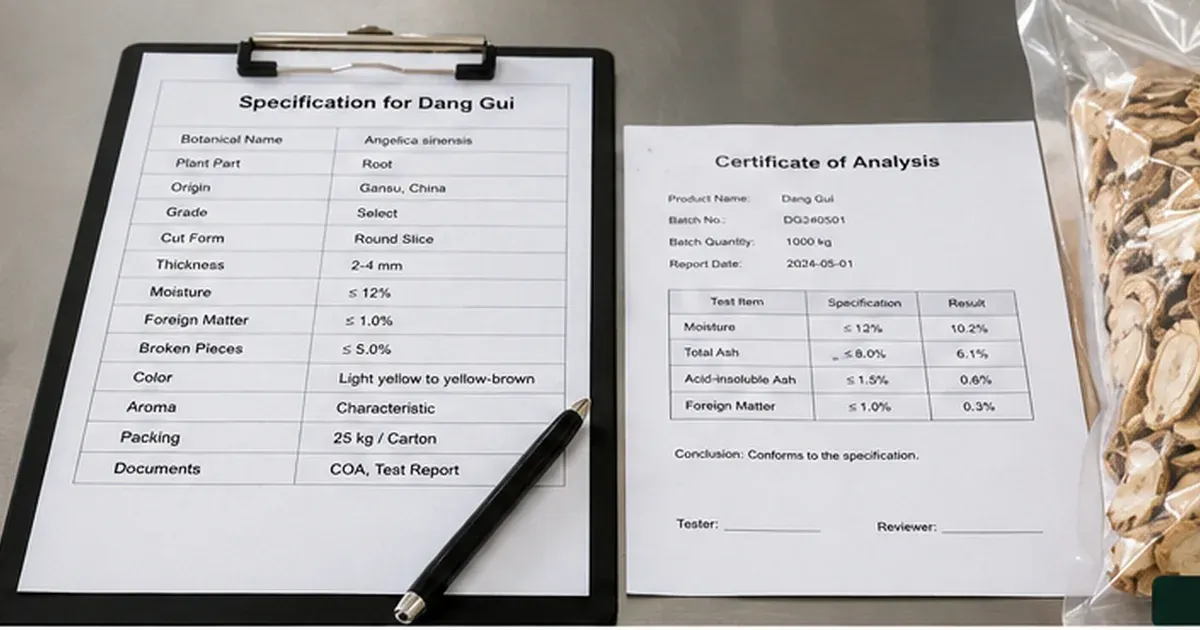
A Chinese herb sample should be approved against a written specification, not appearance alone. Before shipment, buyers should compare the commercial batch with the retained sample for identity, grade, cut size, color, aroma, moisture, foreign matter, packing and batch documents, while allowing normal agricultural variation within agreed acceptance criteria.
An approved sample does not automatically represent the commercial batch. Buyers should connect the sample to a written specification, batch number and agreed acceptance criteria before production is scheduled. This guide explains what to record during Chinese herb sample evaluation, what to compare before shipment and how to respond when the bulk lot differs. Supplier screening is covered in the bulk Chinese herbs sourcing checklist.
Chinese herbal slices are agricultural materials. Color, size, texture and aroma can vary between harvests, growing regions and raw-material lots. A specification written only as “same as sample” does not provide clear acceptance criteria.
The commercial batch should conform to the written specification and agreed acceptance criteria. Identity, plant part, grade basis, cut form, processing requirement, packing and documents must remain consistent. Defined natural variation may be accepted within those fixed requirements.
Appearance and sensory checks do not replace identity confirmation or laboratory testing. Buyers who test a sample in their own laboratory can follow the process in paid samples for lab testing. Thickness, moisture, foreign matter and broken-piece requirements should be confirmed product by product.
Natural variation. Growing region, altitude, soil, weather, harvest timing and raw-material size affect the finished slices. Two lots of the same herb at the same declared grade may differ in color depth, surface appearance and piece size while both remain within the agreed acceptance criteria.
Non-representative sample. A display sample may be hand-selected, drawn from a small quantity or taken from an earlier lot. WHO quality control guidance for medicinal plant materials treats representative sampling as a condition for meaningful evaluation. Buyers should ask which lot the sample came from and how it was drawn.
Origin or raw-material lot change. A different production area, grade basis, harvest season or blend of sources can move the batch outside the approved reference. EMA guidance on good agricultural and collection practice for herbal starting materials covers source traceability, batch identification and written agreements. It is a European quality reference rather than a universal commercial requirement.
Cutting, drying, sorting or packing differences. Slice thickness, cutting angle, segment length, drying and sieving affect the proportion of broken pieces and fines. Packaging strength, compression and moisture uptake can also affect the condition of the material. The required cut form should be stated in the specification.
| Specification field | What to record |
|---|---|
| Product name | Common and botanical identity |
| Plant part | Root, rhizome, leaf, flower, fruit, seed or bark |
| Origin | Required or disclosed sourcing region |
| Grade | Supplier grade plus an objective description |
| Cut form | Whole, round slice, oblique slice, segment or shredded form |
| Size or thickness | Buyer-defined value or approved range |
| Processing | Raw or processed; sulfur-related requirement where applicable |
| Sensory reference | Color range, aroma, texture and visible condition |
| Physical checks | Foreign matter, broken pieces and moisture, confirmed by product |
| Packing and label | Inner pack, carton, lot marking and label information |
| Documents | Batch COA, test report and agreed origin records |
| Sample control | Sample ID, source batch, approval date, approver and version |
WHO guidance describes herbal material specifications as covering source, plant part, processing, drying, cleaning, storage and transport, together with defined acceptance criteria.
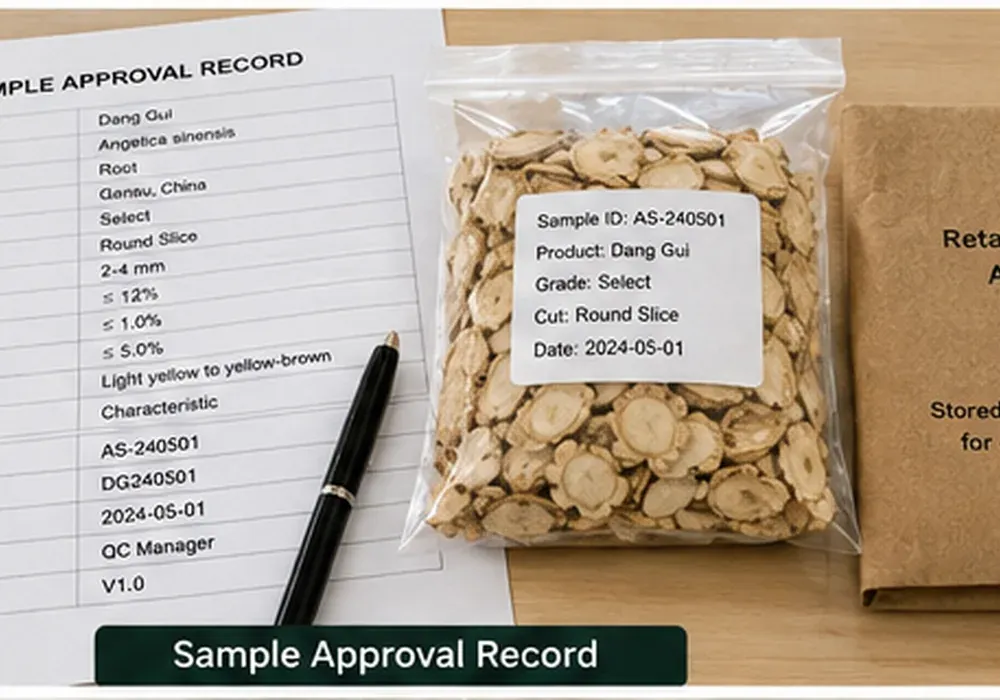
Keep a sealed retained sample according to the buyer’s storage and retention procedure. Record whether the sample was hand-selected or was not drawn from a production lot. Re-approval should be considered when the origin, grade, processing method, specification or production facility changes. The difference between catalogue, pre-order, approved reference and finished-batch samples is explained in botanical ingredient sample approval.
| Evaluation area | Compare in the bulk batch | Evidence | Action if different |
|---|---|---|---|
| Identity | Correct herb and plant part | Label, COA and identity review | Hold and clarify |
| Origin and grade | Agreed sourcing and grade basis | Supplier and batch records | Review the change |
| Cut and size | Distribution in a representative sample | Sieve, ruler or agreed measurement record | Re-sample or rework |
| Color and aroma | Within the agreed natural range | Side-by-side inspection | Investigate process or storage |
| Foreign matter | Representative bulk sample | Inspection or test record | Sort or apply the purchase agreement |
| Moisture and condition | Actual batch result where required | COA or test record | Re-test or corrective action |
| Broken pieces and fines | Representative batch condition | Sampling and inspection | Review cutting and packing |
| Packing and labels | Actual bags, cartons and lot labels | Pre-shipment photos or inspection | Correct before dispatch |
| Batch documents | Lot-linked documents | COA, test report and packing list | Do not approve until clarified |
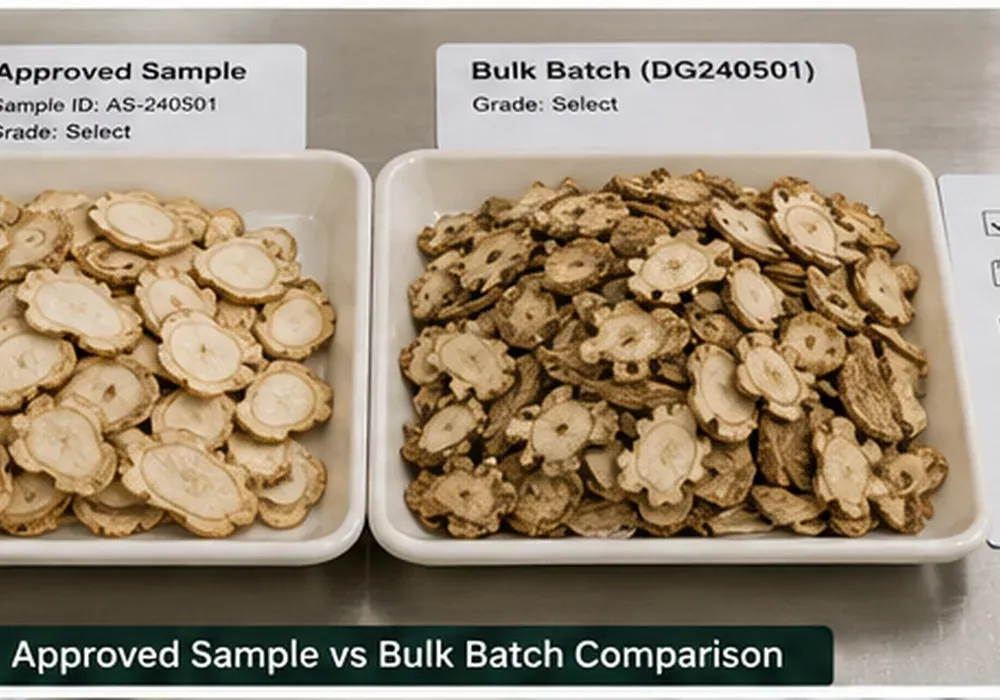
After arrival, use the Herbal Ingredient Receiving Inspection Checklist to verify the delivered shipment condition, labels, quantity and batch linkage.
A representative batch sample depends on how many containers are opened and where the material is taken from. WHO’s Quality Control Methods for Medicinal Plant Materials sets a simple rule that buyers can write into the pre-shipment inspection scope:
| Containers in the batch | Containers to sample | Example |
|---|---|---|
| 5 or fewer | Every container | 4 bags → sample all 4 |
| 6 to 50 | 5 containers | 40 bags → sample 5 |
| More than 50 | 10%, rounded up to the nearest multiple of 10 | 120 bags → sample 20 |
From each selected container, WHO describes taking three portions: one from at least 10 cm below the top, and two from the middle and bottom. The portions are pooled, mixed and reduced by quartering to the laboratory sample. Taking material only from the top of one bag is the most common reason a pre-shipment sample fails to represent the lot.
Visual comparison with the approved sample should be supported by an identity method. USP general chapters <563> (macroscopic and microscopic identification) and <1064> (HPTLC fingerprinting) describe the methods most often used to confirm that a bulk lot is the same botanical material as the approved sample.
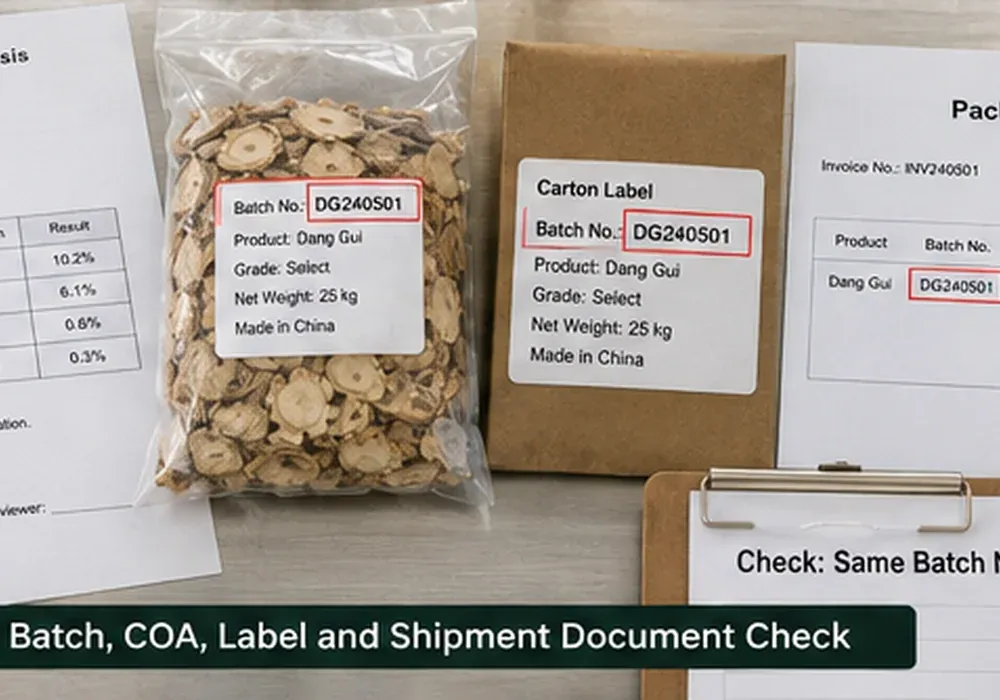
When the bulk batch differs, compare the deviation with the approved specification before accepting or rejecting the lot.
| Situation | Buyer response |
|---|---|
| Variation remains within the agreed range | Document and approve |
| The specification is unclear | Pause approval and define the missing criterion |
| The sample may not represent the lot | Request representative re-sampling and lot identification |
| A cut, packing or label issue can be corrected | Correct and re-inspect before dispatch |
| The COA does not match the shipment batch | Hold approval and request batch-linked evidence |
| Origin, grade, process or facility changed | Request disclosure and formal change approval |
| Material is outside the agreed specification | Apply the corrective action stated in the purchase agreement |
Sample approval can be discussed before production is scheduled so that specification fields and acceptance criteria are confirmed before the commercial batch runs. The specification, batch COA and pre-shipment checks are agreed according to the product and order, including the applicable inspection scope and test items. Batch traceability and pre-shipment review are included in the published quality control process.
Buyers can provide the target herb, botanical name, grade, cut form, quantity, destination market, packing and document requirements. Aile Herb can then confirm the available options and discuss a production-matched sample, sample identification and a suitable pre-shipment comparison method.
Can a Chinese herb bulk order look exactly the same as the approved sample?
No. Color, size, texture and aroma can vary between harvests and raw-material lots. The correct standard is conformity to the agreed written specification and acceptance criteria, with identity, plant part, grade, cut form and processing method remaining consistent.
What should buyers record when approving a Chinese herbal slice sample?
Record the product and botanical name, plant part, origin, grade basis, cut form, size target, processing requirement, sensory reference, physical checks, packing, labels and required documents. Add a sample ID, approval date and specification version for traceability.
How should a retained sample be stored?
Store it sealed and protected from moisture, light and pests under conditions suitable for the material. Label it with the sample ID, product name, supplier, source batch, approval date, grade and specification version. The retention period should follow the buyer’s QA procedure.
How can buyers confirm that a pre-shipment sample represents the actual batch?
Ask for the production lot number from which the sample was drawn and the sampling method used. The same lot number should appear on the COA, packing labels and shipping documents. Undated photos or samples without a lot reference cannot confirm batch representation.
How many bags should be sampled to check a bulk shipment of Chinese herbal slices? WHO guidance for medicinal plant materials recommends sampling every container when a batch has 5 or fewer, 5 containers when it has 6 to 50, and 10% of containers (rounded up to the nearest multiple of 10) when it has more than 50. Take portions from the top, middle and bottom of each selected container and pool them into one representative sample.
Which differences may be acceptable?
Differences within the agreed acceptance criteria may be acceptable, including moderate variation in color depth, surface appearance or piece size for the same herb, plant part and grade. Changes in identity, declared origin, processing method or document accuracy require review and approval.
Send the target herb, grade, cut form, quantity, destination market, packing and document requirements. We will confirm the applicable specification fields, sample identification and pre-shipment comparison method for the product and order.
To arrange a production-matched sample and agree the comparison method before bulk production, see our samples and product development page and send your specification.
