Tell Us About Your Project
Share your product, quantity and project requirements. We will review the details and respond with the relevant next steps.

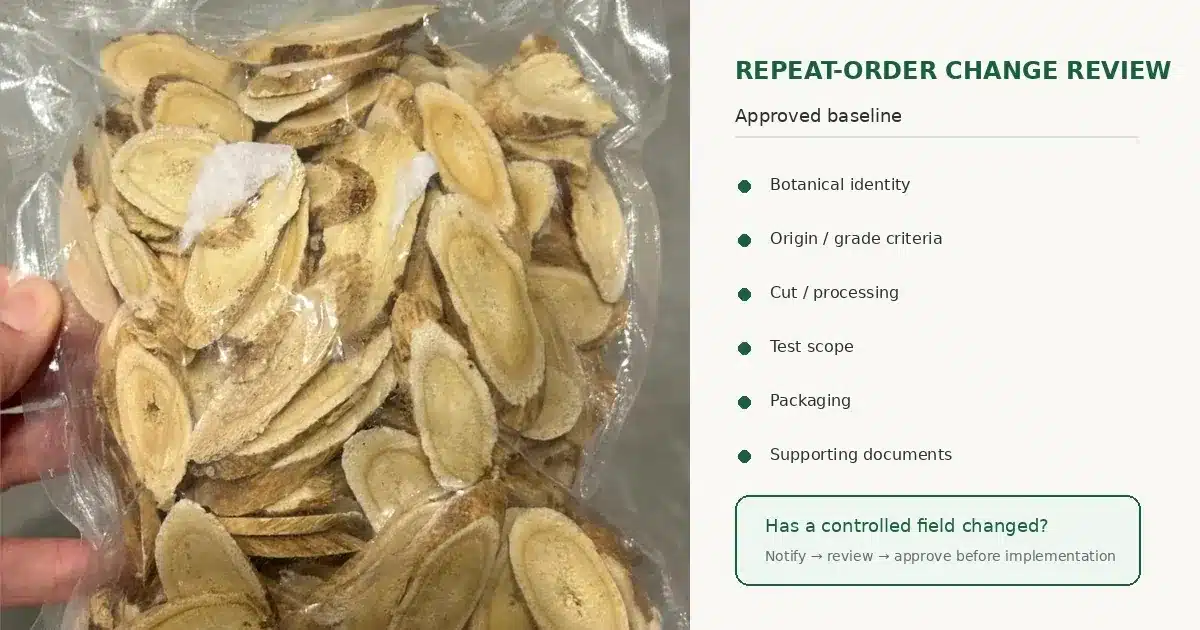
A repeat order does not automatically trigger a new approval cycle. Herbal ingredient supplier change notification applies when a supplier plans to change a buyer-controlled attribute—not when normal agricultural variation remains within the agreed specification. The appropriate buyer response depends on what changed and how the proposed change affects the approved baseline.
Supplier change notification is a documented communication before implementing a planned change that may affect an agreed product attribute, supporting evidence, packaging, traceability, certification status, or the buyer’s ability to compare a repeat order with the approved baseline.
A first approved order typically establishes:
A repeat order should answer one question:
Has anything materially changed from that baseline?
| Situation | Classification | Notification? | Buyer Action |
|---|---|---|---|
| Seasonal colour variation within agreed visible criteria | Normal variation | Usually no | Routine batch review |
| Root or slice-size distribution within written range | Normal variation | Usually no | Routine batch review |
| Moisture variation within agreed limit | Normal variation | Usually no | Review batch evidence as required |
| Crop-year difference where crop year is not controlled | Normal variation | Buyer-specific | Routine review |
| General appearance differences within agreed criteria | Normal variation | Usually no | Routine batch review |
| Different botanical species or accepted botanical source | Controlled change | Usually yes | Review against approved specification and market requirements |
| Different plant part | Controlled change | Yes | Specification review and reapproval as appropriate |
| Origin change where origin is controlled | Controlled change | Yes | Origin and specification review |
| Grade I changed to Grade II | Controlled change | Yes | Quotation and specification review |
| Same grade name but different sorting criteria | Controlled change | Yes | Review underlying grade definition |
| Round cut changed to oblique cut | Controlled change | Yes | Specification and sample review |
| Raw material changed to processed material | Controlled change | Yes | Review specification, sample and supporting evidence |
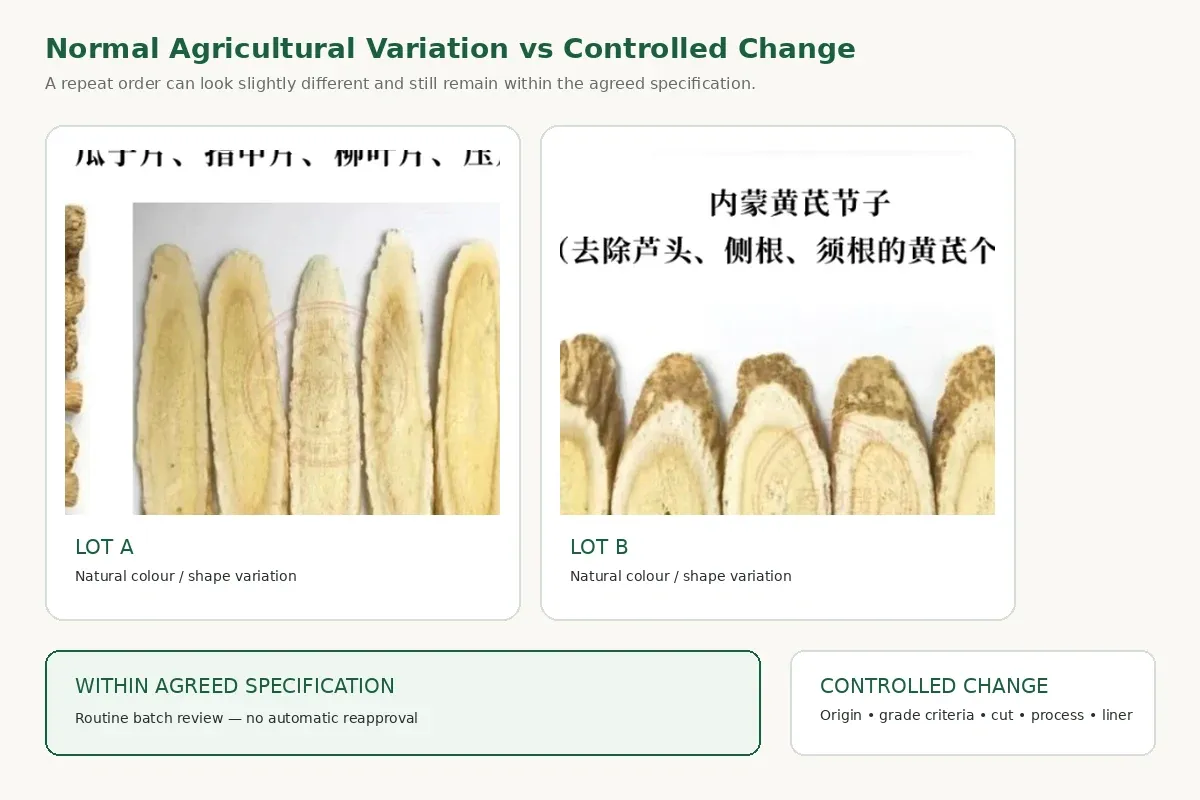
Natural variation may remain acceptable when it stays within the agreed specification.
| Change Category | Examples | Why Buyer May Care |
|---|---|---|
| Identity and source | Species, accepted botanical source, plant part, controlled origin | Affects product identity and approved sourcing basis |
| Grade and physical specification | Grade definition, sorting thresholds, size, cut, thickness | Affects commercial presentation and downstream use |
| Processing and sulfur status | Raw vs processed, Paozhi method, fermentation, sulfur treatment | Affects agreed product state and supporting evidence |
| Packaging | Liner material, closure, vacuum packing, net weight, carton or label | May affect product protection, logistics or buyer requirements |
| Analytical and documentation | COA scope, test method, laboratory, limits, certificates | May affect evidence and comparability between orders |
| Site or subcontractor | Processing, packing, testing or other controlled activities | May matter where the activity or site is buyer-qualified |
Controlled fields may include botanical species, accepted botanical source, plant part, country of origin, and production region where specifically agreed.
A province change is not automatically a deviation.
If the approved requirement states:
Origin: China
a change from one Chinese province to another may remain acceptable if no province or production region was contractually controlled.
If the specification states:
Origin: Gansu
supply from another province changes an approved field and should be disclosed before supply.
The issue is not that one region is inherently better. The issue is whether origin was part of the approved requirement.
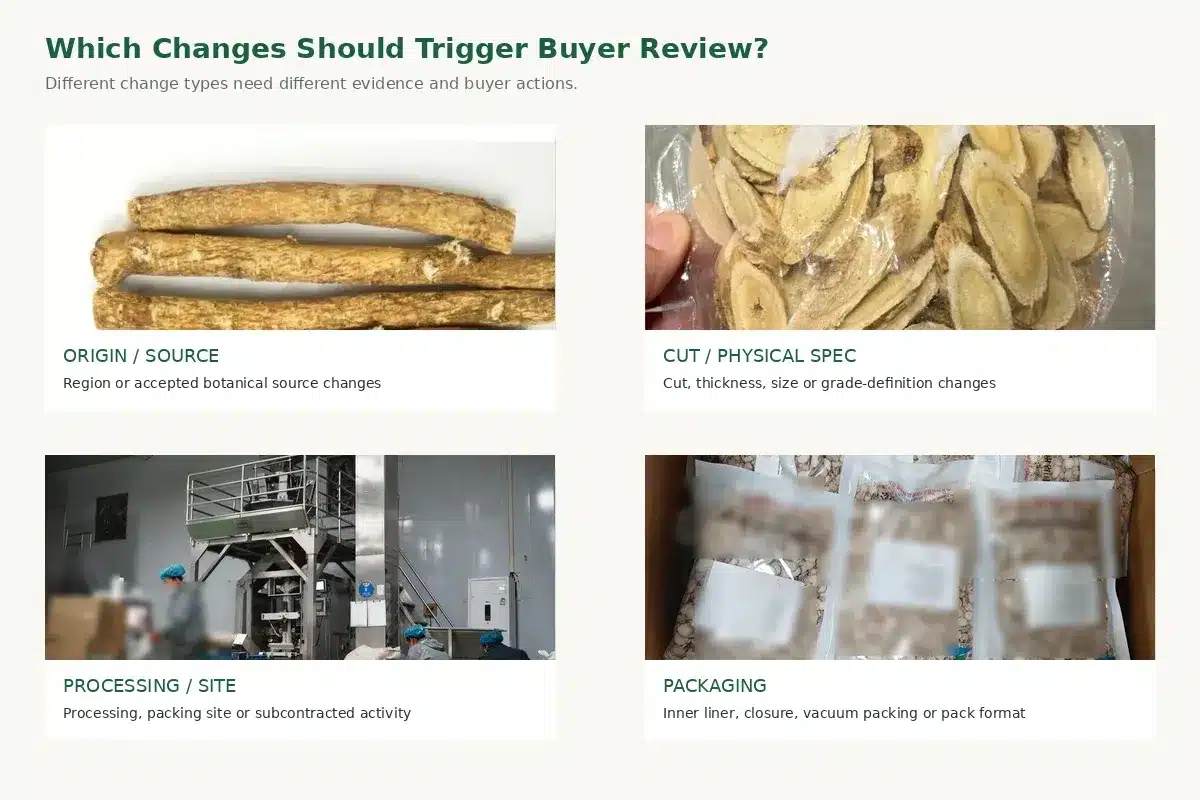
Relevant fields may include:
A grade-name change is obvious, but a grade-definition change can be more important.
For example, a supplier may retain the same Grade I name while changing the size range, whole-piece requirement or broken-piece allowance. If those criteria are part of the approved specification, the buyer should be informed.
Relevant changes may include:
A processing change should be reviewed when it changes an agreed product state, analytical requirement, destination-market requirement or downstream use.
Packaging changes do not all have the same significance.
Product-contact or protection changes may include:
These generally deserve closer review because they may affect product contact or protection.
Commercial or logistics changes may include:
These are buyer-specific and may affect freight, warehousing or handling.
Cosmetic changes, such as outer-carton artwork only, are normally lower risk unless buyer-owned artwork, required labeling or traceability information changes.
A carton artwork change and an inner-liner material change should not be treated as equivalent.
Repeat-Order Supplier Change Notification Form
| Change Situation | Possible Buyer Response |
|---|---|
| Natural variation remaining within agreed specification | Routine batch review |
| Minor documentation, cosmetic label or operational change with no effect on approved requirements | Notification or document review |
| An agreed written requirement changes | Revised specification |
| Change affects cut, thickness, grade, size, form, visible presentation, processing or packaging presentation | Updated sample approval may be appropriate |
| Change affects test scope, analytical comparability or contamination risk | Analytical review or retesting may be appropriate |
| Change affects botanical source, a qualified critical site, certification chain or another buyer-critical field | Deeper review or requalification may be appropriate |
First Approved Order
Specification + Sample / Reference + Documentation
↓
Repeat Order Proposed
↓
Has a Buyer-Controlled Attribute Changed?
No
→ Routine batch review against the existing specification
Yes
→ Supplier notifies buyer before implementation
↓
Assess the Impact
↓
Buyer Response
Notification only
→ Document review
→ Revised specification
→ Updated sample approval
→ Analytical review
→ Requalification where justified
The buyer should be notified before a material change is implemented or before the buyer becomes commercially committed to the changed condition.
Depending on when the proposed change becomes known, notification may occur:
The timing should follow the applicable contract, purchase agreement and buyer requirements rather than an assumed universal 30-, 60- or 90-day notice period.
| Term | Meaning | Buyer Implication |
|---|---|---|
| Planned Change | A known modification proposed before implementation | Assess and notify where relevant |
| Natural Variation | Expected lot variation within agreed criteria | Routine batch control |
| Deviation | Departure from an expected process, plan or requirement | Assess the affected material |
| Non-Conformance | Product or document does not meet an agreed requirement | Resolve according to the agreed acceptance procedure |
These terms should not be used interchangeably. A planned change can be reviewed before implementation, while a deviation or non-conformance is normally identified after something has departed from the approved baseline.
A first approved order establishes the baseline. A repeat order should confirm that controlled fields remain unchanged or that proposed changes have been reviewed.
This process builds on botanical ingredient sample approval and the underlying Chinese herbal slices specification established during the initial order.
Illustrative example only—not an actual Aile Herb specification.
Product: Astragalus slices
| Field | Previous Approved Order | New Proposal | Notification? | Buyer Action |
|---|---|---|---|---|
| Botanical name | [approved botanical name] | Unchanged | No | Routine batch verification |
| Origin | Gansu | Different province | Yes | Review because origin was controlled |
| Grade criteria | [approved criteria] | Unchanged | No | Verify against existing specification |
| Cut | [approved cut] | Unchanged | No | Routine review |
| Thickness | [approved range] | Unchanged | No | Routine dimensional check |
| Inner liner | PE liner | Different polymer | Yes | Review product-contact packaging |
| COA test scope | [approved scope] | Unchanged | No | Confirm batch-linked COA |
| Laboratory | [previous lab] | New external laboratory | Buyer-specific | Review method, scope and reporting basis |
The origin change matters because the previous approved requirement specifically stated Gansu. The liner change requires packaging review because the product-contact material has changed.
A new laboratory does not automatically make the repeat batch unacceptable. The buyer should review whether the analytical method, scope, reporting basis and laboratory acceptance requirements remain suitable.
| Change | Buyer Review |
|---|---|
| COA test item added or removed | Compare against agreed analytical scope |
| Test method changed | Review result comparability |
| Pharmacopoeial edition changed | Check whether applicable method or limits changed |
| External laboratory changed | Review method, scope, reporting basis and lab acceptance where required |
| Specification limit changed | Treat as a specification revision |
| Reporting unit changed | Confirm historical and new results remain comparable |
| COA format changed | Confirm all required fields and batch linkage remain clear |
| Certification or origin document changed | Confirm continued validity and required scope |
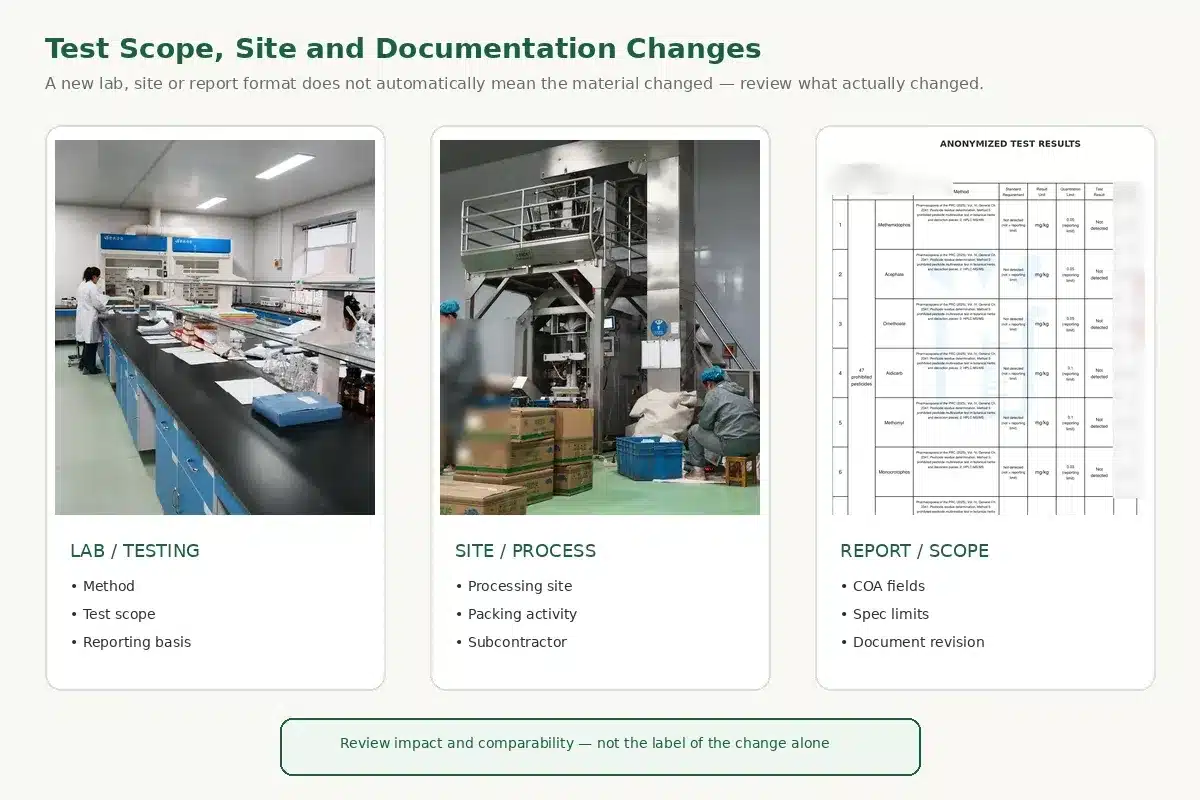
A laboratory or report-format change does not automatically mean the material itself changed. However, a change to test scope, method, reporting basis or acceptance limits can affect comparability with previous orders.
For more detail, see the Certificate of Analysis Guide and How to Read Chinese Herb Test Reports.
A new processing site, packing site, subcontractor, warehouse or laboratory does not have one universal buyer consequence.
Deeper review may be justified when the buyer has specifically qualified:
For ordinary commercial dried-herb purchasing, not every warehouse, production line or equipment change requires supplier requalification.
Certification changes should be disclosed when expiry, suspension or loss of relevant scope affects a contractual requirement, certification claim or intended market.
ISO, HACCP and FDA facility registration should not be treated as universal product approvals.
Quality-system principles such as WHO GACP support documented identity, origin and processing records for herbal materials. ICH Q7, where referenced in pharmaceutical supply chains, applies to active pharmaceutical ingredients and should not be treated as a universal legal requirement for ordinary dried herbal ingredients.
Before repeat-order production, confirm:
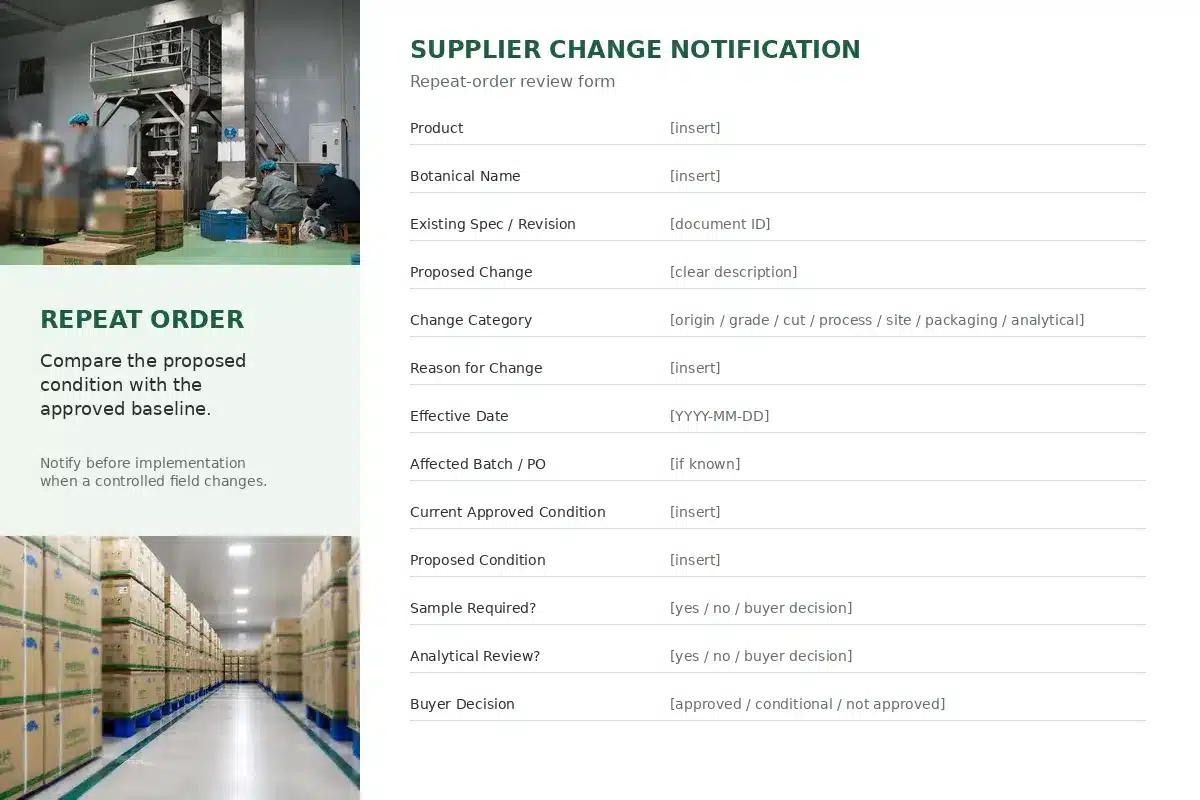
| Field | Entry |
|---|---|
| Supplier | [insert] |
| Buyer | [insert] |
| Product name | [insert] |
| Botanical name | [insert] |
| Plant part | [insert] |
| Existing specification / revision | [document ID / revision] |
| Existing approved sample / reference ID | [if applicable] |
| Proposed change | [clear description] |
| Change category | [identity / origin / grade / cut / process / site / packaging / analytical / certification / other] |
| Reason for change | [insert] |
| Proposed effective date | [YYYY-MM-DD] |
| Affected batch / lot | [if known] |
| Affected PO / forecast | [insert] |
| Current approved condition | [insert] |
| Proposed condition | [insert] |
| Specification impact | [within spec / revision required / pending] |
| Potential impact | [visible / analytical / packaging / documentation / traceability / certification] |
| Sample required? | [yes / no / buyer decision] |
| Analytical review required? | [yes / no / buyer decision] |
| Document changes | [insert] |
| Buyer approval required? | [yes / no / pending] |
| Buyer decision | [insert] |
| New specification revision | [if applicable] |
| Implementation status | [approved / conditional / not approved] |
| Red Flag | Why It Matters | Buyer Follow-Up |
|---|---|---|
| Origin changes without disclosure | A controlled sourcing field may have changed | Review specification and origin records |
| Same grade name but different criteria | The physical specification may have changed | Compare written grade definitions |
| Different cut appears on repeat order | May affect downstream use | Compare against approved cut |
| Sample differs without explanation | Baseline comparison becomes unclear | Ask what source, grade, process or batch changed |
| Product-contact packaging changes without review | Protection or contact conditions may change | Request packaging specification |
| COA test scope silently narrows | Required analytical evidence may be missing | Compare previous and current COA scope |
| New laboratory appears without clarification | Comparability may be affected | Review method, scope and lab acceptance |
| Different processing or packing facility appears on documents | A qualified activity may have moved | Confirm which operation changed |
| Required certification expires or loses scope | Contract or market requirement may be affected | Request current valid evidence |
| Botanical name differs between orders | Product identity needs reconciliation | Confirm species and approved botanical source |
An unexplained difference should be investigated and documented. It should not automatically be treated as evidence of intentional misconduct.
No. A new sample approval is usually unnecessary when the material remains within the existing specification and approved physical criteria. Updated sample review may be appropriate when a proposed change affects cut, thickness, grade, form, processing, packaging presentation, botanical source or another buyer-controlled attribute.
No. Crop-year and seasonal differences are normal characteristics of agricultural materials. They become a controlled issue when the new harvest changes an agreed specification field, required origin, analytical requirement, certification condition or another criterion the buyer has explicitly defined.
It depends on the approved requirement. If the specification states only “China origin,” a province change may remain acceptable. If a named province or production region is part of the agreed specification, changing it should be disclosed and reviewed before supply.
The name may remain the same while the underlying sorting criteria change. If size, whole-piece ratio, breakage, fines or other grade criteria are controlled in the approved specification, changes to those criteria should be disclosed and reviewed.
No. A laboratory change does not automatically indicate a product-quality problem. The buyer should review whether the method, test scope, reporting basis and any required laboratory qualification remain suitable so results can still be interpreted against the approved specification.
Updated sample approval may be appropriate when a proposed change affects observable or physical characteristics such as botanical source, product form, grade, cut, thickness, size distribution, processing status or packaging presentation. Analytical or documentary changes may instead require document or test review.
Share the approved repeat-order baseline and any proposed change before production.
Aile Herb can review product form, grade, cut, processing, documentation and packing requirements against the current specification.
To see how specification revisions, sample references and batch documents are handled across repeat orders, review our OEM and private label process and send the proposed change for review.
Please provide:
Discuss Your Repeat Order
