Tell Us About Your Project
Share your product, quantity and project requirements. We will review the details and respond with the relevant next steps.

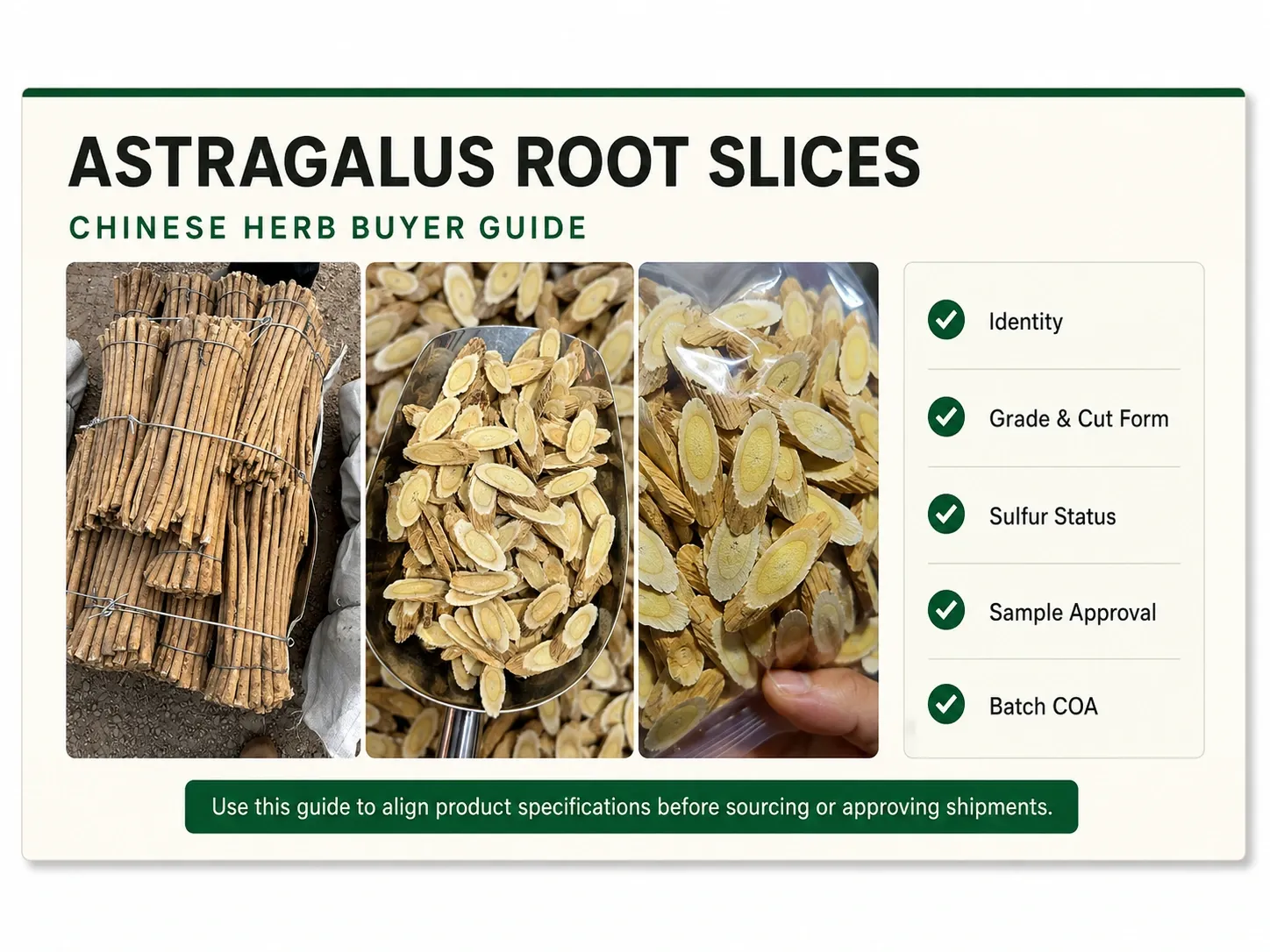
Astragalus Root Slices are a dried botanical raw material. The material is the dried root of an Astragalus species, cleaned, cut into slices and dried for commercial use. In Chinese trade it is called Huang Qi. In pharmacopoeial and trade documents it appears as Radix Astragali or Astragali Radix.
The slices are supplied in bulk to importers, distributors, tea manufacturers and supplement producers. Different buyers need very different material. A tea manufacturer may need thin, uniform slices. A distributor supplying TCM pharmacies may need a different cut and appearance.
This is why a written specification matters more than a product name. Two suppliers can both offer “Astragalus Root Slices” and ship completely different material. Both shipments can be technically correct if the purchase order was vague.
Buyers should confirm five things before placing an order:
This guide explains how to define each item. Buyers who want commercial details on the material itself can review the Astragalus Root Slices product page.
The same material is sold under several names:
These are trade names and traditional medicinal-material names. They are not botanical identification. A purchase order that says only “Huang Qi” does not define what the supplier must deliver.
Buyers should require the botanical name in writing. The botanical name should appear on the purchase order, the specification, the COA and the shipping label.
| Field | Buyer Requirement |
|---|---|
| Product name | Astragalus Root Slices / Huang Qi Slices |
| Botanical name | State the accepted botanical name required by the destination-market standard. Add the synonym if needed. |
| Plant part | Dried root |
| Material form | Dried root slices. State the cut type and thickness range. |
| Origin | Country. Add province or region where commercially relevant and verifiable. |
| Applicable standard | Ch.P. 2025, Ph. Eur., a named food standard, or the buyer’s internal specification |
Three Latin names appear in international documents. Buyers should understand the difference.
| Term | What it means in procurement |
|---|---|
| Astragalus membranaceus | Used in Chinese pharmacopoeial, historical and supplier documentation. Confirm whether a variety is specified. |
| Astragalus membranaceus var. mongholicus | A source recognised in Chinese Pharmacopoeia terminology for Huangqi. |
| Astragalus mongholicus | Widely treated as an accepted botanical name. Used in European Pharmacopoeia naming. |
The Chinese Pharmacopoeia describes Astragali Radix as the dried root of Astragalus membranaceus (Fisch.) Bunge var. mongholicus (Bunge) Hsiao and Astragalus membranaceus (Fisch.) Bunge.
This is a documentation issue, not a supply problem. The risk appears at customs, during customer audits and during regulatory review. Documents that use different names for the same shipment create questions.
The practical solution is simple. Ask the supplier to state the botanical name in the form your destination market requires. Ask them to list the synonym in brackets where needed. Keep that wording identical across the PO, COA and label.
One identity risk in Astragalus Root purchasing is confusion with Hong Qi (Hedysarum polybotrys).
Both materials are traded as Chinese herbal roots. Their commercial descriptions can look similar. They are different botanical materials.
For international procurement, buyers should confirm:
Visual appearance alone should not be used as the only identification method. Buyers can also review common visual identification risks and sulfur-treatment checks in our guide to Astragalus root quality signs.
Our Astragalus root slices product page lists the commercial forms and cut options available for bulk order.
ISO 22988:2020 is the international standard for Astragalus root. Its scope names one botanical source: Astragalus membranaceus var. mongholicus. The Chinese Pharmacopoeia entry for Astragali Radix recognises two: Astragalus membranaceus (Fisch.) Bunge var. mongholicus (Bunge) Hsiao and Astragalus membranaceus (Fisch.) Bunge.
ISO 22988:2020 and the Chinese Pharmacopoeia do not define the same material. A batch that satisfies the pharmacopoeial botanical identity requirement can fall outside the scope of ISO 22988, because the ISO document covers one botanical source and the pharmacopoeial entry covers two.
This is not a theoretical distinction. It decides which supporting documents a shipment needs and which claim a supplier is entitled to make. A supplier stating “ISO 22988 compliant” is making a narrower identity claim than one stating “Chinese Pharmacopoeia compliant” — and if the delivered material is the second source species, the first claim is not available at all.
Both standards have moved, and recently. The 2025 edition of the Chinese Pharmacopoeia took effect on 1 October 2025. ISO 22988:2020 is being replaced by a second edition: ISO/DIS 22988 entered its DIS ballot on 13 May 2026. A specification written today that still names “Ch.P. 2020” is citing a superseded edition, and one that names “ISO 22988” with no year does not identify which text applies.
What to write on the purchase order:
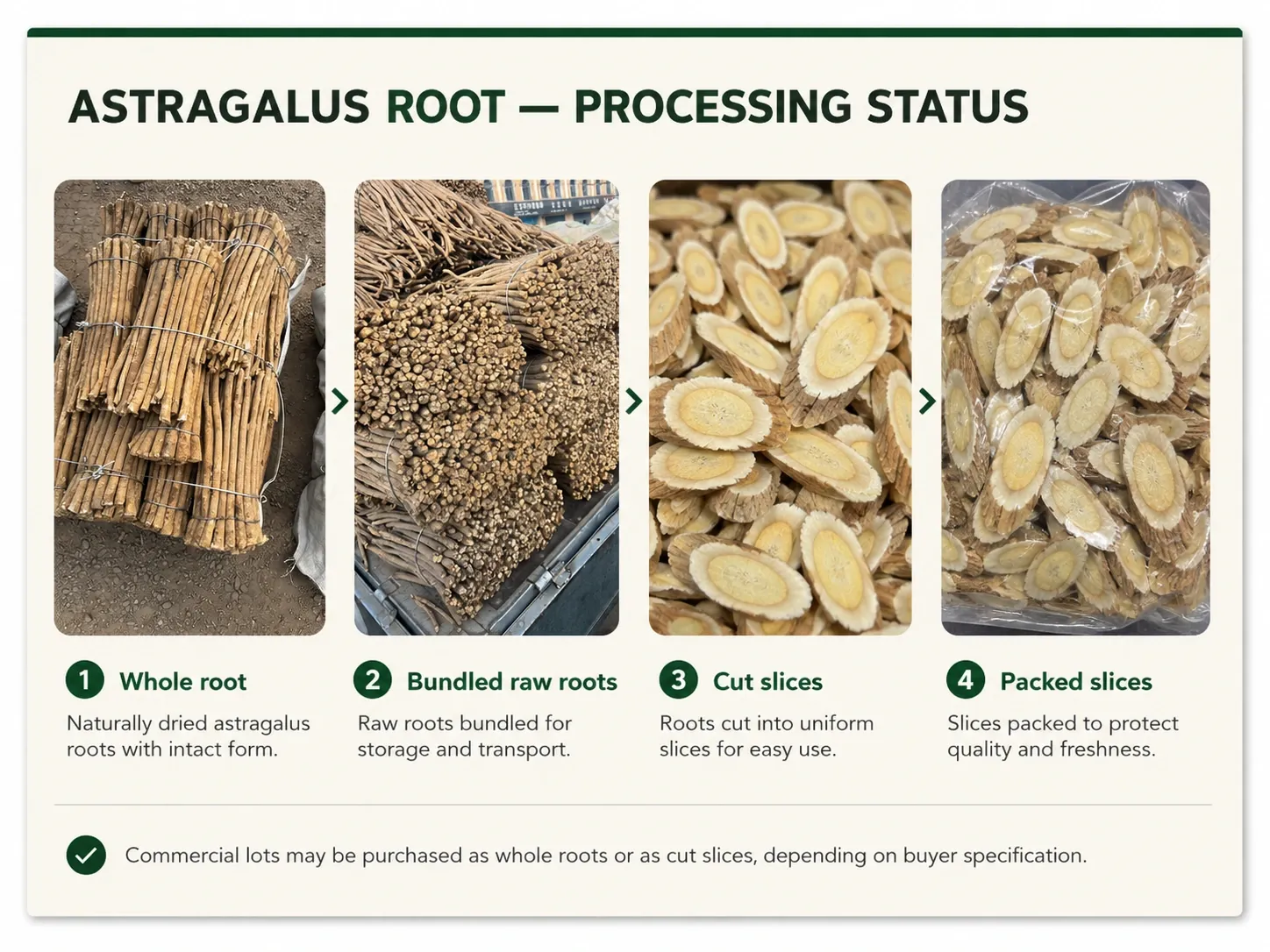
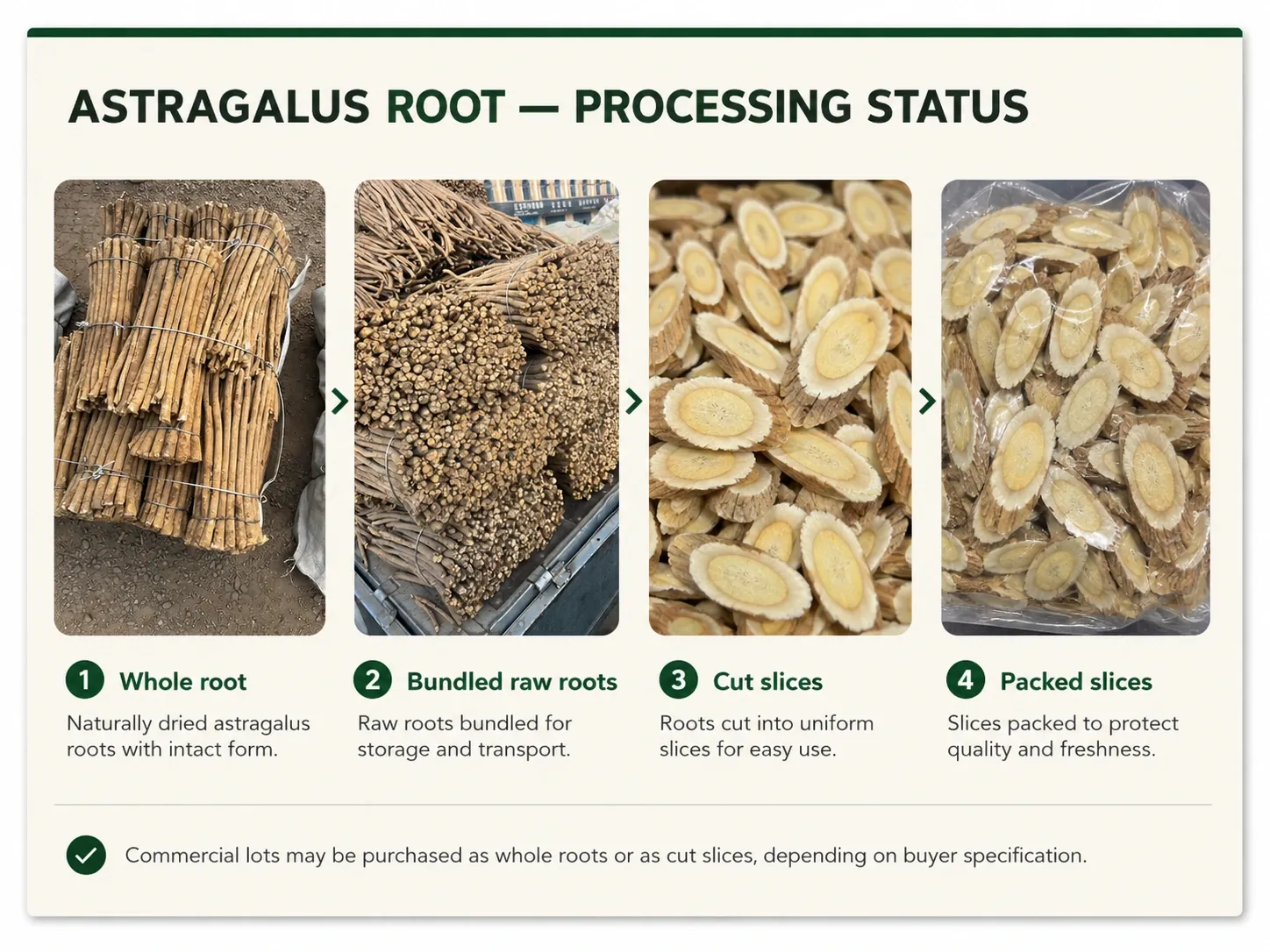
Astragalus is sold in several physical formats. They are not interchangeable. Price comparisons between formats are misleading.
| Form | Common Use | Buyer Check |
|---|---|---|
| Whole dried root | Buyer or third party performs its own cutting | Root diameter, length, rootlet removal, cleanliness, moisture, breakage |
| Standard slices | Most common B2B format for herbal slices and tea materials | Thickness range, size distribution, broken ratio, appearance consistency |
| Thin slices | Tea-bag filling, blending, faster extraction | Exact thickness range, fragility, fines level, protective packing |
| Thick slices | Buyers requiring a more substantial slice or further cutting | Thickness, slice integrity, diameter, uniformity |
| Small slices / fragments | Cost-sensitive or blended applications | Written definition of “small”, fragment percentage, dust limit |
Powder, granules and extracts are separate material categories. They require their own specification, testing panel and process declaration. Do not treat them as substitutes for slices.
Buyers should define these in numbers, not in adjectives:
Suppliers can meet almost any reasonable requirement. They cannot meet a requirement that was never stated.
Astragalus slices are produced through a conventional dry-botanical workflow: inspection, cleaning, cutting, drying, sorting, testing and packing. The stages are not unusual. What varies between suppliers — and what changes the delivered product — is how each stage was actually run.
The last question deserves a written answer on every purchase. Treatment status affects market acceptance and testing requirements.
Before quotation, buyers should confirm the processing method and final product specification.
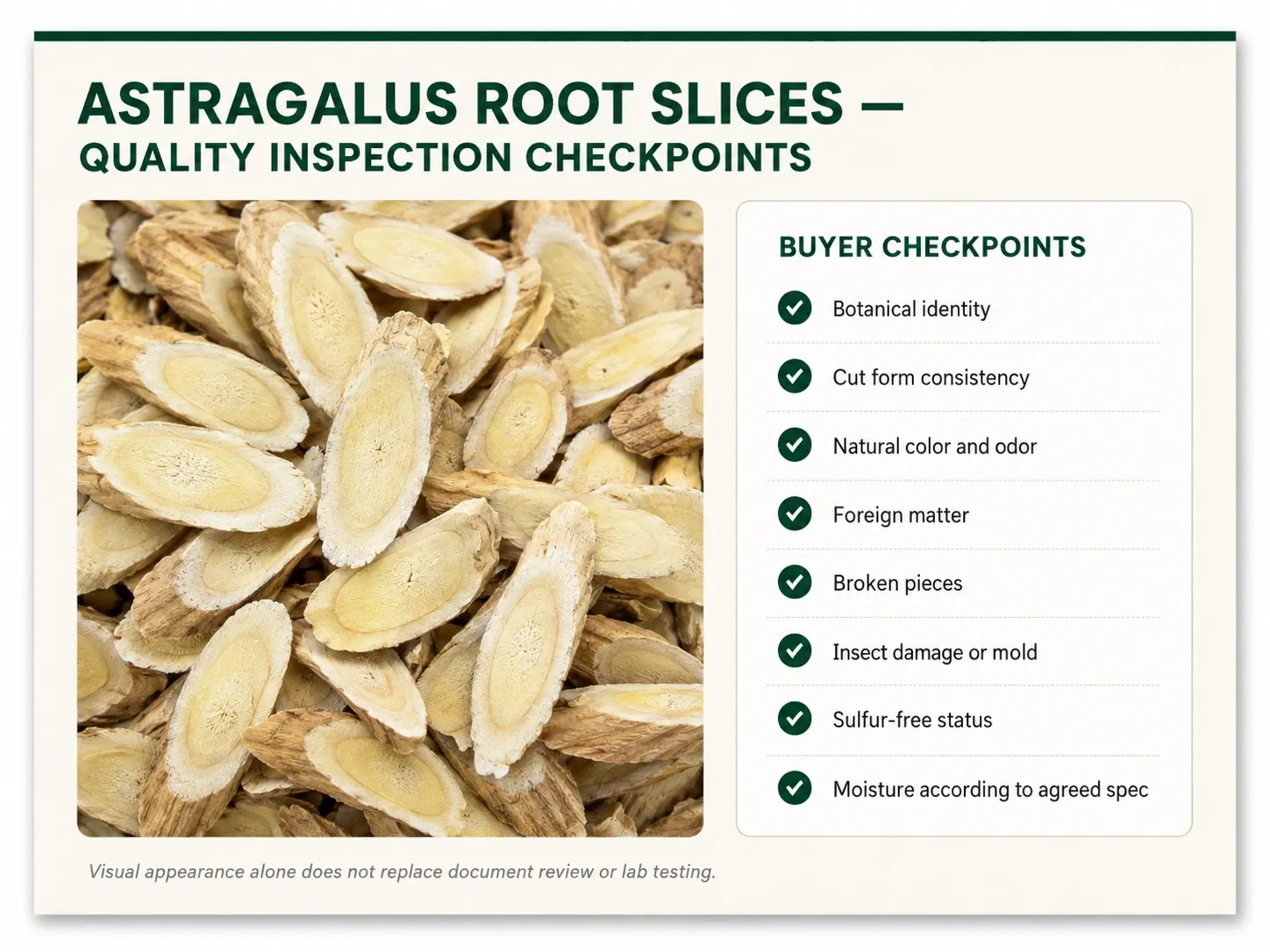
Physical inspection confirms that a delivered batch matches the approved sample commercially. Laboratory testing confirms identity, purity and contaminant compliance. A batch can look correct and still fail a pesticide, heavy-metal or microbiological requirement, so the two are not substitutes for one another. The inspection items themselves — thickness, size, breakage, fines, foreign matter, colour, odour, packaging condition — are the same for any dried root; our receiving inspection guide sets them out in full.
| Inspection Item | Buyer Purpose |
|---|---|
| Slice thickness | Confirm production consistency against the specified range |
| Slice size | Match the finished-product or filling requirement |
| Broken slices | Control yield loss and screening effort |
| Dust and fines | Confirm cleanliness and sieving requirement at receiving |
| Foreign matter | Check processing and sorting control |
| Colour variation | Compare against the approved sample and detect mixed lots |
| Odour | Confirm normal dry material condition before release |
| Packaging condition | Protect shipment quality and confirm lot traceability |
Record results against the approved sample. Photographs are useful evidence in a dispute.
For detailed visual identification points, including sulfur-treatment risks and appearance differences, buyers can refer to our Astragalus root quality guide.
Grade names for Astragalus Root Slices — “Grade A”, “Premium”, “Export Grade”, “Selected” — are supplier-defined commercial descriptions, not contract terms. The method for handling them is the same across every herbal slice: take the commercial word, ask what it means in numbers, write the numbers into the specification, approve a sample against those numbers. Our guide to Chinese herbal slice grades works through that conversion.
Testing requirements come from three different places. Buyers should separate them, because they do not overlap automatically.
These apply when the buyer purchases against a named pharmacopoeia or a customer specification derived from one. They do not apply automatically just because the product is a Chinese herbal material.
Typical pharmacopoeial quality-control areas for Astragali Radix include:
Each of these has a defined method and a defined limit inside the applicable monograph. Buyers should reference the monograph edition and cite limits from the official text, not from supplier marketing material.
The Chinese Pharmacopoeia framework for Astragali Radix uses marker compounds for content determination. Astragaloside IV is a saponin marker used for this purpose. Calycosin-7-O-β-D-glucoside is an isoflavonoid marker also referenced in Chinese Pharmacopoeia quality control for this material.
Astragaloside IV testing is normally performed by HPLC. Buyers requesting it should specify:
Marker content is a quality-control parameter. It is not a performance or health indicator. Buyers should treat it as a specification field only.
The table below lists the reference values most often written into Astragalus Root Slices purchase specifications. Ch.P. 2025 values apply when buying against the Chinese Pharmacopoeia; USP values apply when a U.S. customer specification references the USP monograph. Under Ch.P. 2025, the checks, extractives and assay for the decoction pieces (slices) are the same as for the crude root.
| Parameter | Ch.P. 2025 (Astragali Radix) | USP (Astragalus Root Powder) |
|---|---|---|
| Botanical source | Astragalus membranaceus (Fisch.) Bge. var. mongholicus (Bge.) Hsiao or A. membranaceus (Fisch.) Bge., dried root | Per monograph |
| Slice format | Thick slices (2–4 mm under General Chapter 0213) | Powder monograph |
| Moisture | ≤ 10.0% | Per monograph |
| Total ash | ≤ 5.0% | Per monograph |
| Ochratoxin A | ≤ 20 µg/kg (new in the 2025 edition) | Per monograph |
| Water-soluble extractives | ≥ 17.0% (cold maceration, Chapter 2201) | — |
| Saponin marker | Astragaloside IV ≥ 0.080% (dried basis, HPLC-ELSD) | Cycloartane saponins ≥ 0.04% (dried basis) |
| Isoflavonoid marker | Calycosin-7-O-β-D-glucoside ≥ 0.020% (dried basis, HPLC) | Isoflavonoids ≥ 0.03% (dried basis) |
| Heavy metals | General Chapter 0212: Pb ≤ 5, Cd ≤ 1, As ≤ 2, Hg ≤ 0.2, Cu ≤ 20 mg/kg | Per USP elemental contaminant chapters |
| Pesticides | 47 prohibited pesticides (72 analytes) under General Chapter 0212 | USP <561> pesticide residue limits |
Ch.P. 2025 took effect on 1 October 2025 (NMPA announcement). In the 2025 edition, Astragali Radix no longer carries its own heavy-metal and organochlorine tests in the monograph; both are covered by the general requirements in Chapter 0212 (Chinese Pharmacopoeia Commission interpretation, in Chinese). USP values from the USP Astragalus Root Powder monograph. Always confirm limits against the official text of the edition named on your PO.
These are contract requirements selected by the buyer based on intended use, risk and customer commitments.
| Test Area | When Buyers Typically Require It |
|---|---|
| Pesticide residues | Export shipments, food and supplement use, customer compliance programmes |
| Heavy metals | Destination-market rules or internal risk policy. Usually by ICP-MS. |
| Microbiology | Depends on intended use, processing method and destination market |
| Mycotoxins | Risk-based. May be required by the buyer’s market or finished-product programme. |
| Marker compounds | Pharmacopoeial purchases, pharmaceutical customers, standardised-quality programmes |
| Sulphur dioxide | Where treatment risk, buyer policy or market rules make it relevant |
| Foreign matter | Standard physical-quality requirement on most contracts |
Testing scope should always be driven by three inputs: destination market, intended use and buyer specification. A Chinese pharmacopoeial COA alone does not confirm compliance with every export market.
Buyers defining analyte lists, methods and limits can review Aile Herb’s approach to pesticide and heavy metals testing.
The fields a batch COA has to carry are not astragalus-specific: lot number, specification reference, each parameter with its method, unit, limit and result, laboratory identity and a QA release signature. Our Chinese herb COA guide explains each field and what its absence means.
Aile Herb’s Chinese herb quality-control process page describes the inspection and release flow applied to herbal slices. Buyers should still confirm which controls apply to their exact SKU and contract specification.
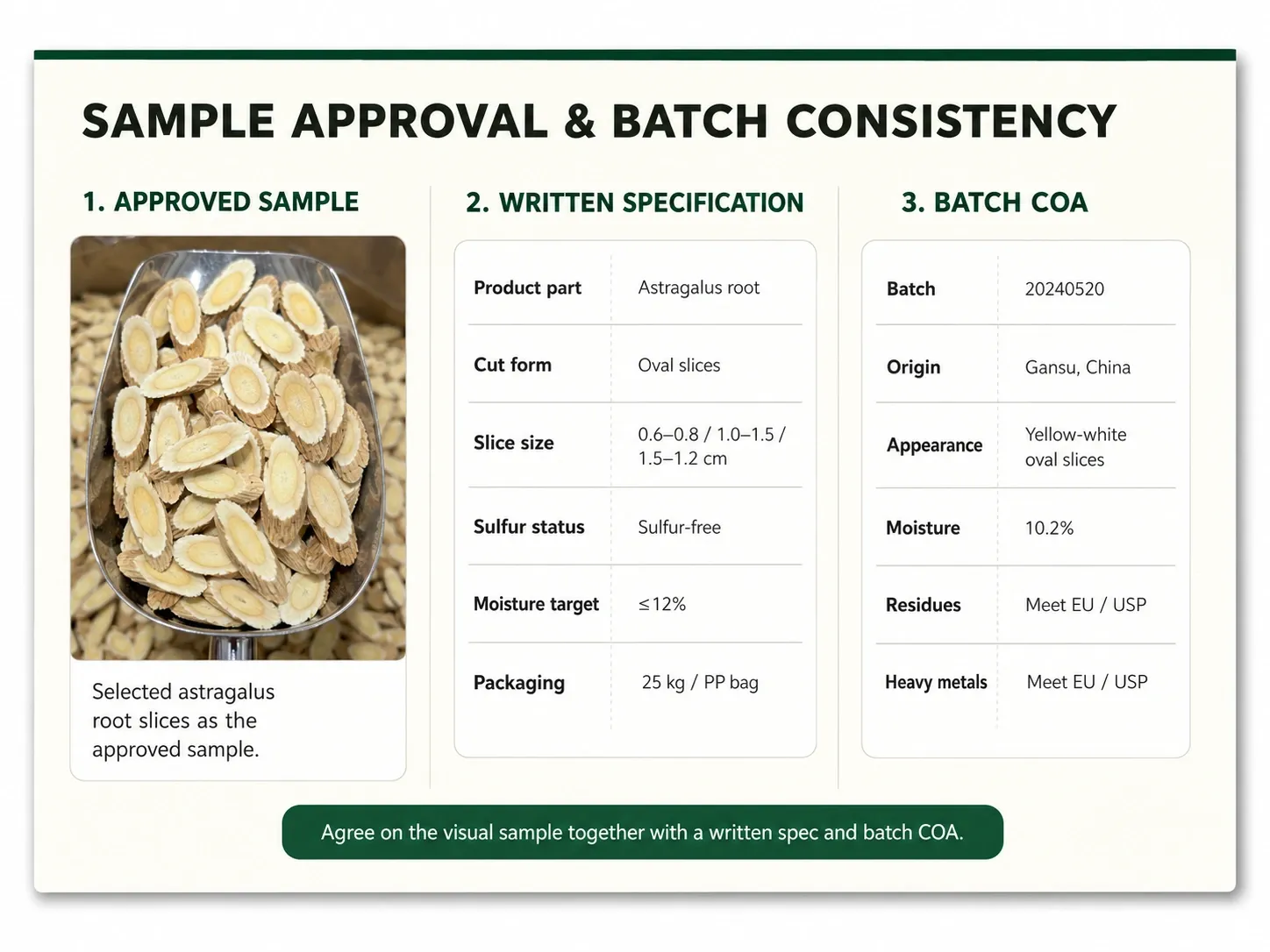
Sample approval protects the buyer only when it is linked to a written specification. The sequence that holds up is: approved sample → written specification → production batch → batch COA → shipment review, with each step referencing the one before it. The full workflow, including retention and deviation handling, is in our guide to botanical ingredient sample approval.
Photographic standards help. A simple photo reference for slice size, colour and acceptable broken content resolves most appearance disputes quickly.
Most buyers do not purchase Astragalus alone. They purchase several root materials together. Angelica Root, Codonopsis Root and Licorice Root are frequently sourced in the same shipment.
These materials share a procurement workflow. They are dried roots, cut into slices, sorted and packed. The same documentation problems appear on each of them.
Standardising your procurement documents across SKUs saves significant time:
| Element | What to Standardise |
|---|---|
| Botanical identity | One naming convention across all SKUs and all documents |
| Plant part | Stated explicitly on every PO line |
| Slice specification | One template with thickness, size, broken ratio and fines fields |
| Testing requirements | One base panel plus SKU-specific additions |
| COA format | One required field list applied to every supplier |
Note that testing panels and physical tolerances are not transferable between materials. Each root has its own specification values. Standardise the document structure, not the numbers inside it.
Buyers sourcing across this material group can review the root and rhizome herbal ingredients range.
| PO Field | Buyer Entry |
|---|---|
| Product name | Astragalus Root Slices / Huang Qi Slices |
| Botanical identity | Botanical name required by destination market, with synonym where needed |
| Plant part | Dried root |
| Material form | Dried slices. State cut type. |
| Slice size | Diameter or length range, or agreed distribution |
| Thickness | Measurable range in mm, plus measurement method |
| Broken ratio | Maximum percentage by weight, with definition |
| Dust / fines | Maximum percentage by weight |
| Moisture | Test method, limit and reporting basis from the applicable standard |
| Testing scope | Full annex: parameters, methods, limits, laboratory requirements |
| Origin | Country, plus region where relevant |
| Applicable standard | Named standard with edition year — e.g. “Ch.P. 2025”, “ISO 22988:2020”. A standard name with no year does not identify a text. |
| Botanical source vs standard scope | Confirm in writing that the delivered source species falls inside the scope of every standard named on this PO |
| Treatment declaration | Fumigation, sulphur, irradiation and other treatment status |
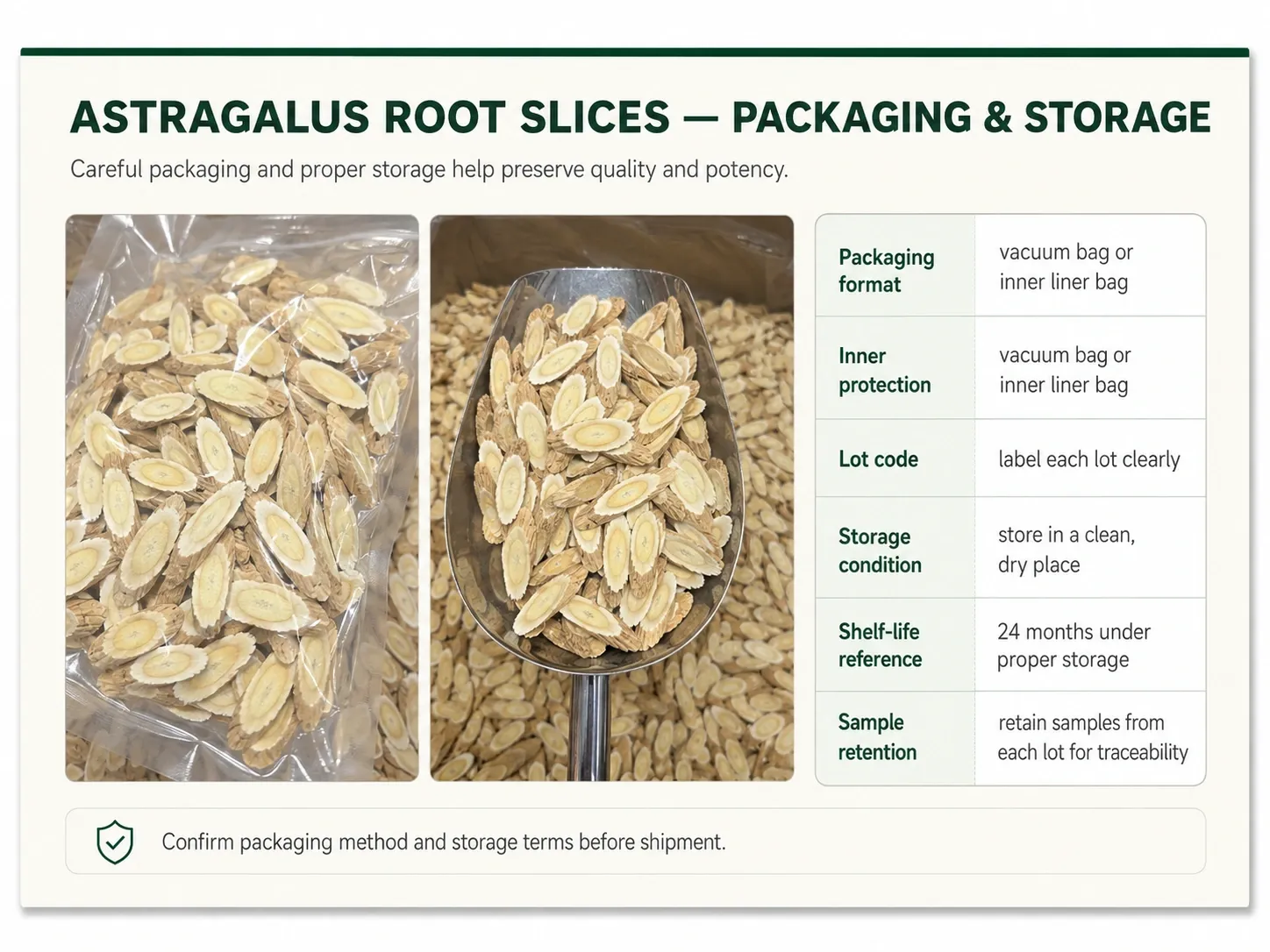
| Packaging | Food-contact liner, outer packaging, net weight, sealing, palletisation |
| Labelling | Product name, botanical name, lot number, origin, net weight, dates, storage conditions |
| COA | Required parameters and release signature |
| Batch number | Must match COA, labels and packing list |
| Sample approval | Reference to the approved sample and its retention record |
| Nonconformance | Rejection criteria, claims process and resolution timing |
What are Astragalus Root Slices? They are the dried root of an Astragalus species, cut into slices and dried for commercial use. The material is known in Chinese trade as Huang Qi and in pharmacopoeial documents as Radix Astragali or Astragali Radix.
What botanical name should appear on purchase documents? The name required by your destination-market standard. Ask the supplier to state it, and to include the relevant synonym in brackets. Keep the same wording across the PO, specification, COA and label.
Are Astragalus membranaceus and Astragalus mongholicus the same? They refer to closely related botanical material, but different standards treat the naming differently. The Chinese Pharmacopoeia and the European Pharmacopoeia use different conventions. Buyers should specify which standard applies rather than assume the names are interchangeable on documents.
Does ISO 22988 cover the same material as the Chinese Pharmacopoeia? No. ISO 22988:2020 states its scope as Astragalus mongholicus root — one botanical source. The Chinese Pharmacopoeia entry for Astragali Radix recognises two. A batch can satisfy the pharmacopoeial identity requirement and still fall outside the ISO document’s scope, so the two claims are not interchangeable on a specification.
Which edition of ISO 22988 applies? ISO 22988:2020 is the published edition. A second edition, ISO/DIS 22988, entered its DIS ballot on 13 May 2026 and is intended to replace it. Until that revision is published, a specification citing “ISO 22988” without a year does not identify which text applies — so write the year, and ask suppliers to give notice if the edition their COA references changes.
What are the Chinese Pharmacopoeia 2025 specifications for Astragalus root slices? Under Ch.P. 2025, Astragali Radix is cut into thick slices (2–4 mm) and must meet moisture ≤10.0%, total ash ≤5.0%, ochratoxin A ≤20 µg/kg, water-soluble extractives ≥17.0%, astragaloside IV ≥0.080% and calycosin-7-O-β-D-glucoside ≥0.020% on a dried basis. Heavy metals follow the general limits in Chapter 0212 (Pb 5, Cd 1, As 2, Hg 0.2, Cu 20 mg/kg).
Which tests should bulk buyers request? That depends on destination market, intended use and internal specification. Identity and moisture are standard on most contracts. Pesticides and heavy metals are common for export, food and supplement use. Microbiology, mycotoxins, sulphur dioxide and marker-compound testing are added based on risk and regulatory requirements.
A clear specification prevents most sourcing disputes. Vague purchase documents create them.
Before requesting a quotation, buyers should prepare the botanical identity, slice specification, testing requirements, packaging details and destination-market requirements.
Discuss your Astragalus Root Slices requirement with Aile Herb.
