Tell Us About Your Project
Share your product, quantity and project requirements. We will review the details and respond with the relevant next steps.

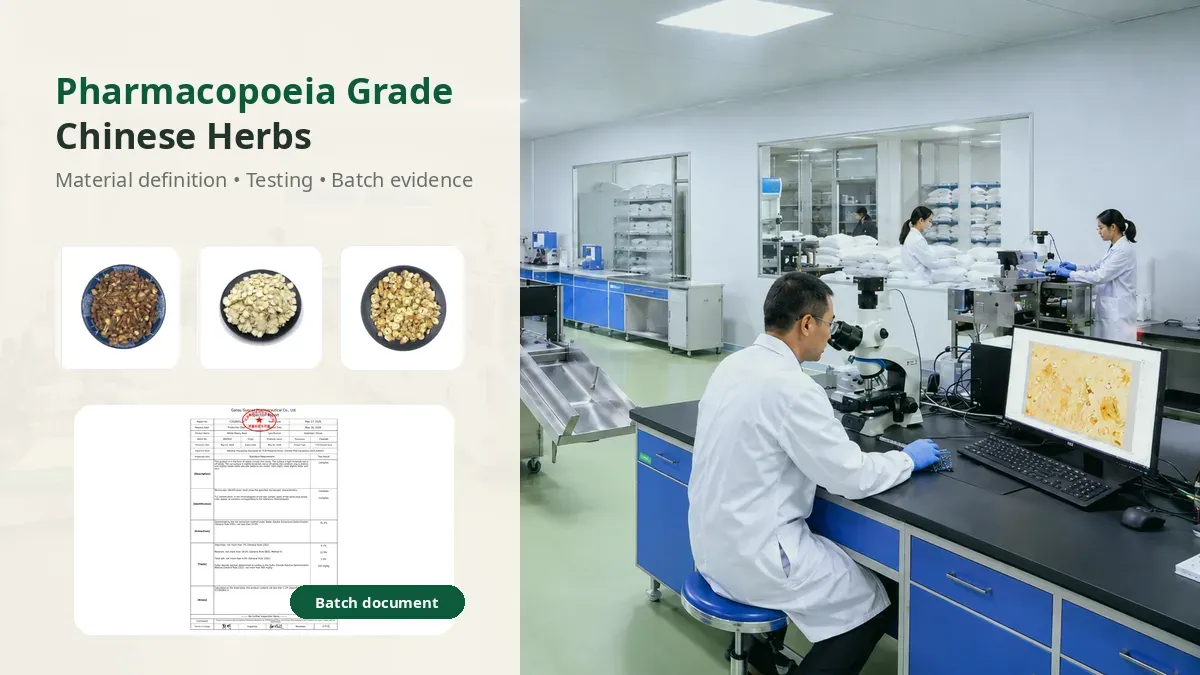
“Pharmacopoeia grade” is not a universal certification for Chinese herbs. In B2B sourcing, buyers should confirm the applicable pharmacopoeia, exact botanical material, plant part, processing status, testing scope, acceptance criteria and batch-specific evidence before accepting a pharmacopoeial compliance claim.
A statement such as “Ph. Eur. tested” is therefore not enough by itself. The important questions are what material was tested, against which requirements, using which methods, and whether the results belong to the actual shipment batch.
The term “pharmacopoeia grade” is commonly used in procurement, but it should not be treated as a stand-alone international certification.
Pharmacopoeias publish monographs, methods, specifications and acceptance criteria. Whether a Chinese herbal material conforms depends on the exact material and the applicable current requirements.
For example, buyers may need to identify:
A batch may be tested using one pharmacopoeial method without having been assessed against every requirement applicable to the material.
For this reason, a better procurement question is not:
“Is this pharmacopoeia grade?”
It is:
“Which pharmacopoeia and monograph apply, and what batch evidence shows that the supplied material meets the agreed requirements?”
Buyers qualifying a new Chinese herbal supplier should also review the supplier’s quality system, testing capability and documentation process before relying on a compliance statement.
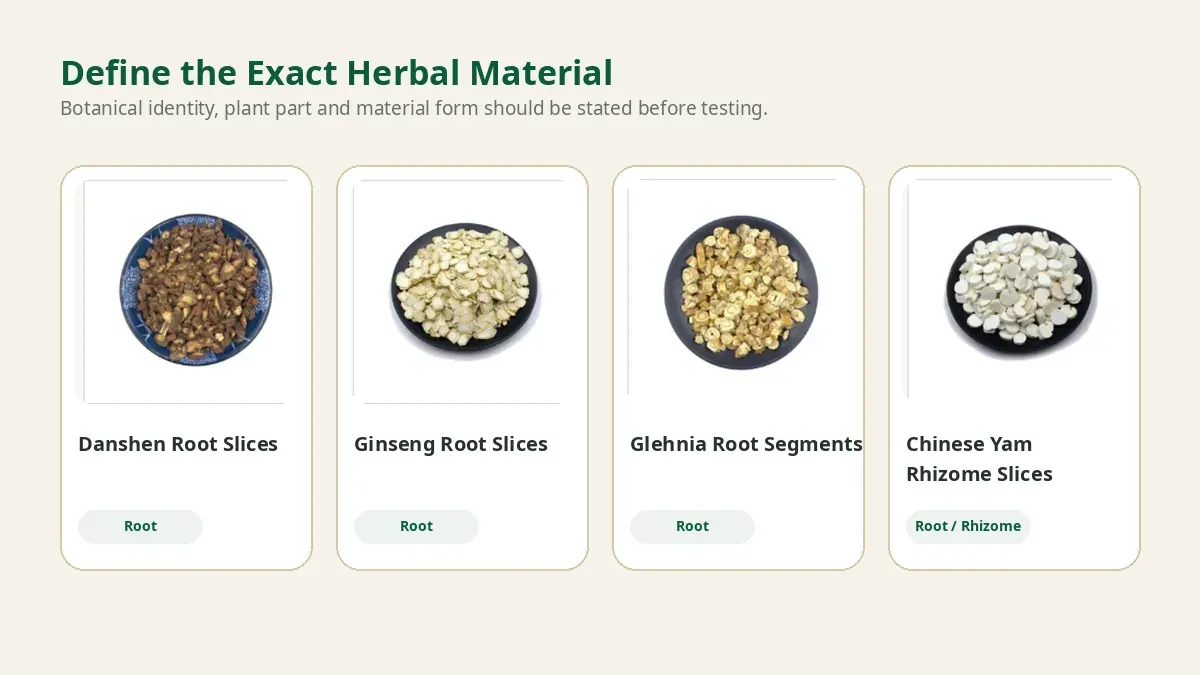
A common herb name is not a complete purchasing specification.
Before discussing pharmacopoeial compliance, define exactly what is being purchased.
Confirm:
Different pharmacopoeias may not define apparently similar herbal materials in exactly the same way.
Root, rhizome, bark, leaf, flower, fruit and seed are not interchangeable descriptions.
The specified plant part should match the material defined by the applicable monograph or buyer specification.
Also state whether the order is for:
Processing can change the appropriate specification, identification approach and testing requirements.
A buyer should therefore confirm the product definition before requesting a quotation or laboratory test. Product form and cut requirements are covered in the Chinese herbal slices specification guide.
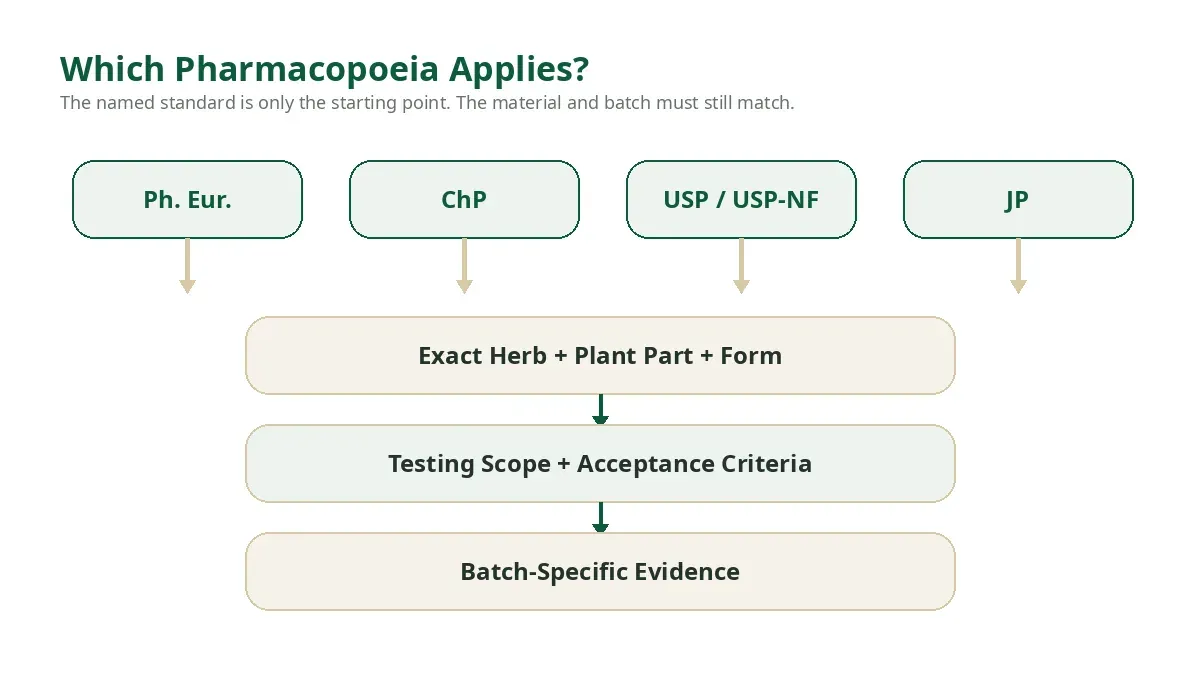
“Pharmacopoeial” is incomplete unless the applicable standard is named.
The major pharmacopoeias can differ in accepted botanical sources, plant parts, processing definitions, analytical methods, assays and acceptance criteria.
| Standard | What the buyer should confirm |
|---|---|
| European Pharmacopoeia (Ph. Eur.) | Exact applicable monograph and the text currently in force |
| Chinese Pharmacopoeia (ChP) | Current Chinese monograph, material definition and processing requirements |
| USP / USP–NF | Whether an applicable monograph or standard exists for the material and intended use |
| Japanese Pharmacopoeia (JP) | Applicable crude-drug monograph and current requirements for Japan/Kampo projects |
| Buyer specification | Additional contractual requirements based on product, market and risk |
The Chinese Pharmacopoeia 2025 edition has been in force since 1 October 2025. Under NMPA Announcement No. 32 of 2025, where a registered drug standard has fewer test items or lower limits than the pharmacopoeia, the pharmacopoeia provisions prevail; where the registered standard is stricter, both must be met. JP19 was published on 10 April 2026. Buyers should still verify the exact current monograph rather than assuming that the same herb is defined identically across different pharmacopoeias.
Most importantly:
ChP conformity does not automatically establish Ph. Eur., USP or JP conformity.
The standards need to be compared material by material.
A pharmacopoeial assessment may involve more than one type of requirement.
A specific monograph may define:
General requirements may describe broader quality expectations or analytical methods that apply when relevant.
The buyer may add requirements based on:
These layers should be reviewed together.
A supplier should not assume that performing one pharmacopoeial test means the entire material conforms to the pharmacopoeia.
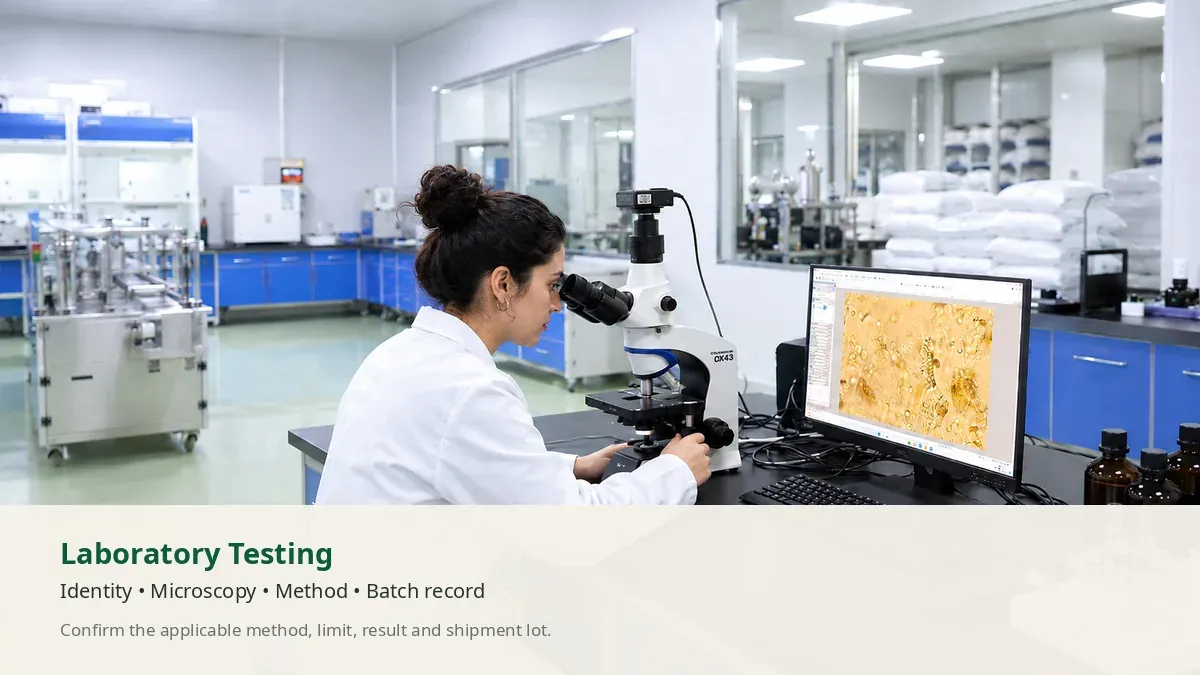
There is no single universal laboratory panel that applies to every Chinese herb.
The required scope depends on the herb, applicable monograph, intended use, market and buyer specification.
| Verification area | What the buyer should check |
|---|---|
| Botanical identity | Correct species, plant part and identification method |
| Physical condition | Appearance and foreign matter where applicable |
| Moisture | Applicable method, limit and batch result |
| Ash | Total ash or acid-insoluble ash where required |
| Pesticides | Analyte list, methods, LOQs and applicable limits |
| Elemental impurities | Which elements were tested and against which limits |
| Mycotoxins | Aflatoxins or other mycotoxins where relevant |
| Microbiology | Tests and limits appropriate to the material and intended use |
| Marker / assay | Applicable marker, method and acceptance range |
| Sulfur dioxide | Where sulfur treatment or SO₂ is a relevant requirement |
| Batch identity | Whether the analytical results belong to the shipment lot |
A statement such as “pesticide tested” provides little useful information unless the buyer knows the pesticide panel, analytical method, reporting limits and acceptance criteria.
Destination-market requirements may also differ from pharmacopoeial requirements.
Pesticide & Heavy Metals Testing
The commercial phrase “heavy metals” can also be too broad.
Buyers should identify which elements are included, the method used, applicable limits and actual results.
Aflatoxin and microbiological testing may be important for some materials and uses, but they should not be presented as universally mandatory for every herb.
The correct question is:
Which tests and limits apply to this particular material and intended use?
This distinction is especially important for European buyers.
European Pharmacopoeia requirements concern pharmaceutical quality standards for materials within their scope. They should not be confused with every other requirement that may apply to a product entering or being marketed in Europe.
Depending on the project, separate requirements may arise from:
EMA also distinguishes EU herbal monographs, which address medicinal use and safety information, from European Pharmacopoeia monographs, which address quality requirements.
Therefore:
“Tested according to Ph. Eur.” does not automatically mean “EU compliant.”
The intended use and regulatory classification of the finished product still need to be evaluated separately.
For pharmaceutical sourcing projects, buyers can review Aile Herb’s supply and documentation workflow for pharmaceutical companies.
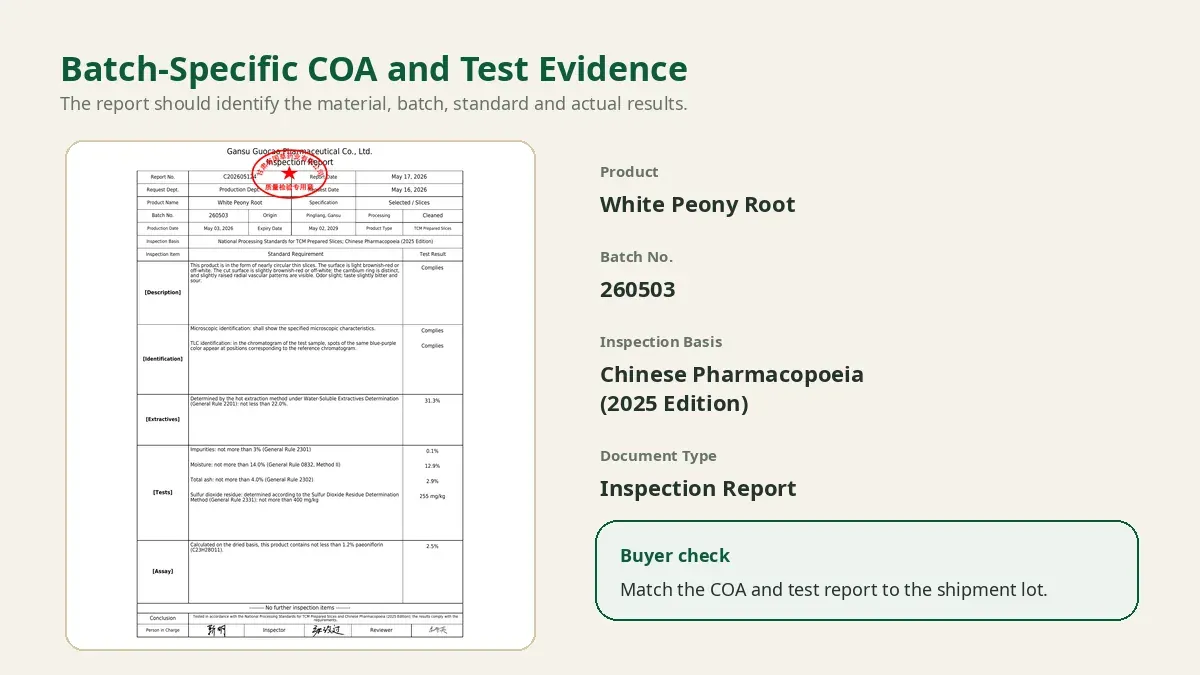
A Certificate of Analysis is an important document, but buyers should review what it actually proves.
A useful batch COA should normally identify information such as:
A generic or historical sample COA can show the document format. It does not prove that the shipment batch meets the same results.
Where detailed analytical evidence matters, buyers may also request underlying laboratory reports. Field-by-field review is covered in the Chinese herb COA guide.
A test report should allow the buyer to understand what was actually analysed.
For critical parameters, check:
A result marked simply as “Pass” can be difficult to evaluate if the test method and acceptance criterion are not stated.
The report should also be matched to the actual shipment batch. For a field-level walkthrough of pesticide and heavy metal reports, see how to read Chinese herb test reports.
Laboratory capability is another part of supplier qualification.
Buyers may want to confirm:
A laboratory certificate or accreditation logo should not be treated as proof that every possible test is within scope.
For critical tests, confirm the applicable method, material matrix and reporting scope. Aile Herb’s own testing scope is described on the in-house laboratory page.
For quality-sensitive or pharmacopoeial projects, buyers should define the documentation package before production.
A practical request may include:
The exact package should be confirmed per product and order.
Do not assume that every supplier document is included automatically with a standard quotation.
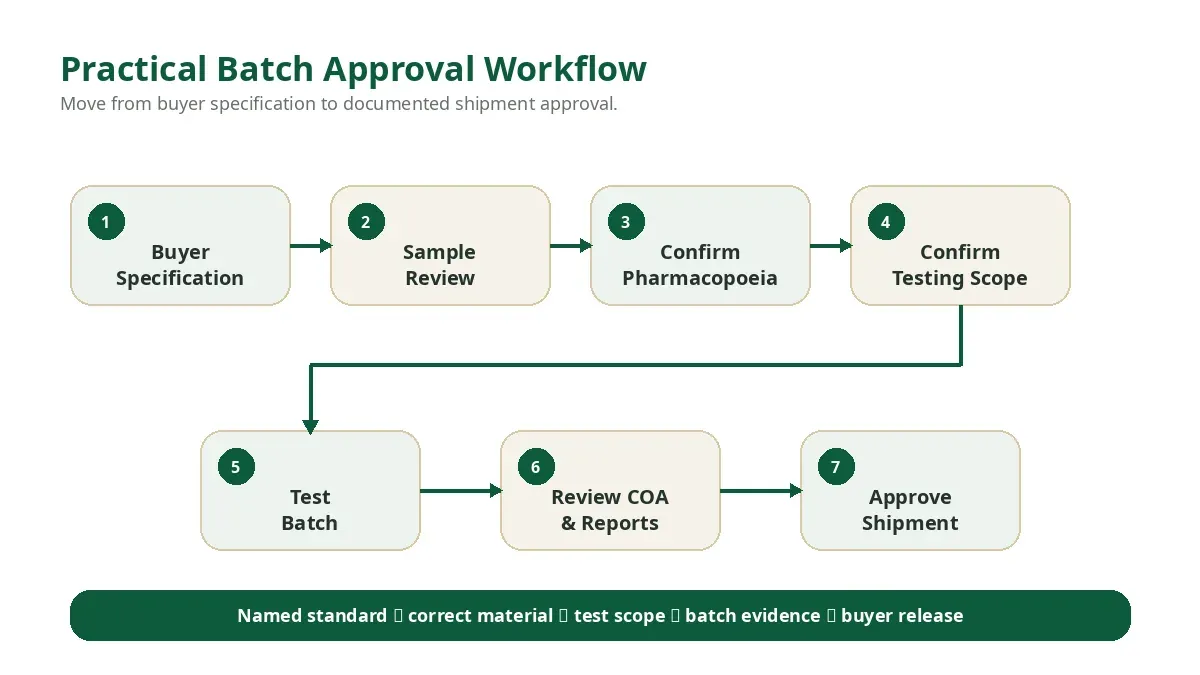
A controlled sourcing project can follow this sequence:
1. Define the buyer specification
Confirm botanical identity, plant part, processing status, destination market and intended use.
2. Confirm the applicable pharmacopoeia
Identify the exact standard and applicable current monograph.
3. Review a representative sample
Evaluate appearance, cut, physical condition and preliminary documentation.
4. Confirm the testing scope
Map pharmacopoeial requirements together with buyer and destination-market requirements.
5. Produce or select the commercial batch
The batch intended for shipment should be clearly identified.
6. Test the batch
Arrange the agreed analytical scope.
7. Review the COA and supporting reports
Check methods, limits, results and batch numbers.
8. Approve the shipment
Release the shipment after the agreed quality and documentation review is complete.
In short:
Buyer specification → sample review → applicable pharmacopoeia → testing scope → batch testing → document review → shipment approval
This process is stronger than relying on a supplier’s generic “pharmacopoeia grade” statement.
Before ordering pharmacopoeia grade Chinese herbs, confirm:
If any of these points remain unclear, resolve them before the batch is produced or released.
Aile Herb works with international B2B buyers to review herbal-material specifications, processing requirements, testing scope, packaging and batch documentation.
Pharmacopoeial requirements are reviewed by product and project. We do not treat “pharmacopoeia grade” as a blanket claim across the entire herbal catalogue.
For a new enquiry, provide:
The applicable material, testing and documentation scope can then be reviewed before quotation.
Not as a universal category for Chinese herbs. Buyers should identify the applicable pharmacopoeia, monograph, material definition, test requirements and batch evidence rather than rely on the grade label alone.
What should “Chinese Pharmacopoeia grade” mean on a 2025 purchase order? It should mean the batch complies with the Ch.P. 2025 monograph for that exact herb, in force since 1 October 2025, backed by a batch-specific COA that names the edition and shows actual results against the monograph limits. Where a supplier’s registered standard is less strict than the pharmacopoeia, NMPA rules say the pharmacopoeia prevails.
Not automatically. The COA must relate to the correct batch and should be reviewed against the applicable material definition, monograph, tests, methods and acceptance criteria.
No automatic equivalence should be assumed. Accepted species, plant part, processing definition, test methods and limits can differ. Buyers should compare the relevant monographs directly.
No. Applicability must be checked for the specific herb and material form using the current European Pharmacopoeia.
No. Pharmacopoeial quality requirements are only one part of product qualification. Food, supplement, medicinal-product, national and other destination-market requirements may apply separately.
Not necessarily in the same scope. Testing should be determined from the applicable monograph, product risk, intended use, destination market and buyer specification.
Testing scope can be reviewed against the confirmed product, specification and order requirements. The required parameters, methods, limits, laboratory and reporting scope should be agreed before testing is arranged.
Send your herb list, applicable pharmacopoeia, destination market and required testing scope.
For herbs supplied against a pharmacopoeial monograph with the matching test scope and batch documents, see our page for pharmaceutical and Kampo manufacturers and send your herb list and applicable pharmacopoeia.
