Tell Us About Your Project
Share your product, quantity and project requirements. We will review the details and respond with the relevant next steps.

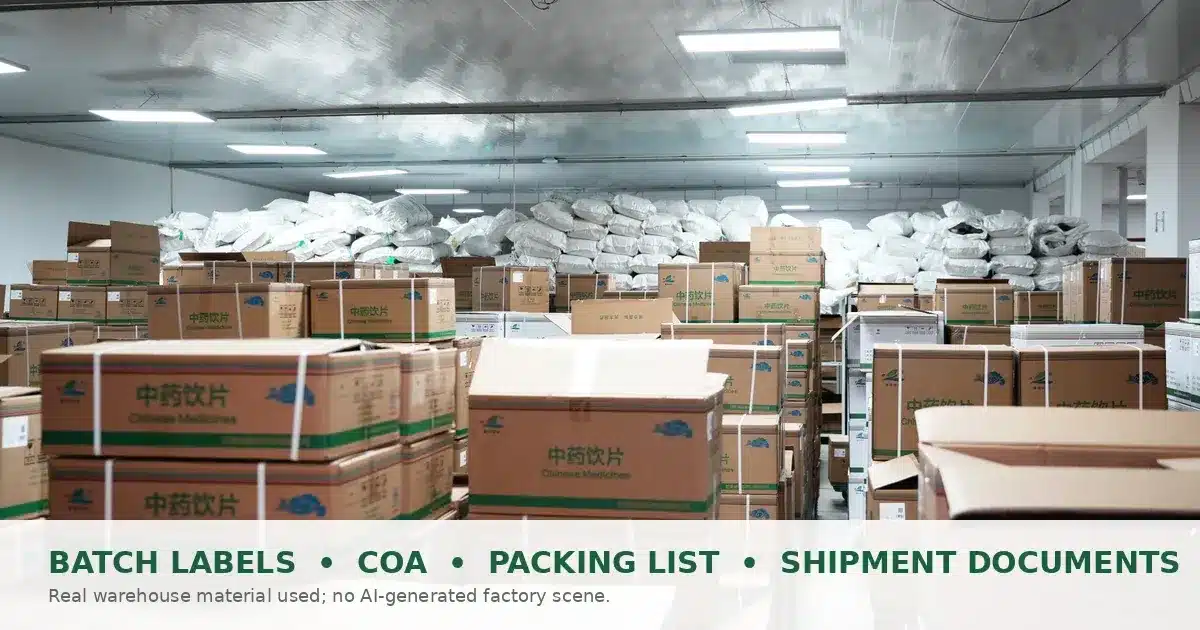
Herbal ingredient batch traceability means the physical goods a buyer receives can be linked to the released finished batch, and that batch can be linked to its COA, packing labels and shipment documents. Batch numbers may change during processing or packing. What matters is a documented relationship between product identity, batch identifiers and quantities.
Four different types of information should be reviewed separately:
| Field / Evidence | What It Supports | What It Does Not Prove |
|---|---|---|
| Product name / botanical name / plant part | Core product identity | That the material belongs to a specific batch or shipment |
| Finished-batch number | Released production batch | Farm-level origin or complete raw-material genealogy |
| COA batch number | Batch scope of the COA | Relevance to the shipment unless matched to labels and packing list |
| Province or region | Geographic origin at the stated level | Farm, plot or organic chain of custody |
| Packing label | Physical-pack batch identity | Full production history |
| Packing list | Product, batch and shipment quantity declared by supplier | Botanical identity or analytical compliance |
| Container / seal number | Logistics and transport reference | Product or batch identity |
Use the approved specification to confirm product identity, the batch code and COA to confirm batch linkage, and shipment documents to reconcile quantities and dispatch information.
For the broader purchasing process, see the Bulk Chinese Herbs Sourcing Checklist.
A finished shipment may contain several linked identifiers across receiving, processing, packing and dispatch.
Raw Material Lot → Receiving & Identity Verification → Processing → Finished Product Batch → Finished-Batch QC / Release → COA → Pack Label → Packing List → Shipment
| Stage | Identifier Used | What Must Remain Linked | Normally Visible to Buyer | Normally Internal |
|---|---|---|---|---|
| Raw material receipt | Incoming raw-material lot | Source material used in the resulting batch | Origin declaration where agreed | Receiving record |
| Processing | Process / batch record | Input lots to finished batch | Processing declaration where required | Full processing record |
| Finished product | Finished-batch number | Product form, specification and quantity | Finished-batch number | Batch release review |
| Finished-batch QC | Batch / sample ID | COA to the released batch | Finished-batch COA | Raw test data and deviations |
| Packing | Pack / label reference | Each pack to finished batch | Physical label and packing list | Label issuance record |
| Shipment | Shipment / container reference | Quantity dispatched by batch | Packing list, invoice, shipment documents | Warehouse dispatch record |
Routine buyer evidence normally includes the finished-batch number, finished-batch COA, physical label, packing list and any agreed origin or processing declaration.
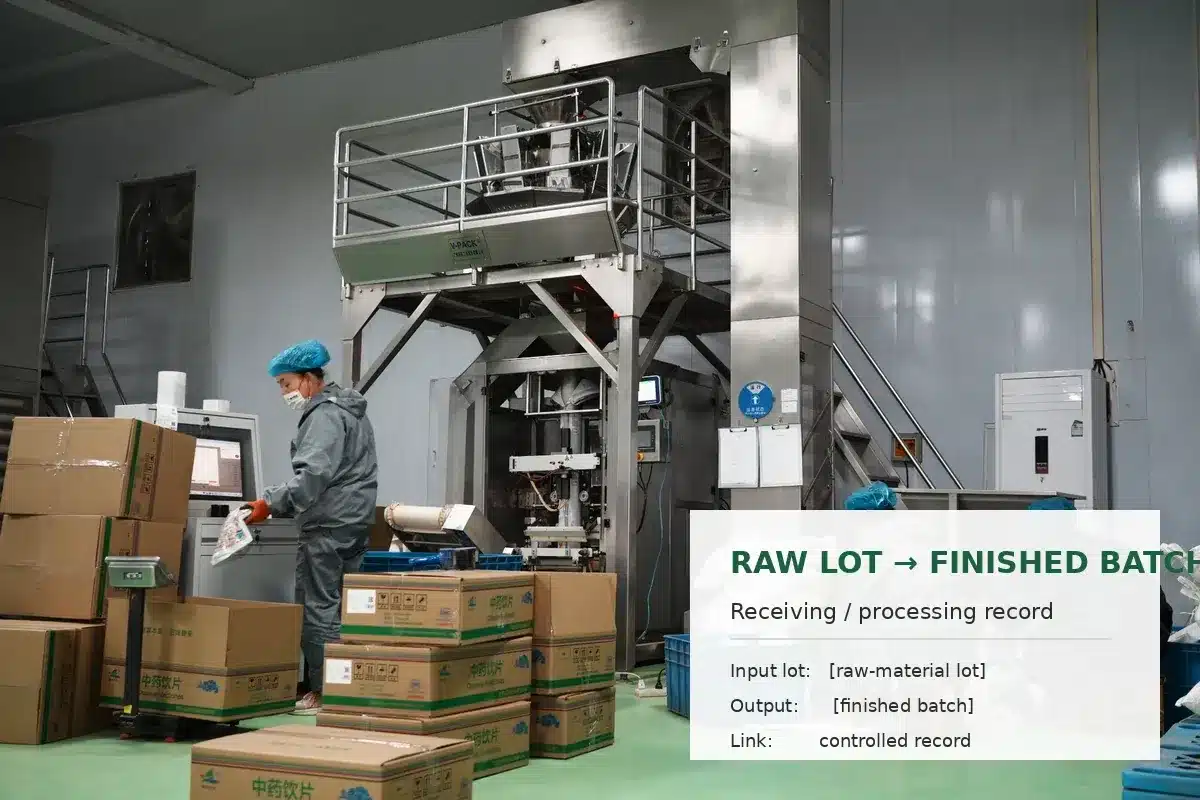
Incoming raw-material records, full production records, warehouse movements and internal deviations normally remain within the supplier’s quality system unless deeper review is justified.
A changed identifier does not automatically mean traceability has been lost.
| Scenario | What May Change | What Must Remain Linked | Buyer Verification Point |
|---|---|---|---|
| One raw lot → one finished batch | Finished-batch code, processing date | Raw lot, finished batch, COA and labels | COA and label identify the finished batch |
| One raw lot → several finished batches | Resulting batch codes and quantities | Parent lot and each resulting batch | Packing list separates batches and quantities |
| Several raw lots → one finished batch | Finished-batch code | Input lots and final batch | Finished-batch COA; input-lot records may be reviewed during audit |
| One finished batch → several packing units | Bag, carton or pallet references | Finished batch and packed quantities | Labels identify the correct batch |
| Repacking into smaller units | Packing reference, carton mark or SKU | Original finished batch and applicable COA | New label retains the original batch or controlled cross-reference |
| Additional processing / reprocessing | Process record and possibly finished-batch code | Original input batch and new release status | Confirm whether documentation covers the final processed state |
| Split shipment from one finished batch | Shipment, container and seal references | Finished batch and dispatched quantity | Each packing list identifies batch and quantity |
| Multiple finished batches in one shipment | Packing-list lines and COA references | Each batch and its quantity | Each batch has separate documentation |
Different lot relationships are acceptable when the supplier can document the input, output and quantity linkage.
Repacking may create a new packing reference, but it does not automatically create a new manufacturing batch or restart shelf life.
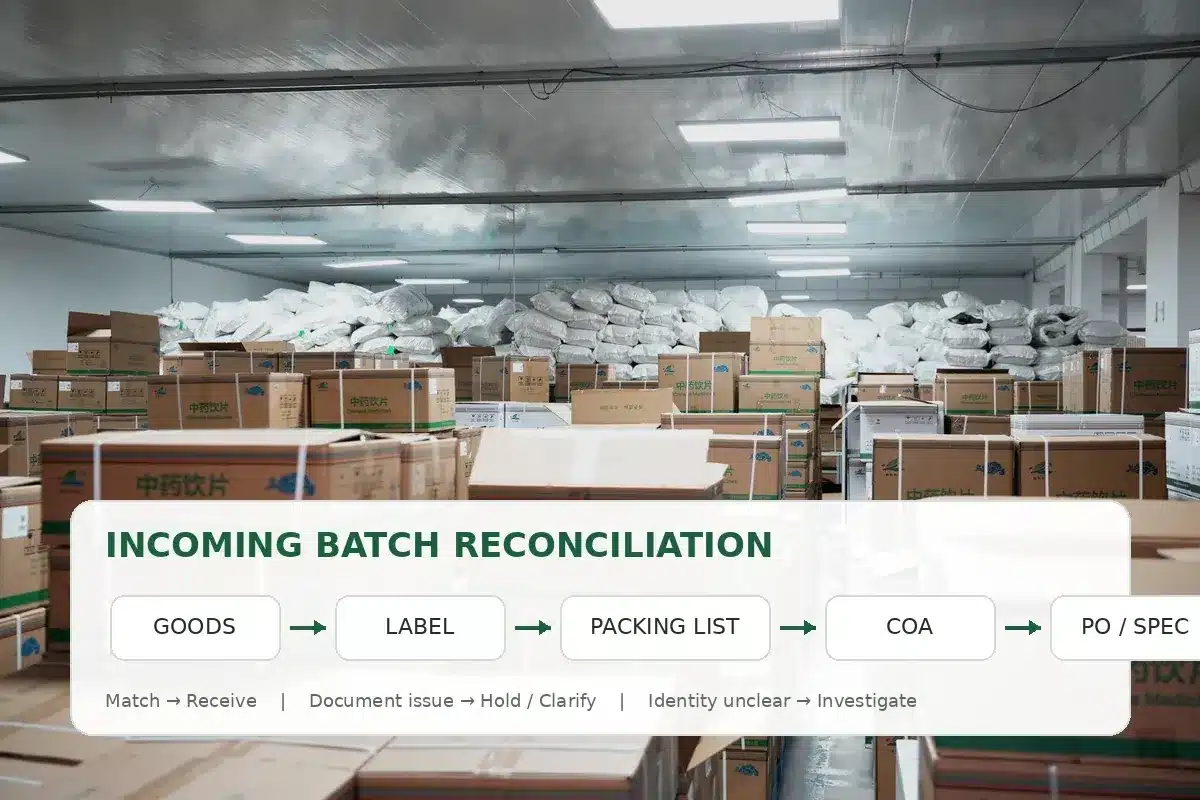
Before shipment approval, reconcile:
Physical Goods → Bag / Carton Label → Packing List → COA → PO / Approved Specification
| COA / Document Field | What It Should Match | Buyer Check | Possible Meaning of a Mismatch |
|---|---|---|---|
| Product name | PO, specification and label | Names refer to the same commercial item | Naming variation, translation issue or wrong document |
| Botanical name | Approved specification | Accepted botanical source or synonym | Wrong material or naming issue |
| Plant part | Specification | Root, rhizome, leaf, fruit, seed or other part agrees | Different material scope |
| Finished form / cut | Physical goods and specification | Whole, sliced, segmented, powdered or other form aligns | Wrong SKU or processing stage |
| Processing status | Purchase specification | Raw / cleaned / processed status agrees | Different commercial product |
| Batch / lot number | Label and packing-list line | Exact match or documented cross-reference | Repacking, changed batch or wrong COA |
| Production / release date | Batch history | Dates follow a logical sequence | Date-field definition or document issue |
| COA issue date | Release workflow | COA date is consistent with batch release | Delayed issuance or obsolete document |
| COA / report number | Shipment reference where used | Correct report maps to correct batch | Ambiguous document mapping |
| Quantity by batch | Packing list | Quantity is separated correctly by batch | Shipment split or incomplete reconciliation |
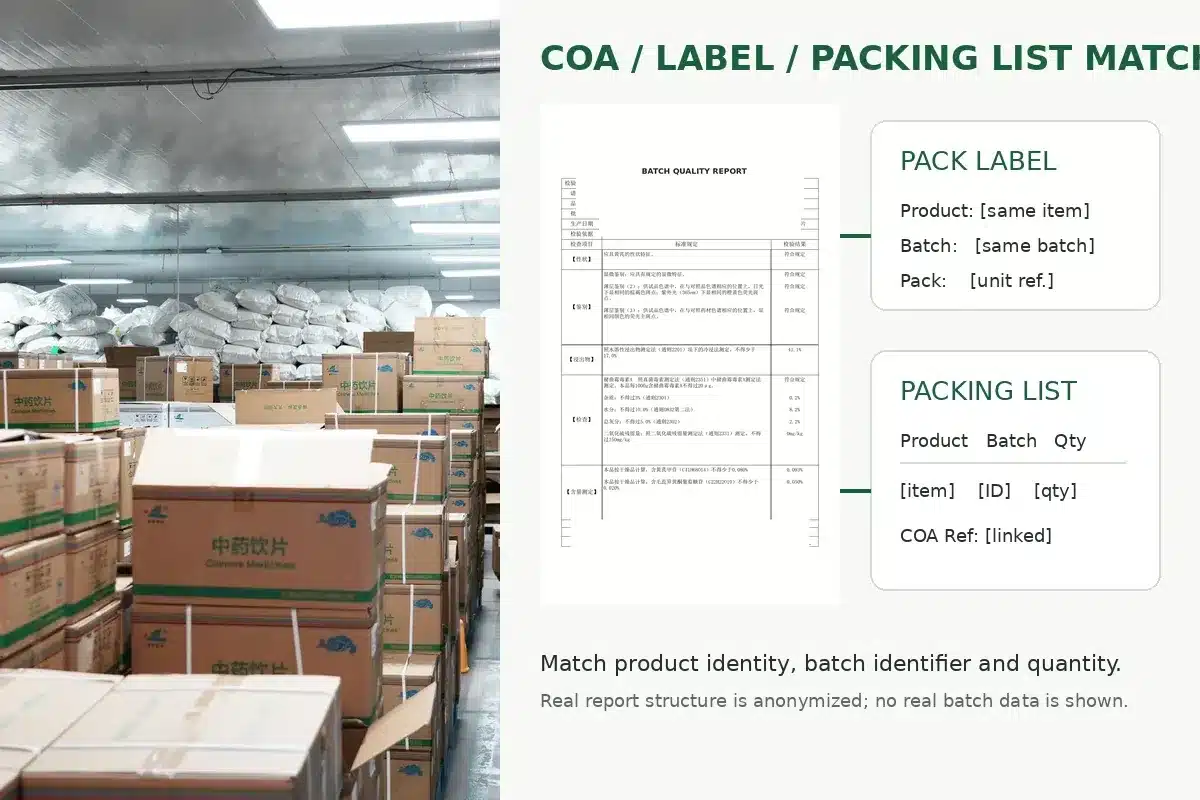
A genuine COA can still be irrelevant to the shipment if it belongs to another batch.
Use the approved specification and COA to verify product and batch status; use the packing list and physical labels to confirm which batch and quantity were actually shipped.
For detailed COA interpretation, see the Certificate of Analysis Chinese Herbs Guide and How to Read Chinese Herb Test Reports.
Different reports support different types of evidence.
| Document Type | What It Can Support | Does It Prove the Shipped Batch? | Buyer Verification Point |
|---|---|---|---|
| Finished-batch internal COA | Supplier release results for the named finished batch | Yes, when batch identity matches shipment documents | Confirm batch and product form |
| Batch-specific third-party report | Independent result for a named sampled batch | Yes, when the sample or lot maps to the supplied batch | Check report ID, sample ID, product and batch |
| Raw-material test report | Incoming material condition | Not automatically | Confirm how the raw lot links to the finished batch |
| Periodic pesticide / heavy-metal report | Supplier monitoring or qualification | No, unless it identifies the shipment batch | Confirm sampling period, material scope and purpose |
| Supplier qualification test | Supplier or material-source assessment | No | Treat as supplier-approval evidence |
| External report without batch ID | General analytical evidence | No | Request batch linkage or clarify scope |
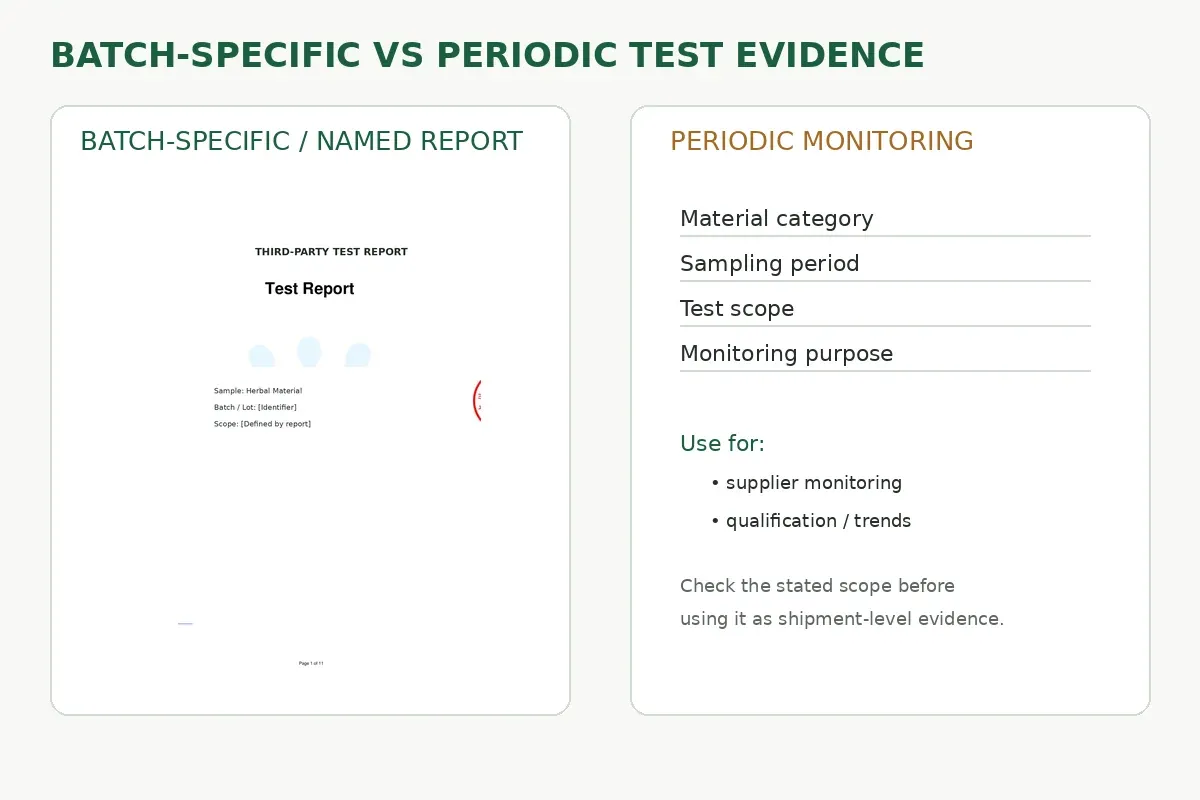
Use batch-specific reports for shipment-level evidence and periodic reports for supplier monitoring or qualification according to their stated scope.
A periodic report can still be useful. It simply answers a different question from a batch-specific release report.
Origin evidence and batch evidence should also be reviewed separately.
| Claim | Evidence It May Require | What It Does Not Prove |
|---|---|---|
| Origin: Gansu | Supplier declaration or regional sourcing record | Farm or plot-level source |
| City / production region | More detailed sourcing documentation | That all material came from one farm |
| Farm identified | Farm record and lot linkage | Organic certification |
| Organic chain of custody | Valid certification and transaction records | Botanical identity or batch release |
| Batch traceable | Controlled relationship between lot, batch, label, COA and shipment | Quality, safety or regulatory compliance by itself |
Match the evidence to the level of the origin claim.
A regional statement supports a regional claim. Farm, organic or chain-of-custody claims require separate supporting evidence.
For Aile Herb’s regional sourcing approach, see Sourcing Origin.
For a routine bulk order, buyers normally do not need every internal factory record.
Request the minimum sufficient evidence needed to verify product identity, batch identity and contractual requirements.
Deeper records may be appropriate for:
One shipment may contain more than one finished batch of the same product.
The important requirement is clear batch-by-batch reconciliation.
Illustrative example — not actual Aile Herb batch data:
| Product | Finished Batch | Quantity | COA Reference | Packing Units |
|---|---|---|---|---|
| Astragalus root slices | AH-240501-A | 600 kg | COA-240501-A | 24 × 25 kg bags |
| Astragalus root slices | AH-240518-B | 400 kg | COA-240518-B | 16 × 25 kg bags |
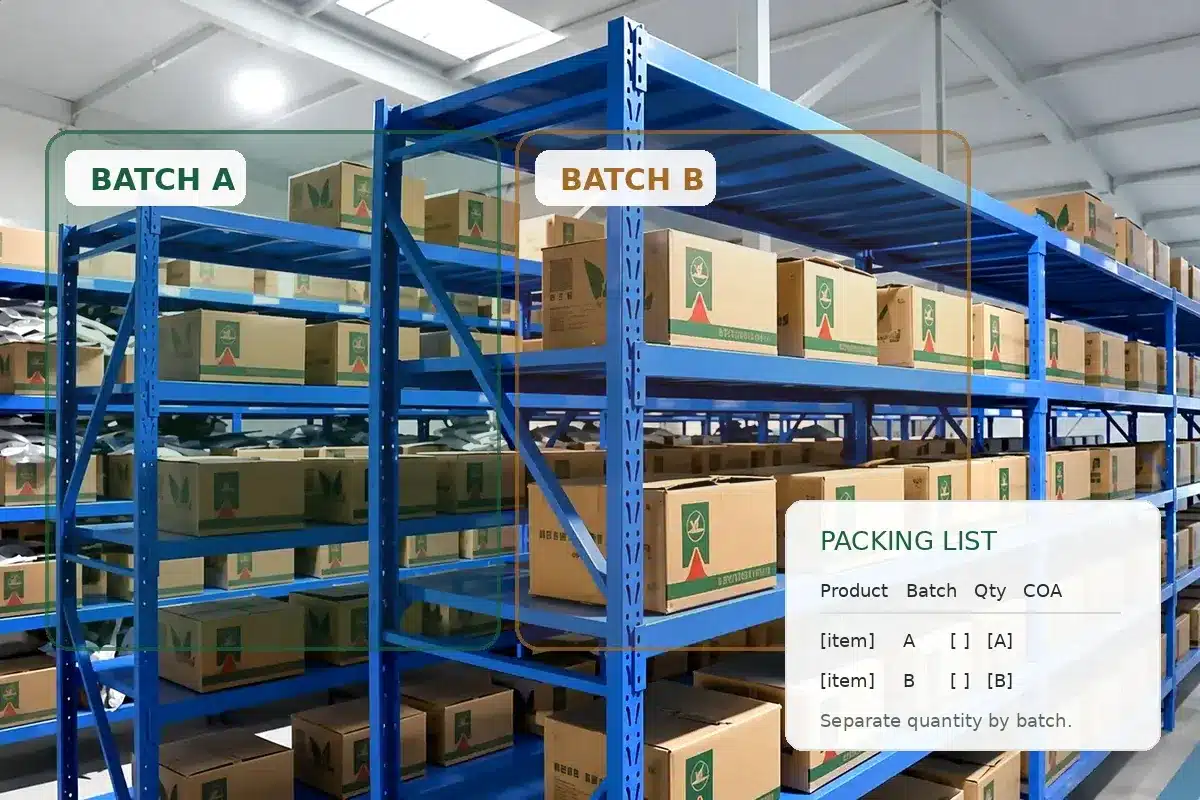
For multi-batch shipments, the packing list should separate:
This allows the buyer to receive and control each batch separately.Sample and Retained-Sample Traceability
| Sample Type | Required Linkage |
|---|---|
| Sales / pre-order sample | May show the product type but not necessarily represent the future commercial batch |
| Approved reference sample | Should have a sample ID or source reference |
| Pre-shipment sample | Should link to the actual finished batch where claimed |
| Retained sample | Should link to the finished batch and retention record |
Sample ID → Batch / Lot → Approval / Review Record
For the full sample workflow, see the Botanical Ingredient Sample Approval Guide.
Before shipment, confirm:
For broader dispatch checks, see Pre-Shipment Inspection for Chinese Herbs.
At receipt, reconcile the same records in reverse:
Goods → Label → Packing List → COA → PO / Specification
→ Receive or release according to the buyer’s QA procedure.
→ Hold document approval and obtain a controlled clarification or corrected document.
→ Receive batch by batch and maintain separate COA and inventory references.
→ Hold or quarantine the affected material until the batch relationship is clarified.
→ Investigate and do not use that COA as release evidence until the discrepancy is resolved.
→ Handle according to the buyer’s QA procedure and agreed contract.
For moisture, package damage, shelf life and physical arrival-condition inspection, see Chinese Herbal Ingredients Storage and Shelf Life.
| Red Flag | Why It Matters | Buyer Follow-Up |
|---|---|---|
| Generic COA with no batch number | Shipment scope cannot be established | Request batch-specific evidence or a controlled cross-reference |
| Label batch differs from COA | COA may not apply to the goods | Hold and request clarification |
| Same COA used for unrelated batches | Report scope may be unclear | Ask whether it is batch-specific or periodic |
| Packing list does not identify batches | Quantity cannot be reconciled | Request revised packing list |
| Several batches shipped but only one documented | Other batches lack clear release evidence | Request batch-by-batch documentation |
| Product form differs between goods and COA | Different SKU or processing stage may be involved | Clarify before release |
| Origin differs among documents | Claim scope may be inconsistent | Confirm what each origin field refers to |
| Periodic report supplied without scope explanation | May be mistaken for batch-specific evidence | Confirm sampling scope and purpose |
| Repacking removes original batch reference | Trace-back may be interrupted | Request repacking record or cross-reference |
| Handwritten batch change with no explanation | Document control is unclear | Request controlled correction |
A mismatch requires clarification and, where necessary, investigation. It does not by itself establish fraud.
| Field | Record |
|---|---|
| Product | [insert] |
| Botanical name | [insert] |
| Plant part | [insert] |
| Raw material supplier | [insert] |
| Origin | [insert] |
| Raw material lot | [insert] |
| Incoming date | [YYYY-MM-DD] |
| Processing batch | [insert] |
| Finished batch | [insert] |
| Production date | [YYYY-MM-DD] |
| Packing date | [YYYY-MM-DD] |
| Specification revision | [insert] |
| COA number | [insert] |
| Third-party report number | [if applicable] |
| Sample ID | [if applicable] |
| Retained sample ID | [if applicable] |
| Package label batch | [insert] |
| Packing list reference | [insert] |
| PO | [insert] |
| Shipment reference | [insert] |
| Quantity | [insert] |
| Buyer receiving status | [accept / hold / investigate] |
Not every buyer needs to populate every field. Use the fields relevant to the product, order and traceability requirement.
No. Processing may assign a new finished-batch number to material received under a different raw-material lot. The important requirement is that supplier records preserve the relationship between the input lot and the resulting finished batch.
Only when the COA’s product and batch identifiers can be matched to the physical labels and packing-list records for the shipment. A valid COA may still relate to another batch if that linkage is missing.
Yes. The packing list should separate quantities and packing units by batch, and each batch should have the appropriate COA or release reference. Multi-batch shipments are acceptable when each batch remains clearly identified.
Not as batch-specific evidence unless it identifies the supplied batch or has a documented relationship to it. Periodic testing can support supplier qualification and ongoing monitoring, but its scope should be clear to the buyer.
No. A province-level statement supports a regional origin claim. Farm-level, plot-level, organic or certified chain-of-custody claims require additional documentation appropriate to those claims.
Not automatically. Repacking may create a new packing reference or commercial SKU, but the original finished-batch relationship should remain documented. Shelf-life treatment should follow the product specification and agreed contractual or market requirements.
For a proposed order, provide:
Aile Herb can prepare the applicable batch COA, packing-list mapping and pre-shipment label information for review before dispatch.
To have batch COA, packing labels and shipment documents matched and reviewed before dispatch, see our pre-shipment inspection service and send your batch documentation requirements.
