Tell Us About Your Project
Share your product, quantity and project requirements. We will review the details and respond with the relevant next steps.

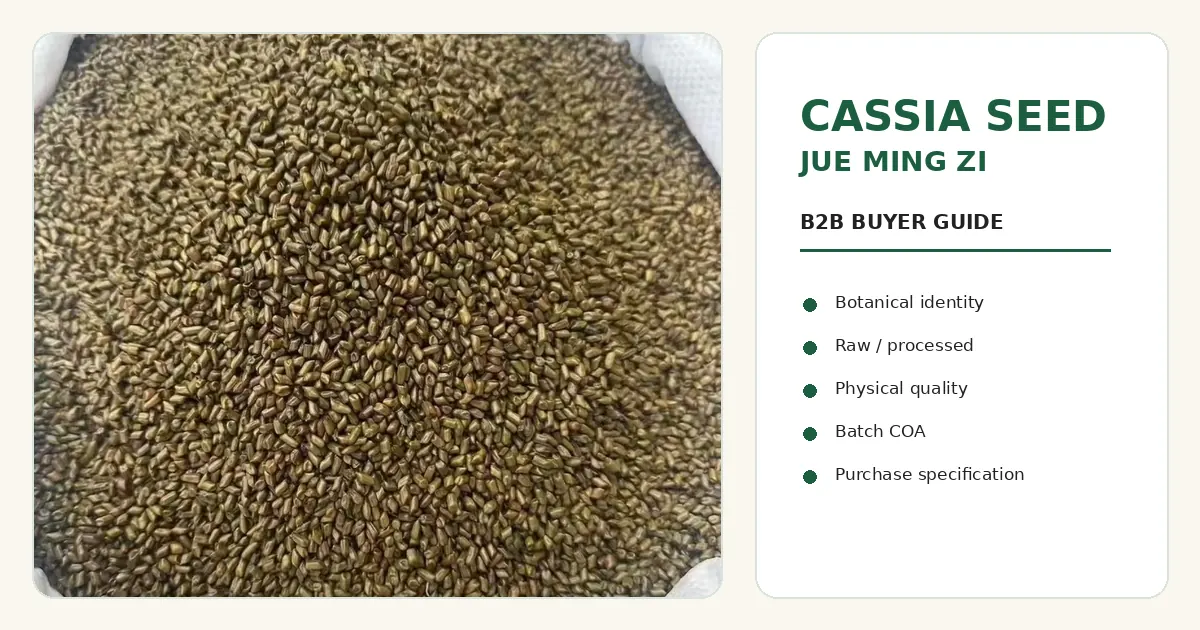
Bulk Cassia Seed purchasing requires a clear specification, not only a product name. Before requesting a quotation, buyers should confirm botanical identity, plant part, processing status, physical form, testing scope, approved sample and batch documentation.
These checkpoints give both buyer and supplier a clear basis for quotation, inspection and batch approval.
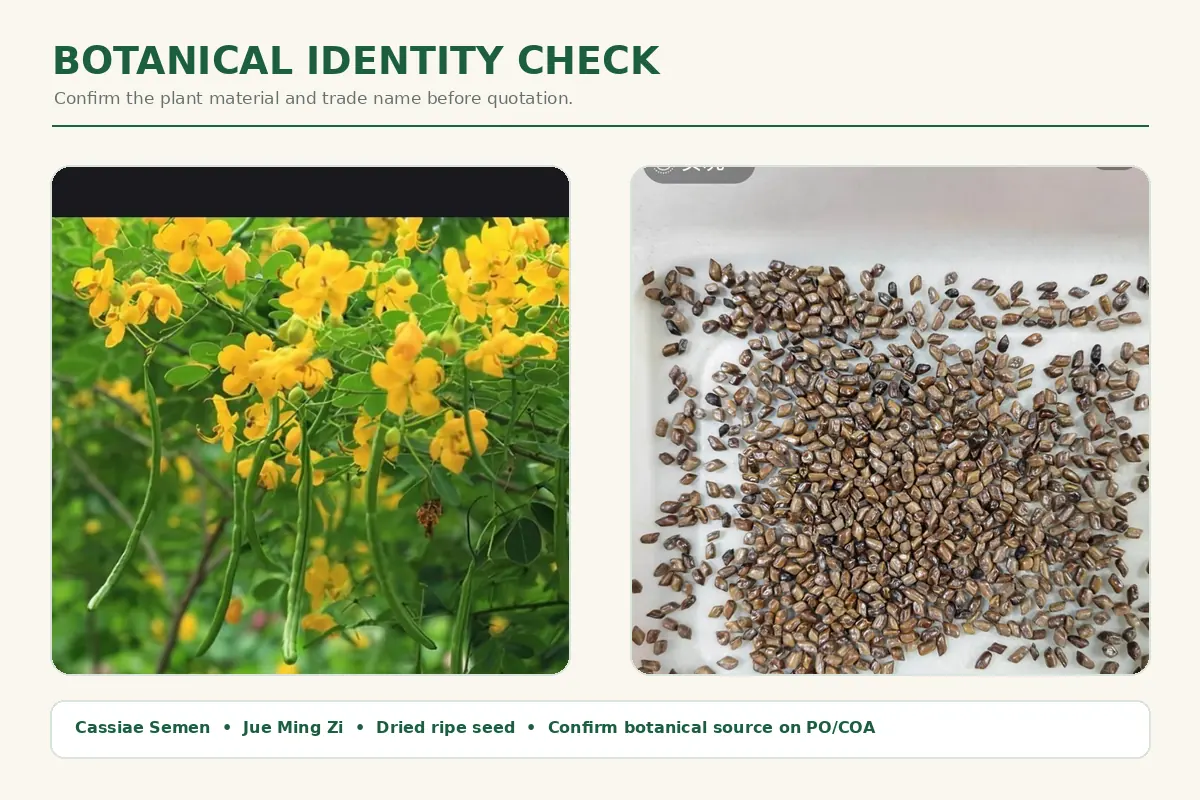
“Cassia Seed” is a trade name. It is not a complete botanical specification.
Pharmacopoeial and Chinese herbal trade references identify Cassiae Semen as the dried ripe seed of Cassia obtusifolia L. or Cassia tora L.
Modern botanical databases may use the names Senna obtusifolia and Senna tora. Older pharmacopoeial and commercial documents may continue to use the Cassia names.
For procurement, the key point is simple: do not rely on the common name alone.
| Term | Procurement Meaning | Buyer Action |
|---|---|---|
| Cassiae Semen | Pharmacopoeial name for the dried ripe seed | Confirm the applicable standard |
| Jue Ming Zi | Common Chinese trade name | Use with the botanical name, not instead of it |
| Cassia obtusifolia | Traditional botanical source name | Confirm how it appears on supplier documents |
| Cassia tora | Traditional botanical source name | Confirm how it appears on supplier documents |
| Senna obtusifolia | Current botanical name used in some databases | May appear on newer documents |
| Senna tora | Current botanical name used in some databases | May appear on newer documents |
| Cassia occidentalis | Different material | Exclude if it is not part of the agreed specification |
The term “Senna” also needs care. In some markets, senna refers to leaf or pod materials rather than seed.
Species naming matters beyond documentation consistency, because at least one destination-market rule is not written on the species name at all. Regulation (EU) 2021/468, which amended Annex III of Regulation (EC) No 1925/2006, added the following entries to Part A — the prohibited list: “aloe-emodin and all preparations in which this substance is present”, “emodin and all preparations in which this substance is present”, and “danthron and all preparations in which this substance is present”. The prohibition in Part A is written on the substance, not on the plant. Cassia obtusifolia, Cassia tora, Senna obtusifolia and Senna tora are not named anywhere in that regulation, and that absence does not by itself place a preparation outside the Part A entries. For EU-bound food supplement use, the question is answered by testing the preparation, not by reading the species name against the list. Buyers shipping into the EU should agree the analytical scope on this point in writing before the order, rather than relying on the botanical name alone.
A purchase order should therefore state:
Buyers comparing bulk Cassia Seed / Jue Ming Zi should confirm these fields before requesting a quotation.
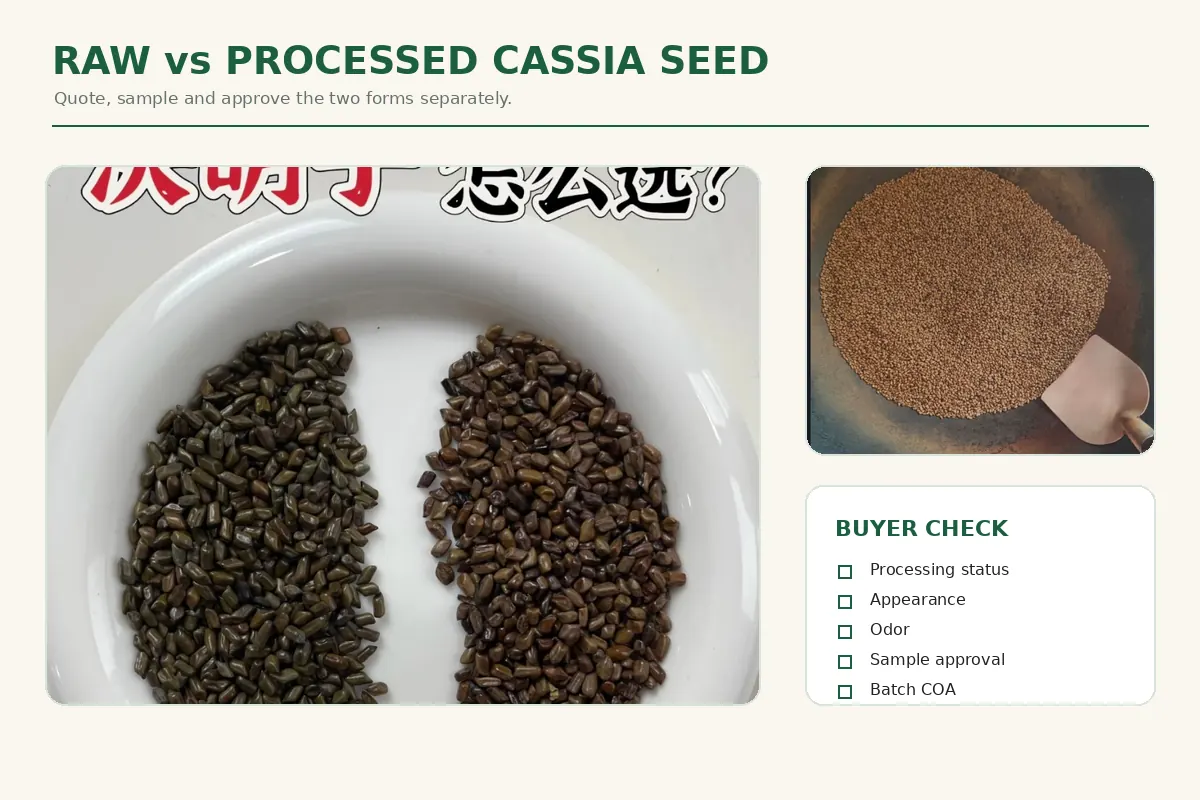
Cassia Seed may be supplied in different processing states.
The two common forms are:
These should be treated as separate procurement items.
Processing may change the material’s:
| Item | Raw Cassia Seed | Processed Cassia Seed |
|---|---|---|
| Processing status | Raw dried seed | Stir-fried or otherwise processed |
| Appearance | Natural seed appearance | Changed according to processing method |
| Odor | Characteristic raw odor | May change after processing |
| Physical condition | Natural hardness | May become more brittle |
| Specification | Written for raw material | Written separately for processed material |
| Sample approval | Raw reference sample | Processed reference sample |
| COA | Linked to raw batch | Linked to processed batch |
A quotation for raw material should not automatically apply to processed material.
The same rule applies to sample approval and batch documentation.
“Cassia Seed, Grade A” is not a useful purchase specification.
It does not tell the supplier what to supply. It also gives the buyer no clear basis for inspection.
A practical Cassia Seed specification should cover:
Terms such as “Premium,” “Grade A” or “Export Grade” should only be used when the supplier explains what they mean in measurable terms.
Buyers reviewing Cassia Seed raw material should define these requirements before confirming price and order details.
Commercial grade labels for Cassia Seed are supplier- or market-defined rather than one universal system. For how to convert grade language into measurable, enforceable purchase-order criteria, see our Chinese Herbal Slice Grades guide.
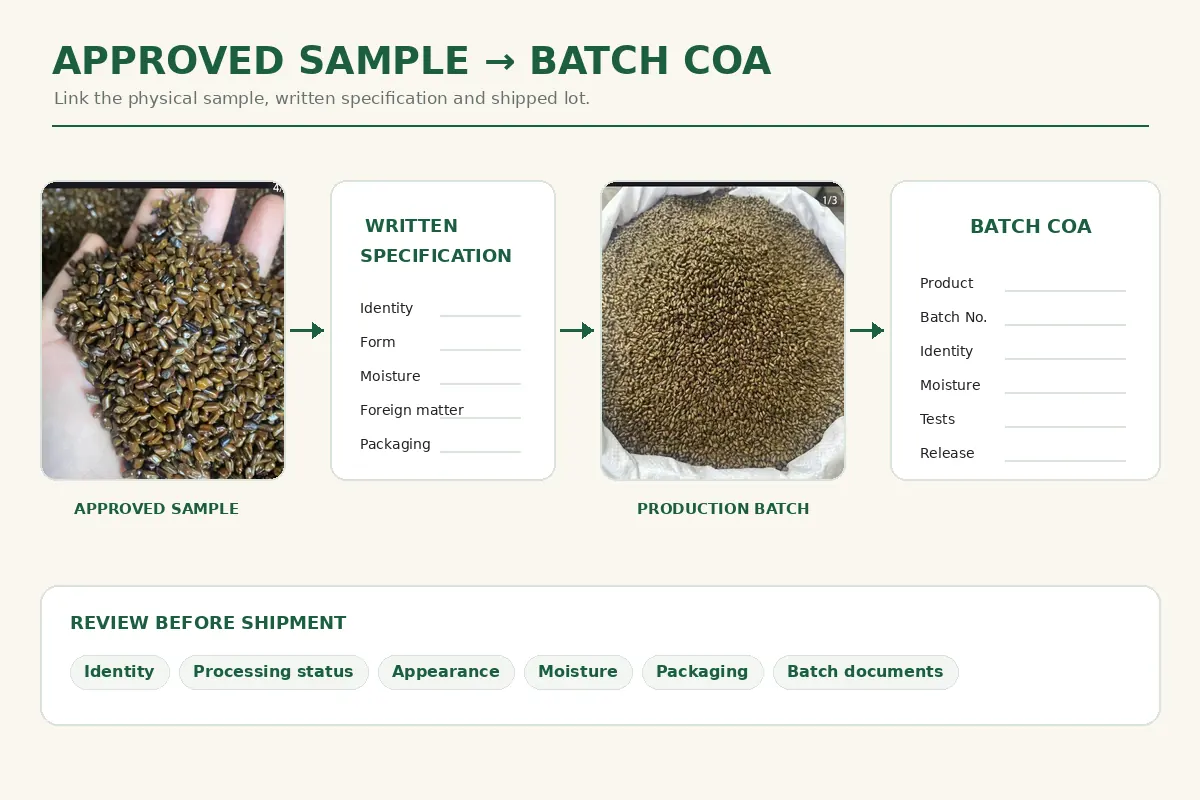
For general COA structure and how to read a batch document, see How to Read Chinese Herb Test Reports and the Certificate of Analysis guide. Where EU-bound use is intended, agree the analytical scope for hydroxyanthracene derivatives separately, as set out above.
Visual inspection and laboratory testing serve different purposes.
| Check | Visual / Physical Review | Laboratory Verification |
|---|---|---|
| Botanical identity | Can flag obvious mismatch | Microscopy or chromatographic methods may confirm identity |
| Seed shape | Directly observable | Usually not required unless identity is uncertain |
| Surface markings | Directly observable | Microscopy may support identification |
| Color | Directly observable | Instrumental testing only if specified |
| Broken seeds | Can be sorted or estimated | Gravimetric or sieve-based measurement |
| Seed size | Can be screened visually | Dimensions or sieve analysis |
| Foreign matter | Often directly visible | Quantitative determination if required |
| Moisture | Dampness may be suspected | Moisture analysis |
| Pesticides | Cannot confirm visually | Analytical testing |
| Heavy metals | Cannot confirm visually | Analytical testing |
| Microbiology | Visible mold is only a warning sign | Microbiological testing |
| Mycotoxins | Cannot confirm visually | Mycotoxin analysis |
| Marker compounds | Cannot confirm visually | HPLC or applicable method |
The buyer should use visual inspection for screening and batch comparison.
Analytical requirements should be verified by the appropriate test method.
Approve the sample together with a written specification, and treat the approved sample — not a verbal agreement — as the reference for every later batch. For the full workflow, see Botanical Ingredient Sample Approval.
Document structure can be shared across SKUs, but test limits and physical tolerances cannot. See Chinese Herbal Slices Specification for how to set these per SKU.
The following checklist can be used before requesting a quotation.
| Field | Requirement to Confirm |
|---|---|
| Product name | Cassia Seed / Jue Ming Zi |
| Pharmacopoeial name | State if applicable |
| Botanical name | Confirm accepted source and naming convention |
| Plant part | Dried ripe seed |
| Excluded species | Define where necessary |
| Origin | Country and region if required |
| Applicable standard | Pharmacopoeia, buyer specification or other agreed standard |
| Raw / processed status | State separately |
| Processing method | Define if processed |
| Product form | Whole, cleaned, broken or milled |
| Size requirement | Define if relevant |
| Appearance | Buyer-defined or applicable standard |
| Seed maturity | Buyer-defined |
| Broken-seed content | Buyer-defined |
| Foreign matter | Applicable standard or buyer-defined |
| Moisture | Applicable standard or buyer-defined |
| Visible insects | Define acceptance criteria |
| Mold | Define acceptance criteria |
| Odor | Define normal and unacceptable condition |
| Sulfur status | Define where applicable |
| Pesticides | Destination-market or buyer requirement |
| Heavy metals | Destination-market or buyer requirement |
| Microbiology | Intended-use or market requirement |
| Mycotoxins | Where required |
| Pharmacopoeial assay | Where applicable |
| Packaging | Inner and outer packaging |
| Net weight | Define by buyer |
| Batch number | Required for traceability |
| Batch COA | Must match supplied lot |
| Approved sample | Identify reference sample |
| Remaining shelf life | Define where required |
| Shipment documents | Define by destination market |
Not necessarily.
“Senna” may refer to different species or plant parts depending on the market. Cassia Seed / Jue Ming Zi should be identified by botanical source and plant part rather than by the word “senna” alone.
The PO should state the agreed botanical source and the applicable pharmacopoeial name where relevant.
Supplier documents may use older Cassia names or current Senna names. Confirm the naming convention before approving the specification.
Yes.
Processing changes the physical material. Raw and processed Cassia Seed should therefore have separate quotations, samples, specifications and batch documents.
No universal commercial Grade A or Premium grade should be assumed.
Ask the supplier to define grade terms through measurable specifications.
No.
Visual inspection can identify physical defects. Pesticide residues and heavy metals require analytical testing when they are part of the specification.
A useful batch COA should identify the product, botanical name, plant part, processing status, batch number, test method, specification and result.
It should also clearly correspond to the lot being shipped.
Before requesting a quotation, confirm the botanical source, raw or processed form, purchase specification, testing scope, packaging, order quantity and destination market.
A clear specification gives both parties the same basis for quotation and inspection.
To source cassia seed (Jue Ming Zi) raw or processed, review our fruit and seed herbs range and send the form, specification and destination market for a sample and quotation.
