Tell Us About Your Project
Share your product, quantity and project requirements. We will review the details and respond with the relevant next steps.

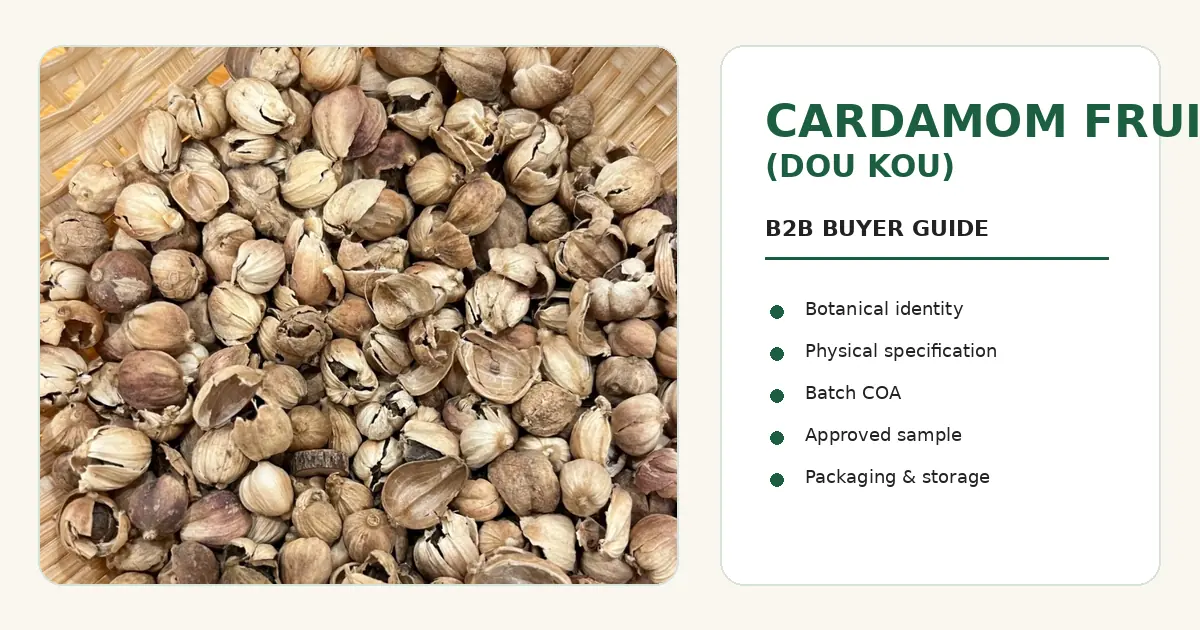
Dou Kou — also sold as round cardamom, white cardamom or Chinese cardamom — is the dried fruit of Amomum kravanh or Amomum compactum. It is not the green cardamom (Elettaria cardamomum) traded as a culinary spice. Bulk buyers should confirm the botanical identity of Cardamom Fruit before requesting a quotation. The purchase specification should also define product form, origin, moisture, foreign matter, testing scope, packaging and batch documents.
An approved sample and a batch-linked COA give buyers a clearer basis for reviewing the commercial shipment.
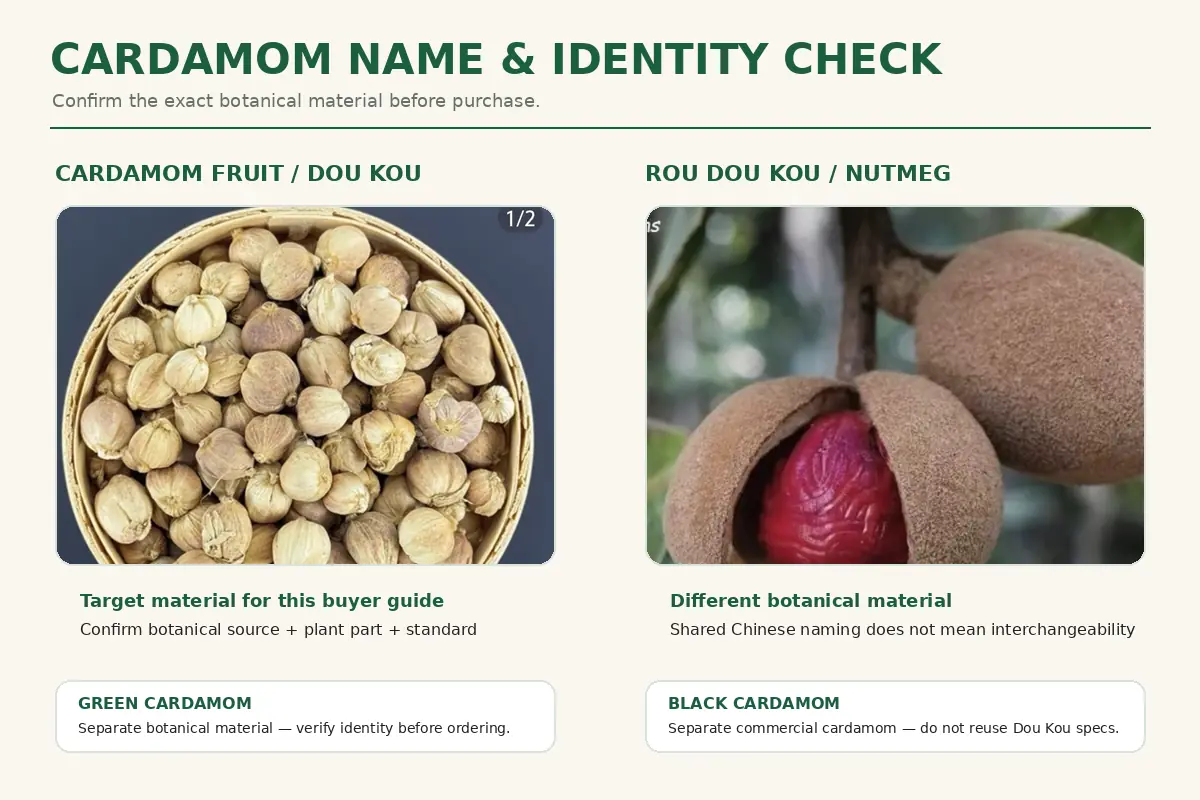
“Cardamom” is not one fixed commercial identity.
Several different botanical materials are sold under similar English or Chinese names. A purchase order that only says “cardamom” or “Dou Kou” can therefore create an identity mismatch.
The material covered in this guide is Cardamom Fruit, commonly called Dou Kou. It is associated with the pharmacopoeial name Amomi Fructus Rotundus.
Reported botanical sources include:
However, buyers should not assume that every market or specification accepts both sources. Confirm the botanical source before placing the order.
| Material | Botanical / Commercial Identity | Buyer Note |
|---|---|---|
| Cardamom Fruit / Dou Kou | Amomum kravanh or Amomum compactum; dried ripe fruit | Confirm the required botanical source |
| Green Cardamom | Elettaria cardamomum; dried fruit | Different genus; green cardamom grading should not be applied to Dou Kou |
| Black Cardamom / Cao Guo | Amomum tsao-ko; dried fruit | Different species |
| Cao Dou Kou | Alpinia katsumadai; dried seed mass | Different genus and plant form |
| Rou Dou Kou / Nutmeg | Myristica fragrans; dried seed kernel | Unrelated botanical family |
There is a second naming issue, separate from the material mix-ups above, and it sits inside the accepted source list itself. Pharmacopoeial and trade documents commonly write one of the source species as Amomum compactum. Under current botanical taxonomy that name is a synonym, not the accepted name: Kew’s Plants of the World Online records the accepted name as Wurfbainia compacta (Sol. ex Maton) Škorničk. & A.D.Poulsen, published in Taxon 67: 29 (2018), and lists Amomum compactum Sol. ex Maton among its homotypic synonyms. The same material can therefore appear under two different genus names depending on which reference the document was written against — a pharmacopoeial specification and a phytosanitary certificate may not match on the genus, without either being wrong. For procurement this means the botanical name alone is not a reconciliation key across document types. State the source name used in your specification, and confirm in writing that the supplier’s COA, phytosanitary certificate and customs description refer to the same material, whichever genus name each of them carries.
Our cardamom fruit (Dou Kou) product page lists the commercial grades and packing available for bulk order.
A useful purchase order should state:
Buyers can also review the available Cardamom Fruit (Dou Kou) format before confirming the final specification.
A request such as “Cardamom Fruit, Grade A, best quality” is not enough for a reliable quotation.
Terms such as Grade A, Premium and Export Grade are often supplier-defined. They do not replace measurable purchase criteria.
A practical specification should cover:
The aim is simple: both buyer and supplier should know what will be inspected before the order is confirmed.
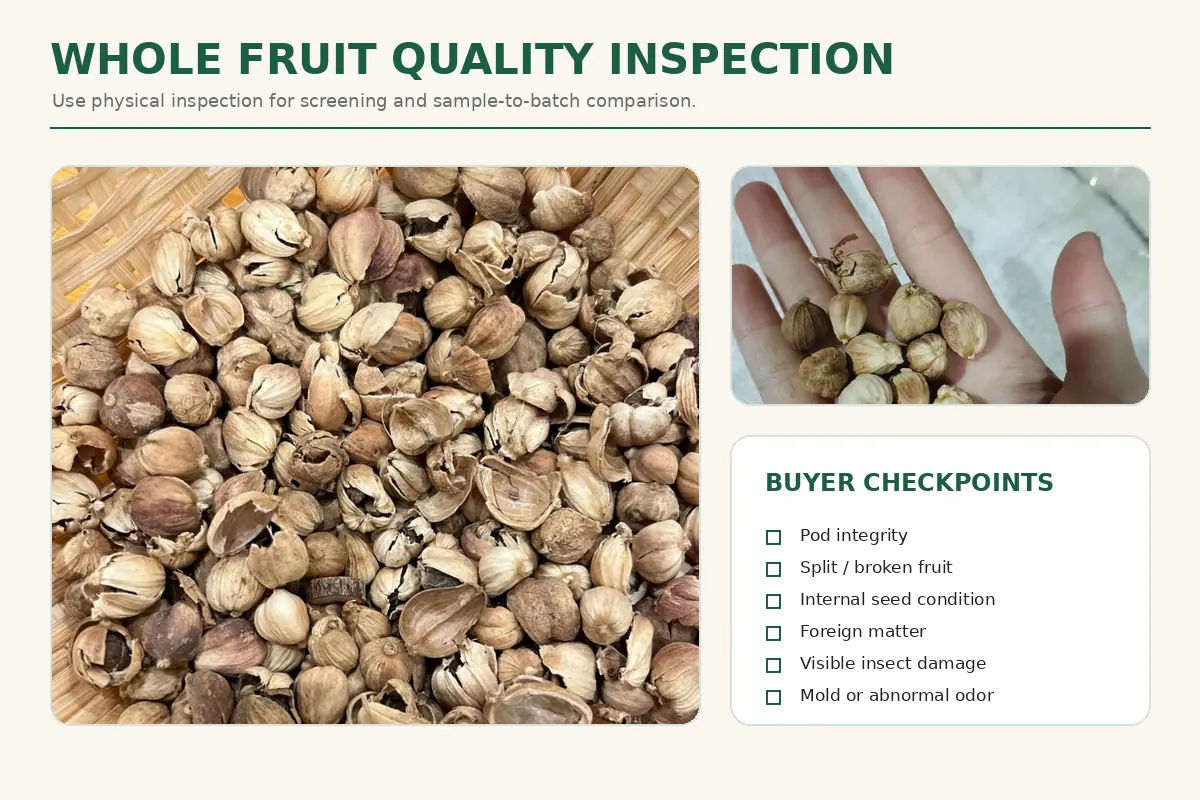
Visual review confirms commercial consistency; it does not confirm botanical identity or contaminant status. For what to check when a bulk shipment arrives, see Herbal Ingredient Receiving Inspection.
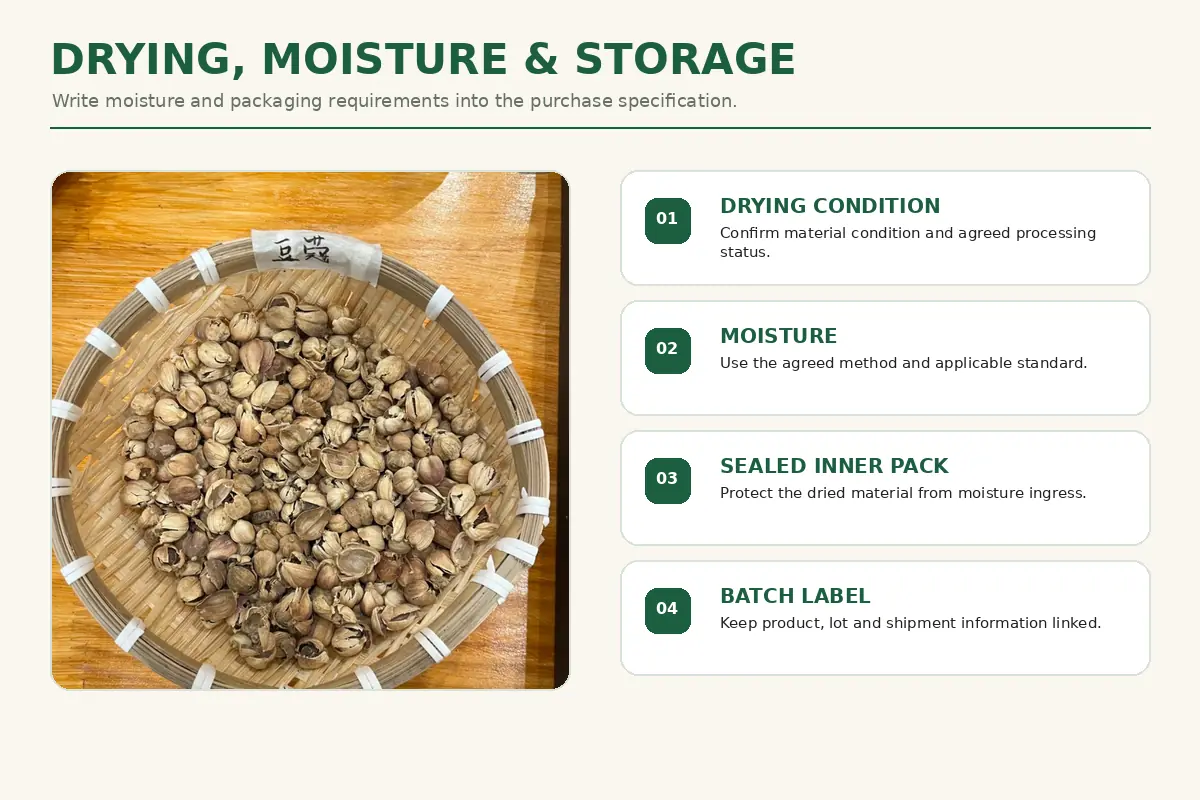
The Chinese Pharmacopoeia sets separate limits for the two commercial types of Dou Kou — Yuan Dou Kou (原豆蔻) and Indonesian white cardamom (印尼白蔻) — so the type must be named on the purchase order.
Under the Chinese Pharmacopoeia 2025 (in force since 1 October 2025, NMPA announcement), Amomi Fructus Rotundus is the dried ripe fruit of Amomum kravanh Pierre ex Gagnep. or Amomum compactum Soland ex Maton, divided by origin into Yuan Dou Kou and Indonesian white cardamom.
| Parameter | Yuan Dou Kou (原豆蔻) | Indonesian white cardamom (印尼白蔻) |
|---|---|---|
| Fruit description | Near-spherical, 1.2–1.8 cm; 3 chambers, about 10 seeds each; seeds 3–4 mm; aromatic, pungent, cool and camphor-like | Slightly smaller; thinner pericarp; shrunken seeds; weaker odour |
| Foreign matter | ≤ 1% | ≤ 2% |
| Moisture | ≤ 11.0% | ≤ 12.0% |
| Volatile oil (seed mass) | ≥ 5.0% (ml/g) | ≥ 4.0% (ml/g) |
| Eucalyptol (1,8-cineole) in seed mass | ≥ 3.0% (dried basis, GC) | ≥ 3.0% (dried basis, GC) |
| Identification | Microscopy and TLC against eucalyptol reference | |
| Decoction pieces | Impurities removed; crushed before use; same checks and assay as the fruit | |
| Storage | Sealed, cool and dry, protected from insects | |
Volatile oil is the most useful commercial quality check for Dou Kou: a lot sold as Yuan Dou Kou but testing at 4.2% volatile oil would meet the Indonesian limit, not the Yuan Dou Kou limit. Because volatile oil and aroma are lost in poor storage, specify sealed inner liners and ask for the packing date. None of these values apply to green cardamom (Elettaria cardamomum), which is graded under its own spice standards.
These values should only be used when they apply to the material being purchased.
Moisture limits for green cardamom, Elettaria cardamomum, should not be transferred directly to Dou Kou. Agree the moisture limit, test method and applicable reference standard on the purchase order rather than assuming a default. See Chinese Herbal Ingredients Storage.
Broken fruit, foreign matter and batch uniformity are three separate acceptance fields and should each carry their own numeric limit on the purchase order, not a single combined tolerance. For how to convert these into measurable criteria, see our Chinese Herbal Slice Grades guide.
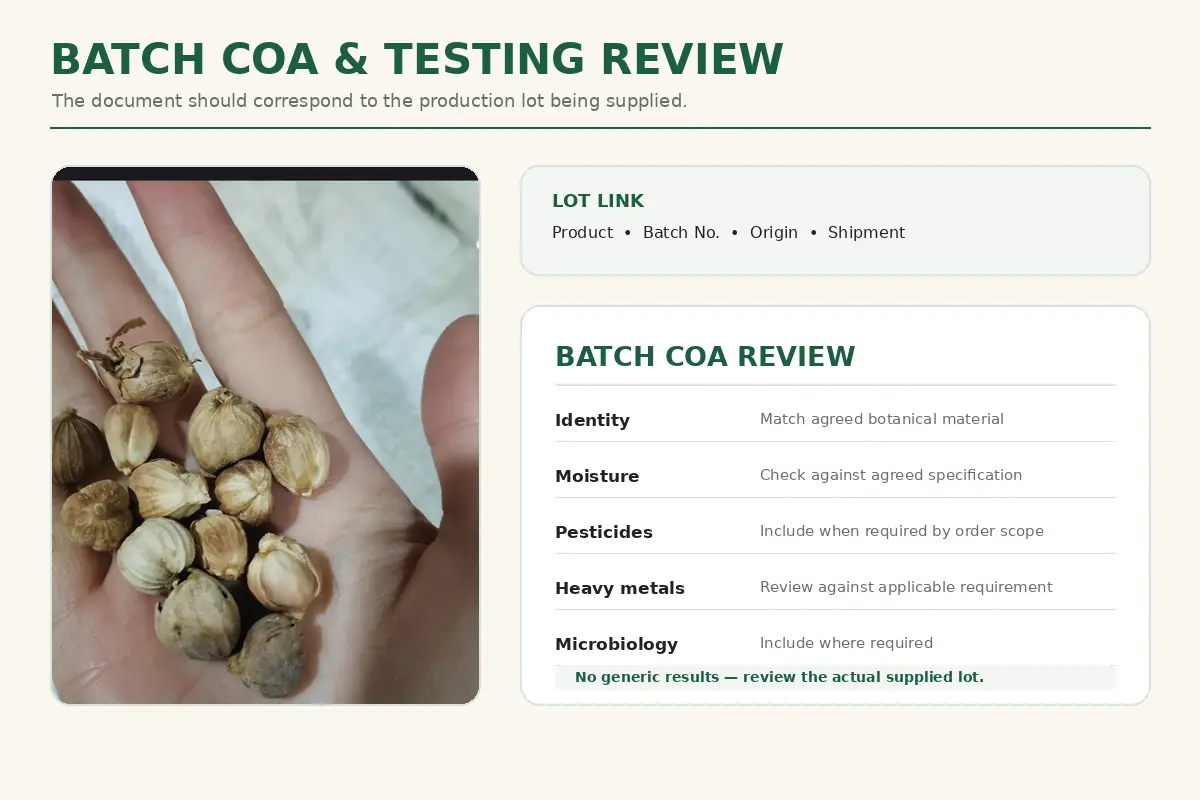
For general COA structure and how to read a batch document, see How to Read Chinese Herb Test Reports and the Certificate of Analysis guide.
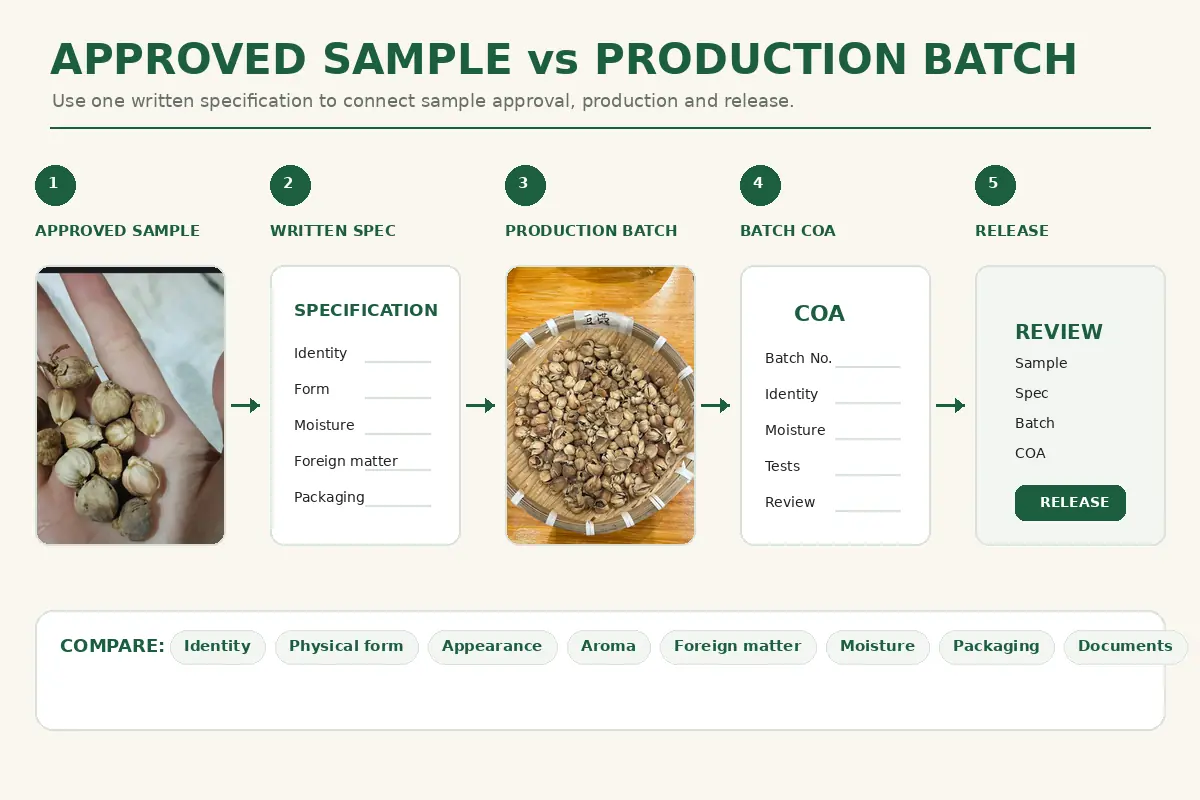
Approve the sample together with a written specification, and treat the approved sample — not a verbal agreement — as the reference for every later batch. For the full workflow, see Botanical Ingredient Sample Approval.
Document structure can be shared across SKUs, but test limits and physical tolerances cannot. See Chinese Herbal Slices Specification for how to set these per SKU.
Use the following fields when preparing a purchase specification.
| Field | Requirement to Confirm |
|---|---|
| Product name | Cardamom Fruit (Dou Kou) |
| Botanical name | Define by buyer / applicable standard |
| Plant part | Dried ripe fruit |
| Origin | Define by buyer |
| Applicable standard | Buyer or applicable pharmacopoeia |
| Product form | Whole or broken |
| Whole / broken requirement | Define by buyer |
| Size / uniformity | Define if relevant |
| Appearance | Define by buyer / applicable standard |
| Internal seed condition | Define by buyer |
| Aroma | Define by buyer |
| Moisture | Define by buyer / applicable standard |
| Foreign matter | Define by buyer / applicable standard |
| Broken material tolerance | Define by buyer |
| Visible insect condition | Define acceptance criteria |
| Mold condition | Define acceptance criteria |
| Sulfur status | Define if applicable |
| Pesticide requirements | Based on destination market |
| Heavy metal requirements | Based on destination market |
| Microbiological scope | Based on intended use and market |
| Packaging | Define by buyer |
| Net weight | Define by buyer |
| Batch label | Define required information |
| Batch COA | Must match supplied lot |
| Approved sample | Define reference sample |
| Remaining shelf life | Define by buyer |
| Shipment documents | Based on destination market |
This table can also be used as a quotation checklist before the supplier confirms price and lead time.
No.
Dou Kou is associated with Amomi Fructus Rotundus and botanical sources such as Amomum kravanh or Amomum compactum.
Green cardamom is Elettaria cardamomum. It is a different botanical material, so its commercial grading system should not automatically be applied to Dou Kou.
What are the Chinese Pharmacopoeia 2025 specifications for Dou Kou? Ch.P. 2025 separates Yuan Dou Kou from Indonesian white cardamom. Yuan Dou Kou must meet foreign matter ≤1%, moisture ≤11.0% and seed volatile oil ≥5.0% (ml/g); Indonesian white cardamom must meet foreign matter ≤2%, moisture ≤12.0% and volatile oil ≥4.0% (ml/g). Both require eucalyptol ≥3.0% in the seed mass on a dried basis.
At minimum, define:
Replace vague descriptions such as “best quality” with measurable criteria.
No.
Color and aroma are useful for visual screening and batch comparison. They cannot confirm identity or contaminant levels.
Laboratory testing is required when those parameters form part of the specification.
The test scope depends on intended use and destination market.
Typical items may include identity, moisture, foreign matter and relevant pharmacopoeial tests.
Pesticide residues, heavy metals and microbiological testing may also be required depending on the market and product use.
Yes.
The commercial batch should be compared with the approved sample and written specification.
Typical comparison points include appearance, product form, aroma, foreign matter, moisture, packaging and required test results.
A clear specification gives both buyer and supplier the same basis for quotation, inspection and shipment approval.
To source Amomum fruit (Dou Kou), review our fruit and seed herbs range and send the botanical source, form, testing scope and quantity for a sample and quotation.
Before requesting a price, confirm:
