Tell Us About Your Project
Share your product, quantity and project requirements. We will review the details and respond with the relevant next steps.

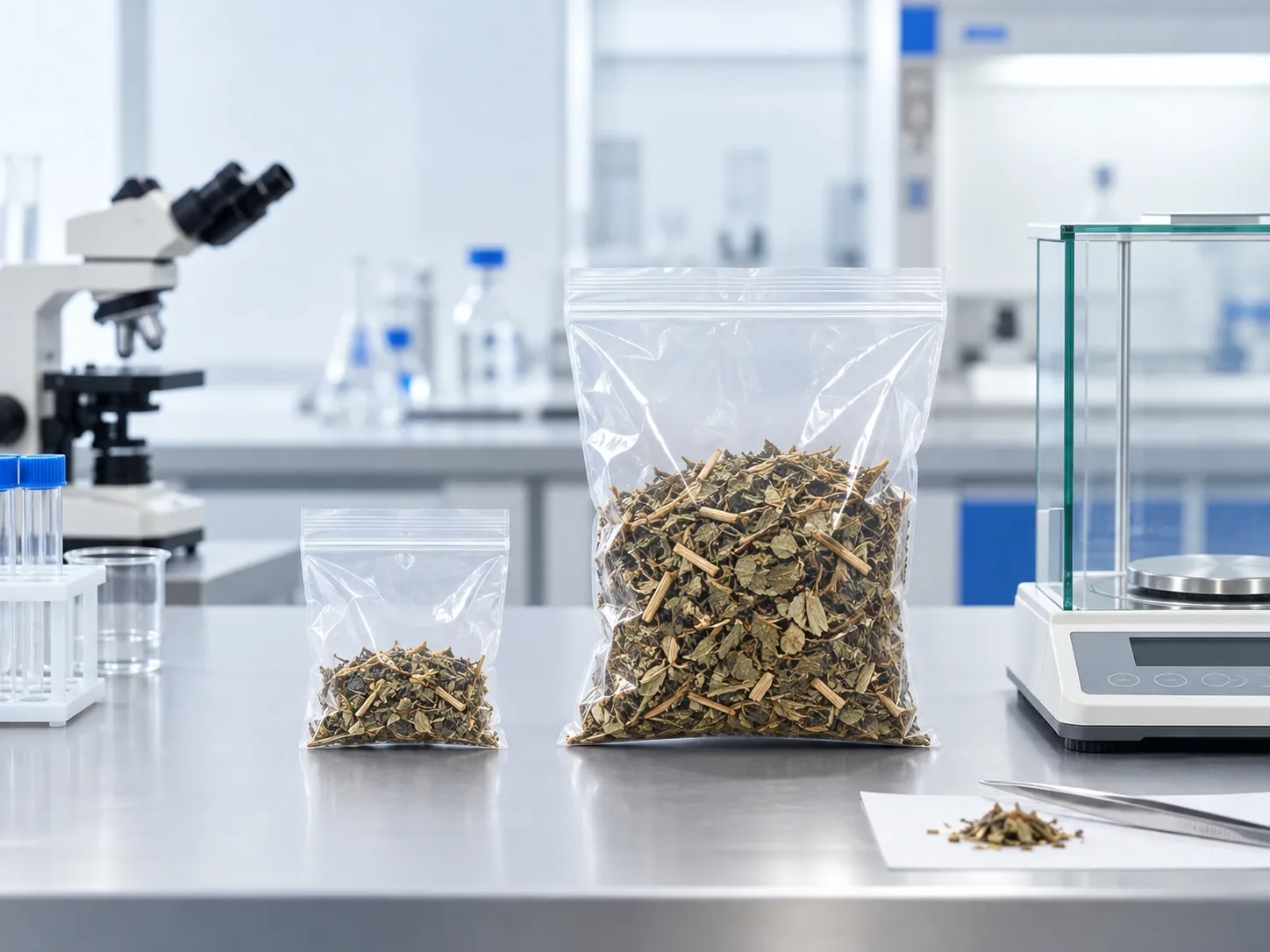
If you plan to order Chinese herb samples for lab testing before placing a bulk order, confirm the testing scope and required sample quantity with your laboratory first.
There is no universal 100 g, 500 g or 1 kg rule. More important is traceability: the sample should come from a defined production batch, the COA should refer to that same batch, and material from the batch should be retained where practical. Before the bulk shipment, confirm whether the approved lot is still the lot that will actually be supplied.
This creates a clear chain:
Paid sample → production batch → batch-specific COA → buyer laboratory result → retained sample → bulk shipment
A small reference sample may be enough to inspect color, odor, cut size and general appearance. How to turn that visual review into written acceptance criteria is covered in our guide to botanical ingredient sample approval.
A paid laboratory sample serves a different purpose. The buyer needs enough material for its own testing and uses the results as part of supplier, product or batch approval before committing to a larger commercial quantity.
This is common when sourcing bulk materials such as:
Appearance alone cannot establish whether a batch meets a buyer’s requirements for pesticide residues, heavy metals, microbiology or other analytical parameters.
The supplier’s COA provides useful batch information. Some buyers also require independent laboratory testing against their own specifications and destination-market requirements.
Two real purchasing situations illustrate why sample quantities vary.
In one project, a European buyer purchased approximately 1 kg of one dried Chinese herbal material and sent the material to its own laboratory. Approval of that sample was the step before a possible bulk order of more than 100 kg.
In another project, an international buyer requested approximately 100 g each across dozens of herbal raw materials, together with English COAs.
Both are legitimate sample requests. They simply show why sample quantity cannot be standardized without knowing what the buyer and laboratory plan to do.
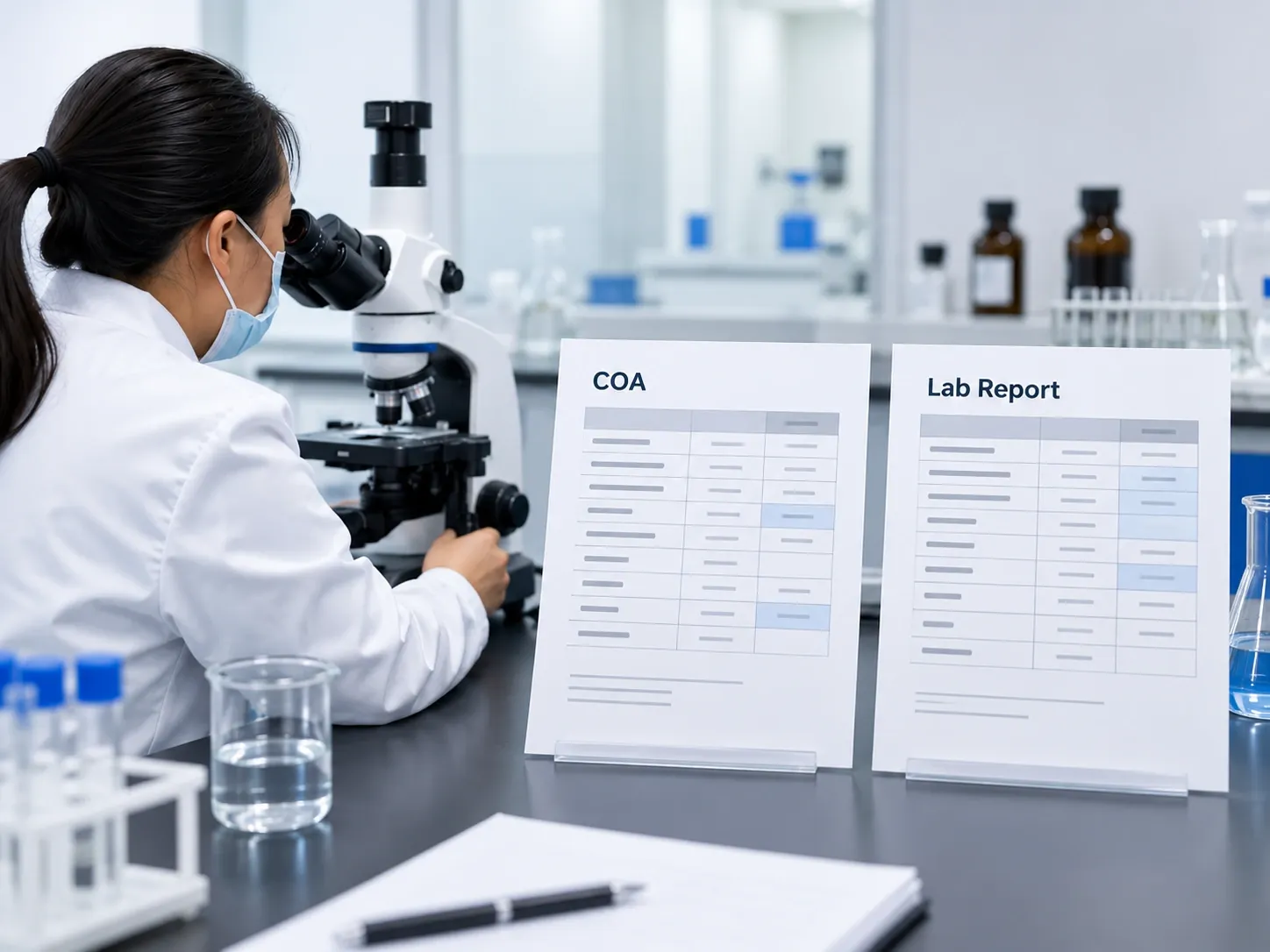
Ask the laboratory before asking the supplier to prepare the parcel.
Required quantity can depend on:
For limited checks, approximately 100 g may be sufficient in some situations.
When multiple panels such as pesticides, heavy metals, microbiology and mycotoxins are required, several hundred grams or approximately 500 g–1 kg may be more practical.
These are working ranges, not universal standards.
For example, official EU pesticide sampling guidance includes laboratory sample quantities in the 0.1–0.5 kg range for dried herbs and spices. Other laboratory and quality-control guidance uses different quantities depending on the test.
Official sampling guidance should also not be confused with a commercial laboratory’s own intake requirement. Your laboratory may request more material for multiple analyses, repeats or retention.
Confirm the required sample quantity before dispatch.
Otherwise, a buyer may discover after delivery that there is not enough material for all planned tests. A second sample may then be needed — and it may no longer come from the same batch.
Two published references help buyers estimate the quantity before asking the laboratory. USDA’s NOP 2610 Sampling Instructions for Residue Testing (Rev. 04, 2024) recommends approximately 500 g (1 lb) per sample for dried commodities, herbs, spices and teas. Commercial laboratories also publish minimum intake quantities per test; the figures below are from BAV Institut, a German food testing laboratory.
| Test | Minimum laboratory quantity |
|---|---|
| Heavy metals | 30 g |
| Pesticide residues | 50 g |
| Mycotoxins | 50 g |
| Microbiology | Typically 100 g |
| PAH | 200 g |
Worked example. A common four-panel check (heavy metals, pesticides, mycotoxins and microbiology) needs about 230 g at these minimums. Allowing for a repeat test and a retained portion brings the practical request to roughly 500 g, which matches the USDA figure for dried herbs. Whole roots and coarse slices are less homogeneous than powders, so buyers testing whole or sliced material often request more. Treat these as planning figures and confirm the exact quantity with your own laboratory.
The test scope should be based on the product, intended use, destination market and buyer specification.
| Test | Why Buyers May Check It | How to Treat It |
|---|---|---|
| Botanical identity | Confirms species and plant part | Particularly important for medicinal or pharmacopoeial materials; methods depend on product and specification |
| Pesticide residues | Checks residues against applicable market limits | Legal MRLs exist, but this does not mean every buyer is legally required to independently test every lot |
| Heavy metals | Checks elements such as lead, cadmium, arsenic or mercury | Applicable limits depend on product category and market; buyers may also set internal specifications |
| Microbiology | Checks pathogens and general microbial quality | Food-safety obligations apply, while exact panels and limits depend on product and specification |
| Mycotoxins | Relevant where storage or botanical characteristics create risk | Legal limits apply to specified commodities; buyers may add testing based on risk |
| Pyrrolizidine alkaloids | Relevant to certain herbal materials and infusions | Particularly important for certain European product categories; applicability should be checked by commodity |
| Moisture / loss on drying | Supports storage and quality control | Often a specification or pharmacopoeial parameter |
| Foreign matter | Checks unwanted plant material or other foreign material | Normally controlled through specifications or applicable pharmacopoeial requirements |
| Sulfur dioxide | Relevant for materials where sulfur treatment is a concern | Commodity-specific rather than a universal herb test |
| Other contaminants | May include PAHs, nicotine, MOSH/MOAH or other parameters | Depends strongly on product, market and buyer risk assessment |
A legal maximum limit and a buyer testing requirement are not the same thing.
A market may set a maximum pesticide residue level, for example, without requiring every importer to send every incoming lot to an independent laboratory.
The commercial question is therefore not simply:
“Which tests are legally required?”
It is:
“Which limits apply to this material, and what evidence does our quality system require before we approve it?”
The same botanical material may be purchased for different uses.
It may become:
Those uses can involve different specifications, documentation and testing expectations.
Tell the supplier the intended use and destination market before the sample is prepared. A generic herb specification may not answer the questions your laboratory or quality team needs to address.
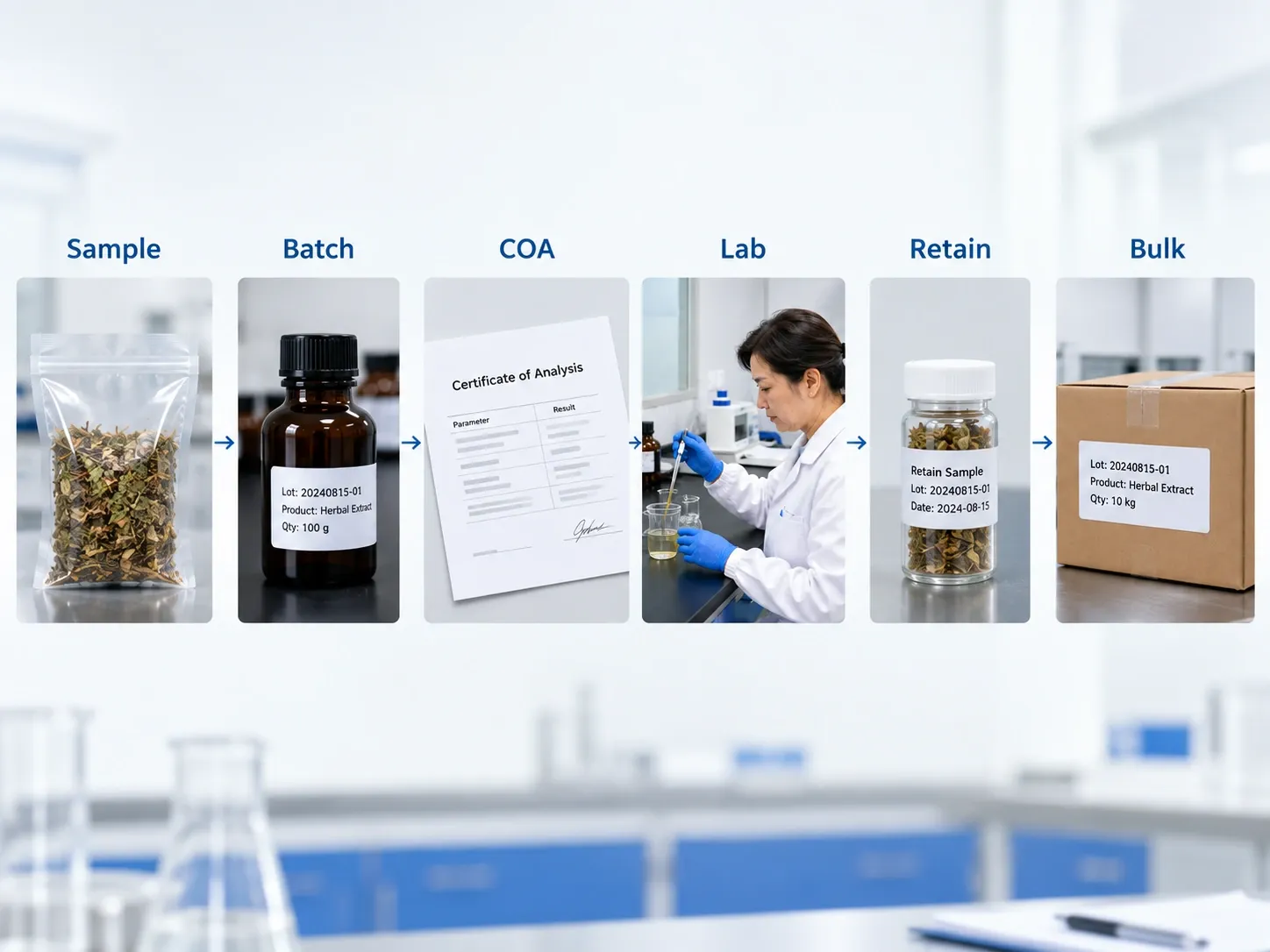
This is the most important part of a laboratory sample program.
A laboratory result describes the material that was actually tested.
If the sample cannot be linked to a production batch, it becomes much harder to connect that result to the later commercial shipment.
For batch approval, the preferred chain is:
Sample → batch number → COA → buyer laboratory result → retained material → commercial lot
Suppose a buyer tests Batch A and approves it.
Several weeks later, the bulk shipment is prepared from Batch B.
Batch B may also be good material. But the previous laboratory report describes Batch A, not Batch B.
The buyer and supplier therefore need to know when a batch changes.
If the purpose is only product presentation, a generic reference sample may be enough.
If the purpose is batch approval, the sample should instead be taken from an identified lot that represents the commercial material being evaluated.
Representative sampling matters because dried botanical materials are not perfectly homogeneous.
A pesticide residue, mycotoxin, moisture level or microbial issue may not be distributed equally throughout every bag or every part of a lot.
Where appropriate, sampling from several locations or containers and preparing a representative composite gives the laboratory a better picture than taking a handful from the top of one bag.
The exact sampling procedure should follow the buyer’s quality system or applicable laboratory guidance.
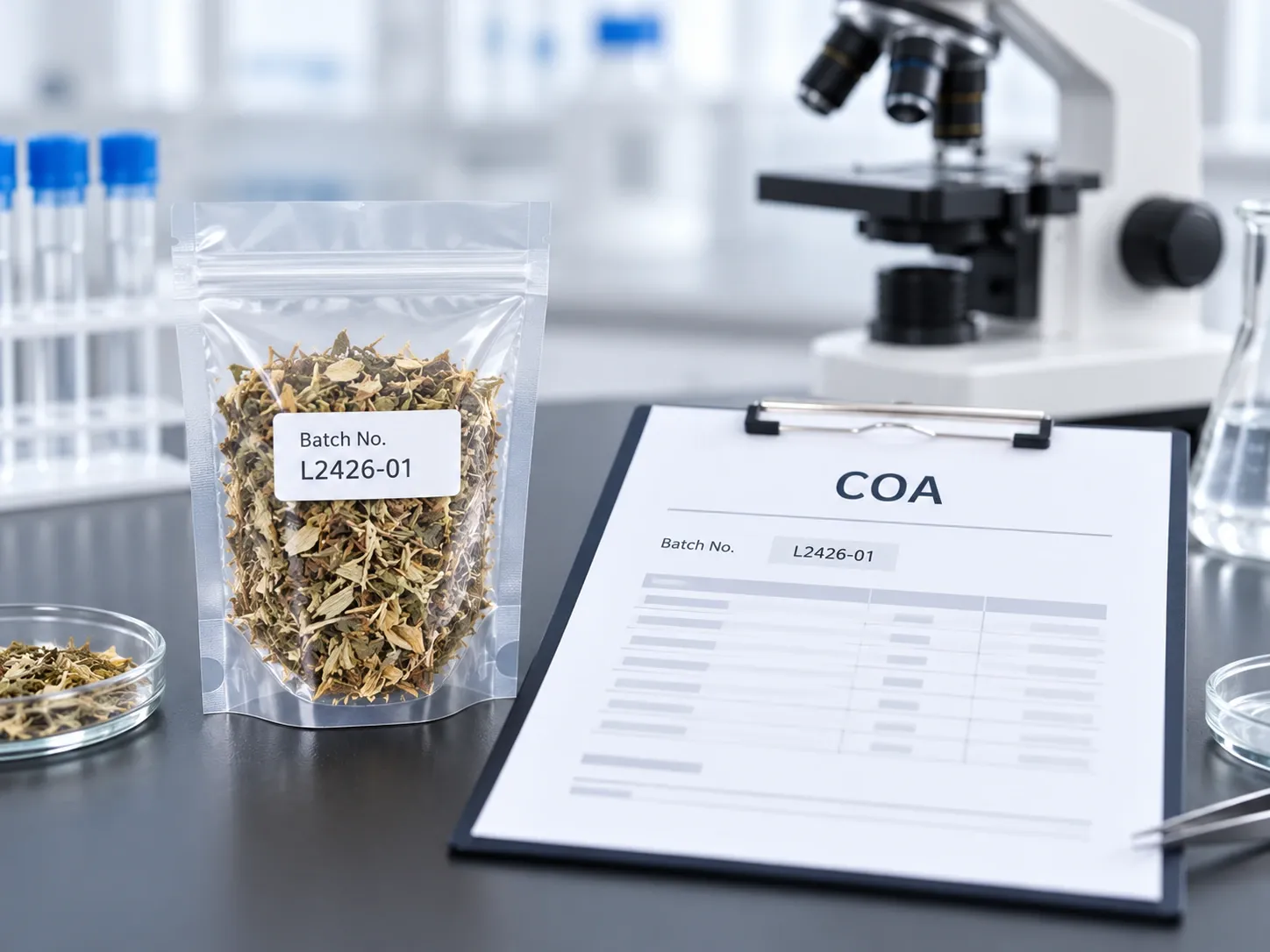
At minimum, the buyer should be able to match:
1. The physical sample
The sample label should identify the product and relevant batch or lot number.
2. The supplier’s COA
The COA should refer to that same production batch rather than being only a generic product specification.
3. The buyer’s laboratory report
The laboratory report should clearly identify the submitted sample so the result can later be traced back to the batch.
The practical principle is simple:
The batch number on the sample and the batch number on the COA should agree.
Without that connection, a laboratory result may still tell you something about the sample, but it is much less useful for approving a commercial lot.
After sending the buyer’s sample, keeping material from the same batch can be useful.
A retained or reference sample can support:
This should be treated as quality-control practice rather than a universal legal requirement for every food-herb transaction.
The storage period, quantity and conditions should depend on the product and the parties’ quality procedures.
For an important laboratory-approval order, however, retaining material from the tested batch can save considerable time if a result later needs to be investigated.
This is a practical issue buyers should consider before testing.
The laboratory process may take time. During that period, inventory from the tested batch may continue to be sold.
Before sending the sample, buyer and supplier should therefore discuss whether:
Batch reservation is a commercial arrangement and should not be assumed automatically.
Before the bulk shipment, confirm the actual batch again.
If the approved lot is no longer available, the supplier should identify the new lot and the buyer should decide whether it needs:
The required response depends on the buyer’s quality system.
The important point is transparency: approval of one batch should not silently become approval of another batch. To compare the finished bulk lot with the approved sample before dispatch, use the sample-to-bulk consistency checklist.
A useful COA for an international botanical buyer may include:
Not every field is legally mandatory for every botanical food ingredient.
The purpose is to give the buyer enough information to identify the material, understand the specification and connect the document to the physical batch.
For a laboratory sample, batch identification is especially important.
There is no universal rule requiring every Chinese herbal material COA to be issued in English.
English COAs are nevertheless commonly requested in international B2B purchasing.
They allow the buyer’s purchasing team, quality team and external laboratory to review the same information without relying on separate translations.
If an English COA is required, confirm this before the samples are prepared.
This is particularly useful when dozens of raw materials are being evaluated at the same time.

Different results do not automatically mean that one laboratory is wrong.
Several technical factors may be involved.
Botanical materials are naturally variable.
Two subsamples from the same lot may not contain exactly the same residue or contaminant concentration.
How the sample is collected, ground, mixed and reduced to the analytical test portion can influence the result.
This becomes especially important with heterogeneous contaminants such as mycotoxins.
Laboratories may use different extraction procedures, instrumentation and validated methods.
Two reports both labelled “pesticide testing” may not cover the same pesticides.
A laboratory testing several hundred compounds and another laboratory using a different target list are not necessarily answering the same question.
Different detection and quantification limits can cause one laboratory to report a low residue while another reports it below its reporting threshold.
Check whether both laboratories use the same units and whether the result is reported on an as-is, dry-weight or other basis.
Results close to a specification or legal limit require careful interpretation.
When two reports differ, compare:
method → analyte list → LOQ → units → reporting basis → sampling information
before comparing only the final numbers.
Agreeing the test scope in advance can reduce avoidable disputes later.
Switzerland is not an EU member state.
For pesticide residues, Switzerland maintains its own regulatory framework under the FDHA Ordinance on Maximum Residue Levels for Pesticide Residues in or on Products of Plant and Animal Origin (VPRH/OPOVA).
Swiss requirements are extensively coordinated with developments in EU food law, and Swiss authorities update the VPRH annexes regularly. However, the applicable Swiss entry should still be checked for a Swiss-bound product rather than assuming that Regulation (EC) No 396/2005 directly governs the shipment.
For plant health, Switzerland makes an important distinction between fresh plant material and products that have already been processed.
Swiss authorities state that processed plant products such as dried, powdered, frozen, pickled or otherwise processed plants do not require a phytosanitary certificate and are not inspected by the plant-health service.
This does not remove other possible requirements.
Customs, food-safety rules, pesticide and contaminant limits, and CITES controls for protected species remain separate questions.
Do not use one blanket statement for all Chinese herbs.
Plant-health requirements depend on the botanical material, its processing state, origin and classification.
Before shipping, the importer should verify the exact commodity against the current EU requirements.
Food-safety requirements, including applicable pesticide and contaminant limits, must also be considered separately from plant-health rules.
Great Britain now operates its own plant-health risk categorisation.
Depending on the commodity, plant products can fall into high-, medium- or low-risk categories, with different requirements for phytosanitary certification and IPAFFS pre-notification.
Great Britain also maintains its own statutory pesticide MRL register. Existing EU-derived MRLs remain part of the system unless changed, but GB and EU limits can diverge over time.
Check the current GB classification and MRL rather than assuming the current EU requirement is identical.
For the US, FDA and USDA APHIS address different issues.
FDA Prior Notice
FDA states that Prior Notice applies to food imported for use, storage or distribution in the US, including trade samples and quality-assurance or quality-control samples, unless a specific exemption applies.
A small shipment value or quantity does not by itself create a Prior Notice exemption.
FDA has separate enforcement guidance for certain small research or analytical samples, so the importer should determine the correct treatment before shipment rather than assuming that “sample” status is enough.
USDA APHIS
APHIS regulates plant-health risks.
Its current guidance specifically notes that dried and processed plant products — including herbs and citrus peel — can be restricted depending on the product and country of origin.
Use the current Agricultural Commodity Import Requirements database to check the exact botanical material before dispatch.
The courier method comes after the product and documentation questions have been resolved.
For one recent Swiss laboratory-sample project, a tracked small-parcel DDP route from China was used with an expected transit of approximately 12–15 days.
That is an example from one shipment route, not a standard delivery promise.
Actual transit can change with the destination, courier, customs process and commodity.
Regardless of route, keep the sample description, batch number, supporting documents and tracking information together.
A practical process is:
This is not a universal legal procedure.
It is a practical way to make a paid laboratory sample useful for a later commercial decision.
There is no universal quantity. USDA’s NOP 2610 sampling instructions recommend about 500 g for dried herbs, spices and teas, and commercial laboratories publish per-test minimums such as 30 g for heavy metals, 50 g for pesticides, 50 g for mycotoxins and about 100 g for microbiology. A four-panel check therefore needs roughly 230 g at minimum, or about 500 g once a repeat test and a retained portion are allowed for. Ask your laboratory before dispatch.
It may be, depending on the laboratory and testing scope. Do not assume it is enough when pesticides are combined with heavy metals, microbiology, mycotoxins or other tests.
If the purpose is batch approval, ideally yes. The laboratory result describes the material tested. If the later commercial shipment comes from another batch, the buyer should know and decide whether additional approval is necessary.
Yes, when the COA is intended to describe the tested sample. Matching lot identification makes it possible to connect the physical sample, supplier documentation and buyer laboratory result.
A retained sample can support repeat testing, investigation and comparison if the buyer’s laboratory result differs from the supplier’s result or if a later quality question arises.
Not universally. English or bilingual COAs are commonly requested in international B2B trade because they allow the buyer, laboratory and supplier to work from the same document.
No. Customs, food-safety and plant-health rules depend on the destination and the actual commodity. In the US, food trade and QA/QC samples generally fall within FDA Prior Notice requirements unless an applicable exemption applies.
If laboratory approval is part of your purchasing process, send Aile Herb your:
We can then check the available specification, production batch and documentation requirements before the sample is dispatched.
To arrange paid samples with batch identification for your laboratory, see our samples and product development page and send the product list, test scope and sample quantity.
