Tell Us About Your Project
Share your product, quantity and project requirements. We will review the details and respond with the relevant next steps.

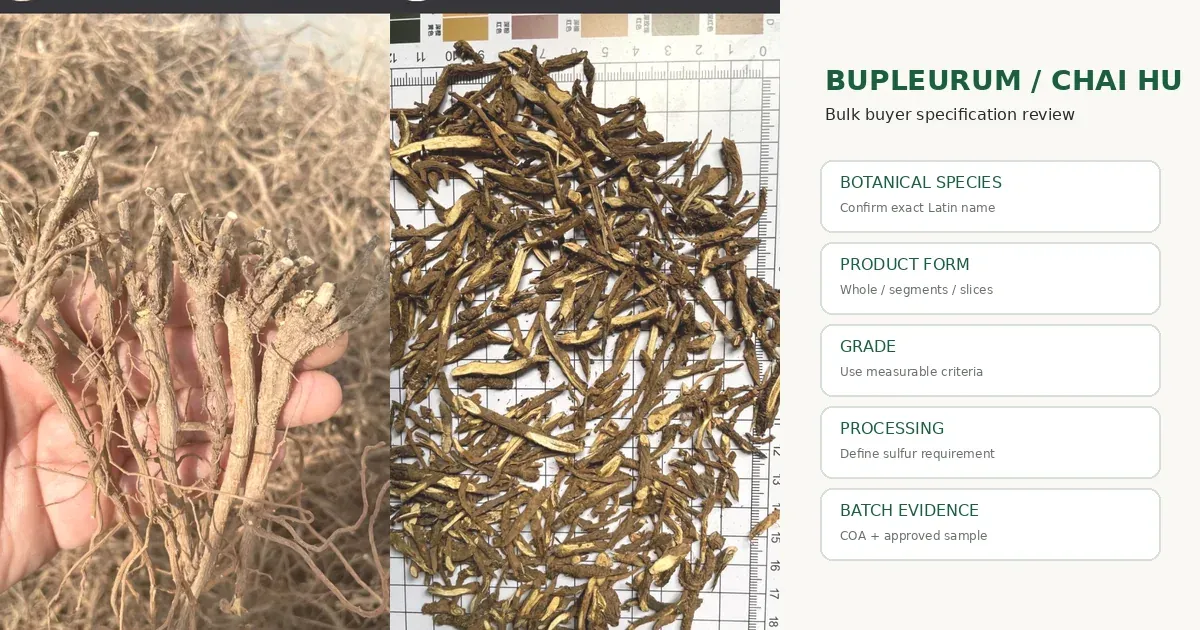
Before ordering Bupleurum (Chai Hu) root, define the botanical species, origin, product form, cut, measurable grade criteria, processing and sulfur status, testing scope, batch COA and sample-approval criteria in writing. This Bupleurum buyer guide covers each of these fields so the purchase specification — not the name “Chai Hu” alone — defines what you receive.
| Field | Buyer Should Define |
|---|---|
| Product | Chai Hu / Bupleurum Root |
| Botanical species | Exact Latin name |
| Plant part | Root |
| Origin | Controlled or informational |
| Product form | Whole / segments / slices |
| Cut | Agreed type |
| Grade | Measurable criteria |
| Processing | Cleaned / dried / cut / other agreed status |
| Sulfur requirement | Defined before order |
| Testing | Buyer / destination-market scope |
| Batch COA | Required |
| Sample | Approval criteria |
| Packing | Agreed format |
“Chai Hu” alone is not a complete purchasing specification. These fields should be agreed before quotation, not discovered on arrival.
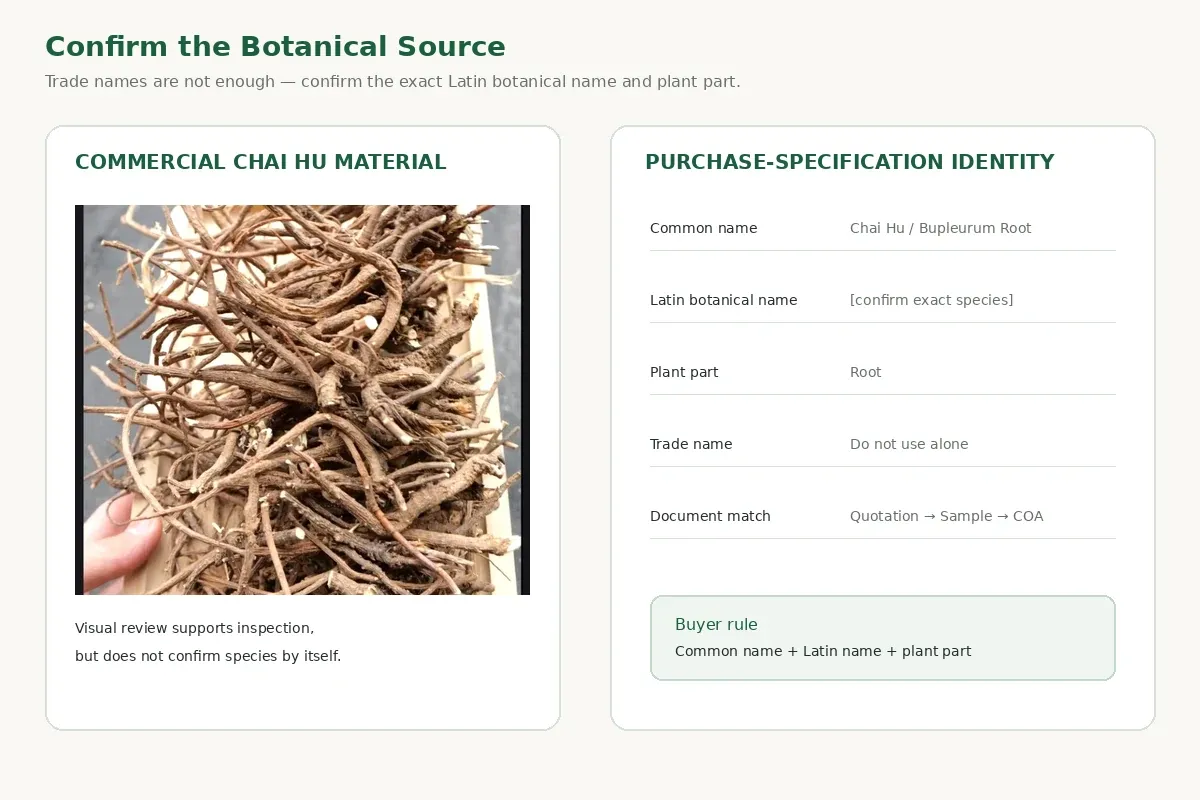
Bupleurum is a genus name, not a purchasing specification. Ordering by the English word “Bupleurum” alone leaves the species undefined.
| Name Used in Trade | What Buyer Should Confirm |
|---|---|
| Chai Hu | Exact botanical species |
| Bupleurum | Species + plant part |
| Bupleurum Root | Species + plant part |
| Bei Chai Hu | Confirm whether supplier means Bupleurum chinense |
| Nan Chai Hu | Confirm whether supplier means Bupleurum scorzonerifolium |
The safest purchase-specification format is:
Common name + Latin botanical name + plant part
For example:
Chai Hu / Bupleurum Root — Bupleurum chinense DC. — Dried Root
Under the Chinese Pharmacopoeia, Bupleurum chinense DC. and Bupleurum scorzonerifolium Willd. are recognized sources of Bupleuri Radix. Other Bupleurum species may appear in trade or be covered under different national or international standards.
This is not a hypothetical gap. ISO 23965:2022, the international standard for this material, sets a wider botanical scope than the Chinese Pharmacopoeia does. Its scope states: “This document specifies minimum requirements and test methods for Bupleurum chinense, Bupleurum scorzonerifolium and Bupleurum falcatum root.” The Chinese Pharmacopoeia entry for Bupleuri Radix recognises only the first two. A batch of Bupleurum falcatum root can conform to ISO 23965:2022 and still fall outside the Chinese Pharmacopoeia entry for Bupleuri Radix. Specifying “ISO 23965” alone does not fix the botanical source to what a Ch.P.-based specification requires. Buyers citing ISO 23965 on a purchase order should confirm separately, in writing, that the delivered species is B. chinense or B. scorzonerifolium if Ch.P. compliance is also required.
For commercial forms, cut options and packing available for bulk order, see our Bupleurum root slices product page.
Commercial names such as “Chai Hu” and “Bupleurum Root” do not by themselves identify which species is being supplied. Confirming the Latin botanical name in writing is the practical safeguard.
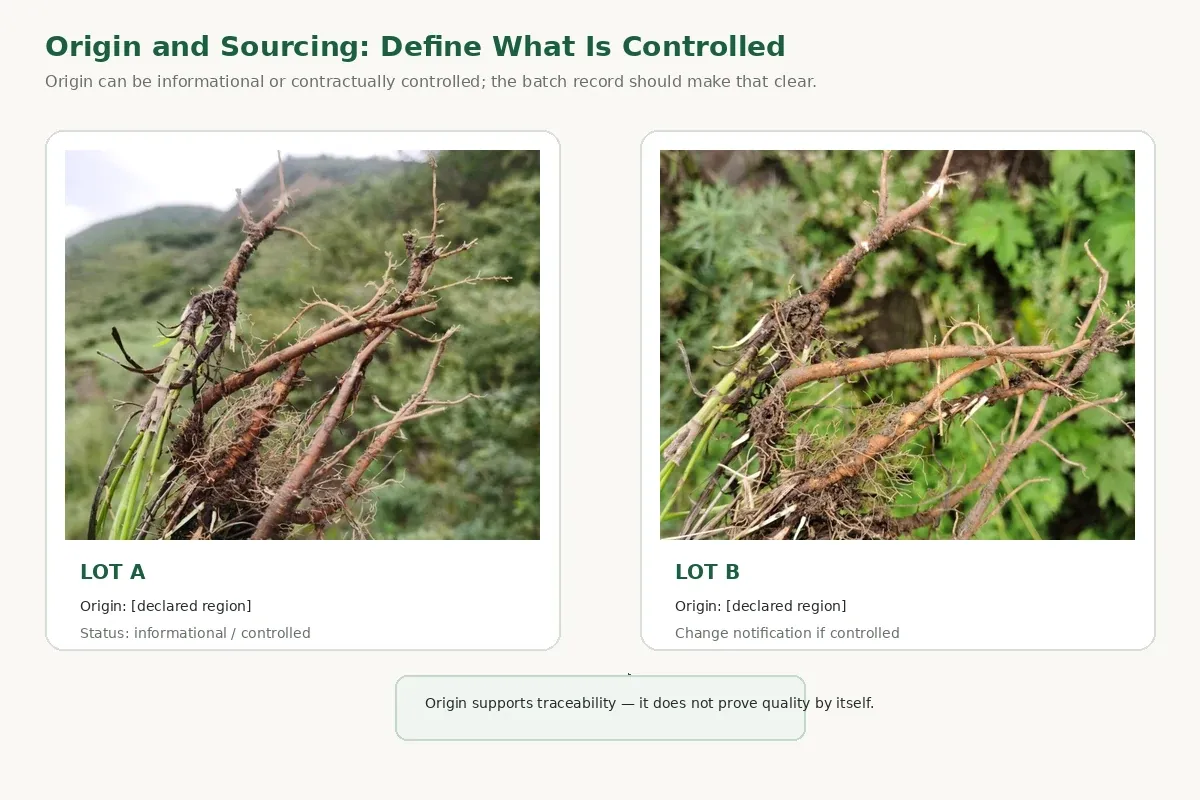
Commercial Bupleurum is sourced from multiple production regions across China. There is no single “best” origin — origin should be defined according to the purchase specification rather than ranked.
Decide whether origin is:
Informational — the supplier states the sourcing region, but it is not a contractual requirement.
Controlled — the buyer requires an agreed province or region and expects notification before any change.
Origin can support traceability and purchasing consistency, but origin alone does not prove botanical identity or analytical quality.
If origin matters to the specification, state it explicitly and require change notification. If it does not, focus verification on species, grade and analytical evidence.
| Product Form | Buyer Advantage | Main Specification Fields |
|---|---|---|
| Whole root | Easier visual review of general root morphology | Length, diameter, branching, surface condition |
| Root segments | Easier handling and packing | Segment length, diameter, breakage |
| Cut slices | Easier to define a repeatable commercial cut | Cut type, thickness, diameter, broken pieces, fines |
No form is universally superior. The appropriate form depends on the buyer’s intended use and downstream processing.
For cut slices, define:
Use an agreed numeric range rather than terms such as thin, large or premium cut.
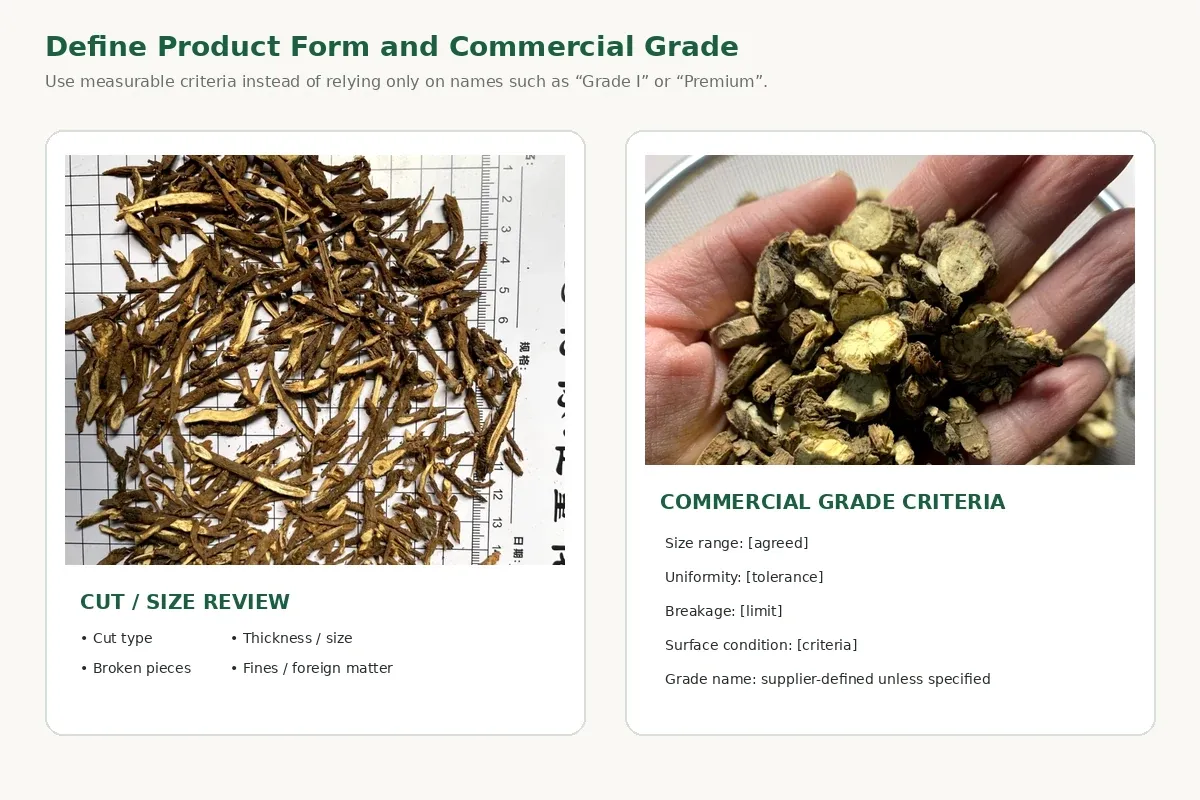
Commercial labels such as Grade I, Grade II, Premium, Selected and Standard are generally market- or supplier-defined
Commercial grade labels such as Grade I, Grade II, Premium and Selected are generally market- or supplier-defined rather than one universal Bupleurum grading system. For how to convert grade language into measurable, enforceable purchase-order criteria, see our Chinese Herbal Slice Grades guide.
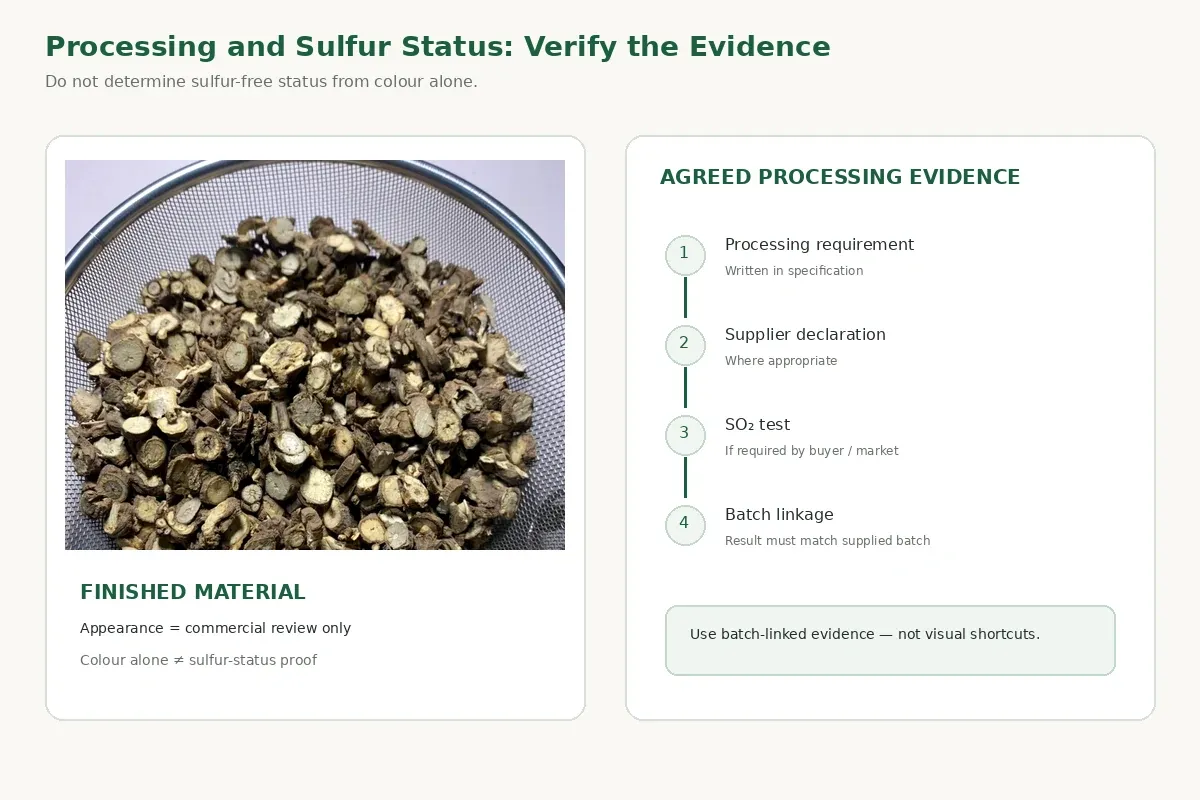
State the finished processing status in the specification — for example “dried, cleaned and cut into agreed slices” — rather than assuming a default. Sulfur-free status should not be judged by colour alone. For general sulfur-fumigation risk and how it affects colour and COA acceptance, see our sulfur-free sourcing guide.
For general COA structure and how to read a batch document, see How to Read Chinese Herb Test Reports and the Certificate of Analysis guide.
Saikosaponins, particularly saikosaponin A and D, are commonly used as Bupleurum quality-control markers and may be included in the analytical specification where required.
They are quality-control markers rather than proof of therapeutic efficacy or overall product quality.
Any specific assay requirement should be verified against the current authoritative monograph or buyer specification being used for the order.
For general COA review, see our Chinese Herb COA Guide.
Testing scope for pesticides, heavy metals and microbiology is set by destination market, intended use, and buyer specification — not by a single fixed list. See Chinese Herb Supplier Qualification for how to define this before the first order.
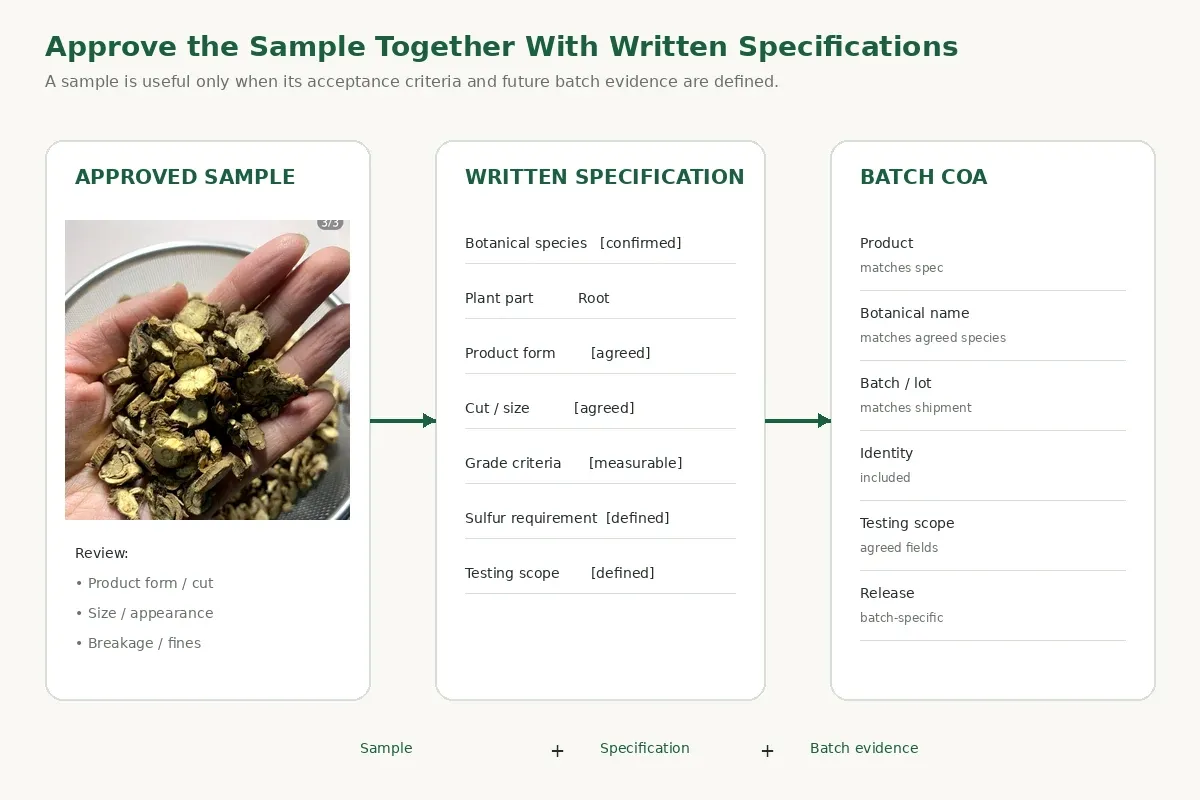
Approve the sample together with a written specification, and treat the approved sample — not a verbal agreement — as the reference for every later batch. Colour, diameter, length, branching and texture vary naturally between agricultural batches, but botanical species, origin where controlled, grade definition, cut, processing, sulfur requirement and testing scope should not change without agreement. For the full workflow, see Botanical Ingredient Sample Approval.
| Red Flag | Why It Matters | Buyer Follow-Up |
|---|---|---|
| Supplier cannot clearly identify botanical source | Material identity remains unclear | Request botanical confirmation before order |
| Species differs between quotation, sample and COA | Documents are inconsistent | Request clarification and reconciliation |
| “ISO 23965 compliant” cited with no species confirmation | The standard’s scope includes B. falcatum, which is wider than the Ch.P. entry for Bupleuri Radix | Confirm in writing that the delivered species is B. chinense or B. scorzonerifolium |
These are reasons for follow-up and reconciliation, not automatic evidence of fraud or adulteration.
| Field | Requirement |
|---|---|
| Product name | Chai Hu / Bupleurum Root |
| Latin botanical name | [confirmed species] |
| Plant part | Root |
| Origin | [controlled / informational] |
| Cultivated / wild | [only if controlled] |
| Product form | [whole / segments / slices] |
| Cut type | [insert] |
| Thickness | [agreed range] |
| Diameter / size | [agreed range if controlled] |
| Grade criteria | [measurable definition] |
| Broken pieces / fines | [agreed limit] |
| Foreign matter | [agreed requirement] |
| Processing status | [insert] |
| Sulfur requirement | [insert] |
| Moisture | [agreed specification] |
| Identity tests | [agreed scope] |
| Assay / marker | [if required] |
| Pesticide testing | [destination-market / buyer scope] |
| Heavy metals | [agreed scope and limits] |
| Microbiology | [if applicable] |
| Batch COA | Required |
| Sample approval | [yes / no] |
| Packing | [insert] |
| Label fields | [insert] |
| Batch traceability | Required |
| Change notification | [controlled fields] |
Under the Chinese Pharmacopoeia, Chai Hu includes Bupleurum chinense DC. and Bupleurum scorzonerifolium Willd. Other Bupleurum species may appear in international trade or under other standards, so buyers should confirm the exact Latin botanical name before ordering.
Bei Chai Hu generally refers to Bupleurum chinense, while Nan Chai Hu generally refers to Bupleurum scorzonerifolium. For procurement, the important point is that the trade name alone should not replace the botanical name in the written specification.
No. Grade terms such as Grade I, Premium and Selected are generally supplier- or market-defined rather than one universal pharmacopoeial grading system. Buyers should request measurable criteria for size, uniformity, breakage, foreign matter and other relevant physical characteristics.
Do not rely on colour alone. Where sulfur status is controlled, request a written processing requirement and appropriate batch-linked sulfur dioxide evidence according to the agreed specification and applicable standard.
Check the product name, Latin botanical name, plant part, batch number, origin where controlled, identity, moisture and any agreed assay, pesticide, heavy-metal, microbiological or sulfur-dioxide results. The batch number should also reconcile with the package and shipment documents.
Not necessarily. Root size is primarily a commercial and visual characteristic. It does not by itself establish botanical identity, marker-compound content or contaminant compliance. Analytical requirements should be confirmed through the agreed specification and batch testing.
Define the botanical species, product form, cut, grade criteria, testing scope and packing requirements before quotation.
Aile Herb can review your Bupleurum specification and provide sample, batch-document and packing information according to the confirmed order scope.
To source Bupleurum (Chai Hu) root, review our root and rhizome herbs range and send the species, form, cut, sulfur requirement and testing scope for a sample and quotation.
Please provide:
Discuss Your Bupleurum Requirement
