Tell Us About Your Project
Share your product, quantity and project requirements. We will review the details and respond with the relevant next steps.

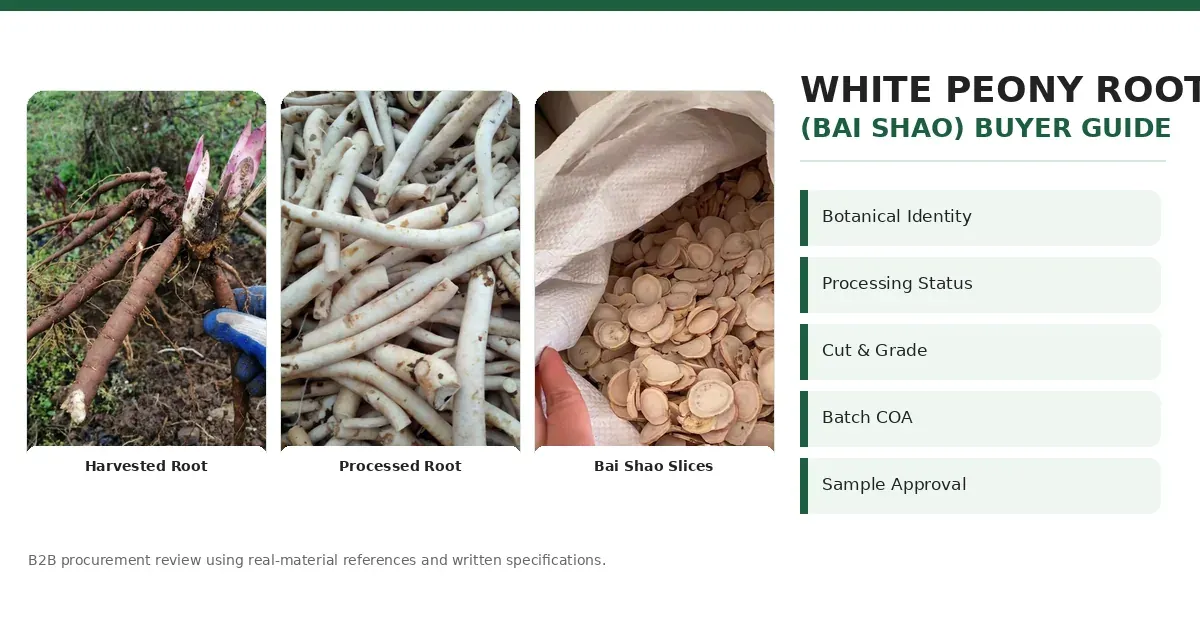
Bulk buyers sourcing White Peony Root (Bai Shao) should define the specification before requesting quotations, not after receiving a sample. At minimum, confirm botanical identity, processing status, product form, cut and size, measurable commercial grade, sulfur requirement, testing scope, batch COA, and sample approval criteria in writing. If you are comparing White Peony Root slices suppliers, see our White Peony Root Slices (Bai Shao) wholesale product page.
| Field | Buyer Should Define |
|---|---|
| Product | Bai Shao / White Peony Root |
| Latin botanical name | Paeonia lactiflora Pall. |
| Plant part | Root |
| Pharmacopoeial identity | Paeoniae Radix Alba where applicable |
| Processing status | Peeled, boiled and dried |
| Origin | Controlled or informational |
| Product form | Whole / segments / slices |
| Cut | Agreed type |
| Grade | Measurable criteria |
| Sulfur requirement | Defined before order |
| Testing | Buyer / destination-market scope |
| Batch COA | Required |
| Sample | Approval criteria |
| Packing | Agreed format |
“White Peony Root” alone is not a complete purchase specification.
Bai Shao / Paeoniae Radix Alba is based on Paeonia lactiflora Pall., plant part root. Processing status is part of the commercial and pharmacopoeial identity, so it should be stated alongside the botanical name rather than assumed.
A practical specification format is:
Common name + Latin botanical name + plant part + processing status
Example:
Bai Shao / White Peony Root — Paeonia lactiflora Pall. — Peeled, Boiled, Dried Root
Terms such as “White Peony,” “Peony Root,” or “Paeonia lactiflora Root” can be incomplete on their own. They may not confirm the intended processing status or exact commercial material. Include plant part and processing status in the RFQ, PO, and COA request.
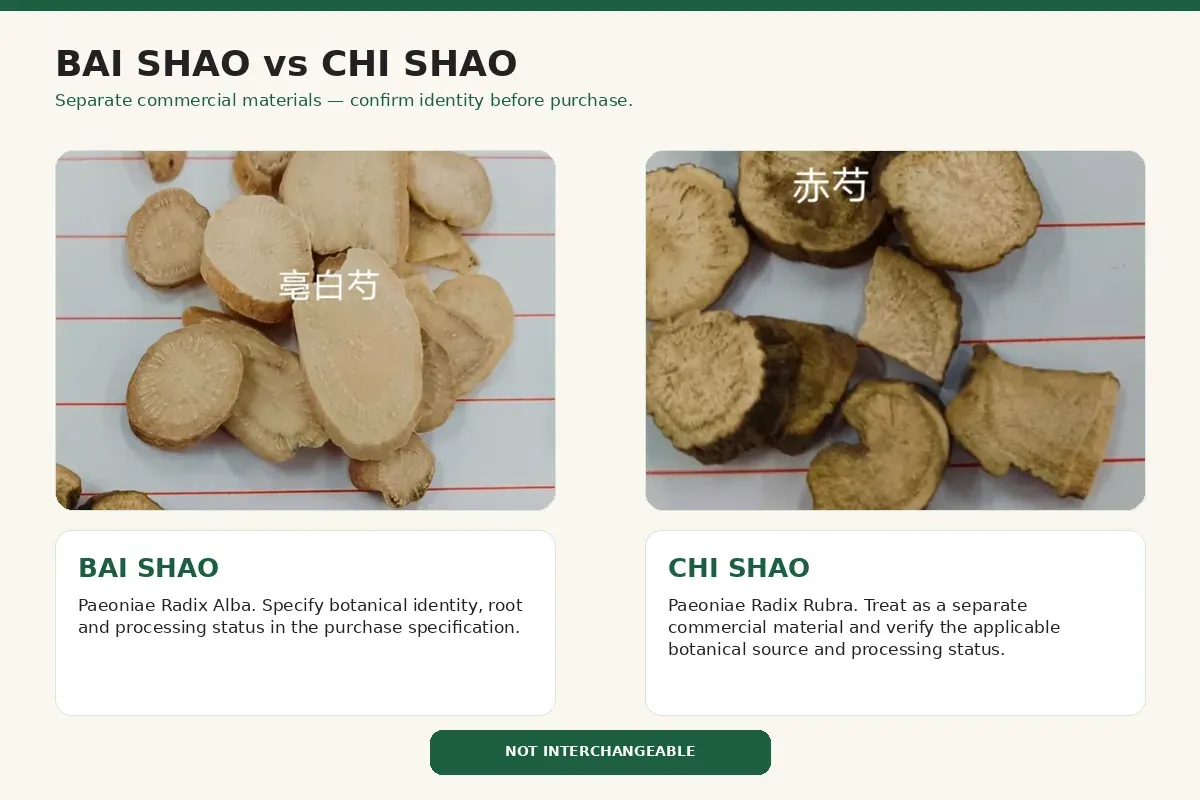
| Field | Bai Shao | Chi Shao |
|---|---|---|
| Pharmacopoeial name | Paeoniae Radix Alba | Paeoniae Radix Rubra |
| Botanical source | Paeonia lactiflora Pall. | Depends on the applicable pharmacopoeial standard |
| Plant part | Root | Root |
| Typical commercial status | Processed | Unpeeled / differently processed |
| Processing | Peeled, boiled and dried | Different processing status |
| Commercial appearance | Lighter, smoother processed surface | Generally darker / rougher commercial appearance |
| Buyer requirement | Specify Bai Shao + processing status | Must not substitute for Bai Shao |
Bai Shao and Chi Shao are separate commercial and pharmacopoeial materials and should not be treated as interchangeable names.
A quotation, sample, or COA that uses only a broad term such as “peony root” does not provide enough information to confirm the intended material.
Appearance can support sample review, but it does not replace botanical identity, processing status, and supporting documentation.
The international standard for this material draws the same line. ISO 22586:2022 covers Paeonia lactiflora Pall. root processed as Bai Shao, and its scope states explicitly: “It is not applicable to red peony root.” A supplier holding ISO 22586 certification for Bai Shao is not thereby certified for Chi Shao, and the two should not appear on the same specification line.
Chi Shao is a separate material with its own specification; see our red peony root (Chi Shao) product page if that is the material you need.
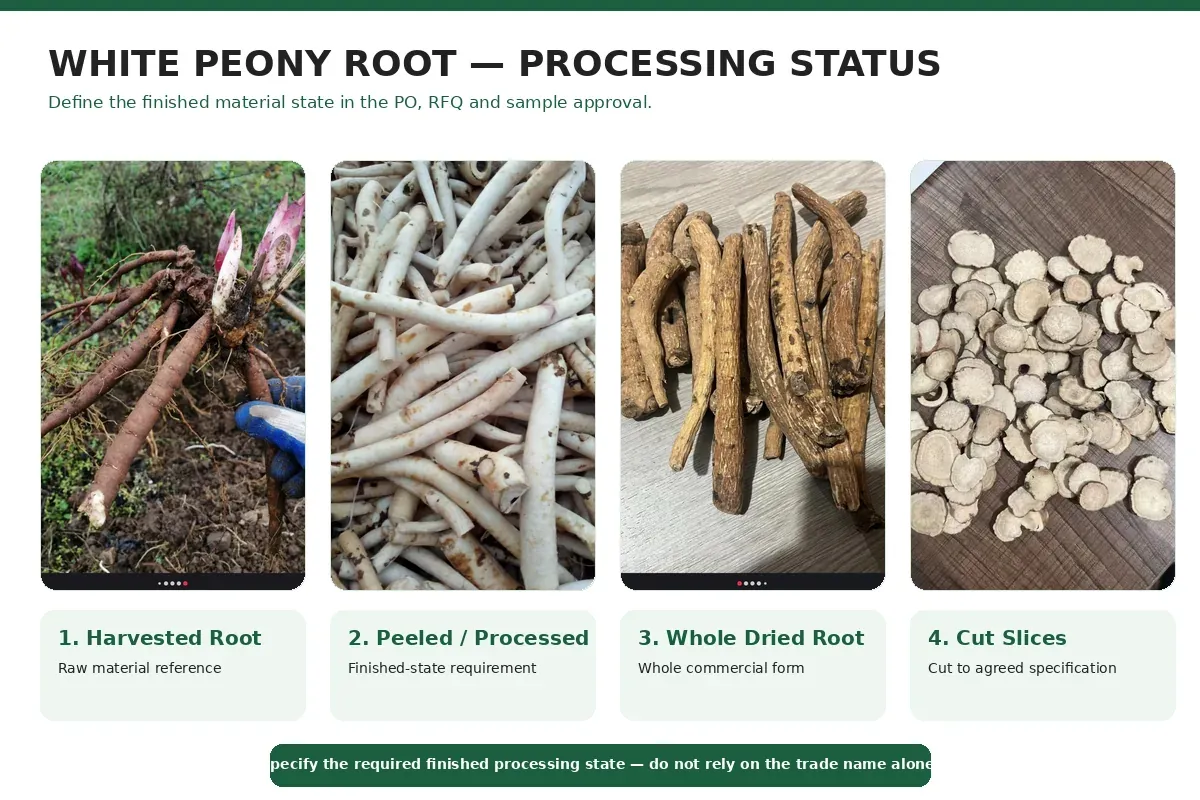
White Peony Root Bai Shao processing from whole root to finished slices
Informational Origin — the supplier states the sourcing region, but it is not contractually fixed.
Controlled Origin — the buyer specifies the region and requires written notification before any change.
Origin supports traceability and purchasing consistency but does not independently prove analytical quality.
Bai Shao is not simply dried peony root.
Commercial processing typically includes cleaning, rootlet removal, peeling, boiling or blanching, drying, sorting, and cutting where required. Suppliers may sequence some operations differently, so the purchase specification should focus on the required finished condition.
For example:
Peeled, boiled and dried Bai Shao root, cut to the agreed specification.
| Product Form | Buyer Advantage | Main Specification Fields |
|---|---|---|
| Whole processed root | Suitable for further cutting or processing | Diameter, length, peeling, surface condition |
| Root segments | Easier handling and packing | Length, diameter, uniformity, breakage |
| Cut slices | Easier to standardize for commercial supply | Cut type, diameter, thickness, broken pieces, fines |
For slices, buyers may define:
There is no universal commercial slice size for every Bai Shao buyer. Thickness and diameter should therefore be written as an [agreed range] for the specific order.
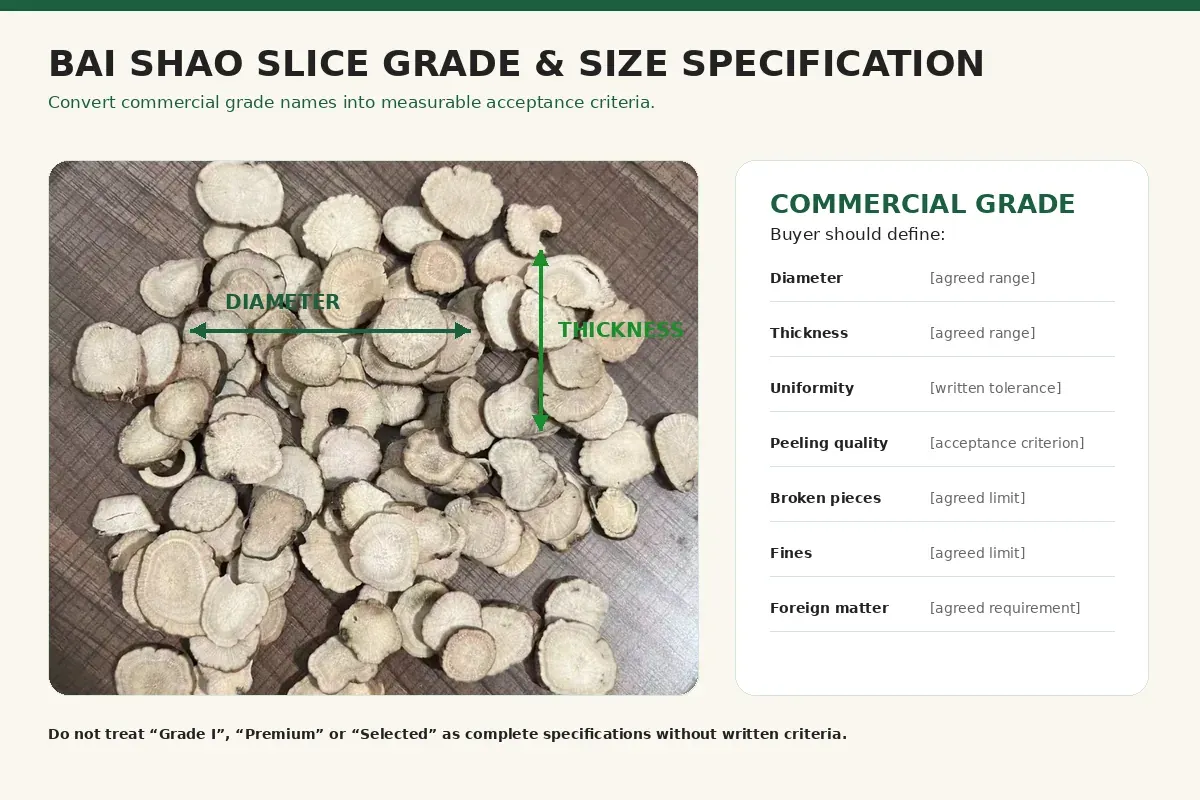
Commercial grade labels such as Grade I, Premium and Selected are generally market- or supplier-defined rather than one universal Bai Shao grading system. For how to convert grade language into measurable, enforceable purchase-order criteria, see our Chinese Herbal Slice Grades guide.
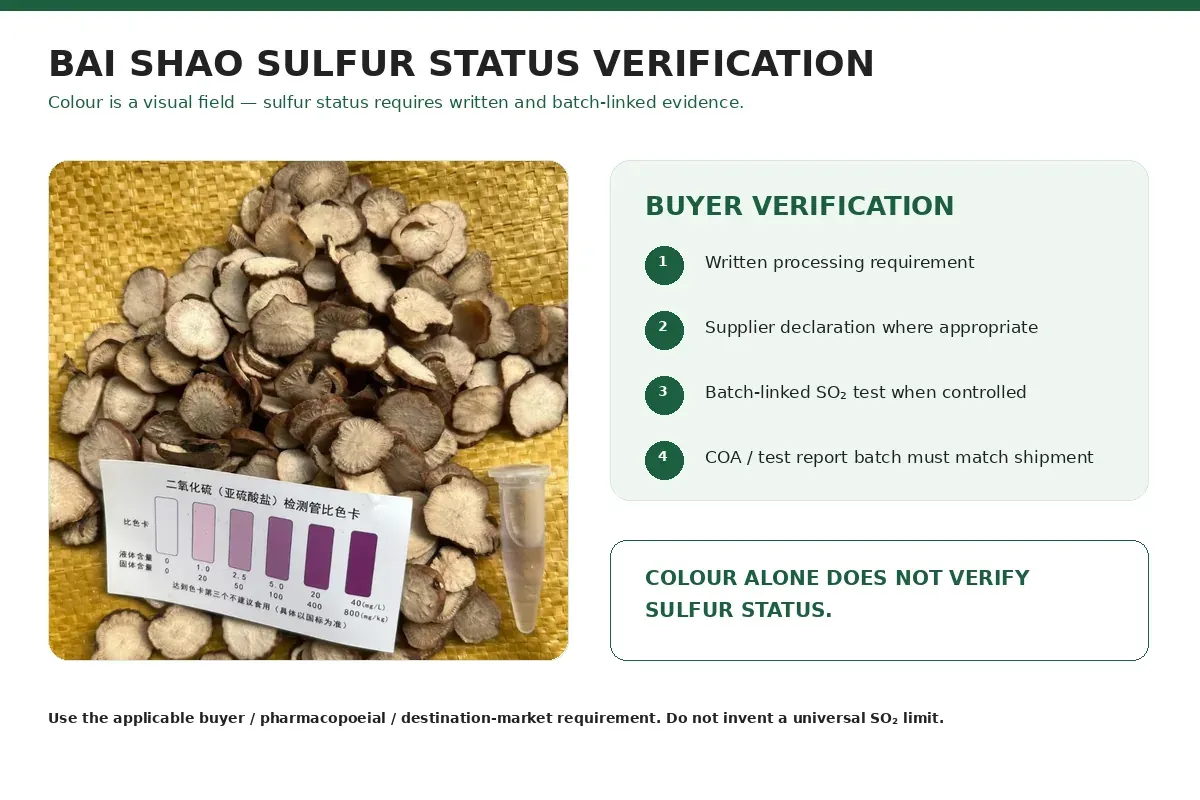
Because Bai Shao is scalded and peeled during processing, its baseline colour already differs from unpeeled root — treat that processing-driven difference separately from any question about sulfur treatment. Colour alone should not be used to judge sulfur status. For general sulfur-fumigation risk and how it affects colour and COA acceptance, see our sulfur-free sourcing guide.
For general COA structure and how to read a batch document, see How to Read Chinese Herb Test Reports and the Certificate of Analysis guide.
Paeoniflorin is used as an analytical quality-control marker for Bai Shao.
It should be reviewed together with botanical identity, physical specification, and contaminant requirements rather than treated as a standalone quality score.
A specific minimum percentage should only be written into the specification when the applicable current monograph or buyer standard has been confirmed.
The Chinese Pharmacopoeia 2025 monograph for Baishao (Paeoniae Radix Alba) assays paeoniflorin by HPLC on the dried basis: not less than 1.6% for the crude root and not less than 1.2% for prepared slices, including stir-fried and wine-processed slices. Most bulk buyers purchase slices, so confirm which limit the COA is reporting against.
| ChP 2025 test | Crude root | Slices | Stir-fried slices | Wine-processed slices |
|---|---|---|---|---|
| Identification | TLC against paeoniflorin reference (all forms) | |||
| Moisture (Chapter 0832, Method 2) | ≤14.0% | ≤14.0% | ≤10.0% | ≤14.0% |
| Total ash (Chapter 2302) | ≤4.0% | ≤4.0% | ≤4.0% | ≤4.0% |
| Sulfur dioxide residue (Chapter 2331) | ≤400 mg/kg | ≤400 mg/kg | ≤400 mg/kg | ≤400 mg/kg |
| Water-soluble extractives (hot extraction, Chapter 2201) | ≥22.0% | ≥22.0% | ≥22.0% | ≥20.5% |
| Paeoniflorin (HPLC, dried basis) | ≥1.6% | ≥1.2% | ≥1.2% | ≥1.2% |
Testing scope for pesticides, heavy metals and microbiology is set by destination market, intended use, and buyer specification — not by a single fixed list. See Chinese Herb Supplier Qualification for how to define this before the first order.
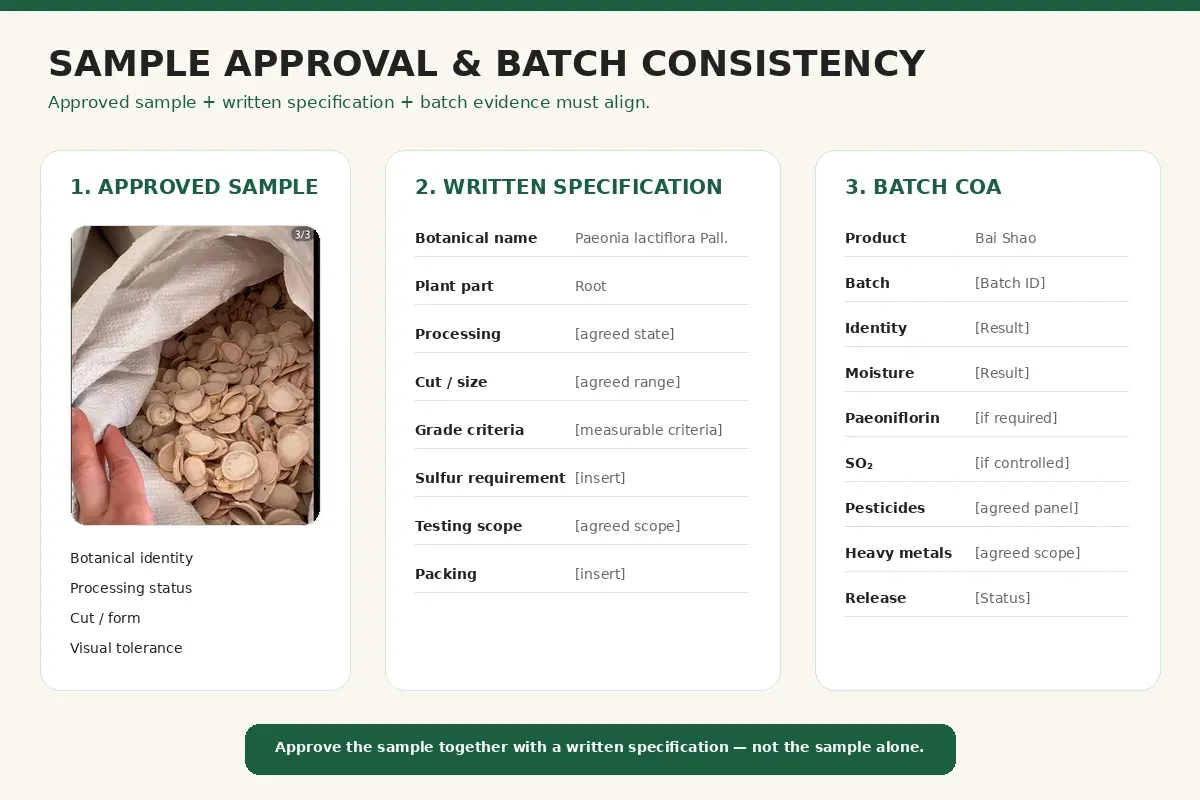
Approve the sample together with a written specification, not the sample alone. Agricultural batches naturally vary in diameter, shape, colour and surface texture, but botanical identity, processing status, origin if controlled, grade definition, cut, sulfur requirement, analytical specification and testing scope should remain consistent. For the full workflow, see Botanical Ingredient Sample Approval.
| Red Flag | Why It Matters | Buyer Follow-Up |
|---|---|---|
| Bai Shao / Chi Shao terminology used inconsistently | Separate pharmacopoeial materials may be confused | Clarify and reconcile before acceptance |
| “ISO 22586 certified” cited for material sold or labelled as Chi Shao | ISO 22586:2022 explicitly excludes red peony root from its scope | Confirm Bai Shao / Chi Shao identity in writing, separately from any ISO certification claim |
| Field | Requirement |
|---|---|
| Product name | Bai Shao / White Peony Root |
| Latin botanical name | Paeonia lactiflora Pall. |
| Plant part | Root |
| Pharmacopoeial identity | Paeoniae Radix Alba where applicable |
| Origin | [controlled / informational] |
| Product form | [whole / segments / slices] |
| Processing status | [agreed processed state] |
| Peeling requirement | [if controlled] |
| Cut type | [insert] |
| Thickness | [agreed range] |
| Diameter / size | [agreed range if controlled] |
| Commercial grade criteria | [measurable criteria] |
| Broken pieces | [agreed limit] |
| Fines | [agreed limit] |
| Foreign matter | [agreed requirement] |
| Colour / surface | [written acceptance criteria] |
| Sulfur requirement | [insert] |
| Moisture | [agreed specification] |
| Identity | [agreed scope] |
| Assay / marker | [if required] |
| Pesticides | [panel / destination market] |
| Heavy metals | [scope / limits] |
| Microbiology | [if applicable] |
| Batch COA | Required |
| Sample approval | [yes / no] |
| Packing | [insert] |
| Label fields | [insert] |
| Batch traceability | Required |
| Change notification | [controlled fields] |
For the broader framework, see the Chinese herbal slices specification guide.
No. Bai Shao (Paeoniae Radix Alba) and Chi Shao (Paeoniae Radix Rubra) are separate pharmacopoeial materials with different commercial and processing definitions. Buyers should specify the required material clearly and should not allow one to be substituted for the other.
Specify Paeonia lactiflora Pall., plant part root, together with the required processing status. The botanical name alone does not fully define the finished Bai Shao material, so processing should also appear in the purchase specification.
No. Colour is a visual acceptance field and does not confirm sulfur treatment. Bright white does not prove sulfur-free processing, and yellow or brown colour does not prove sulfur treatment. Sulfur status should be verified through the agreed batch-linked testing.
Paeoniflorin is the assay marker for Bai Shao in the Chinese Pharmacopoeia 2025: not less than 1.6% for the crude root and not less than 1.2% for prepared slices, measured by HPLC on the dried basis. Confirm which limit the COA reports against, and review it together with botanical identity, physical specification, and contaminant results rather than as a standalone quality indicator.
It depends on the buyer’s traceability requirements. Origin can remain informational or be written as a controlled field requiring notification before any change. In either case, origin supports traceability and consistency but does not independently prove analytical quality.
Some variation in colour, shape, diameter, and surface texture is normal for agricultural material. Review whether the controlled fields—botanical identity, processing status, cut, grade criteria, and analytical results—still meet the written specification. Material deviations should be clarified before acceptance.
Define the botanical identity, processing status, product form, cut, grade criteria, testing scope, and packing requirements before quotation.
Aile Herb can review your Bai Shao specification and provide sample, batch-document, and packing information according to the confirmed order scope. Product details are on our White Peony Root Slices (Bai Shao) page.
Please provide:
Discuss Your Bai Shao Requirement
