Tell Us About Your Project
Share your product, quantity and project requirements. We will review the details and respond with the relevant next steps.

Bulk buyers should define the exact botanical identity, dried rhizome as the plant part, required processing form, whole or sliced material, measurable commercial grade, sulfur requirement, testing scope and batch documentation before ordering Bai Zhu. Bai Zhu and Cang Zhu are separate commercial and pharmacopoeial materials, so the Latin botanical name should appear in the purchase specification.
| Field | Buyer Requirement |
|---|---|
| Botanical name | Atractylodes macrocephala Koidz. |
| Plant part | Dried rhizome |
| Processing status | Raw / stir-fried / bran-fried |
| Product form | Whole rhizome / segments / slices |
| Origin | Controlled or informational |
| Cut / size | Agreed range |
| Commercial grade | Measurable criteria |
| Sulfur requirement | Defined before order |
| Analytical scope | Buyer / destination-market defined |
| Batch COA | Required |
| Sample approval | Written criteria |
| Packing | Agreed format |
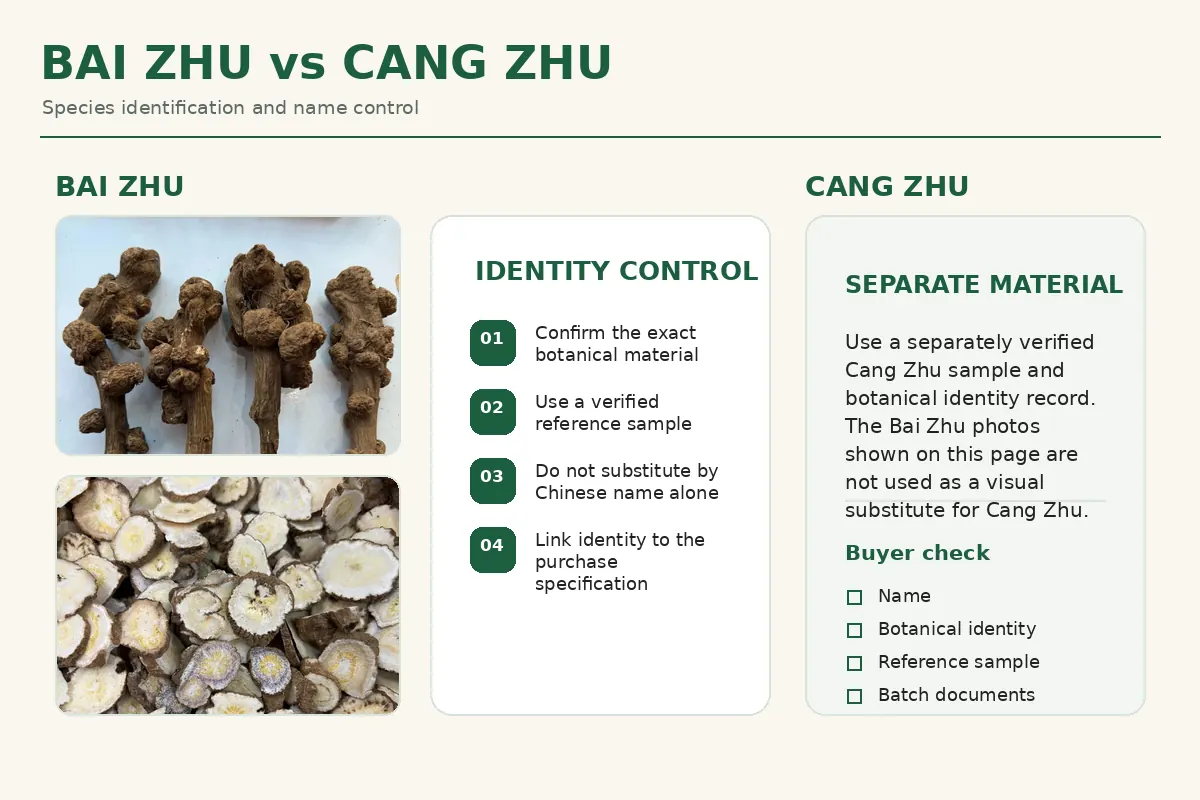
Bai Zhu corresponds to Atractylodis Macrocephalae Rhizoma, sourced from Atractylodes macrocephala Koidz., with the medicinal part being the dried rhizome.
“Atractylodes” or “Atractylodes root” alone is too broad for a purchase specification. The genus includes different materials used in trade, and Bai Zhu is specified as a rhizome rather than a root.
A clear purchase specification should use:
Common name + Latin botanical name + plant part + processing status
Example:
Bai Zhu / White Atractylodes Rhizome — Atractylodes macrocephala Koidz. — Dried Rhizome, [Raw / Bran-Fried / Stir-Fried]
| Field | Bai Zhu | Cang Zhu |
|---|---|---|
| Pharmacopoeial / commercial name | Atractylodis Macrocephalae Rhizoma | Atractylodis Rhizoma |
| Botanical source | Atractylodes macrocephala Koidz. | Atractylodes lancea or Atractylodes chinensis |
| Plant part | Dried rhizome | Dried rhizome |
| Typical material appearance | Grayish-yellow to brownish-yellow surface, commonly thicker and irregular | Dark grayish-brown to dark yellow-brown surface, commonly irregular cylindrical material |
| Commercial identity | Bai Zhu-specific material | Separate Cang Zhu material |
| Main buyer risk | Substitution under a generic “Atractylodes” description | Mislabeling or specification confusion with Bai Zhu |
The RFQ, PO, specification and COA should identify the material by both common name and Latin botanical name.
International standards treat these as two separate materials, not two grades of one material. ISO 13615:2024 covers Atractylodes macrocephala rhizome (Bai Zhu) specifically. A companion standard for Cang Zhu — ISO/CD 25825, covering Atractylodes lancea and Atractylodes chinensis — is still at Committee Draft stage as of this writing. That means no ISO standard for Cang Zhu can be cited yet; a supplier claiming “ISO-compliant Cang Zhu” is not referencing a published document.
Cang Zhu is a separate material with its own specification; see our Cang Zhu (Atractylodes rhizome) product page if that is the material you need.
Bai Zhu is commercially produced in several regions of China. For procurement purposes, the more important distinction is whether origin is informational or controlled.
Informational origin — the supplier states the growing region, but it is not contractually fixed.
Controlled origin — the buyer specifies the region in writing and requires notification before any change.
Origin supports traceability and supply consistency; it does not independently prove analytical quality.
| Processing Form | What Buyer Must Specify | Document Check |
|---|---|---|
| Raw | Raw or unprocessed | COA or specification states raw processing status |
| Stir-fried | Stir-fried or dry-fried | Processing method is identified |
| Bran-fried | Bran-fried or Fu Chao | Processing method is identified |
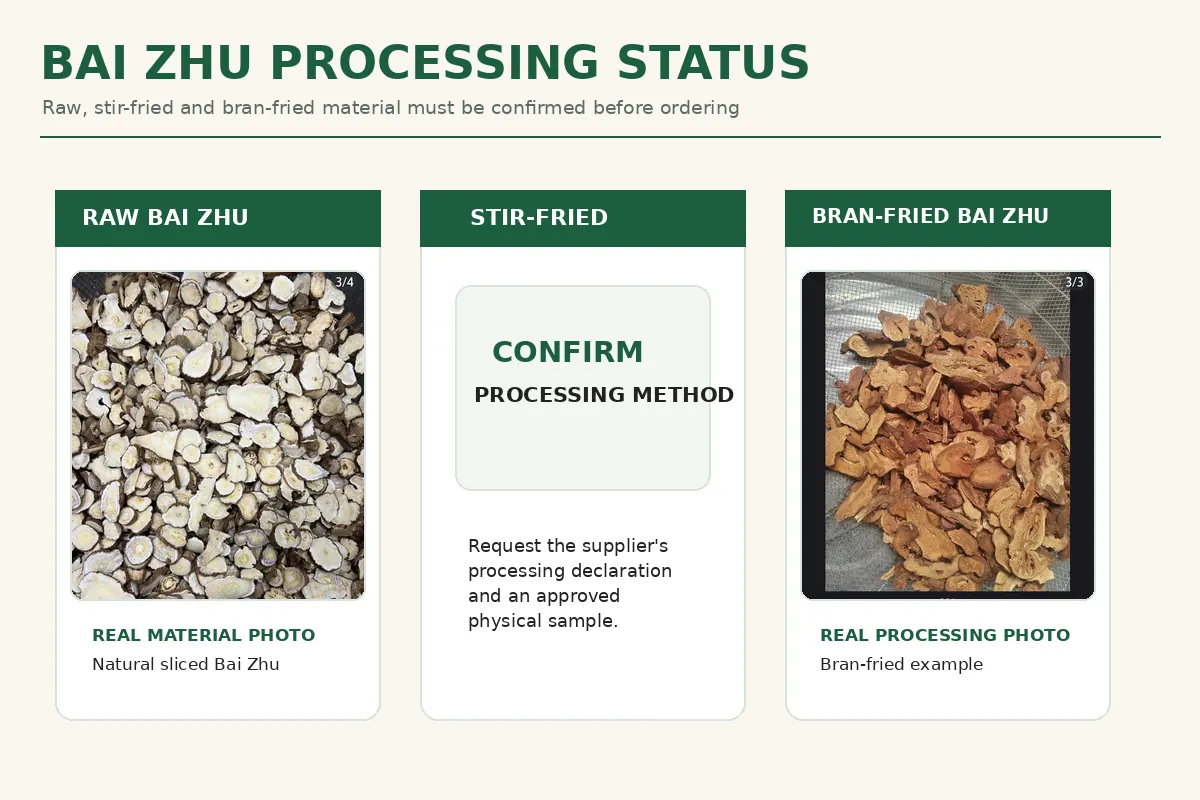
“Bai Zhu” alone does not confirm processing status. The required form should be written into the RFQ, PO and approved specification because processing affects the commercial material supplied.
| Product Form | Buyer Should Define |
|---|---|
| Whole rhizome | Size, surface condition, foreign matter, moisture / analytical specification |
| Slices | Cut type, diameter, thickness, uniformity, broken pieces, fines |
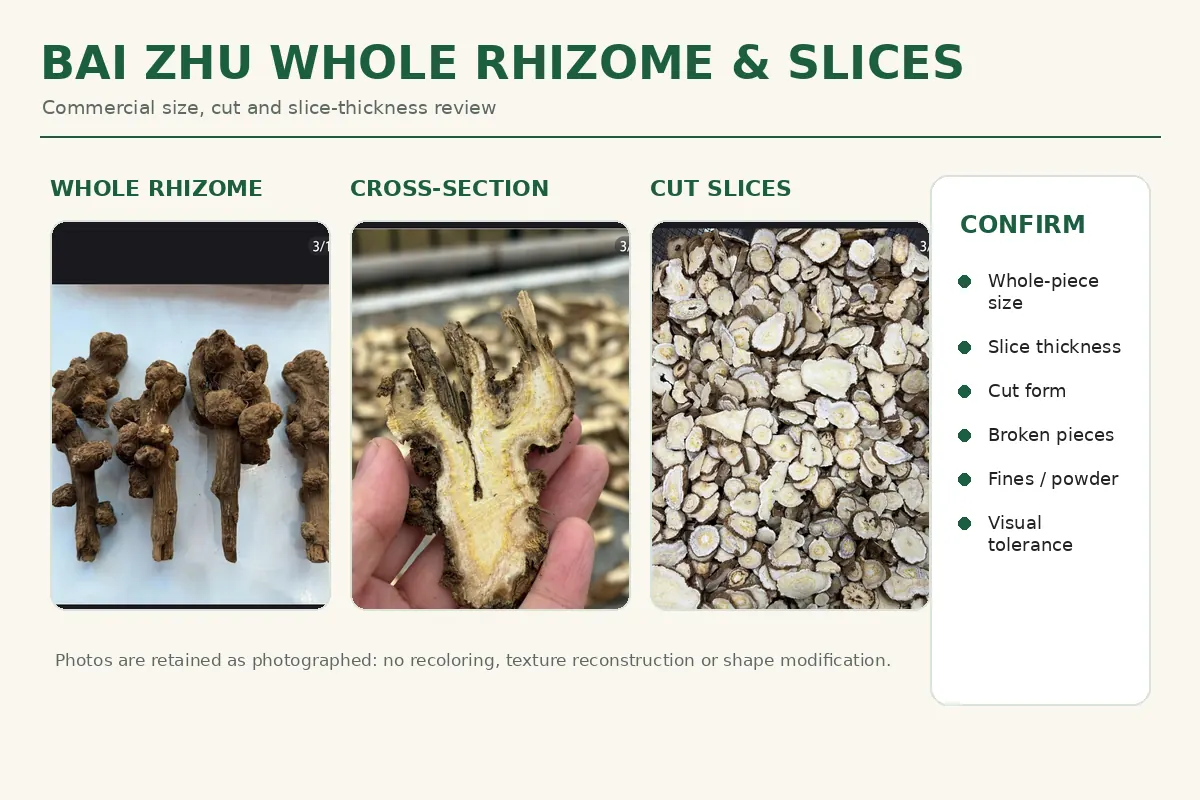
For whole rhizome, agree the required size range and surface acceptance criteria rather than assuming a standard dimension.
For slices, specify an [agreed thickness range] and [agreed size range], together with a [buyer-approved tolerance] for broken pieces and fines.
The dimensions should reflect the buyer’s application and the supplier’s confirmed cutting capability rather than an assumed universal grade.
Commercial grade labels such as Grade I, Premium and Selected are generally market- or supplier-defined rather than one universal Bai Zhu grading system. For how to convert grade language into measurable, enforceable purchase-order criteria, see our Chinese Herbal Slice Grades guide.
Cross-section colour and visible oil chamber (油室) features are commonly used to help distinguish Bai Zhu from Cang Zhu, though visual inspection alone is not proof of botanical identity or sulfur status. Colour alone should not be used to judge sulfur treatment. For general sulfur-fumigation risk and how it affects colour and COA acceptance, see our sulfur-free sourcing guide.
Visual review can cover:
These visual features can help distinguish Bai Zhu from Cang Zhu, though inspection alone does not prove botanical identity or sulfur status. Colour alone should not be used to judge sulfur treatment. For general sulfur-fumigation risk and how it affects colour and COA acceptance, see our sulfur-free sourcing guide.
For general COA structure and how to read a batch document, see How to Read Chinese Herb Test Reports and the Certificate of Analysis guide.
Atractylenolides may be included as analytical markers where required by the buyer, but they should not automatically be treated as mandatory quantitative fields for every Bai Zhu order.
For general COA structure and batch matching, see the Certificate of Analysis guide.
Approve the sample together with a written specification, not the sample alone. Agricultural materials naturally vary in shape and colour between batches, but botanical species, processing status, cut and analytical scope should remain within agreed requirements rather than match a reference sample visually point-for-point. For the full workflow, see Botanical Ingredient Sample Approval.
See the botanical ingredient sample approval guide for the broader approval process.
| Red Flag | Buyer Action |
|---|---|
| Bai Zhu / Cang Zhu terminology used inconsistently | Reconcile before acceptance |
| “ISO-compliant Cang Zhu” claimed | No published ISO standard exists yet for Cang Zhu (ISO/CD 25825 is still at Committee Draft stage) — ask which document is being cited and confirm it is not being sold as a finished standard |
| Field | Requirement |
|---|---|
| Product name | Bai Zhu / White Atractylodes Rhizome |
| Pharmacopoeial name | Atractylodis Macrocephalae Rhizoma |
| Latin botanical name | Atractylodes macrocephala Koidz. |
| Plant part | Rhizome |
| Origin | [controlled / informational] |
| Product form | [whole rhizome / segments / slices] |
| Processing status | [raw / stir-fried / bran-fried] |
| Cut type | [insert] |
| Size / diameter | [agreed range] |
| Slice thickness | [agreed range] |
| Commercial grade | [measurable criteria] |
| Broken pieces | [agreed tolerance] |
| Fines | [agreed tolerance] |
| Foreign matter | [agreed requirement] |
| Surface / cross-section | [buyer specification] |
| Sulfur requirement | [buyer requirement] |
| Identity | [applicable standard] |
| Moisture | [agreed specification] |
| Other pharmacopoeial tests | [applicable standard, where required] |
| Optional marker assay | [required / not required] |
| Optional volatile oil | [required / not required] |
| Pesticides | [buyer specification] |
| Heavy metals | [buyer specification] |
| Microbiology | [required / not required] |
| Batch COA | Required |
| Sample approval | [required / not required] |
| Packing | [insert] |
| Label | [insert] |
| Batch traceability | Required |
| Change notification | [controlled fields] |
For general cut and thickness options, see Custom Cutting and the Chinese Herbal Slices Specification Guide.
No. Bai Zhu (Atractylodis Macrocephalae Rhizoma) comes from Atractylodes macrocephala Koidz., while Cang Zhu (Atractylodis Rhizoma) comes from Atractylodes lancea or Atractylodes chinensis. They are separate commercial and pharmacopoeial materials and should not be treated as interchangeable trade terms.
Use Atractylodes macrocephala Koidz. and specify dried rhizome together with the required processing status. The botanical name confirms the species, while the plant part and processing status define the exact commercial material required for the order.
It depends on downstream requirements. Whole rhizome allows further cutting after purchase, while slices provide a defined ready-to-use material form. In either case, size, thickness, uniformity and breakage tolerances should be written into the specification rather than assumed.
No. Colour is a visual acceptance field and does not confirm sulfur treatment. Neither lighter nor darker material proves sulfur status on its own. Where sulfur control is required, use the agreed processing requirement together with appropriate batch-linked sulfur dioxide verification.
No. These terms are generally supplier- or market-defined rather than fixed cross-industry standards. Buyers should convert grade names into measurable criteria such as size, thickness, uniformity, broken pieces, fines and foreign matter.
Compare botanical identity, processing status, product form, cut and thickness, surface and cross-section condition, broken pieces, fines, foreign matter, packing and label. Natural variation in shape and colour is expected; controlled specification fields should remain within agreed tolerances.
Send your required botanical identity, processing status, product form, cut, testing scope, packing and destination market for review. Aile Herb can confirm feasibility and provide samples and batch documentation against the agreed specification.
